What would be some hallmarks of a Utopian civilization?


This post is a response to a question posed in its complete format: “If you lived in an advanced-utopian civilization, what would likely be some of the hallmarks of said thriving and freedom loving society?”

On my way to where I am now to undergo a first-time experience that I’m not looking forward to, I had the opportunity to observe a passenger on the bus who prompted me to think about the environment I grew up in.

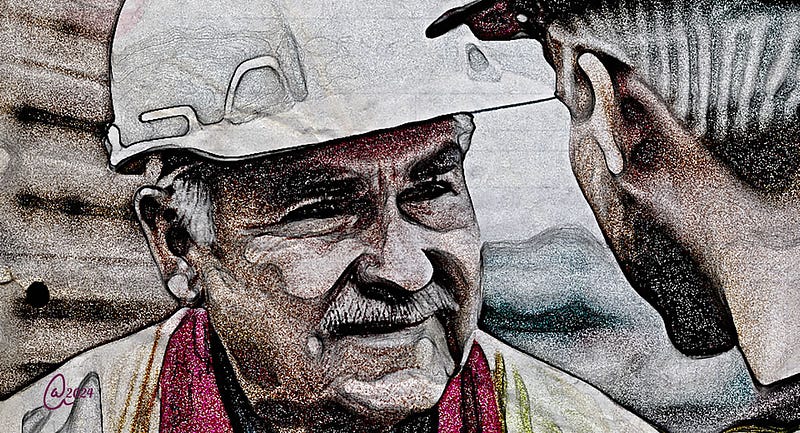
This person, who appeared somewhat masculine in his maleness, was adorned with a few piercings that were never seen in the backwoods troglodyte village of toxic masculinity I grew up in, but that was not what caught my eye. I’ve seen enough piercings, tattoos and a variety of body decorations now that most of it goes unnoticed.

In this case, his nails first caught my attention, and the colour he had painted on them appeared an aesthetically pleasing burgundy. That’s what prompted me to notice the rest of his presentation.

My cultivated biases assumed unimportant superficial characteristics about this person. Still, upon further glances, I felt them melt away because, beyond the decorations, he appeared like a typical CIS male to me.

I wondered how much of that approach to aesthetics I would have adopted had I been raised in a “more modern” setting.

I never experienced more than passing thoughts about getting an ear pierced or getting some tattoos that I never found the courage to do. Still, I would have if it were not for the rather conservative upbringing I experienced in a low education and highly biased environment that has left me with a lingering self-consciousness of doing so.

Then I arrived at my destination, and while patiently waiting for an appointment (that would consume most of my day but won’t begin for another hour, even though I was expected to arrive two hours before admission), I encountered this question on my notifications feed.

My first thought went to the person I observed and how social expectations would be far less regimented and myopic in a Utopian environment.

Another characteristic I would expect is that my waiting experience to perform a standard procedure would be done at home with far less discomforting advanced prep and greater expediency.

I also read, on my bus trip here, that the UK has been making “anti-cancer injections” available to the public for addressing about fifteen common varieties of cancer. It’s a treatment that appears to function like a vaccine by boosting a body’s immune system and training it to recognize cancer cells, to remove them naturally in their early stages. The article was, however, rather skimpy on detail, so I will research it further in depth when I get home.


(Here we go — my appointment was far shorter than I feared.):
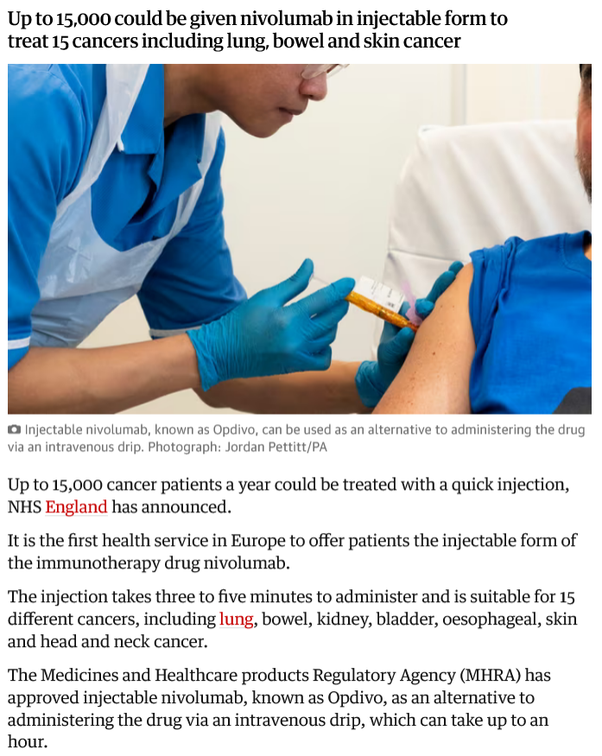
Cancer patients in England to be first in Europe to be offered immunotherapy jab

NHS England » NHS Cancer Vaccine Launch Pad


I think simple remedies for complex medical challenges that we struggle with today would also be another feature of a utopian environment.

Other features of an advanced society to me would include, along with many technological advances for assisting with biological issues, transportation, and the provisioning of various resources like education and access to community administration processes for public engagement, would include access to resources permitting one’s development of a meaningful vocation without being distracted by meeting basic survival challenges.

Whatever interests a person might have would be easy for them to explore without encountering numerous barriers preventing them from developing their interests in ways that engage and benefit the public.

For example, I read about an eleven-year-old girl developing a means of testing for lead contamination in water.

While we can celebrate the innovation and ingenuity demonstrated by a remarkable youngster, we often overlook how such a child would have required access to supports not common to most to have been privileged enough to pursue an interest to such a degree that their idea can save lives.

One of the most destructive limitations we place on human potential is the misanthropic attitude many people display, cultivated by an economic system distorted by toxic competitiveness.

A utopic society would have cleansed our collective psychologies of the many mental health maladies that we’ve inherited from centuries of generational CPTSD. The most potent form of utopic boost to our potential as a species is our ability to support one another while possessing the courage to address the psychological dysfunctionalities that hamper our development.

A utopia would be a humanity free from the burden of many of the toxic aspects of human psychology that are the cause of so much pain and suffering on levels that would be considered outlandish in fiction and a bloody horror show of sociopathic stupidity in real life.

This kind of shit, for example, would not exist in a Utopia because we would have matured enough to acknowledge, first and foremost that this is a treatable medical condition that should disqualify these people from operating in any position of authority. This kind of broken mentality should be considered a socially destructive mental health issue in which the effects are severe enough to warrant mandates for compulsory treatment before being allowed to participate in activities that could be harmful to others.

A Utopia would not be suffering from a mental health pandemic affecting one in five people and resulting in a whopping majority (70%-80%) of families being dysfunctional.

Until we can deal with our mental health issues, however, any form of utopia will remain a pipe dream as we allow our species to be consumed by the chaos created by our psychological dysfunctionalities.

When I witness casual examples of people breaking stereotypes, however, such as a male with burgundy nails, I think that although we may be dragging our asses into maturity as a species, at least we can see some subtle signs of progress.

Would obesity rates drop by banning McDonald’s?

This post is a response to a question posed in its complete format: “If McDonald’s were banned in some countries, would obesity rates be halved?”

If you want to see a reduction in obesity, which is a goal that is consistent with some administrations but not universally supported by all public leaders, the public at large, or the billionaires and corporations they own which profit from exploiting public health for profit, then the first place to start is not with banning anything, and much less restaurants.

You begin with public education and awareness programs that can create a cultural awareness of health issues that encourage an organic form of change.

Once the public begins demanding increased quality of food, restaurants like McDonald’s adapt to the demand as they already have. They have made some, but not a lot of progress, and that’s mainly because people think nothing of a burger with fries and a soft drink as a “normal meal” without considering how much healthier it would be with minor changes. Instead of fried potatoes, for example, they could have a baked potato. Instead of a soft drink, they could drink sugar-free tea.

I know. Several chills just went down people’s spines when they read these suggestions, but that’s precisely my point.

People have gotten so used to grossly unhealthy choices that they can’t imagine tolerating, much less enjoying, alternatives.

The notion of a soft drink like a Coke with my food sends a chill down my spine and makes my stomach churn. It has, however, taken me decades to get to this point. It’s not that I always make healthy choices, but. I am aware of the difference between healthy and unhealthy. Over time, that knowledge has contributed to changing my consumption habits.

What we learn to become accustomed to results in behaviours that our children emulate, and this is how we can collectively improve the state of health in our society.

This is an example of how we are all a part of a larger whole and how our choices, as insignificant as they may seem on individual levels, combine to result in significant social changes.

This is how we have evolved from a culture where a majority smokes cigarettes to one which publicly shuns smoking.

Significant social change is slow, but by being slow, it is also permanent in ways that legislation cannot accomplish.

This isn’t to say that all legislation is pointless, but that we can be selective in the types of legislation we can focus on. Instead of legislating healthy food choices in restaurants, we can introduce legislation to remove and replace high fructose corn syrup (which is an addictive sugar intended to increase product sales and plays a significant role in the obesity epidemic) with healthier alternatives.

The U S. is the world’s largest consumer of this food additive, and it shows in the prevalence of obesity throughout the nation in ways that exist nowhere else.

This is why agencies like the FDA can be critical allies in encouraging public health. Elon’s DOGE supporters are clueless about why they must be less mindlessly judgmental of government departments they don’t understand or appreciate.

The more the public supports healthy food choices, the more elected public officials will, too. The more critical people perceive physical health, the less likely the public will elect someone who lives on fast food to important public leadership roles.

Change is a massive wheel that seems impossible to get started moving, but once it does, it creates its momentum, eventually requiring little to no effort to push for a specific change.

Why try to control natural emotions?

This post is a response to a question posed in its complete format: “If emotions are natural, why do we spend our whole lives trying to control them?”

Well, that’s your mistake right there.

To control your emotions requires letting them flow freely.

“Controlling” your emotions requires you to let go of control over your feelings.

If that sounds counterintuitive to you, it’s because it is.

“Controlling” your emotions requires understanding them. The best way to understand your feelings is to observe them through someone else’s eyes.

Let them flow through you and watch how they affect you. Learn to spot your thoughts as they affect the intensity of your emotions.

A breathing technique you can use to help you disengage from your emotions involves taking a deep breath while drawing your arms inward toward your chest. Curl your hands into a tight fist as you imagine yourself “collecting your emotions into your chest” and then hold your breath momentarily. Then expel your breath as you open your arms and stretch them outward to expel as much air as possible while envisioning those emotions leaving your body.

Generally, when emotionally overwhelmed, they also recall situations that have stimulated those emotions at other times.

So, getting angry to the point of being overwhelmed by one’s anger is a process of recalling and “gathering all of those prior moments of anger” and rolling them up into a ball that can propel one’s anger to its natural conclusion, either by being spent or by allowing oneself to act out in destructive ways.

That emotion demands release; sometimes, the only way to release it is to empower it beyond one’s instincts to restrain it.

In other words, you already have a natural response of restraining your emotions. At the same time, your body fights to expel them, and that creates more anxiety and stress, becoming a feedback loop on your feelings.

If you have noticed how your emotional intensity always resolves itself, you will have also noticed that once it’s spent, you undergo a period of introspection. That’s the process you already naturally undertake to learn how to control your emotions. Sadly, in most cases, it often accompanies regret over allowing one’s emotions to explode out of control.

By training your mind to disengage from your emotions as you experience them, you will find they have less control over your reactions. You can watch them build up and be expended while identifying the triggers that tweak them to their extremes.

By identifying those triggers, you scour your memories for the moments in your life that brought them to the surface, which allows you to develop some objectivity about events that occurred in your past.

The next time you experience an associated emotion, you will find it’s not quite so intense once you’ve worked through previously unresolved issues.

Please keep in mind this is not a magical solution to managing emotions but a path, a skill, and a discipline to master over time so that you have the power you need over your feelings to reign in the destruction they can have on your life.

Good luck.

What policy proposal could combat teen pregnancies by men over 21?

This post is a response to a question posed in its full format as follows: “66% of teen pregnancies are fathered by men over 21. Do you have a policy proposal for how to combat this?”

When I worked in community development as an “Educational Counsellor” (Residence Life Coordinator), part of my role involved developing programs to address common issues affecting college-age students. Since many were away from their rural homes for the first time in their young adult lives and often were from strict homes, they spread their wings and acted out in sometimes unhealthy ways.

The overconsumption of alcohol was one of the most common unhealthy coping mechanisms many adopted. This necessitated various strategies for mitigating the effects of over-consumption, which would develop into habits over time and become addictions if one was unable to free oneself from such a toxic dependency.

This role was how I encountered a drinking cessation strategy by Homewood Health Services in Canada that used a series of posters in one of their awareness campaigns.

All the posters were designed to provide uplifting and inspirational messaging with colourful imagery and a touch of humour to appeal to that demographic’s sensibilities. One specific poster prompted me to reply to this question. I looked for it briefly online, but it was a poster from about 40 years ago, so I unfortunately cannot see it.

A brief description in which you will have to imagine a brightly coloured illustration with a chalk pastel texture. It was an image of the back of a person’s head while propped over a toilet bowl. The image was intended to convey how unpleasant over-consumption can be. I don’t remember the caption, but I remember how popular it was.

Of the various posters available for students to pick from and post on their walls, this particular poster was far and away the most popular.

I didn’t realize at first why beyond the mockery it would generate because no one likes the experience of “driving the porcelain bus,” and everyone laughs at the people who over-indulge to such a degree.

As it turned out, the poster became a type of “scorecard” in the party apartments within the residence complex. Each time someone “chatted on the porcelain phone,” they signed the poster.

It was disheartening at first because the poster was having the opposite effect it was intended for. It’s not like it encouraged people to over-consume alcohol, but it was like a ledger keeping track of the number of times one went too far.

At the end of the academic year, as students packed up their belongings, I encountered a few as they packed up and took their posters. In each case, the expressions they conveyed were that it had been quite a year and that they had enjoyed a lot of memories from their parties, except for the experience they had with a night’s discussion with “Raaalf.” The number of times they had signed the poster was like a demerit to remind them of the unpleasant experience.

They expressed regret over how much they had over-imbibed, and when they returned for their next academic year, they were far more reserved in their behaviours. Those students went from high levels of over-consumption in their first year to being much more academically committed students in their second year who had learned to drink moderately. They still socialized in their second year but were far more responsible.

The poster had worked.

It took one full academic year, but signing the poster after a night of “hurling chunks” left an indelible impression in their minds.

That’s how an education program works, slowly and with far more spectacular results than the heavy hand of imposition. When people learn to choose a healthier alternative because they want it, the results impressively outperform any authoritarian strategy.

This is what anti-abortion people don’t understand and why they’re so disgusting when they barf up ignorantly abusive disparagements such as characterizing an oppositional view as “pro-abortion.”

No one is “pro” a bad situation.

No matter how one characterizes an abortion. Nothing about it can be considered desirable, mainly by those who feel that’s their last hope. This is also why anti-abortion people are so inhumanly disgusting. They’re stealing a final lifeline of hope for someone in desperate straights… even worse is that they force medical emergencies into becoming incidents of premeditated murder by their depraved indifference.

This is why the SCOTUS rejection of Biden’s attempt to compel the state of Texas to perform emergency abortions based on a life-saving medical procedure makes them entirely unfit to lead the nation in its laws. Their responsibility to society is to establish a higher morality that respects and preserves life.

Nothing about the alleged “pro-life” is anything but “anti-life,” and nothing can make that more accurate than the numerous horrors that have already presented themselves since they betrayed women across the country and the world by extension with their reversal of Roe v. Wade.

The only policy that will effectively address the issue of teen pregnancies by young adults above the age of 21 is the policy that creates the peer pressure necessary to make those young adults who have not managed to mature beyond an abysmal level of under-developed morals afraid of being ostracized by their peers.

Nothing works more effectively than peer pressure. Education and awareness programs are the only way to achieve that kind of pressure. The more people realize the consequences of destructive behaviour, the greater the likelihood of it being mitigated “on its own” over time.

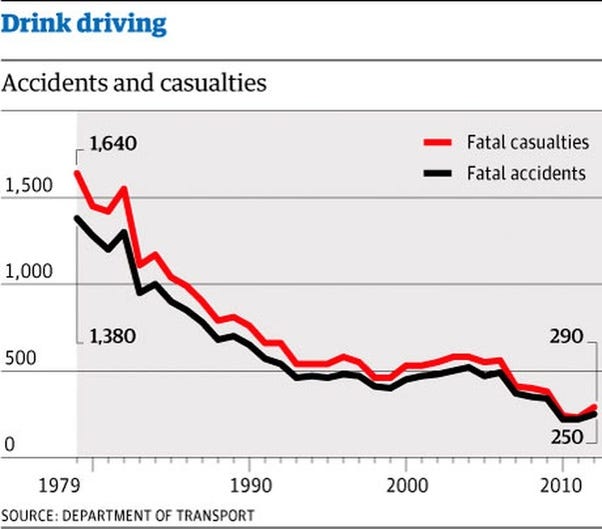
Time and patience are required to realize the benefits, but they are permanent fixtures in an evolving society. Peer pressure is how we have managed to reduce incidents of drinking and driving.

The heavy hand of an authoritarian never works. If anything, the consequence of imposition is always to make the problem worse.

My friend thinks I’m lazy not to want to work more than 40 hours for extra money.

The original question this post responds to in its full format is as follows: “My friend admitted that he thinks I am lazy and childish to not want extra hours for extra money. He said working 40 hours a week, smoking weed, and playing video games is very, very lazy and I should ashamed. Is he right?”

Your “friend” is opinionated and not much of a friend.

He’s also been conditioned to believe life is a race to the top of the economic ladder and that it’s within everyone’s reach if they apply themselves.

Forty years from now, he’ll find himself alone and lonely while getting nowhere because the world will have changed so much that everything he believes now won’t apply.

He will then view the friends he knew as people who had life figured out much better than he did by taking as much time away from work to enjoy life as much as possible when they still could, mainly because they managed to find a community to fit into while prioritizing their enjoyment of life so that they have supports that he will no longer have from alienating himself from the people he looked down on as lazy.

Ask yourself and him what those extra hours of work will get him. What will an additional fifty dollars do for him? Will he bank it and watch it grow over time?

That sounds wise until you realize how fragile your savings are when an economic bust comes along and corporations gouge you with price increases while keeping your salary low. Inflation eats away at your buying power so that those extra few dollars are no longer extra but necessary to survive on.

The harsh reality is that his go-getter attitude has been exploited to the point where leisure time has been lost because every moment is expected to be invested in monetization efforts.

Your leisure time is much more important than he realizes. It’s how you keep sane while he gets an ulcer.

This isn’t to say that if you feel motivated to grow your life in a particular direction, putting in extra effort isn’t worth it because it is. It’s just that you need a better reason than just collecting extra cash. Money is good for getting stuff, but what you get for it is what matters.

Something you may have already noticed is how the workaholics among us who do well financially also piss away a lot of their money on expensive toys. Instead of being happy with a $20,000.00 sedan, they buy a $100,000.00 sports car.

That may make them happy but also quite stressed when they freak out about people bumping into their car and scratching the paint.

Life is about more than impressing people with material things — not to say that you shouldn’t aspire to some luxuries, only that you don’t allow materialism to define the whole of your life.

Life is about finding a balance that makes you happy and feeling fulfilled, not about what other people expect of you.

Please do what you can to plan for a happy future for yourself but don’t forget you have a present to live in or by the time you realize how much time you’ve lost in gaining something you can’t take with you, it’s going to be too late to recover moments to build memories you can treasure.

Life is about accumulating happy memories of doing what you love and with people whose company you enjoy, not about the objects you collect or the transient status that leaves you hollow when it’s gone.

You do you, and he can do him.

If that’s not good enough for him, he’ll move on with his life, and you will do it with yours.

The only competition worth your attention is the one you have with yourself as you challenge yourself to grow as a human being, learning about yourself and the world you inhabit for such a brief and fleeting time.

Temet Nosce