To what extent is George Soros a political figure?


This post is a response to two questions posed in their complete formats as: Question 1: “To what extent can George Soros be termed as a political figure?” and Question 2: “Democrats, what would you say to a group of Republicans begging you to give them a chance to prove that they are good people?”

To no extent in “capital P Politics” and a limited extent in “small p politics.”

He mostly avoids public statements about politics, politicians, and political issues. He recently made a rare comment referencing tariffs as warfare when Trump began his tariff rampage, but that was the extent of his input.

It had bothered me for some time that he hadn’t been more vocal, but then I realized how anything he says can create massive ripples throughout the marketplace.

His voice is like Marvel’s Black Bolt from the Inhumans.

He has to be extremely careful about what he says publicly because a slip of the tongue can kill an entire industry and dramatically impact people’s lives.

It took me a long time to arrive at that realization and regret being so dense about it.

I wouldn’t want that kind of influence. It’s way too much stress and responsibility that few can handle, and even fewer can be trusted to handle it responsibly.

Elon Musk and Donald Trump are excellent examples of being too incompetent to have as much power as they do.

He is a shadowy figure who quietly does what he can to leave a positive legacy for the world. That makes him a lightning rod for the toxic among us and an inspiration to those who value his contributions.


Question 2: What do you say to MAGAs who claim they are good people?

Stop begging and start doing.

Actions speak louder than words.

Republicans are being judged by their actions.

Remaining silent in the face of a fascist takeover of the nation is complicity with that fascism.

It doesn’t matter how much you beg, you’re still an ass, and a cowardly one at that if you don’t stand up and fight against it.

If you do that, you won’t need to debase yourself by begging. Grow a spine and take responsibility for the actions of the party you identify with.

Why do you think people are just as pissed off with the DNC?

It’s because they have been spineless while all this destructive nonsense has been happening.

People from all walks of life, except the privileged, demand a new world. The status quo can’t survive because we can’t survive it. We need to work together, and that includes the enraged MAGAts who need to stop attacking their neighbours and start demanding changes from the monsters they admire.

After all, you can’t seriously be okay with being told that you’ll have to cut back on buying dolls for your kids this Christmas, and then be OK with Mango Mussolini getting a half-billion-dollar gift from the people who financed the 9/11 tragedy to jet around the globe to visit his branded properties.

No one who can accept those two conditions can be a good person. Only a coward and a hypocrite who refuses to protect their family could accept that. If you want to be seen as a good person, then it’s time to do the right thing, not the Reich thing.
Wouldn’t a corporate income tax system be better than tariffs?

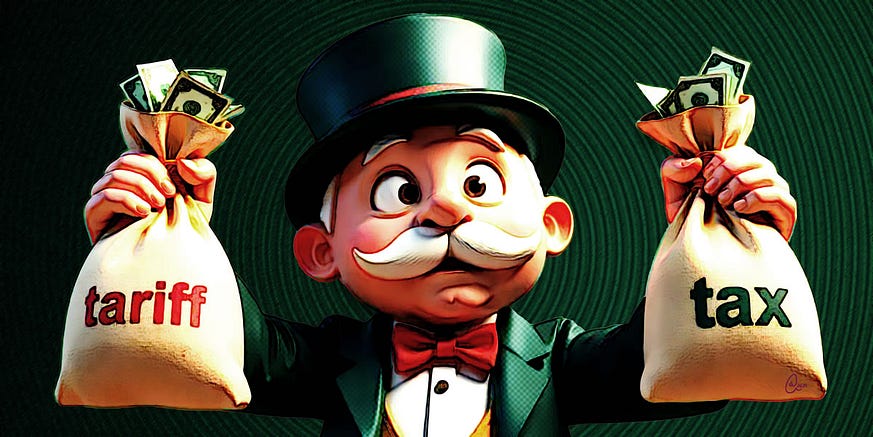
This post is a response to a question posed in its complete format: “Wouldn’t a better option than tariffs be to have a corporate income tax system that would create incentives for companies that hire domestically and penalize them for hiring in other countries?”

A “better option” is an alternative strategy for accomplishing what tariffs are intended to achieve. Tariffs protect local businesses and industries that can be overwhelmed out of business by foreign exports, which would otherwise dominate market niches to evolve into monopolies without constraints.

Tariffs are not helpful for much of anything else. The way Trump is using tariffs as a negotiating strategy would be the equivalent of using a scalpel to carve up a side of beef. Inevitably, that scalpel becomes dull and easily broken. People unfamiliar with scalpels would at first marvel at how clean it would cut, then become frustrated with scalpels altogether from misuse.

That’s what’s happened with tariffs.

Trump has misused tariffs as a club for negotiations and, consequently, has created a misperception of their function in a reasonable trade deal that would otherwise be used to protect local industry. He has lied about tariffs stimulating manufacturing, or is so incompetent that he sincerely believes his nonsense.

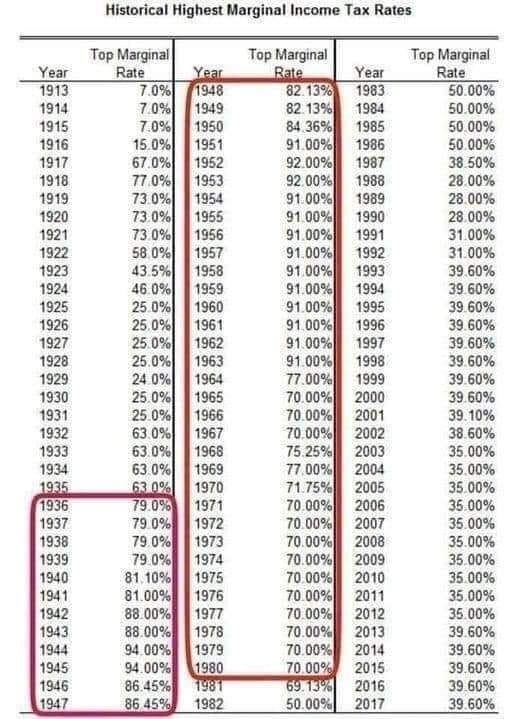
What this question suggests was already in play during the Eisenhower years, when corporate taxes were high. See the chart below:

The tax rates highlighted by the red outline comprise the years in which the economy was most stable and grew steadily, while the middle class flourished.

The higher tax rates on the upper end incentivized corporations to reinvest in their operations by increasing their hiring to reduce their tax burden. (Other laws were also in place to support this economic growth, such as prohibiting stock buybacks to increase dividends, which were eliminated along with several protections throughout these last decades.)

This stable dynamic changed because the wealthy class wasn’t satisfied with being the richest. They wanted more and continue to want more, such that we have repeated the economic disparity that has repeatedly destroyed stable societies throughout history.

The problems we are struggling with are made incredibly easy to understand once one adjusts their perceptions to realize our struggles are the consequence of a centuries-long class warfare against the people by those who seek dominion in this world.

We will experience a correction in one of two ways:

1. Through a reasonable form of relenting by the wealthy class, who collectively restrain the twenty percent of them who comprise a psychopathic psychological dysfunctionality, and re-establish the rich and influential among us as ethical leaders for humanity, or

2. By continuing to allow the corruption to influence public policy in the way that has encouraged fascism to grow out of control and repress economies while stripping people of their rights, until a tipping point occurs and societies collapse upon themselves in such a dramatic fashion that chaos rules the day. At which point, the people will reassert their power over the powerful in the traditional manner established throughout history by violently deposing the corrupt among us.

We are very close to widespread chaos ruling the day around the globe, while the Canadian election has provided us with a slim glimmer of hope. Meanwhile, the corruption that has fueled this fascist resurgence continues to corrupt the best of humanity.

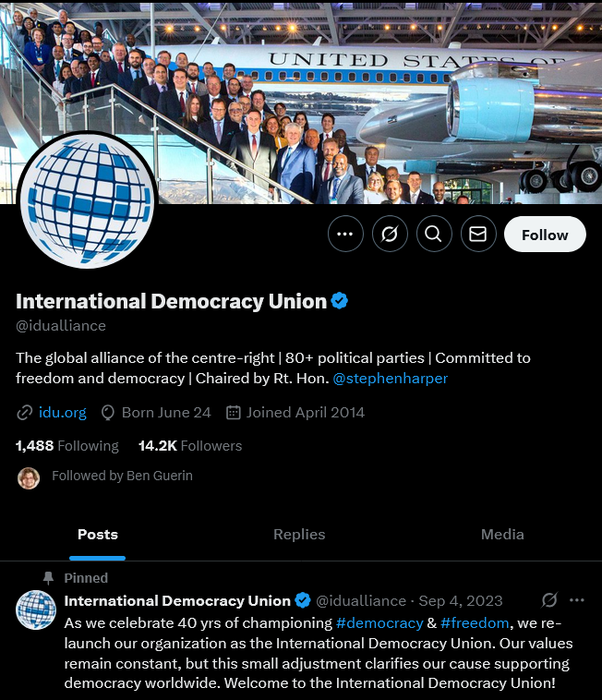
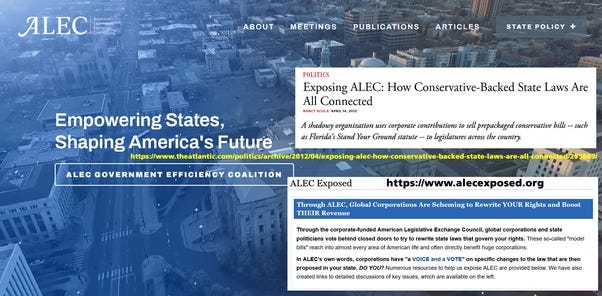
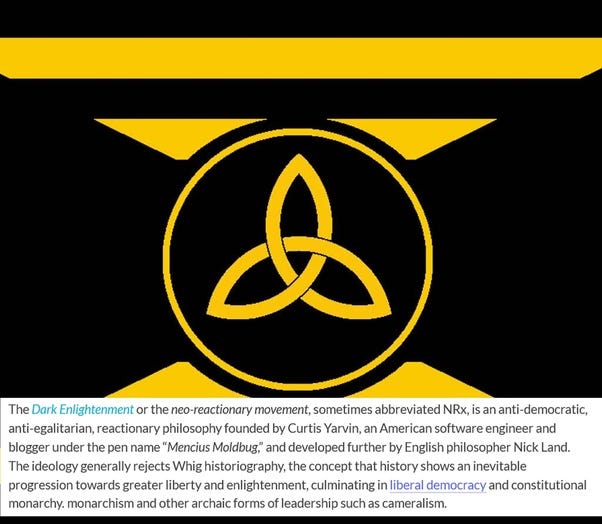
MAGA is the public face of organizations like the IDU, the Heritage Foundation, ALEC, and an ideological movement self-described as a “Dark Enlightenment” which feed the economic distortions that threaten the integrity of democratic societies worldwide by favouring corporate power and fascist governance through targeted disinformation to manipulate election outcomes based on negative campaigning.

Our best option today is to mitigate the corruptive power of these hatemongering groups and of the psychopaths within the one percent who seek to reestablish a two-class society of rulers and serfs.

Corporations are allowed to exist to serve the people, not rule them. We have eliminated kingdoms from our societies because they are toxic and destructive, limiting our potential as a species. We can restructure corporations into democratic institutions, and we must because the trajectory they are taking us all on is inviting us to repeat a blood-soaked history.

We are again at a crossroads that we have repeatedly visited throughout history because the corrupt among us have little to no respect for humanity. We now have the benefits of a long history and an established pattern, while the changes we need to make to rid society of this corruptive scourge once and for all are within our grasp. This will be our last time at this crossroads if we unite as a people and assert our power as individuals within a shared community that refuses to bend our knees to incompetent and cruel rulers.

Why does the Chinese government look like geniuses run it?

This post is a response to a question posed in its complete format: “Why is that for Chinese living inside China, the Chinese government is not perfect, but for people looking at China from the outside, the Chinese government looks like it is run by geniuses who plan far ahead into the future?”

I believe it’s important to highlight a harsh truth that completely escapes MAGAt minds.

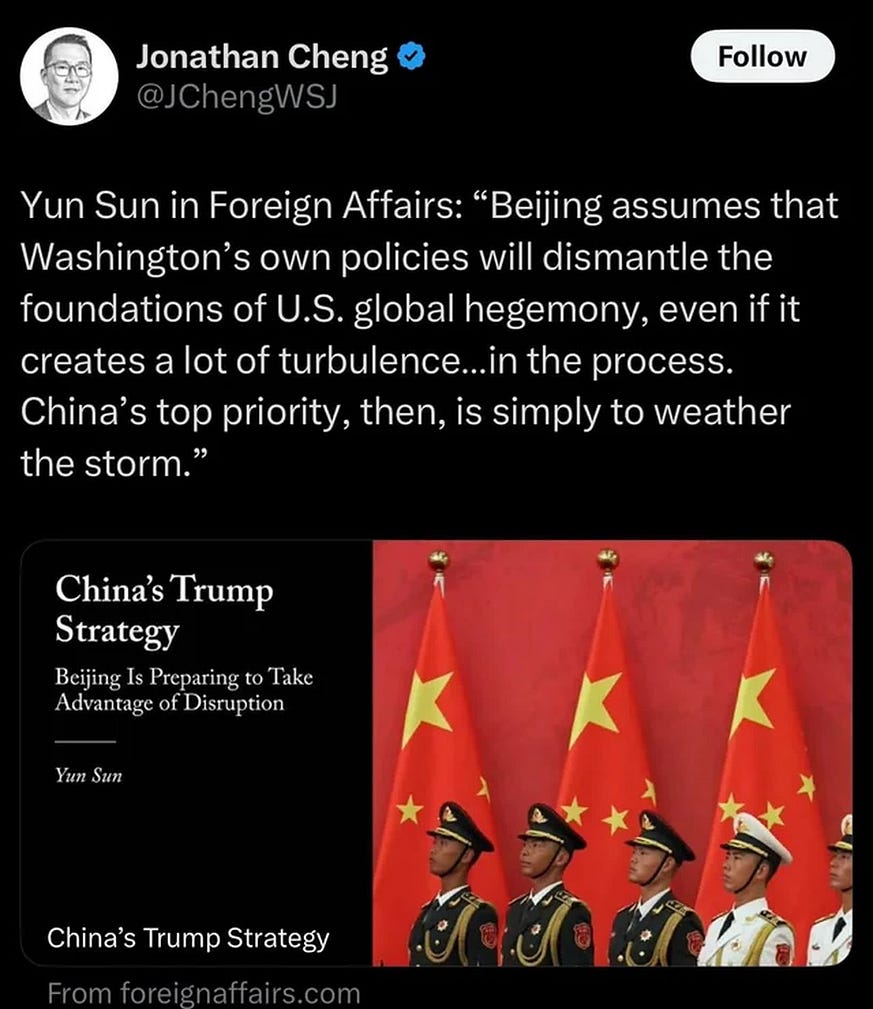
China isn’t “run by geniuses” but by ordinary minds who use “common sense” to plan “far ahead into the future.” They leverage the minds of their people, and many are geniuses, making incredible technological breakthroughs.

Nations cannot plan for the short term without missing the boat on the long term. People can prepare for the short term because the lives of individual people are short compared to the lives of nations. Nations must plan for millions of lives and not just one.

“Common sense” leadership is acknowledging one’s limitations and relying respectfully on the crowd’s wisdom to achieve a nation’s most significant potential. Authoritarian mindsets will always fail against this kind of “common sense.”

It doesn’t take a genius to figure this out.

All that’s required is not to be a stupid, short-sighted narcissist who thinks the world magically dances to the sound of one’s voice.

That’s precisely the problem fueling the self-destructive hubris sending the U.S. careening into becoming a third-world shithole and all of this is entirely due to the machinations of short-sighted bigots whose goal is the resurgence of another Reich because they continue to refuse to learn from history.

MAGAts may claim to value “common sense,” but their short-sighted and self-serving biases are not “common sense,” but an entirely “subjective and self-destructive sense.”

This period in history is teaching us once again that we must cure our species of the authoritarian virus that we have been fighting against since the dawn of human civilization.

China has had enough experience with authoritarianism to know how to handle the U.S. slide into fascism.

How did great inventors get ideas for their inventions?

This post is a response to a question posed in its complete format: “How did great inventors manage to come up with the ideas of their inventions? Currently, even people who are smarter than the average are hardly able to do the same.”

Think about the last time you had an idea you thought was an excellent solution to a problem you were dealing with. Do you remember feeling frustrated with that problem and fixated on that problem while hoping a solution would present itself so that you didn’t have to deal with that problem again?

My guess is that almost no one goes through life without this experience. It may be true that you haven’t, but the odds are excellent that you will at some point in your life.

”Great inventors” are no different in this regard. They ponder issues, identify problems, and think about ways to devise solutions to those problems. The only difference is the kind of problems they solve.

Suppose you can solve one of the numerous problems facing the development of nuclear fusion as an energy source. In that case, you can be considered a genius for accomplishing that relatively small contribution to a more significant problem. If you can solve all the “little problems” that comprise the more substantial problem of nuclear fusion energy generation, you will become known throughout history as a “Great inventor.”

The only difference between the two is one’s problem-solving capacity. Some people are undeniably much better at solving certain classes of problems than others, but that doesn’t negate the value of the contributions of those who solve only one or a few aspects of a more significant problem because their solutions can contribute to the development of ideas that solve many problems at a time — including the much more substantial problem.

People of all levels of intelligence, from under-average to average to above-average to geniuses, contribute toward solving the massive problem of human evolution. All contributions are valuable, while people like Einstein are rare and always will be.

What we should be focusing on in society is to learn how to recognize budding geniuses and support them in their development so that they can maximize their contributions to society by achieving their potential.

Sadly, we live in a world which penalizes the gifted while wallowing in our crab psychology by the wilfully ignorant among us who drag down those whose gifts they envy. That’s a much bigger problem for society to resolve, and it will require all eight billion of us to recognize how severe that problem is.

In reality, Einstein-level geniuses may be rare, but they exist among the population at rates as high as one in every thousand humans. In a world of eight billion people, that means we have eight million Einsteins living among us whose genius is being pissed away because we don’t know how to create systems that encourage them to achieve their potential.

Our system is so corrupted by toxic forms of competition that we see in our politics how people forego their critical thinking skills or any form of objective analysis to select the most competent leaders to lead us into a brighter future. We choose monsters who would destroy us all and fill their pockets with money that will be useless to them if they succeed.

If we sincerely wish to live in a world that encourages great inventions by inventors, we must stop rewarding maliciously self-serving and destructive ignorance.

Does economic nationalism create global divisiveness?

This post is a response to a question posed in its complete format: “Is economic nationalism the solution to preserving jobs, or will it create deeper global divisions?” Responses to follow-up questions are included along with the answer given to this question.

Economic nationalism is economic isolation in a highly interconnected world.

It means shutting a nation off from the rest of the world.

It means North Korea.

It means a complete restructuring of an economy to adapt to an impoverished and repressive existence without access to a diversity of goods, services, and technologies that permit a nation to evolve and organically create jobs.

In today’s world, it means dropping out of the global trend toward automation for the citizenry. It means the people learn to adapt to functioning as disposable serfs to an elite class that avails itself of all the perks the rest of the world enjoys.

It means a government focuses on conscripting the able-bodied to serve primarily as military drones to eventually become cannon fodder with expansionist strategies to keep their economy from collapsing altogether.

The global divisions are the ones that a nation makes as it shuts itself off from functional relationships with other countries.

The rest of the world will continue to develop and strengthen its international relationships to become a united entity that can push back on expansionist regimes.

For the U.S., it means going from being a global power to being a global radioactive zone until it can be fully isolated.

Follow-up Question #1:

Is there any scenario where a nation can balance economic nationalism with global trade, or is full integration the only path to prosperity?

The term “full integration” implies a loss of identity and sovereignty. Neither of those is true. In Canada, an external threat to national identity immediately rallied the people into a unified front to protect their sovereignty.

Meanwhile, you can drive around Canada and seldom see the performative patriotism you can see everywhere in the (highly divided) U.S.

Follow-up Question #2:

Do you think Canada’s approach is unique, or have other nations successfully balanced global ties with a strong national identity?

I can’t speak for other nations, but I have long recognized the distinction between a melting pot and a multicultural mosaic.

For all the reverential lip service American culture displays toward individuality, its practice of homogeneity runs counter to that professed ideal.

On the other hand, Canadian culture promotes community through a practiced respect for individuality.

This contrast addresses the difference between a genuinely profound love of country organically cultivated versus a performative love of country cultivated through grooming.

It’s the difference between a deeply held but silent personal belief versus the cultivated optics of shallow regard for something that can be leveraged for sociopathic motivations through attention-focusing performances.

How can a society allow everyone to succeed?

This post is a response to a question posed in its complete format: “How would you design a society where everyone has the opportunity to succeed?”

Until Ronald Reagan and Margaret Thatcher, humanity was well on its way to perfecting that democratic society in which everyone had a reasonable opportunity to achieve class mobility and a basic form of success that permitted a life of dignity with what was characterized as the “American Dream.”

A mortgage on a house with a surrounding picket fence, a vehicle, a family with 2.5 kids and an annual vacation wasn’t only possible but virtually guaranteed to anyone who made the effort to earn it.

They betrayed the entire middle class around the world to curry favour from the wealthy who have long desired a return to a barbaric age of kingdoms with rulers and disposable serfs.

We failed to modernize the one institution that has proven itself the greatest threat to the goal of an egalitarian society, industry.

Almost every other entity in society is a democratic body. Corporations, however, are holdovers from a medieval structure of rigid hierarchy fraudulently appointing members to an inner circle of power, allegedly based on merit, while elevating those who support their corrupt application of power.

We can repair this mess of corruption with only a few fixes, but one of the most important and most easily overlooked solutions will be a difficult challenge to implement. It will (and has been) meet(ing) massive resistance by those who most adamantly refuse to give up their power, as it involves restructuring how corporations exist and do business in society.

We can quickly implement numerous initiatives today, such as UBI, Universal Healthcare, and Universal access to education, that will have long-term implications leading toward much more stable societies that can guard against corruption.

Other initiatives, such as a global cap on personal net worth and restructuring industry into democratic institutions, are potentially much more disruptive to society. We are, however, fortunate to find ourselves amidst a radical transformation into full automation throughout every level of society. This transformation will allow us to restructure political systems while increasingly democratizing society and flattening global power structures.

The only way to ensure society can facilitate opportunities for everyone to succeed is to flatten power and spread it across the globe to the people. At this stage in our history, our existence faces an existential threat due to the corruption of disproportionate power running rampant throughout society. It may be the case that we will have to rely on historical inspirations to repair the damage the wealthy class has done to society and make reparations for their betrayal of the social contract.

Why are you a liberal (left-wing)?

This post is a response to a question initially posed on Quora, and can also be accessed via “https://www.quora.com/Why-are-you-a-liberal-left-wing/answer/Antonio-Amaral-1

I’m not. I hate ideologies because they kill brain cells and destroy one’s critical thinking skills.

I prefer focusing on issues, learning about them, determining the best solutions, and then identifying who tries to do the same. I also look for those who have developed agnostic ideas and proposed solutions that work best for everyone, especially the people, because the wealthy often don’t need help. The government has favoured them so much over the last several decades that they’ve become a threat to the rest of the world.

What I identify with in the founding principles of liberalism are the values of “liberty, fraternity, and equality,” which often align me with liberalism, but not always. The only political party I’ve ever been a member of is the now-defunct National Party, also known as the Progressive Conservative Party. That party no longer exists. Their views have been stripped from them to become the Frankenstein’s monsters of humanity called the Maple MAGAts in Canada. They are a “light version” of the American MAGA movement, and mainly because the Koch parasites who have corrupted the American political landscape have been doing the same in Canada while focusing on Alberta and its oil wealth.

The results have led to corruption in that province in ways that run counter to Canadian values. Their current Premiere is an example of toadying for power, and how it perverts community values and cultivates a misanthropic attitude toward the people they’re supposed to serve.

My thoughts align with the direction the Canadian Liberal Party has taken, and I’m pretty excited about a full Prime Ministerial term with Mark Carney at the helm. I was initially hesitant because he was an unknown, but his interview with Jon Stewart quickly won me over. The more I see him in action, the more I like him.

While Jack Layton was the leader of the NDP, I was drawn to his party because his values focused on everyday Canadians. Governments have focused far too much on developing the corporate sector, which has been a detriment to the people and the nation.

No nation can exist without its people. Corporations are supposed to serve the people, not rule them. It severely disturbs me that what should be a community development function for governments has become a sociological corruption, supporting a sociopathic, profit-chasing national development model.

If I were to encapsulate my political views, I would describe them as a community development-oriented vision for politics and social leadership at all levels (and most notably, at this stage in my life because of specific issues that have been draining my attentions in an incredibly destructive way involve “encouraging” the police to review their function in society to align themselves with the ethos of protecting and serving more closely. I’m of the mind that they’ve become so corrupt in a heinous militarization strategy that they’ve become little more than a government-sanctioned domestic terrorist organization.)

How do we deal with Fox media lies?

This post is a response to a question posed in its complete format: “How do you deal with a family member who believes everything that Fox News says?”

I remember as a kid how futile it was to explain to my parents that wrestling on television was fake.

They would point to the blood they saw and use it to prove it was real.

It didn’t matter in the least what was said to them or what was pointed out as an obvious ploy or staged athletic move; they refused to acknowledge the truth of the fraud the rest of us kids saw in the wrestling performance.

Making matters more convincing that it wasn’t an argument worth pursuing was how their agitation quickly escalated into anger if we persisted past the point of their capacity for maintaining patience with their annoying children. We learned that once we detected visible signs of anger, it wasn’t worth the effort to push them any further. By that point, the conversation had escalated into a frightening experience.

We eventually gave up and decided there was no harm in letting them believe whatever they wanted to believe.

Fox is an entirely different matter because its effect on their audience has contributed to a nightmare affecting the world.

I suggest one does not bother addressing the issue with one’s family because even if one succeeds in helping them accept reason, that victory has little impact on the severity of the problem Fox poses in society.

Addressing Fox as a threat to national stability and security is essential. There could be several approaches to addressing this problem, and one of them could be an aggregated accounting of behaviors exhibited by Fox adherents, collected by family members to construct a compelling argument for affecting legal change and influencing the media as a whole for the benefit of society.

My view on news media in society is that there is no justification for consolidated enterprises serving a profit motive. The Fourth Estate is a critically important entity within a democratic society that must be capable of earning and maintaining the public trust. That is impossible when their mandate is to serve the billionaires who are the existential threat to our democracies that we now face.

Let us take a page from the peer review process applied within the scientific community, ensuring integrity throughout the science discipline and the scientific community.

Matching the scientific community’s level of granularity in self-policing is as simple as breaking up large news media enterprises into community-based and locally-owned operations.

The more numerous the entities that represent the Fourth Estate, the more able they can become in ensuring the public is well served with a diversity of perspectives that can achieve a far more objective delivery of information than is possible through the lens of a billionaire who controls the dissemination of information with a self-serving agenda.

Funding for individual operations could be coordinated through a crown corporation that provides administrative services, such as an access point for advertising and a payment system modeled on existing systems, like Medium, where payments are distributed based on readership and engagement. Graduated access levels could be permitted, and stories can be assessed on a scale of widespread need for distribution versus content catering to niche markets. Public and subscription-based funding could support a system for disseminating critical information to broader audiences, ensuring everyone can access news crucial to their lives.

Why is there no neutral ground in America?

This post is a response to a question posed in its complete format: “Why does it seem that there is no neutral ground for political parties in America? You seem either extreme right or extreme left. Indeed, agreeing that the opposite party have a point seems to brand you as a traitor? Why is there this perception?”

The perceptions you describe result from a myopic lens in which the nation is ruled by one extreme.

There is no extreme left in the U.S.

No parties or groups are demanding to seize ownership of the means of production.

You argue that there is an extreme left because it helps to lessen the seriousness of the challenges facing your nation today. It’s a perception that helps to justify its Nazification as a reaction to a perceived enemy rather than a decline and degradation of its long-held moral values.

To believe an extreme left exists is to deny the harsh reality of natural cruelty your nation has been cultivating for decades.

Gordon Gecko was a warning against this cruelty, but as a nation, you embraced it, and you embody it by permitting the ongoing mass murderers of children in schools, by denying healthcare as a human right, by permitting whole towns to poison their people through contaminated water, and by justifying a profit motivation.

Your nation has been welcoming this transition into a culture of sociopathic dehumanization for decades, and you have cheered it on. You cheered when Reagan fired the air traffic controllers’ union. You cheered when he shut down mental health facilities and threw the vulnerable out onto the streets. You supported his hatred of gay people and allowed countless murders of them by denying them life-saving medical treatment.

You justify the fabricated existence of a far-left because you struggle to avoid facing the ugly truth of the nation you have become by choice.

There is no neutral ground because all that remains is a toxic evil threatening global stability. Those who struggle to muster the courage of their ancestors are stunned to find themselves engaged in a surreal battle against monsters who should know better than to deem themselves modern-day kings among the educated and democratized masses.

How close is the U.S. to a dictatorship?

This post is a response to a question initially posed on Quora, and can also be accessed via “https://donewiththebullshit.quora.com/How-close-is-the-U-S-to-a-dictatorship-10

This question assumes that a threshold is crossed, and a switch flips between a non-dictatorship and a dictatorship. The reality is that there is a transitional stage between the two states.

If you think of the process as day becoming night, twilight occurs between the two unless you live on the equator.

The U.S. is in the twilight stage of becoming a dictatorship and already exhibits key stages of the transition into darkness, such as launching a strategic assault on private law firms that would challenge his executive orders and other actions in court. His strategy has been to intimidate those entities that would restrain his efforts to achieve a complete dictatorship.

Paul Weiss and Skadden Arps are two major law firms that have capitulated to Trump’s bullying. These entities are essentially among the nation’s final layers of protection against a full manifestation into a dictatorship. If these protections fail, full-on chaos is the only option for the people. There won’t be enough time to hold out for another almost two years for a mid-term election. Americans will have no choice but to embrace a violent uprising because defeating these entities essentially guarantees he has the full cooperation of the courts to do what he pleases.

That means he will likely declare Martial Law to tamp down any resistance to furthering his stranglehold on the nation.

Americans are on the precipice of losing their democracy completely. Even though they’ve endured the pseudo-democracy of a corporatocracy for the last more than one decade, they’re entering entirely new territory if Trump succeeds in defeating enough law firms to gain his legal stranglehold over the nation.

To answer this question from the perspective of a countdown to midnight clock used to determine how close the world has been to nuclear annihilation, the U.S. is best expressed through a song by Midnight Oil, “Minutes to Midnight”:

Everybody say, “God is a good man”
(Minutes to midnight)
Everybody say, “God is a good man”
(God is a good man)
Ah, clock on the world
(Yes, he’s a good man)
Driving a dump truck up to the sun
(Is he a soul man?)
A sigh in the human heart
(Three sides to every god)

I look at the clock on the wall
It says three minutes to midnight
Faith is blind when we’re so near

But ears can’t hear
What those eyes don’t see
But ears can’t hear
What those eyes don’t see
And you can’t see me