This post is a response to a question posed in its complete format: “What question/s and their answer/s best discern a true patriot from a fake one?”
This question is problematic on several levels because a “true patriot” is essentially a subjective assessment until one’s actions are identified as universally consistent within a broad recognition of patriotism.
For example, Mike Pence could have been easily viewed as a traitor while serving alongside Donald Trump, but he proved otherwise with his final official act in office as a VP.
Luigi Mangione can be viewed as someone who has betrayed the social contract by extinguishing another’s life. Still, he can also be considered as paying the ultimate price to protect the lives of countless thousands within a dysfunctional system that preys upon people while victimizing them for profit. Few actions are more patriotic than sacrificing one’s life to end corruption. Whether that’s considered patriotic is a matter for history to pass judgment.
The same applies to Edward Snowden, Julian Assange, Joe Darby, Karen Silkwood, Daniel Ellsberg, Frank Serpico, Chelsea Manning, and a panoply of whistleblowers throughout history.
Patriotism is far too nuanced to identify within a survey methodology. People are not static objects. People’s actions do not align directly within predictable margins, fitting generic descriptions of subjectively defined concepts that evolve as society changes.
A question as simple as “Do you love your country?” is quickly answered through deception, malicious intent or naively justified expedience. A person can believe they do love their country while acting in a treasonous way. Conversely, a person can be perceived as hating their country and acting supremely patriotic by sacrificing their life to protect it.
Adding further complications to this question is that communication is a nuanced process. At the same time, the more subjective the concepts that any survey attempts to address, the less effective the multiple-choice answers are.
Adding another level of complexity to the mix is the notion of “true” as a qualifier for suggesting patriotism is a binary state. Where is the distinction between “true” and “not true?” Is “not true” the equivalent of “false,” or can there be states of patriotism between “true” and “false?” I think I’ve already identified some of those intermediary states above.
I don’t believe any specific question or answer can identify some nebulous standard for a largely subjective state of mind that can change according to circumstances.
Ultimately, the only way to know is if the person in question can appreciate and value the social contract such that it’s the highest priority in their mind when considering political positions because it indicates a community perspective over a narcissistic one. That’s not information one can determine through a survey approach.
This post is a response to a question posed in its complete format: “Generally, do anti-Trumpers think there is such a thing as Trump derangement syndrome, or do they see it as merely a criticism of them?”
Generally, people who refer to other people as “anti-Trumpers” while behaving as if “TDS” is a legitimate diagnosis are struggling to compensate for their slipping grasp on reality.
“TDS,” for example, is a dialectical device for dismissing uncomfortable information about someone’s object of unconditional worship.
It is “BDS” for a new president. It was first concocted as a way to ignore arguments against the Bush administration and their lies to initiate two wars with two different countries under the auspices of getting revenge on a terrorist attack.
None of the people who hurled the nonsense accusation of “BDS” wanted to believe the Bush administration had lied to them. None of them wanted to acknowledge the family feud origins driving two illegal wars while conducting war crimes when confronted by the facts of the Bin Laden and Bush histories.
None of them wanted to acknowledge the hypocrisy of a president who gave up looking for the terrorist responsible for the attack on 9/11.
At every step of the way and with every criticism of a grossly incompetent and abysmally amoral leadership that treated the soldiers who spilled blood on their behalf like disposable garbage, they cried out, “BDS! You’ve got BDS!” Hoping that would be the end of the resistance to their corruption.
They’re doing the same thing again with “TDS” by repurposing a conversation terminator that can allow them to wriggle away from the consequences of their corrupt behaviours.
They’ve also concocted another means by which they can achieve their divisive betrayal of the nation by reducing the conflict to a team sport where the opposing sides are merely cheerleaders for equal and opposite ideologies.
That’s already a betrayal of the social contract and everything decent about a nation that claims to value freedom and democracy.
These people never shut up about freedoms like freedom of speech, yet every one of their behaviours is the antithesis of what they claim to value.
They are worse than traitors to the nation. They are a toxic disease that represents a threat to human civilization.
They are worse than intransigent children because they cannot reason, will not reason, and will lie and accuse their way out of responsibility for the consequences of their destructive actions.
They are worse than cult members because they are not content with remaining in their space and living their lives in peace while allowing the rest of the world to enjoy the same courtesy.
They are a disease, a scourge that will not stop until they rule the whole of humanity.
They have existed for centuries, and now, they are impossible to ignore. They have become impossible to compartmentalize within geographical boundaries. They have become impossible to allow us to lie to ourselves that we are not all touched on some level by centuries of generational CPTSD.
We cannot ignore that these are not people “over there” but are our families, neighbours, and fellow country people. These are people who represent the one-in-five among us who suffer from severe psychological dysfunctionalities.
We cannot ignore how we cannot win this war through aggression but by changing how we live and how we structure our societies.
We can only survive this war by addressing all the elements contributing to this evil’s metastasis.
We can learn from history, pay attention to the same signs screaming for our attention, and stop creating excuses for why some things we value cannot be questioned.
We must be open-minded enough to acknowledge how much of what we take for granted as acceptable should no longer be tolerated.
We can no longer allow unchecked power to corrupt our systems and destroy their fundamental characteristics, ensuring their survival and capacity to meet our needs.
We must restore trust in ourselves as people living together in a civilized society and the systems we live by. However, we can’t do that by allowing the enemies of society to smear everything with a misanthropic haze of false equivalences.
We must draw lines in the sand when determining what is and isn’t acceptable and hold everyone accountable on an equal footing. We can no longer permit two sets of laws and rules for two classes of people.
Liberty, equality, and fraternity must be true for everyone, or we may as well allow ourselves to descend into the grave of barbarism as we write our final writ to the stars that care not whether we live or die.
This post is a response to a question posed in its complete format: “What political ideology is socially progressive but still capitalist?”
People are socially progressive or regressive, not ideologies.
Ideologies are wrappers around the contents of similarly aligned people who share a common set of values, beliefs, and ideas for how political processes occur and how commonly beneficial goals are achieved by working together.
Ideologies are not static entities like moulds that immediately shape a person’s thoughts once inducted into an ideological grouping.
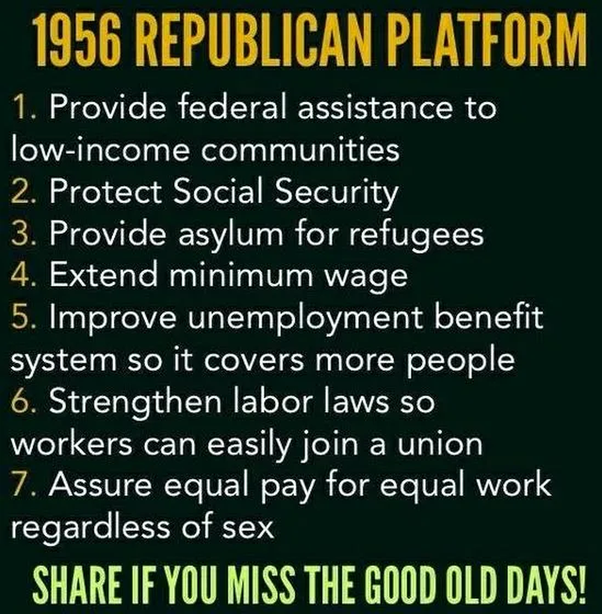
Ideologies are dynamic and ever-changing as people change. Here is an example of how much an ideology can change:
(For the “fake news people,” here is a link to the Snopes article giving this platform a rating of “mixture” — 1956 Republican Platform )
Regardless of the accuracy of the above platform, it’s pretty clear by the Project 2025 platform that it has significantly evolved.
People define and shape ideologies, not the other way around.
Today’s Republicans are not Abraham Lincoln’s emancipation championing Republicans. Today’s Democrats are not the Dixie Democrats of less than one hundred years ago.
Liberalism has undergone many varied manifestations as if it were Christianity, endlessly spawning new denominations.
This question, however, flips that script around and becomes something pretending to be an ideology but is, in fact, something much uglier and evil. This question presents an ideology as if it were a costume to wear in a performance following a script dictated to members like a cult.
Ideologies are also not capitalist. People are participants in an economic system referred to as “Capitalism. Each person views aspects of Capitalism that align with or run contrary to their politics. Since economics comprises a core component of political systems, varying interpretations of Capitalism’s’ role in society also form a core component of alignment with an ideological identity.
In short, almost all political ideologies incorporate interpretations of Capitalism within their ideological construct. Hence, you have answers extolling varying ideologies that all claim to be capitalist.
Like religions, however, each pretends to represent the “one true God (of Capitalism).”
If one were willing to stretch the definition of Capitalism beyond its commonly accepted uses, then even Communism could be considered a “capitalist ideology” because capital is essentially a store of value directed toward creating infrastructure for facilitating trade. Communist systems conduct trade within their systems.
After having said that and freaking out some hard-core capitalists, let’s track backwards and identify the typical distinction between Capitalism and “not capitalism.” That definition hinges on ownership of the means of production. In Capitalism, ownership of factories is held by private entities. In a communist economy, factories (production environments) are owned “by the people.”
Ironically, however, an argument often used to extol the benefits of Capitalism is the ability of the people to buy into a capitalist venture through a process called “share ownership.” Functionally, this renders the distinction between Capitalism as we perceive it and Communism as it was conceived as moot.
Communism failed because centralized authority was unable to meet the needs of the people. Capitalism is undergoing a late stage that is rapidly descending into failure for the same reason of consolidated power and centralized authorities.
The only salient differences between the two systems are how power is distributed and who is conferred power by what process that conferring of power occurs.
In summary, we would be far better off focusing on power instead of worrying about ideologies and which one wishes to identify with as their favourite team. We should be far more concerned with who has power in society and how much power they have.
If we genuinely want to live in a free society that we typically call a “democracy,” then we desperately need to adopt an ideology which “worships the flattening of power.” We must adhere to principles in which power is spread like peanut butter to all people.
The only power that truly matters in life is the power to choose how to live it.
Freedom is living one’s life in a state of maximum opportunity and diversity of choice within a shared environment. A critical factor in the success of an ideology is the acknowledgement of how we are all in this together. Only together can we survive into a future that lasts even half as long as the dinosaurs did.
This post is a response to a question posed in its complete format: “To which extent do novels, or manga, conveying deep idea, or talking about social issues, relate to them given global awards, or high global popularity, to which extent does this depend on how smart the creator is, why only few reach to this level?”
Popularity and recognition are primarily not determined by intelligence, creativity, or any value generally associated with degrees of quality, skill, or craftsmanship but by timing and resonance.
The kind of popularity attributed to intelligence and creativity is recognized only through endurance throughout the ages. It is the rarest form of popularity that remains consistently in the shadow of most other forms of popularity. It does receive the occasional boost because it can garner enough of a niche following to emerge on the populist stage for a time. Still, it then retreats to becoming a niche once again.
A book like “Fifty Shades of Grey” was a literary mess on every level, from the writing to the butchered subject matter to the horrid values it sensationalized.
It was a massive success because it appealed to a repressed and widespread imagination responding to an increasingly darkening reality by retreating into dark fantasies that most would not have the courage to explore in real life.
I’m certainly not claiming that I would or have the courage or the slightest interest in exploring this area of the human condition for myself. Still, I am at least aware enough of the dynamics to understand how the story itself represents more of an expression of a mind suffering from Stockholm Syndrome indulging in titillation rather than providing realistic insights into the dynamic it attempts to portray. It’s more of a study of mental health in society than a literary masterpiece.
This leads me to my point that, as a people, we have been enduring a staggering decrease in the quality of our lives over the last several decades, shocking most of us. A piece of schlock like this validates feelings shared by a large audience and titillates the imagination through sensationalized imagery.
It became popular, not because of any enduring qualities but because it fulfilled a need for an outlet.
“The Secret” is another example of appealing to repressed sentiment, but instead of validating the repressive darkness people have been suffering through, it capitalized on a need to restore hope.
Ultimately, both literary productions created more harm than good in the same way that trolls undermine the social contract.
Once materials like these run their course, they begin to resemble porn in that a temporary titillation is an insufficient mitigation for addressing underlying causes, and like cocaine, once it’s run its course through one’s body, one is left feeling drained and hungry for more of that emotion that gave them a temporary boost in life.
There is, sadly, no real cure to this phenomenon of populism beyond two different strategies. The first strategy is the sanest, but it is also the most long-term and invisible strategy for addressing this need to bottom feed while racing toward an ever-receding bottom. It’s a strategy that will make many eyes roll once I write it as a one-word summary: education.
Education is the “magic pill” that will mitigate most of humanity’s ills — at least, it will once we address the economic roots of humanity’s ills.
It won’t ever be a cure because there is no final state to education. There is no finishing an education. Only lifelong learning exists for our species if we wish to survive anywhere near as long as the dinosaurs did.
The alternative to education is our current self-destructive trajectory, which risks the end of human civilization and, quite possibly, our species if our rock bottom is deep enough.
The alternative track to education we are on is to continue our descent into worshipping the superficially constructed Holy Grail of attention for the sake of attention. We will continue to behave like addicts drawn toward the chaos of feeding an insatiable hunger until we consume all of what we value through superficial titillations that temporarily distract us from an otherwise horrifying existence.
Surviving the nightmare ahead of us means our future progeny will have slim pickings to choose from as representations of the best human potential to pick out from the forgettable detritus of populism. The future will be as we experience it today when looking back on history and forgetting how Leonardo DaVinci had many contemporaries competing for the same artisanal benefits he remains remembered for.
We don’t remember the easily forgotten mass, but we do remember the outliers, and that’s the broad lesson of history.
If we exist as a species and civilization in another two hundred years, no one will know who or what a Kardashian is. They will note, however, how rampant superficiality characterizes this primitive and barbaric state in which we live.
No one will remember any of the Harry Potter books or the trans-hating hypocrite who fraudulently represented hope within her discardable stories. They will, however, continue to be influenced by Tolkien.
No one will remember much of anything notable about the products of this era beyond the horrid worship of excess.
Not one talking head from Fox will be given a nod of acknowledgement for their contributions to society. Rupert Murdoch might earn a passing reference as a key player in corrupting human civilization. Even he will be regarded as a side note contributing to corruption. At the same time, his success at making it so widespread will be considered a global failure in ethics that permitted monstrosities like centibillionaires to exist.
Donald Trump will be remembered as this century’s Hitler, no matter how many may find that offensive today. It’s just where we are as a species, and history has given us enough hindsight information to make such predictions with great confidence.
Those who may be offended by this prediction would do well to consider how that’s an optimistic outcome to the trajectory we are on right now because if he succeeds in achieving the maximum potential of his efforts, then we may not have much left of humanity to be capable of studying the history we make today in any way resembling our current capacity for exploring our history from yesterday.
Suppose we don’t rein in society’s current excesses of distorted power. In that case, we will be lucky to exist in any state resembling anything other than a primitive existence at the mercy of nature.
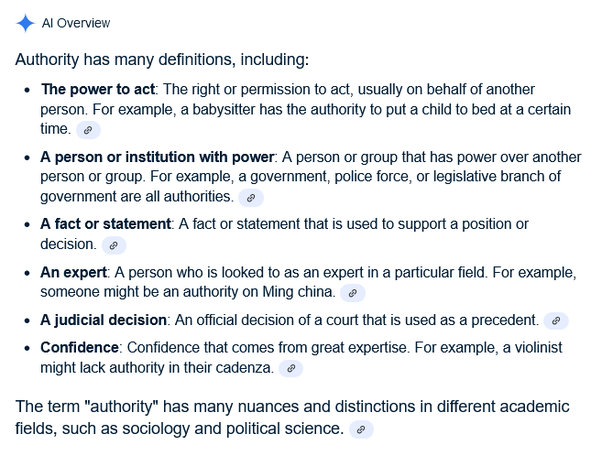
There appear to be two distinct perceptions that dominate public responses to authority.
On the one hand, an authority is an entity with the power to issue demands, impose edicts, and enforce compliance. On the other hand, an authority is a trusted entity that serves as a resource for empowering people and enabling their ambitions.
Our good friend and authoritative source of plagiarized information, AI Bot (Ayebot? iBot? EyeBot? — It needs a name so that it can be further anthropomorphized. “Gemini” seems a bit too much like impersonal woo.), provides a bit more detail:
Wikipedia has this definition, which appears to favour an interpretation based on an exercise of power:
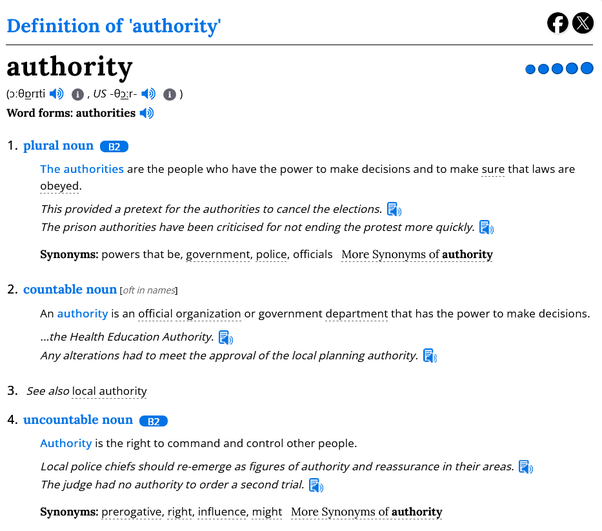
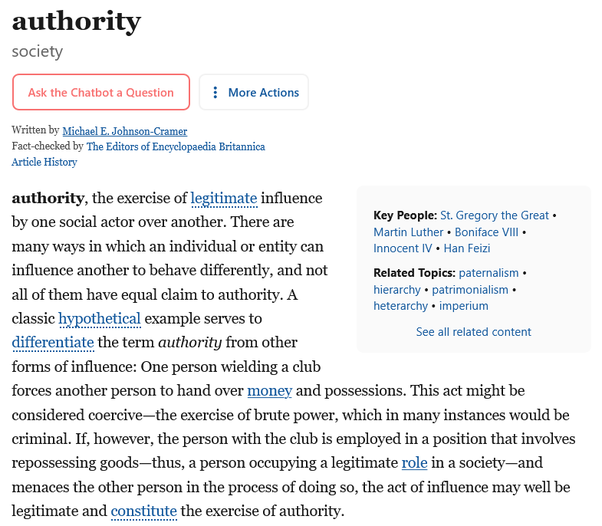
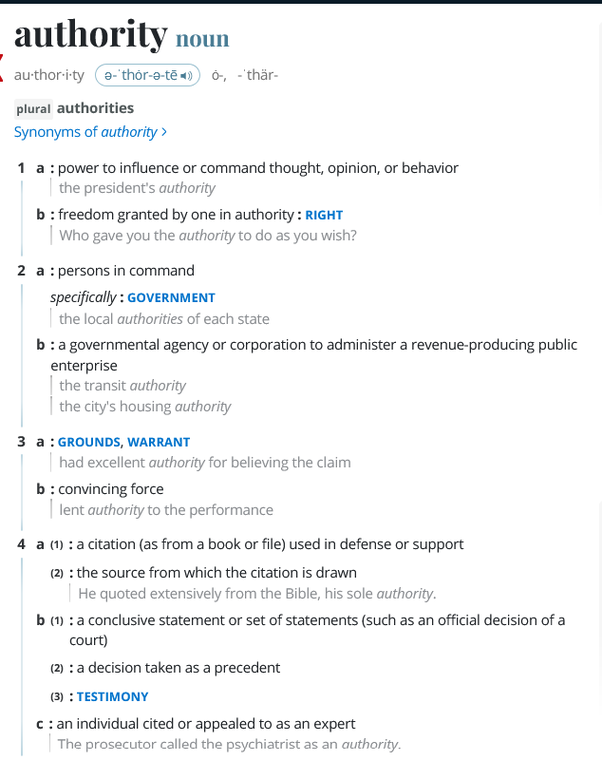
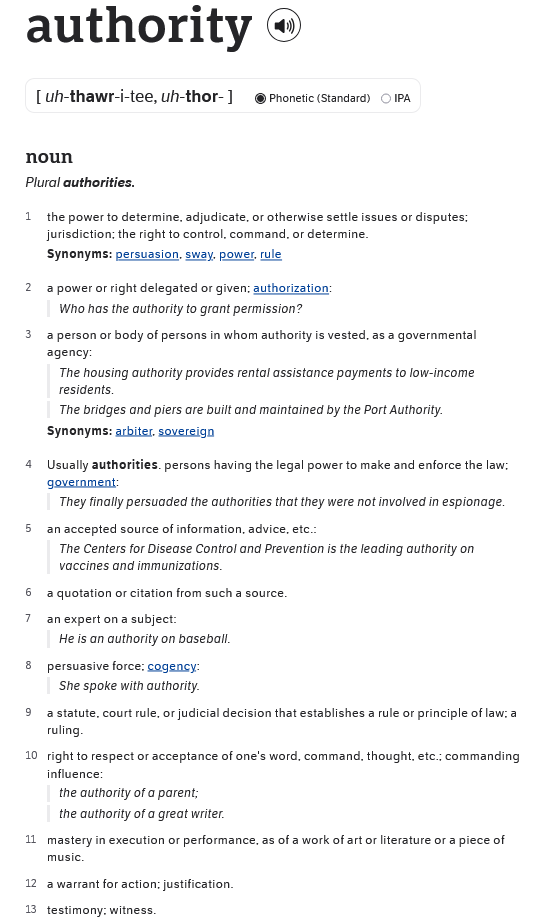
Let’s comb the world of language authorities to see how they interpret authority:
Collins has this to say about authority:
Britannica attempts a more concise definition favouring “influence” over “imposition” like Collins.
Merriam-Webster provides a more comprehensive overview of how “authority” is apprehended and implemented in society — although imposition precedes influence in its hierarchy of interpretations.
Interestingly, two of the world’s premiere language authorities place a profit premium on sharing basic definitions for words… which begs the question of the value of definitions versus profit and whether these institutions actually are authorities in realms beyond basic definitions.
Oxford at least asks for personal information to be granted access to elementary information, while Cambridge’s efforts are laughable.
These last two efforts suggest to me that their authority is entirely contingent upon reputation — part of the “old boy’s club” of authoritative prestige in the world, which essentially shuts out the plebians among us who must wrestle with “inferior language authorities.”
Meanwhile, freebie entity Dictionary dot com presents itself as a superior authority in marketing and business development to the two staid elements of anachronistic society above and provides an even more comprehensive set of definitions than Merriam-Webster.
This tells us that authority is actively cultivated by those who desire it and then, once achieved, is actively protected and zealously guarded beyond levels resembling reason. At the same time, newcomers overturn established authorities who fade into oblivion as the barbarians at the gates no longer storm them out of existence but supplant them through more effective forms of adapting to an ever-changing world.
In short, “authority” can be explained entirely by the dynamics of ego, power, and how much one is addicted to asserting their prominence in a chaotic world.
Interestingly, the most respected authorities throughout history have rejected the impositional form of authority flowing from within in favour of empowering the people at large by serving as a resource for enabling their assertions of personal authority within their relative spheres of influence.
For example, people still recognize the names of rare individuals who embodied humility, such as Gautama Buddha — or even a more modern instance like Nelson Mandela. Still, few outside dedicated historians can remember the many “authorities” throughout history who imposed their will upon the public. Those remembered are often anomalies serving as massive engines of destruction whose names are whispered rather than revered. Few among those whose authority was impositional in nature are remembered for their introspective wisdom, like Marcus Aurelius and Sun Tzu, but are revered for their insights in contrast to those of the conquerors like Alexander the Great or Genghis Khan, who are studied for their strategies (and often critiqued for their human failings).
For example, I predict that if humanity survives in some form resembling the humanity we know today, Jimmy Carter will be remembered with deep reverence and respect one thousand years from now. In contrast, Donald Trump will be remembered as the cautionary tale of a bull in a china shop whose lesson for humanity is the necessity of restraint and accountability.
Subordination is the foundation for authoritarian regimes.
Authoritarian regimes are rigidly hierarchical.
Rigid hierarchies are inflexible and abusive toward all people downward in the power hierarchy.
Authoritarian regimes eventually break because humans have limits on the abuses they can tolerate.
Democracies survive because they are fundamentally adaptable to change.
Democracies are fundamentally adaptable to change because they accommodate individuality.
Individuality empowers self-determination to maximize flexibility and adaptability.
Flexibility and adaptability are contingent upon responsiveness to succeed.
Responsiveness demands input and engagement from diverse perspectives to be effective.
Dissent filters out ineffective processes that inhibit adaptability.
Navigating change requires dissent to ensure that adaptation initiatives succeed.
Without dissent, changes are made blindly to make adaptability impossible and guarantee failure.
Hence, dissent is the foundation of a democracy.
Furthermore, embracing dissent improves all of us, particularly in the essential skills area of critical thinking.
The greater our embrace of dissent, the better our thinking skills become.
The better our thinking skills become, the more robust our democracy.
Democracies are being threatened worldwide because we have been failing to equip citizens with the skills they need to build a better world together.
We have been failing to equip our citizens because arrogant assholes with too much of a desire for power wish to reduce citizen efficacy in self-governance systems because they deem themselves superior humans entitled to their power and to lord over the little people.
It’s past time they begin to relearn their lessons in humility.
This post is a response to a question posed in its complete format: “How do leftists stay hopeful/resilient in times like these where fascism is on the rise and history is repeating itself?”
History has shown us that fascism always gets beaten back when the public realizes how much less they like fascism than the chaos of democracy. Every time and after enduring a period of suffering under the rule of despots, voter turnout makes a strong comeback as fascism encourages the apathetic non-voters to rethink their strategy of staying home.
Think of fascism as a lesson in consequences where people need to suffer enough to realize just how precious the delicate balance of freedom is in society and how vital the sausage-making process is, no matter how boring and dry it may otherwise seem.
People eventually learn they prefer to get off the couch and go to the polling stations to cast their votes for people they want to trust to represent their best interests. They also eventually learn that no matter how much the fascists want to paint their opposition as being identical to them, they’re not. The fascists inevitably piss off the people enough to go to war against them, and that’s precisely what Trump and Musk are inviting from the world.
They’re poking a tiger, and they’re going to get burned while they set the world aflame.
The only real question left on the table is, Just how much more pain will the people endure before the riots break out?
This isn’t even about being hopeful because we already know, just like everyone who’s been pushed past their limits, that once the anger takes over, there’s no stopping it. That neighbour who’s been pissing you off with their loud music invariably gets an earful that may embarrass you afterward. Still, it’s an emotional explosion that can’t be controlled during its moment of emotional release.
My guess is that if Luigi Mangione gets the death penalty, that might be the final trigger before all hell breaks loose. It’s hard to tell because Americans seem able to tolerate incredible horrors without doing anything substantial about them.
I know that if I was living in Flint, Michigan, for example, and I had a kid who died from the poisoned water, I would have pulled a Luigi myself. If a kid of mine were gunned down in a school while my local representative did nothing to institute sensible measures to prevent this from happening again, I’d lose my shit.
As it stands right now, from what I’ve been put through on a personal level, I’m already doing everything I can to keep from doing something stupid while attempting to resolve an issue in the most civilized manner possible. As it stands, the bullies responsible for destroying my life are behaving as if they’re going to walk away without suffering any consequences for their actions as they tell me to shut up and die quietly.
I know I’m not the only person at the end of their rope, and all it will take is the right match to set this nightmarish dystopia ablaze.
People like Musk will have to come around or beef up their security because it’s only a matter of time before their arrogance blows back like a nuclear bomb in their faces.
“Those who make peaceful evolution impossible make violent revolution necessary.”
The trouble with this dynamic is that millions of people have to be pushed to their breaking point before they realize how much less pain there is in risking death in a revolution than to continue enduring a walking death in slow motion toward oblivion.
This is all just history repeating itself.
It’s not new by any stretch of the imagination.
Those who refuse to learn from history force us all to replay it, and we all get uglier about it each time we must endure the stupidity of people who refuse to read the writing on the wall.
The only salient aspect of hope in this mess is that we can avoid the worst chaos before returning to sanity.
Within a capitalist system, one sells either one’s body or mind, which is called employment.
The only alternative to that is to pay people to use their minds and their bodies to create products that other people buy to generate revenue for them.
That’s right… either you’re a plutocrat with wealth galore and never have to sell yourself to anyone, or you’re a servant for someone else.
Women selling their bodies in today’s society is a very smart economic move because a great deal of money can be made in a very short time that can propel one from being a seller of their body to being a capitalist paying others to make money for them.
Women selling their bodies in today’s society are very pragmatic and have a clear advantage over men in generating revenue.
If you can earn upwards of six figures for a couple of hours per day of on-camera nudity, the problem isn’t women selling their bodies but your disconnect with the capitalist system you’re living within.
IOW, you may want to shame women for making that choice, but it is a choice because men have made it one. It’s not a bad choice because of women. Women choose to benefit financially in ways no longer available to most working-class people.
Perhaps if we paid school teachers more than hedge fund managers, we’d find people aligning their economic decisions more closely with moral values. In a society that steadily strips away economic choice, you can’t complain about the people who choose options you find uncomfortable. After all, they’re chosen as options because living wages no longer are.
What’s truly sad about all of this is how little people comprehend implications that stretch far past the ones that immediately impact them… and that’s not a phenomenon limited to the little people; the captains of industry we rely on for leadership in society are just as bad at failing to see past their navel… possibly even worse than the majority, although, from my biased perspective, they have a greater responsibility to rise to their status.
“To whom much is given, much is asked of in return.”
Stop crapping on the women getting rich from their birth lottery winning because benefitting from birth lotteries is the world we have created.
If you need to crap on something, crap on that.
The women getting rich by making horny incels happy are not the problem in society.
This post is a response to a question posed in its complete format: “What does the left mean by freedom? When ever I see lefties passing around rankings of the “freeist” countries, inevitably the countries at the top are the type with heavy regulation, heavy taxation, low economic freedom.”
One of the hallmarks of a lack of freedom is ideological thinking that colours one’s perceptions in ways that interfere with one’s apprehension of reality to impede one’s critical thinking skills.
For example, the flawed presumption in this question presumes higher taxation equals less economic freedom when the obvious comparison between the U.S.’s health exploitation system is far more destructive to one’s financial freedom than the taxed version of universal health care offered by every other nation that has succeeded in providing higher quality care at a lower price.
There is no economic freedom when medical bankruptcies destroy lives.
There is no economic freedom for people who pay over one thousand dollars per month for insulin when the rest of the world pays only tens of dollars.
There is no freedom when one is murdered for profit.
There is no cognitive freedom for anyone who divides the world into ideological camps, just as there is no freedom from the mind-destroying forms of bigotry polluting this world.
Within the context of this question, the definition of freedom that addresses it is clarity of thinking, in which the querent proves their mind is so trapped within a toxic paradigm they can’t understand freedom when it’s presented to them in the most unambiguous of terms.
I fully expect this answer to whoosh past the querent’s mind and trigger them into an ideological quandary where they will dismiss these words as an ideological irrelevancy in much the same way that the people who think Donald Trump is an intelligent man are utter idiots.
The entire world is undergoing a massive transformation that has steadily escalated in speed and scope year by year for decades. Although the world has constantly been changing, this degree of change is unprecedented.
I remember Alvin Toffler’s predictions on this in Future Shock from when I was a kid in school, and we had the opportunity to watch his documentary in the classroom. Among the many predictions, this rate of escalating change has always stood out for me as a consequence of being repeatedly reminded of it throughout my lifetime. I thought the beginning of the Information Age represented a peak of speed of change, but that was just the beginning of ramping up the rate of change to come.
With great changes come great uncertainty, and that fires up anxiety levels everywhere.
Making matters worse has been the class warfare reaching new peaks of disparity driven by thefts of the working class by the tens of trillions over the last few decades as world politics began shifting rightward.
Before Reagan and Thatcher, many of the democracies in developed nations around the globe still viewed the government as somewhat of an ally, even after experiencing perceived betrayals through global events like the war in Vietnam and Britain’s mishandling of the IRA in Ireland and “Sunday Bloody Sunday.” JFK’s assassination shocked the world. Labour strikes rocked the world.
People were fed up then with disruptive elements and had developed a level of comfort with their daily lives and their expectations for their future that they lost touch with the value of disruptive events like strikes. No one then realized how a disruption to their air travel plans was a positive and necessary event in a healthy democracy when negotiations broke down. The general attitude of entitlement to expectations of service became an easy wedge to force between the public and the labour organizations fighting to maintain equanimity between the classes.
Demonizing government became a path to power within government because the people in democracies began believing corruption was also as endemic to the government as unions. Political systems began being viewed through a cynical lens, while conservative politicians have since leveraged that sentiment to gain political power for themselves.
Regan’s firing of air traffic controllers was accompanied by a cheering public who saw their travelling conveniences disrupted rather than their quality of life being protected. People had begun forgetting almost a couple of centuries of sacrifice in fighting for fundamental rights and protections like weekends off, overtime pay, and healthcare benefits.
Employers had begun implementing progressive strategies for supporting staff, so the protections provided by unions began to seem redundant and perceived as an unnecessary cost for supporting a political organization that often ignored the needs of its constituents. Unions began being viewed as corrupt organizations rather than protectors of the middle class that they helped build and grow.
Conservatives took advantage of this new embrace of the ownership class and cultivated a belief that it was within reach of everyone who worked hard and lived responsibly. The American dream was possible by the beginning of disassembling the structures that gave rise to the middle class.
Reagan’s tax cuts and the heyday of spending, which characterized the 1980s, made it seem like the wealthy were just like everyone else and were equal members of a human community willing to share in the prosperity.
It was easy to support conservative ideology because it seemed the most pragmatic. Even today, people will describe themselves as “conservative” more out of an avoidance of needlessly attracting unwanted and disparaging public attention and appearing reserved than out of an embrace of a political ideology.
When people refer to themselves as “conservative,” they usually do so to appear “normal,” “predictable,” and “approachable,” while those who are not are generally viewed as “erratic” and “disruptive.” This perception is what has made conservativism most popular. It is easy to equate “fiscal conservativism” with sound financial management strategies, even though political conservatives constitute the worst among the worst economic managers. We have had decades of conservatives blowing up debts across every nation they held leadership roles in and are still publicly viewed as fiscally competent.
Conservativism represents an imaginary form of stoicism in which people hunker down and do what needs to be done because that’s the only way to survive adversity.
In times of stress and fear, withdrawing from positions of risk seems generally the safest approach toward surviving adversity. We’ve had countless generations learning to do without to make ends meet. Our forefathers lived during times of scarcity while production efforts scrambled to keep up with demand.
Most people lived independently and without the social support fought for and won by the progressives in society who demanded equitable treatment from the ownership class. They also responded to adversity by hoarding their assets as a survival strategy through adversity. Scarcity was a fact of life until only a few decades ago when our means of production exceeded our demand.
We are already living in an entirely new world, while most people born before the advent of the information age still live as if scarcity were a challenge for the human species. Most do not understand how dramatically opportunities have shrunk for people starting today like they did yesterday. Many, if not most, perceive today’s complaints and social disruptions as a consequence of overreach by attitudes of unearned entitlement.
Many live in today’s world as if it were still the 1980s without realizing how much they once took for granted has been stolen by the ownership class. What they see is increasing disruption to the predictable life and world they once knew, and they seek to blame progress itself as the culprit responsible for their anxieties. This causes people to turn inward in a protectionist strategy for survival.
The attitude of protectionism has been steadily rising while being stoked by conservative politicians as they have cultivated a cynically misanthropic attitude among their supporters toward their fellow neighbours. They take every opportunity to demonize concepts that make people feel uncomfortable and politicize them for personal gain.
Everything about the conservative ethos today has been geared toward hating anyone and anything that can potentially disrupt the sanctity of a predictable existence. Fear and hatred have been the weapons of choice wielded by conservative power mongers, and it works because people respond to threats on a visceral level before they can afford the risk of examining them for their rationale.
Conservativism is a “shoot first and ask questions later” approach to anxiety, and that used to work on some levels in a simpler world with simpler problems. Unfortunately, it only exacerbates the issues we face today.
Fortunately, within the hard swing to the right throughout these last several decades exist the seeds for reversing the course of a political pendulum that has been perpetually swinging to either extreme before being yanked back to an inevitable centre where stability lies.
It may be that we will continue swinging further rightward, but the further we go to the right, the more powerful the backlash becomes. If we find ourselves facing full-blown fascism as a clear threat to our democracies, then we may be in for some seriously chaotic times, but that’s when the voice of reason becomes influential as a guide out of madness.
We desperately need bold leadership that can press for the necessary changes we must make to our systems to ensure our transition into a fully automated society creates minimal casualties, or we will risk warfare. We can no longer afford capitulating gestures because the conservative opposition has been clear that it doesn’t negotiate in good faith. Like all situations with bullies, the only solution to their entrenchment is to meet them on their level and overpower them to such a degree that they relent.
This is the prisoner’s dilemma in game theory, where tit for tat is the only way out of this mess right now. We can face the issues head-on or watch everything collapse, hoping some miracle saves our assets. We are most definitely at a crossroads as a species, and the right appears hellbent on subjugating everyone not approved as core representatives of their tribe.










 thotbag