This post is a response to a question posed in its complete format: “What happened to us, where and when did the human race decide to become so judgmental and predatory, what happened to the old fashioned sense of community?”
wut?
Here’s a rule of thumb about reality: Noticing something for the first time doesn’t mean that thing hasn’t been around for a long time.
It only means that your mind has clicked something into focus that had previously been on the periphery of your vision.
You are not unaware that wars have been waged practically everywhere on the planet throughout human history.
You are not unaware that hatred of very many forms, including racism and misogyny, along with sex and gender bigotries, have existed for centuries and have been a part of our story since the dawn of human civilization.
The only thing that has changed is our ability to tune it out because we are now in an information age.
We can no longer retreat into the comfort of ignorance while lying to ourselves that the suffering of those we have been overlooking is not caused by our inability to face the harsh truth about humanity. We are a psychologically damaged species, and the sooner we can face that, the sooner we can learn to heal ourselves and our species.
We haven’t “gone wrong,” because we are awakening to realities we have had the luxury of ignoring. We cannot heal ourselves until we accept the truth about ourselves, and that’s a harsh and bitter pill to swallow.
We are undergoing the first and most necessary step in our healing, awareness of our broken nature. We must first accept that we are suffering as a species, and this time of awakening is a necessary part of the process.
We cannot mature as a species if we cannot accept that we have been struggling, and the only way to end the struggles is not to ignore the suffering but to acknowledge its existence.
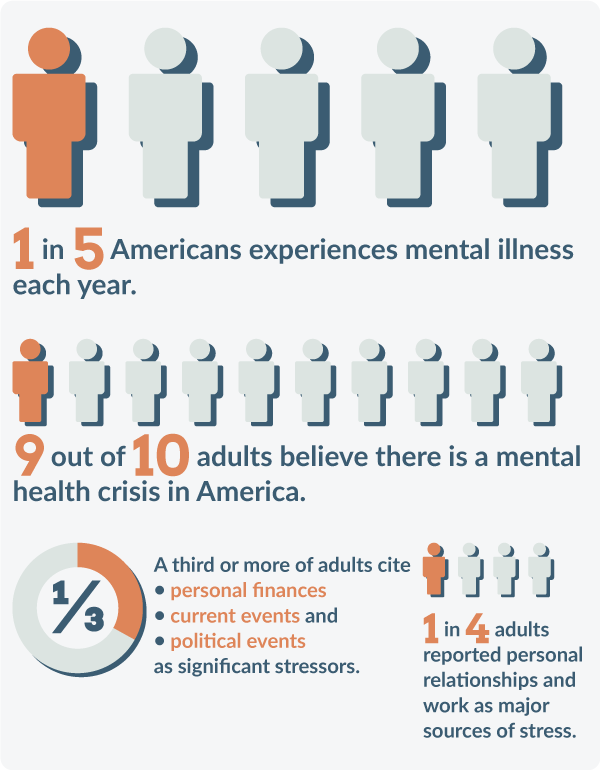
One in five people is suffering from a visible form of mental health issue. A whopping majority 70%-80%) of families are dysfunctional.
We cannot ignore these statistics and pretend there is nothing wrong with humanity.
We can only learn to embrace our broken selves and work together to help each other heal.
There is no other path to a better world.
The sooner we accept that, the sooner we can progress toward achieving a better world for everyone.
It is true, however, that our focus on community has taken a beating as our community boundaries have expanded beyond quaint notions of imaginary lines dividing us into becoming a global community.
The challenge is acknowledging that our community is no longer a geographic boundary but a global one in a much larger and inaccessible community among the stars.
Most people embrace the potentiality of exploring beyond our current home and wonder if we can join a broader community of life. We must first unite as a community in our house before the universe can open its arms to accept us as a species among the stars.
Looking past our limitations, we may find the synergy we need within the community to manifest our aspirations to travel the stars.
There is something better ahead to hope for, but we cannot ever reach it without acknowledging what is holding us back, and that begins with the state of our psychological health as a species.
In short, nothing “has happened to us” that has not been happening all along; we are only learning to understand how we must face these issues together as a community.
This post is a response to a question posed in its complete format: “Can a person be highly empathetic and think empathy can be overdone and in many cases detrimental to better outcomes? Can being conscious of empathy and in control of your emotions be called for to create more realistic circumstances?”
No. You’re conflating empathy with other unrelated characteristics such as sympathy or pity.
Empathy is a complex phenomenon, more adequately described as an additional sense, not entirely unlike intuition or your other five senses. It’s a blend of cognitive parsing, information gathering, and processing, adding a layer of intellectual stimulation to our understanding.
There are three types of empathy: “affective empathy” (or “emotional” — feeling what someone else feels), “compassionate empathy” (recalling one’s feelings from similar situations and re-experiencing the emotion), and “cognitive empathy,” (intellectually identifying the emotions and connecting them to stimuli to comprehend the context in which the feelings are expressed).
The people most prone to being overwhelmed by an empathetic response to stimuli, often referred to as “hyper-sensitive,” struggle to discern between original feelings generated within and feelings they pick up from external stimuli. Their empathetic natures are primarily derived from the emotional form of empathy, akin to a radio tuned into a station while the volume is set to maximum. It can be overwhelming to find oneself tuned into powerful signals.
It can take a lifetime to cope with one’s sensitivity, primarily because of a lack of social support for such sensitivity. More often than not, highly sensitive types tend to be targeted by bullies because they are perceived as easy victims who are also usually shunned by their peers. This lack of support can lead to feelings of isolation and exacerbate the challenges that sensitive individuals face in society.
These have been socially acceptable attitudes toward highly sensitive people, while many still doubt that empathy is genuine and is not a personality dysfunction. The first of these two questions is an example of misunderstanding empathy on that disparagement vector.
The second question, however, points toward a somewhat effective solution or means of coping with one’s sensitivity. Learning to discern between one’s natural feeling and those one receives from others on a subliminal level is crucial to maintaining one’s composure, if not sanity.
On the upside, once one learns to master the all-too-rare skill of self-awareness, they discover they possess a “superpower” and become “human lie detectors.” It can be frightening to learn that they are talking to a stranger who almost instantly knows their deepest secrets and more about them than they know about themselves.
Empaths who have mastered their emotional regulation and awareness skills also learn to conceal their awareness of others, as they generally don’t want to create enemies who are intimidated by them. Making matters more complicated is that one’s empathetic sensitivities are not infallible and can often be mistaken about other people. Much of this judgment error is due to unresolved personal growth issues. In essence, what I referred to as a “superpower” is more about “power over oneself” rather than over others.
Highly empathetic people tend to be the most honest because they must learn to be honest with themselves to maintain their internal equanimity. Living with the lies one tells oneself is much harder to do when one’s cognitive dissonance escalates rapidly, much more so than for those with diminished sensitivities to empathy.
The two other forms of empathy, “cognitive” and “compassionate,” generally complement affective empathy, but there may be cases where they don’t. I don’t know of such cases, nor see how that’s possible. Still, I’m not a professional who has spent a lifetime studying the manifestations of empathy in thousands of patients and volunteers.
Emotional regulation is otherwise a skill that anyone can benefit from, regardless of their sensitivities or empathetic capabilities.
This post is a response to a question posed in its complete format: “Elon Musk apparently didn’t dismiss empathy entirely, but thought that we have a problem with empathy for the wrong people. How do you judge?”
I partly disbelieve this moronic assertion but won’t deny it’s possible he would say something so stupid.
I wouldn’t put it past him because he disowned a daughter that he paid to ensure she was born physically as a male.
He got pissed that he didn’t get what he paid for and punished his child for daring to assert her identity.
Suppose he lacks empathy, which he seems to demonstrate while bemoaning his inability to experience empathy proudly. In that case, he’s a walking-talking case for how badly screwed up some kids can be when their sociopathic parents severely screw them over.
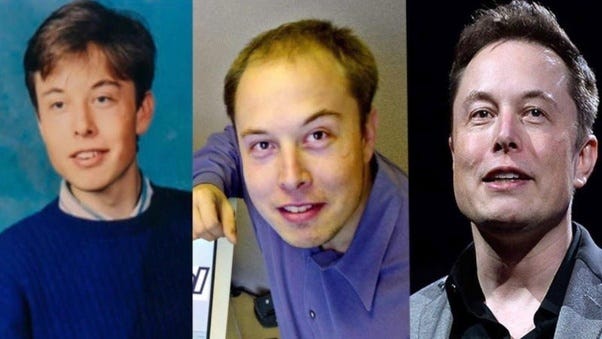
It still amazes me when I look at photos of him as a kid because he appears as a somewhat sensitive type of nerd who tried being himself but was abused for it.
That’s the only explanation I can devise that makes sense of his severe state of dysphoria (minus the drug addiction of both the chemical kind and the egotistical drug of power through his wealth).
He appears as a youth to be a typical “sensitive” who would likely have been highly empathetic. Still, it’s been beaten out of him through likely mostly verbal abuse (because he doesn’t appear to show typical traits of physical abuse — such as scars or even an emotional coldness in his demeanour). (Unlike DonOld Trump, whose physical abuse is written all over his demeanour. You can almost read the number of times his father physically beat him like counting rings on a tree trunk.)
Statements like the one attributed to him show the child attempting to speak through the cracks of a semi-polished exterior.
Empathy is like any other characteristic, which presents itself in varying degrees throughout the population. Empathy is like muscle mass; it has a developmental potential but must be cultivated to show itself in its most developed form.
In his case, his capacity for empathy was stripped from him and has been starved to (near?) non-existence.
I suspect some vestiges of empathy remain alive within him but that he’s trapped in a world where he cannot trust, allowing himself to experience it because the fear of permitting himself to experience it openly has been beaten out of him by his parents.
It’s not that the “wrong people have empathy” but that people have had their empathy wrongly denied their right to experience it without adverse repercussions.
This post is a response to a question posed in its complete format: “Do you feel that Wal Mart employee’s lack of performance could be due to the fact that welfare literally forces people to accept a job offer or lose benefits that provide Food and Housing? Support #UBI”
When employers don’t care about their staff, their staff stops caring about them.
When employees stop caring about their employers, they disengage and produce the minimum they can get away with. They focus less on productivity and more on toxic politicking to gain personal benefit over others in an increasingly misanthropic culture that pits people against each other.
The sociopathic Walton family is teaching their people to hate them, their operation, and the society which permits them to exploit the vulnerable. Their people, staff and customers are being virtually trained to devalue everything about human life and modern society. This naturally results in the disengagement that every other historic failure of society has experienced preceding widespread systemic collapse.
This isn’t rocket science. It’s reciprocity.
Most people understand it clearly as “you get what you give.”
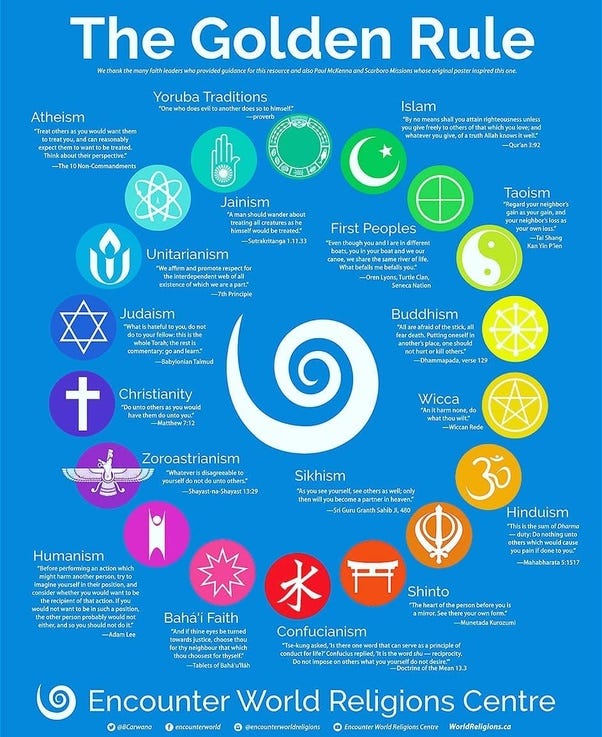
Sadly, we’ve allowed our societies and our systems to forget the most critical principle to acknowledge and characteristic of the human condition to preserve within everything we do. Strangely, it’s also a core principle within almost every religion throughout the history of religion.
It’s not complicated in the least.
Even science acknowledges it.
It’s cause and effect.
“Do Unto Others As You Would Have Them Do Unto You.”
It’s only a matter of time before the greedy, misanthropic Walton family finds themselves confronted with the bill for the consequences of their sociopathic and parasitic disdain toward society. In effect, they are no different than this person who justifies shoplifting.
They are responsible for breeding this kind of thinking because this is precisely their reasoning as they disempower their people and force them to rely on government assistance so that they can increase their hordes in an escalation of the misanthropic decay of society.
They are spitting on the social contract from the comfort of their luxurious mansions.
They are no different from this person and are responsible for validating this skewed justification.
UBI is a basic correction to veering off-course in the last several decades. UBI is insurance for the transition toward automation, which is well underway. UBI is a stabilizing societal element that will eliminate poverty, homelessness, and various social problems that create conflicts from which we all suffer.
We have cultivated it by allowing our societies to grow into corrupt monstrosities that people have no choice but to struggle to survive within.
We have placed a physical resource like money at the top of our values and have dehumanized people every step of the way. At the same time, we convert human beings into disposable commodities.
We are dehumanizing ourselves at every level by endorsing a system that devalues the ineffable qualities of humanity because they are not viewed as profitable by industry. Instead, we have ways of further dehumanizing people by leveraging their despair against them with global institutions that dictate dogma to follow without question.
Everything has become reduced to a competition for tentative comforts that bear no intrinsic value or meaning beyond serving the immediate gratification of shallow desires.
None of this contributes toward the growth of those qualities of humanity that we value. None of this brings us together as people in common cause for the betterment of all. Everything is catered toward the propulsion of individuals we stratify with blind worship.
When we replace human qualities we cherish with an avatar, like money as a metric for determining their value, we become divorced from our humanity.
While living in a world that views wealth as an indicator of all positive human qualities, people inevitably start to develop disparaging views toward their neighbours because everyone has been left fighting over the same scarce resources that are left behind by the plutocrats dehumanizing all of us with a system they parasitically siphon of wealth at our expense.
We can only live so long with oppressive conditions before the effects grow out of control and well into making our environments breeding grounds for chaos.
Misanthropy is just an early stage of widespread systemic collapse.
“Humanity” is from the late 14th century and derived from the Latin word “humanitatem” or “humanitas” for “human nature, humankind, life on Earth, the human race, mankind,” and Old French “humanité, umanité.” “Humanity” includes all humans but can also refer to the feelings of “kindness, graciousness, politeness, consideration for others,” which humans often have for each other.
Variations of the term, such as the adjective “humane,” which arose in the mid-15th century, refer to the ineffable qualities of being human rather than the physical characteristics of human existence. By the early 18th century, it evolved from meaning “courteous, friendly, civil, and obliging” into “tenderness, compassion, and a disposition to treat others kindly” and evoke “kindness” within the sphere of the human condition.
By the 1700s, the plural of humanity — “humanities” was adopted as a description of the study of “human culture” through the literature branches of rhetoric and poetry and from a secular perspective rather than religious via “literae divinae.”
“Humanism” emerged from that evolution in meaning from the Latin “humanitas” or “education benefitting a cultivated man” while supporting the notion of humanity as symbolic of the best qualities of our species.
Much of this evolution in meaning is derived from a history stretching long before prehistory to a time when our survival as a species was contingent upon working together to feed and clothe ourselves as we hunted in packs.
Successful interdependence requires supporting one another; thus, empathy was given rich soil to grow.
I suspect, however, that none of this constitutes new information for you even though your question misses the point altogether — and to such a degree it screams severe psychopathy, even as an entertainment-seeking provocation.
From initially reading it in my notifications for questions I’ve been asked to answer, my first thought was that it’s an apparent provocation from a misanthrope and most likely a troll. What I discovered upon encountering your profile is something far more insidious.
Let’s begin with the presumption in this question, “Why should I feel it?” etcetera.
There is no “should” in that you are not “obligated to feel” anything. That’s not how emotions work. You appear somewhat educated — or at least literate — based on the number of publications you’ve written and have posted on Amazon.
Somehow, though, a fundamental comprehension of oneself as an “intelligent” member of an interdependent species escapes your notice. You rely on others to feed, clothe, and house yourself through literary endeavours and can’t acknowledge how you already “feel it, need it, and want it.”
Even this provocation attempts to cater to those basic needs by identifying people who can respond in ways that support egotistically defined goals.
Most literate people develop a basic comprehension of emotions and the atavistic precursors making them manifest. On my behalf, this could be a flawed presumption, but I’m pretty sure you’re no stranger to “darker” emotions such as fear and anger, and you have no misapprehension about their manifestations within you. The sarcasm in your writing indicates your preference for wallowing in those emotions and is consistent with the attitude displayed within your provocation disguised as a question.
The problem you struggle with is that you hate your interdependence and deny that it exists within you — most likely due to having found yourself disappointed and hurt repeatedly by people who failed to live up to your expectations from a very young age.
Sadly, in a world where a whopping majority 70%-80% of the population is raised within a dysfunctional family unit, your experience is far from being a minority. Unlike some lucky few who can cope with their pain to the degree that can transcend it on levels that allow them to minimize the transmission of a toxic mentality characterized by misanthropy, you have chosen to embrace the cynical view that humanity is beyond hope.
Whether or not that’s true is irrelevant to me because my biased perspective shudders at the prospect of living in a world where one broadly hates all of humanity to such a degree they fail to see or experience the gestalt of existence within each of us.
To live a life without comprehending the value of joy is the equivalent of living a life deprived of meaning. It’s like a walking death. Even if one’s life circumstances necessitate a deprivation of joy, knowing it exists can often be enough to overcome the most painful hurdles.
Even the briefest taste of love in a fleeting life characterized by its absence or a prevalence of fraudulent forms of love is enough to sustain one’s spirit for a lifetime.
That’s the power of living on the side of light those who wallow in the dark fail to comprehend.
Once one understands that power, one no longer feels pushed into seeking something out of conceptual reasons but from an atavistic need to partake in as much as one can, like struggling for breath while deprived of oxygen because of a plastic bag covering one’s head.
Sadly, you’ve never tasted it, or you would know why you are drawn to it while feigning a disinterested rejection. As much as your ploy may feel like a shield protecting you from further disappointment, it’s a cry for help heard echoing its way around the world, crying out in pain.
If nothing else, in your case, it merely reveals you as a product of a wholly dysfunctional era in which we exist today as a species suffering from generation upon generation of transmissible trauma.
In other words, you asked this question because, on some level, you realize your struggle. Although it may be easy to peg you as a statistic identified as part of “the one in five” visible sufferers of a mental health condition in society, you’re not. Instead, the psychopathic dysphoria you struggle with is made invisible by its type of dysfunctionality and how it fits within the accepted definition of a psychologically well-adjusted individual within a maladaptive system (by which I mean our environment and economies are not suitable for cultivating the best of humanity).
As unhealthy as your expressions are, their implications exist outside the boundaries of what the psychological sciences deem unhealthy because you seem capable of functioning at a high enough level to adapt to the rigours of your day. In my view and statistically speaking, of the remaining four in five who do not display visible signs of an inability to adapt, three of those four are still victims suffering from degrees of stress that remain invisible to a triage mentality characterizing the state of our species today.
Your wallowing in cynicism is not your fault. You’re a victim of an entirely dysfunctional world. You happen to be smarter than the average bear, making a positive adaptation to a broken world much harder.
If you’re lucky and can make yourself willing and available to receive the cream of humanity, you’ll feel the answer you seek that words alone cannot give you.
This post is a response to a question initially posed on Quora.
Human rights are essentially an agreement between humans to protect a characteristic or behaviour of all humans within their community.
Human rights exist only by virtue of the agreement itself and the degree of commitment by other humans to protect those rights.
This is a global issue, with human rights being violated all the time and everywhere on the planet. It’s a problem that demands our immediate attention and action. This is why human rights are violated all the time and everywhere on the earth.
We have far too many humans who view rights as scalable according to their essentially misanthropic perceptions of humanity — because we are suffering from a mental health pandemic affecting at least one in five among us. We are only now beginning to realize that we are a species that has been suffering for centuries from generational trauma from our barbaric origins.
The fight for universal human rights is a fundamental building block in a healing process that will require centuries to emerge from.
We are far better off today than we were one century ago simply because of our increased awareness of the issues we are dealing with and an emerging appropriate context from which we interpret our experiences.
Human rights are crucial to preserving the social contract and ensuring systemic stability.
Without human rights as a concept enshrined into law, we descend into barbarism.
After writing this answer and posting it, I realize I’m doing a disservice to the concept by providing such little context.
Human rights have a long and bloody history of development in which their inklings as concepts we should value as a species were responses to centuries of brutal violence characterizing human life.
The earliest examples of human rights enshrined in local laws date back to circa 2350 BC in Asia as the reforms of “Urukagina of Lagash,” which evolved into more well-known examples of legal documentation such as “The Code of Hammurabi” from circa 1780 BC.
Ancient Egypt also supported fundamental human rights through documents such as “The Edicts of Ashoka” (c. 268–232 BC). Other principles of human behaviour emerged during this period, while one such principle has been incorporated throughout most living religions today and is popularly known as “The Golden Rule.”
Fast forward to 622, and “The Constitution of Medina” functioned as a formal agreement between Muhammad and the tribes and families of Yathribe, which included Muslims, Jews, and pagans. This agreement was an early means of uniting all peoples of the land under a common identity referred to as “Ummah” and incorporated several changes to how slavery was defined and limited.
Early Islamic laws from this period incorporated principles of military conduct and the treatment of prisoners of war that became precursors to international humanitarian law.
Moving forward into the Middle Ages, the most influential document establishing the modern basis for human rights was the creation of the “Magna Carta,” itself heavily influenced by early Christian thinkers such as St Hilary of Poitiers, St Ambrose, and St Augustine.
The Magna Carta of 1215 influenced the development of “common law” and several constitutional documents following, all related to human rights, including the (1689) “English Bill of Rights” and the (1789) United States Constitution.
Some may remember from the Iraq War and the establishment of Guantanamo that the Bush administration suspended the writ of “Habeas Corpus” — the right to know what one has been accused of — was a right established in the Magna Carta. This was a fundamental violation of a basic right that set the nation back in time to an era of barbarism — and they hypocritically leveraged that violation to commit war crimes for waterboarding that the U.S. itself forced Japan to face an international tribunal for war crimes over the same behaviour decades earlier.
This is a stain on the American people that will not wash off their conscience while they do nothing to own responsibility for their grotesque violation. This dark moral failing of the nation has become a slippery slope of moral failures permitting the monstrosity of immoral behaviour. We — as in the world- are now on the verge of potentially falling entirely into a pit of immorality because of their “leadership” in this area.
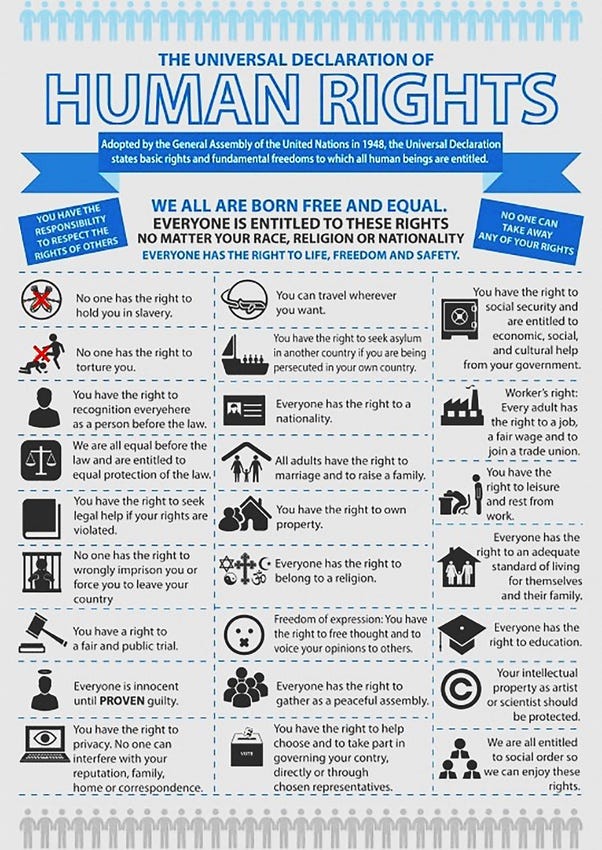
At any rate, I’ll avoid proselytizing further and get to the goods of reading material and a “pretty picture” at the end with a chart of the Universal Declaration of Human Rights:
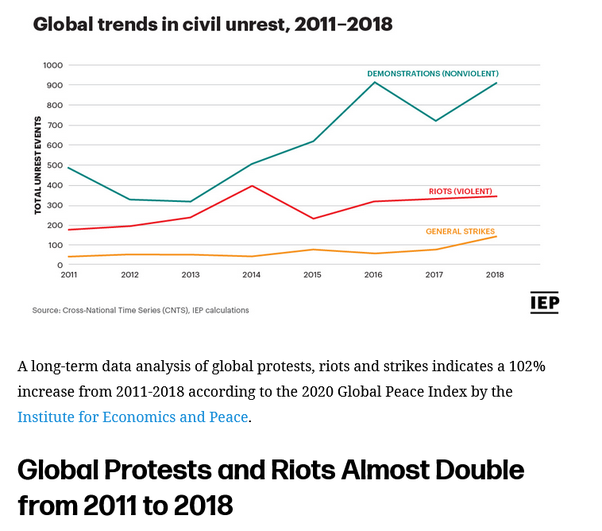
The Institute for Economics and Peace provides an in-depth analysis of civil unrest in the UK specifically through the .pdf available from the link below:
Note from this quote a clue as to the causes of civil unrest:
“The UK has become less peaceful in the last decade. Peacefulness in the UK deteriorated by almost 11 percent in 2022, the most recent year of measurement. This is the eighth deterioration in peacefulness in the last decade and the first since 2020. Fifty-eight Police Force Areas (PFA) deteriorated, while eight improved. This is the largest number of PFAs to deteriorate since 2018.
Of the five UKPI indicators, homicide was the only one to improve, while the remaining four — violent crime, weapons crime, police officers, public disorder — deteriorated”
This suggests the aggravating factors for civil unrest do not lie within social dynamics among the population but an overall level of dissatisfaction with systems failing to meet the needs of the people.
Sadly, the propensity for ignoring causes and treating symptoms has exacerbated the problems as police have increasingly adopted militaristic policies for “serving and protecting” the public.
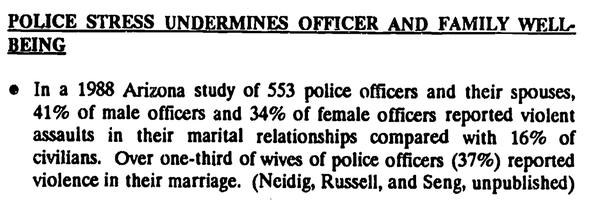
The militarization of the police has made this phenomenon worse, not better and they’ve been allowed to evolve in a counter-productive strategy that fails on every front from inciting civil unrest to increasing incidents of their wrongdoing as police are responsible for up to 40% of all domestic violence incidents.
The strategy of militarization of the police has turned them into a terrorist organization for many citizens. This is a consequence of conservative politics because imposition is the only language they understand.
Here is a summary provided by Chat GPT on social events in which Police catalyzed riots as a consequence of their inept approach to conflict de-escalation (from a U.S. perspective):
Numerous social events throughout history have seen police actions catalyzing riots. Here are some notable instances:
1. 1965 Watts Riots (Los Angeles, California):
– Trigger: The arrest of Marquette Frye, a black motorist, by a white California Highway Patrol officer.
– Outcome: Six days of rioting, resulting in 34 deaths, over 1,000 injuries, and extensive property damage.
2. 1967 Newark Riots (Newark, New Jersey):
– Trigger: The arrest and beating of John Smith, a black cab driver, by white police officers.
– Outcome: Six days of rioting, 26 deaths, hundreds of injuries, and widespread destruction.
3. 1967 Detroit Riots (Detroit, Michigan):
– Trigger: A police raid on an unlicensed bar, or “blind pig,” in a predominantly black neighbourhood.
– Outcome: Five days of rioting, 43 deaths, over 1,000 injuries, and significant property damage.
4. 1968 Chicago Riots (Chicago, Illinois):
– Trigger: The assassination of Dr. Martin Luther King Jr., followed by police actions during protests.
– Outcome: Several days of rioting, 11 deaths, numerous injuries, and extensive property damage.
5. 1980 Miami Riots (Miami, Florida):
– Trigger: The acquittal of four white police officers in the beating death of Arthur McDuffie, a black motorcyclist.
– Outcome: Several days of rioting, 18 deaths, numerous injuries, and extensive property damage.
6. 1992 Los Angeles Riots (Los Angeles, California):
– Trigger: The acquittal of four LAPD officers in the videotaped beating of Rodney King, a black motorist.
– Outcome: Six days of rioting, 63 deaths, over 2,000 injuries, and widespread destruction.
7. 2001 Cincinnati Riots (Cincinnati, Ohio):
– Trigger: The police shooting of Timothy Thomas, an unarmed black teenager.
– Outcome: Several days of rioting, resulted in injuries and significant property damage.
8. 2014 Ferguson Unrest (Ferguson, Missouri):
– Trigger: The police shooting of Michael Brown, an unarmed black teenager, by a white police officer.
– Outcome: Weeks of protests and riots, resulting in injuries, arrests, and property damage.
9. 2015 Baltimore Protests (Baltimore, Maryland):
– Trigger: The death of Freddie Gray in police custody.
– Outcome: Several days of protests and rioting, resulted in injuries, arrests, and property damage.
10. 2020 George Floyd Protests (Nationwide, USA):
– Trigger: The police killing of George Floyd, an unarmed black man, by a white police officer in Minneapolis.
– Outcome: Protests and riots across numerous cities in the U.S., resulting in deaths, injuries, and significant property damage.
These events highlight the recurring issue of police actions triggering significant social unrest, often reflecting deeper systemic issues within society.
Imposition is conflict escalation NOT conflict resolution.
Although the militarization of the police is entirely the wrong way to go in addressing social unrest, they are a symptom of resolvable political problems beginning with the short-sighted views of conservative politicians who interpret every problem as a nail because they have learned only how to wield a hammer.
Nuance escapes them.
The patience required to facilitate peaceful resolutions runs contrary to a profit-oriented mindset that equates time spent with lost dollars.
The core problem is also exacerbated by their sycophantic support of the conditions that led to last century’s Great Depression and were responsible for triggering the Second World War. We are watching those conditions and their consequences replaying themselves right now in real-time with the horrifying implications inherent within the corrupt American system.
No nation is immune to the impact of economic distortions feeding despair among the public.
The core problem catalyzing the increase in civil unrest is economic by nature.
The core problem feeding the despair driving otherwise peaceful citizens into extreme action is the economic distortion corroding the basic patience, tolerance, and decency of otherwise peaceful people who want only to live modestly dignified lives but cannot because we have all been robbed of trillions in a class warfare that seeks to resurrect a facsimile of governance resembling a medieval caste system of two classes of people; rulers and serfs.
This trajectory is unsustainable and will continue to feed unrest.
This sociopathic profit motive cannot but lead to chaos.
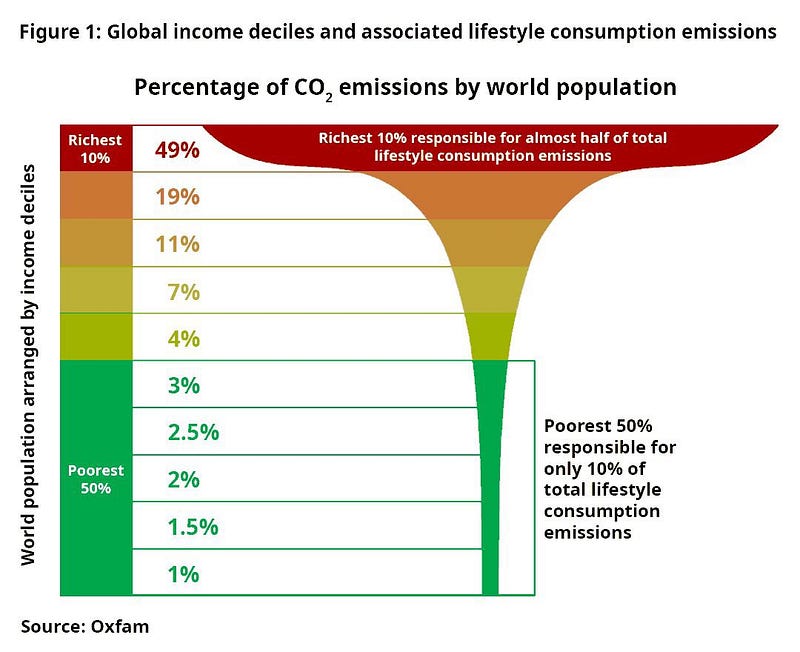
Making matters worse is that the lifestyles of the wealthy class have put humanity on a trajectory toward its extinction.
No one should be surprised by an increase in public unrest.
Things are going to get MUCH uglier before they get better.
The questions we need to address are:
“How many casualties can we tolerate before we come to our senses?”
How much pain and suffering can we stomach before we lose our shit?
How many millions must die due to preventable causes and the behaviours of sociopaths hellbent on destroying this planet will it take before civilization is a chaotic mess of violent insurrections all around the world?
What will it take for the wealthiest among us to show some leadership and help set this ship of humanity onto a path toward a sustainable future?
(This post was an answer to a Question posed on Quora — where all my posts on Medium have originated; hence the personal response indicated within this article. — https://www.quora.com/profile/Antonio-Amaral-1/ )
To “distribute wealth more evenly” implies a dictatorial imposition of a narrowly and politically defined sum of what constitutes “evenly.”
There are numerous problems with that strategy that go well beyond not fixing the underlying issues contributing to the corruption of what should be an agnostic system but isn’t due to how it has been corrupted.
This approach not only accomplishes nothing in the way of fixing the underlying issues, which, on that level alone, would create a “rubberband effect” of “snapping economics back to their originally corrupt state,” it would also justify an exacerbation of a centuries-long class warfare that has allowed the corruption of an economic system to take root. IOW. The degree of corruption existing today that has led to historic levels of income injustice would escalate from a cold war into a blazing furnace of vengeance against the little people by the wealthy. Their loss of wealth would be temporary, and they would be motivated by more than greed to rebuild their hoards; they would also be motivated by a desire for retribution.
We should focus instead on adjusting the parameters of a wealth redistribution system like capitalism to ensure wealth flows freely throughout the system rather than collect like plaque in arteries to clog up the entire system with private hoards held by a few whose obscene accruals threaten a system-wide collapse.
We need to establish rules to ensure equitability from a system-wide perspective to make fairness an inherent characteristic of the capitalist system. We need the system to rein in corruption at the top while empowering the middle and enabling the bottom.
If our economic systems were to operate on a holistic and agnostic basis, then success would not be a measure of how much wealth the wealthiest are collecting but how stable the economy is and the degree of economic mobility the system facilitates. We should measure economic success based on how people move out of poverty and into wealth. We should measure economic success on the stability and growth of the middle class. The middle class has always been the engine of the economy, and we must prioritize its health and efficiency to ensure that the entire system is stable.
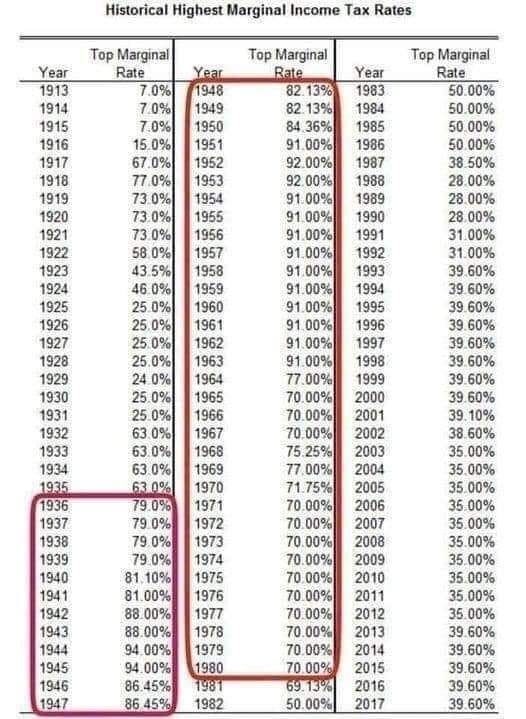
This can be “easily” accomplished (once the political will is established) through a few simple measures. We can begin with the adjustment of tax rates to levels historically proven to spur the greatest economic growth and the greatest growth of a thriving middle class.
Restoring tax rates to Eisenhower levels incentivizes investments back into companies to hire more staff to minimize a tax burden. It means capital investments into the operation instead of stock buy-backs to boost share value and billionaire hoards.
Restoring tax rates to Eisenhower levels gives the economy a boost of liquidity flowing through the entire system to boost everyone’s well-being while restraining the excesses of greed, which contributes to creating a ruling class through a dynastic acquisition of wealth and political power.
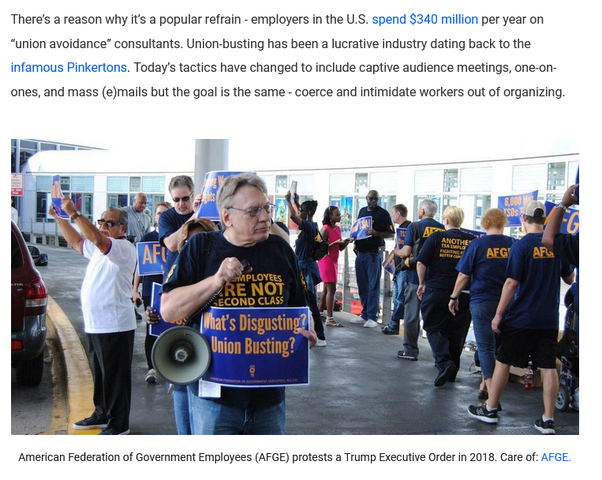
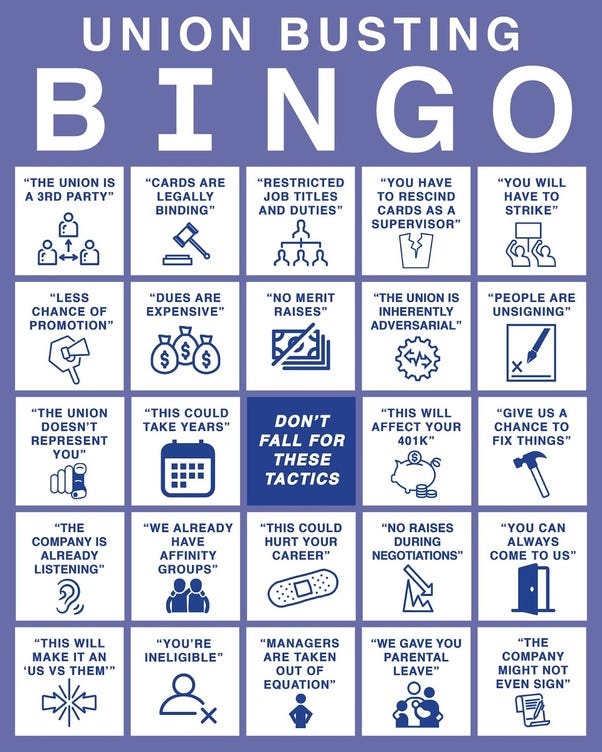
Restoring taxes to sane levels permits the implementation of a universal basic income that mitigates the leverage of wealth in labour negotiations. People will no longer be forced to choose between a depressed wage and basic survival. Since unions are an easy target to attack and disempower, as occurred following Reagan’s example, which led to a strategic initiative by employers to eradicate unions, UBI eliminates that weakness.
A Universal Basic Income provides economic stability for a nation because when a corporation contracts, thousands of jobs are lost, not just a few or dozens. The entire economy is impacted by an exaggerated shrinkage that benefits the wealthy at the expense of the working class.
The boom and bust outcome of a trickle-down economy is intentional because it is during a bust that the wealthiest make their greatest gains by leveraging desperation against people to buy out smaller businesses at fire sale prices.
Restoring tax rates to Eisenhower levels eliminates the boom and bust advantage while UBI insulates the vulnerable from the predatory practices of the wealthy.
The above represents two primary initiatives that would restore equity throughout the economy. These alone are temporary measures subject to reversals, putting us back on this same destructive track we are on.
We must cement fairness into our systems on levels greater than the simple vectors of corporate taxes and employee protections.
We must make fundamental changes to a vulnerable political system which allows the worst of our impulses to dominate political discourse while being manipulated through corrupt media enterprises owned by powerful stakeholders.
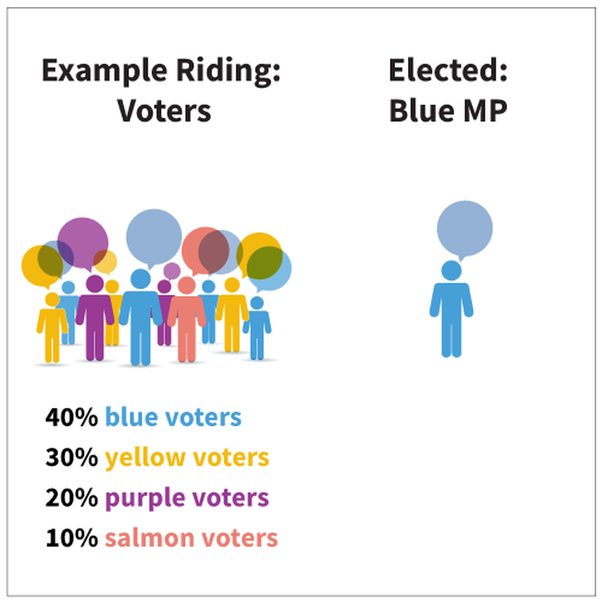
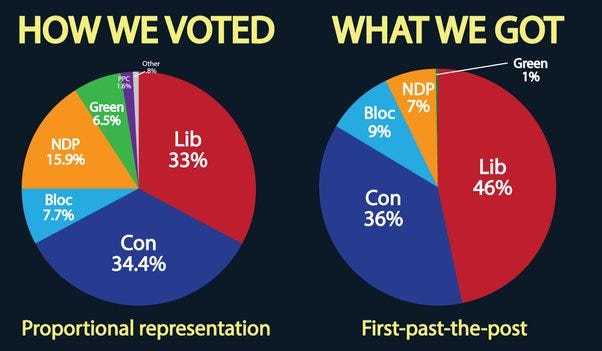
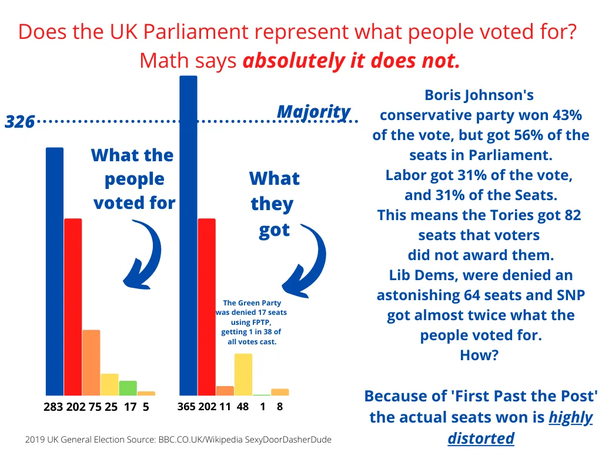
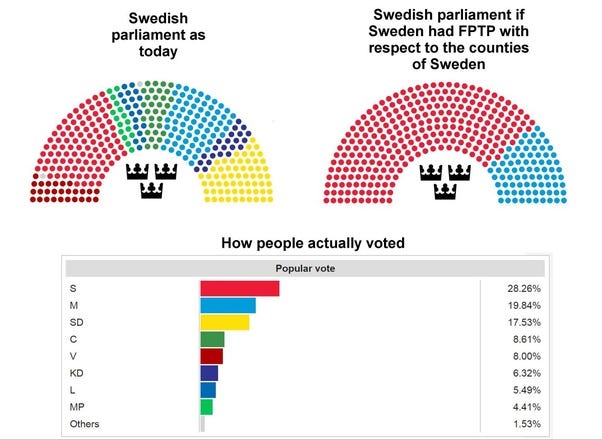
Electoral reform initiatives to eliminate the toxically competitive first-past-the-post elections and replace them with proportional representation and a ranked-choice voting process will eliminate the hegemony of party politics and allow a public to engage on an issue-resolution basis rather than be reduced to a gaggle of high school cheerleaders caught up in tribalist fervour.
This initiative also mitigates the impact of wealth on the election process because it’s much harder to “create a team of tax and revenue manipulators” when “multiple teams” exist in a multiparty system that more accurately reflects the different views and positions of a diverse voting public.
Eliminating private funding from the election process would also protect the political system from corruption. Both initiatives above would transform the entire political process into an agnostic system of representatives who fully represent the diversity of the people’s will.
First-Past-the-Post-Elections shut out most voices from representation to favour the horse race winner.
Democracy is a government that is supposed to represent the will of ALL the people, not just the horse race-winning team.
Finally, the most difficult challenge to implement and arguably the most important initiative to protect our world’s democracies from the greatest villains we have ever fought throughout history is to rein in excesses at the top around the globe.
We should not keep breeding generation after generation of entitled people who assume their wealth equates to superior humanity and the right to shape the world in their image. The wealthy class is not comprised of superior beings but flawed humans. They possess too much power at such a degree of disproportion that they can individually tip the scales of humanity’s future toward extinction or utopia.
Guess where they are collectively leading us all today:
Chances are excellent that if you have to ask strangers online, you’re already concerned about their reactions.
That should be a huge red flag, especially after reading some of the horror stories in the answers already given.
Your parents have spent a lifetime being who they are and believing what they do.
Their vision for having children was miniature versions of themselves who they could accept may take a different path than they took for themselves but would at least hold the same values they do.
As you may have noticed, religious beliefs are not like most other beliefs people have about different things in life.
Religious beliefs are personal identities, group associations, and a support structure where opportunities in life are found.
They will view their religious beliefs as a prescription for success in life and a symbol of unity within their family. All their children sharing in their beliefs means they will have become successful parents who have given their children their best chances at leading a happy and rewarding life like they feel religion has done for them.
Rejecting their religious beliefs will be interpreted as a rejection of their parenting.
It may not make sense to think of religious beliefs you don’t share on this level in that way. The reactions you will get from them if you insist on having them see you on a different path to self-development, self-discovery, and self-discipline than they took will show you what a wedge in your relationship will feel like.
They may initially show some acceptance because they love you more than their adherence to their beliefs, but that acceptance will grow into a distance between you.
You will eventually discover their open embrace of you, and your accomplishments will be responded to with increasing disinterest.
During periods of conflict, they may claim they no longer understand you and will blame your straying from their beliefs as the cause. They will look for scapegoats to blame and begin criticizing your choice of friends, the school you attend, or the video games you play.
Anything they can use to justify how you are not choosing to betray them willingly, they will weaponize during open conflicts you might have. If you have never experienced open conflicts with them before, you likely will afterwards.
To answer your question directly, it’s okay to be who you are, and it’s even recommended in a world where you will spend your entire life fighting to preserve who you believe yourself to be, but you will have to learn to pick your battles in life, and some are just not worth fighting.
Eroding one of the most important relationships you will ever have is not a battle anyone should take lightly, particularly in a world where a whopping majority (70%-80%) of families are dysfunctional. Suppose you have a happy family life as it currently stands. In that case, you might want to accept how that’s already a treasure beyond what most experience. It may not be worth giving that up to have them accept what you believe in yourself because your assertion could very well end up in your rejection.
You can certainly continue to question your views on religious beliefs, and you should continue to do that for the rest of your life because that’s how you will grow as a person. Understand, though, that it is always a personal journey one takes. As much as one would like to share every intimate detail of that journey with others, it’s impossible with almost every other person one will encounter.
Your personal development journey will always be your journey. The rest of everything you encounter will be about how to get along with the people in your life so that your life isn’t made any more complicated than it already is or will be.
Good luck with your journey through this nuthouse.



















 thotbag