Why are you a liberal (left-wing)?

This post is a response to a question initially posed on Quora, and can also be accessed via “https://www.quora.com/Why-are-you-a-liberal-left-wing/answer/Antonio-Amaral-1

I’m not. I hate ideologies because they kill brain cells and destroy one’s critical thinking skills.

I prefer focusing on issues, learning about them, determining the best solutions, and then identifying who tries to do the same. I also look for those who have developed agnostic ideas and proposed solutions that work best for everyone, especially the people, because the wealthy often don’t need help. The government has favoured them so much over the last several decades that they’ve become a threat to the rest of the world.

What I identify with in the founding principles of liberalism are the values of “liberty, fraternity, and equality,” which often align me with liberalism, but not always. The only political party I’ve ever been a member of is the now-defunct National Party, also known as the Progressive Conservative Party. That party no longer exists. Their views have been stripped from them to become the Frankenstein’s monsters of humanity called the Maple MAGAts in Canada. They are a “light version” of the American MAGA movement, and mainly because the Koch parasites who have corrupted the American political landscape have been doing the same in Canada while focusing on Alberta and its oil wealth.

The results have led to corruption in that province in ways that run counter to Canadian values. Their current Premiere is an example of toadying for power, and how it perverts community values and cultivates a misanthropic attitude toward the people they’re supposed to serve.

My thoughts align with the direction the Canadian Liberal Party has taken, and I’m pretty excited about a full Prime Ministerial term with Mark Carney at the helm. I was initially hesitant because he was an unknown, but his interview with Jon Stewart quickly won me over. The more I see him in action, the more I like him.

While Jack Layton was the leader of the NDP, I was drawn to his party because his values focused on everyday Canadians. Governments have focused far too much on developing the corporate sector, which has been a detriment to the people and the nation.

No nation can exist without its people. Corporations are supposed to serve the people, not rule them. It severely disturbs me that what should be a community development function for governments has become a sociological corruption, supporting a sociopathic, profit-chasing national development model.

If I were to encapsulate my political views, I would describe them as a community development-oriented vision for politics and social leadership at all levels (and most notably, at this stage in my life because of specific issues that have been draining my attentions in an incredibly destructive way involve “encouraging” the police to review their function in society to align themselves with the ethos of protecting and serving more closely. I’m of the mind that they’ve become so corrupt in a heinous militarization strategy that they’ve become little more than a government-sanctioned domestic terrorist organization.)
What political ideology is socially progressive?

This post is a response to a question posed in its complete format: “What political ideology is socially progressive but still capitalist?”

People are socially progressive or regressive, not ideologies.

Ideologies are wrappers around the contents of similarly aligned people who share a common set of values, beliefs, and ideas for how political processes occur and how commonly beneficial goals are achieved by working together.

Ideologies are not static entities like moulds that immediately shape a person’s thoughts once inducted into an ideological grouping.

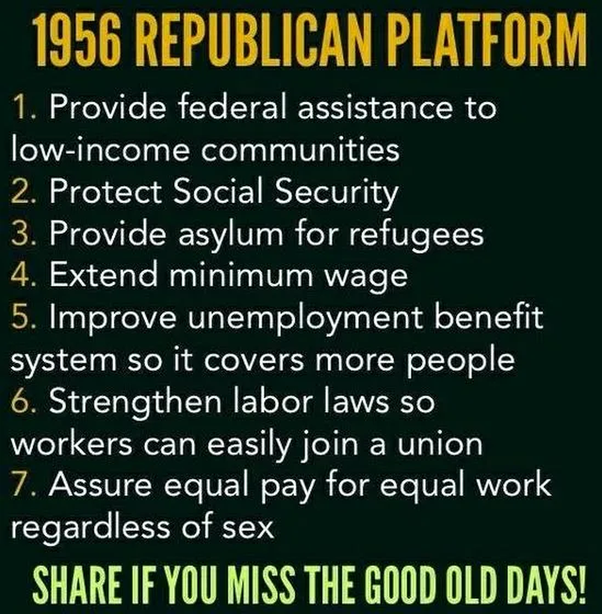
Ideologies are dynamic and ever-changing as people change. Here is an example of how much an ideology can change:

(For the “fake news people,” here is a link to the Snopes article giving this platform a rating of “mixture” — 1956 Republican Platform )

Regardless of the accuracy of the above platform, it’s pretty clear by the Project 2025 platform that it has significantly evolved.

People define and shape ideologies, not the other way around.

Today’s Republicans are not Abraham Lincoln’s emancipation championing Republicans.
Today’s Democrats are not the Dixie Democrats of less than one hundred years ago.

Liberalism has undergone many varied manifestations as if it were Christianity, endlessly spawning new denominations.

This question, however, flips that script around and becomes something pretending to be an ideology but is, in fact, something much uglier and evil. This question presents an ideology as if it were a costume to wear in a performance following a script dictated to members like a cult.

Ideologies are also not capitalist. People are participants in an economic system referred to as “Capitalism. Each person views aspects of Capitalism that align with or run contrary to their politics. Since economics comprises a core component of political systems, varying interpretations of Capitalism’s’ role in society also form a core component of alignment with an ideological identity.

In short, almost all political ideologies incorporate interpretations of Capitalism within their ideological construct. Hence, you have answers extolling varying ideologies that all claim to be capitalist.

Like religions, however, each pretends to represent the “one true God (of Capitalism).”

If one were willing to stretch the definition of Capitalism beyond its commonly accepted uses, then even Communism could be considered a “capitalist ideology” because capital is essentially a store of value directed toward creating infrastructure for facilitating trade. Communist systems conduct trade within their systems.

After having said that and freaking out some hard-core capitalists, let’s track backwards and identify the typical distinction between Capitalism and “not capitalism.” That definition hinges on ownership of the means of production. In Capitalism, ownership of factories is held by private entities. In a communist economy, factories (production environments) are owned “by the people.”

Ironically, however, an argument often used to extol the benefits of Capitalism is the ability of the people to buy into a capitalist venture through a process called “share ownership.” Functionally, this renders the distinction between Capitalism as we perceive it and Communism as it was conceived as moot.

Communism failed because centralized authority was unable to meet the needs of the people. Capitalism is undergoing a late stage that is rapidly descending into failure for the same reason of consolidated power and centralized authorities.

The only salient differences between the two systems are how power is distributed and who is conferred power by what process that conferring of power occurs.

In summary, we would be far better off focusing on power instead of worrying about ideologies and which one wishes to identify with as their favourite team. We should be far more concerned with who has power in society and how much power they have.

If we genuinely want to live in a free society that we typically call a “democracy,” then we desperately need to adopt an ideology which “worships the flattening of power.” We must adhere to principles in which power is spread like peanut butter to all people.

The only power that truly matters in life is the power to choose how to live it.

Freedom is living one’s life in a state of maximum opportunity and diversity of choice within a shared environment. A critical factor in the success of an ideology is the acknowledgement of how we are all in this together. Only together can we survive into a future that lasts even half as long as the dinosaurs did.

The Impact of “Woke Ideology” on Society

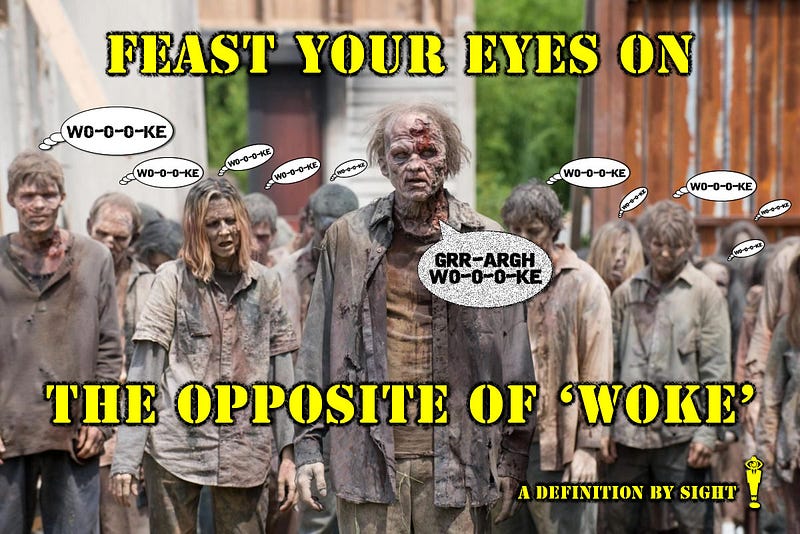
The Opposite of Woke

It’s incredible how much of an impact a non-existent thing can have on people.

It’s much like religion and a non-existent paternal figure.

“Woke” is a word that describes an attitude of awareness over systemic injustices that must be corrected in society.

That’s it.

There is no “ideology” exactly like no “woke mind virus” exists.

All of the hysteria surrounding the term “woke” amounts to nothing more than the whining of children who don’t want to be held accountable for their abusive behaviours.

An ideology is, by definition, a collection of beliefs organized under a dogmatic banner, but to be woke isn’t a belief unto itself. It’s an attitude favouring the support of justice in society and equal access to it for all people — not just the privileged few.

“Woke” itself leads to nothing because it’s not an ideology people rally around in protest of making the world “woke.” There is no singular image of “woke.” There are no collections of rules defining “woke.” There is no institution, group or body of people who represent “woke” as any organized movement for change in society.

“Woke” means simply that a person has realized a corrupt status quo is not sustainable.

“Woke” simply means a person understands and accepts how wrong it is for police to barge into a private residence and shoot people to death while they’re sleeping.

A person who is described as “woke” is just someone who is not only capable of empathy and compassion but is also not intimidated into keeping silent when injustices occur.

That’s what pisses off the people who whine about “woke” as an ideology and invent childish slurs like “woke mind virus” to serve as a boogeyman to fear and attack it out of an illusory need to protect oneself from an imaginary threat.

Some people don’t want social justice.

Some people want to hate.

It’s an addiction for those people, and the media feeds it with a steady diet of conflict porn.

Conservative politicians build their careers around hating groups of easily victimized people.

History is filled with the graves of millions sacrificed on the altar of hatred.

To be “woke” is to know this and be horrified by what humanity has done.

To be “woke” is to want better for themselves, their families, friends, and their communities.

To be “woke” is to want a better future for one’s children and all of us as humans striving to reach our potential as a species.

Some, however, are just mentally ill. Unfortunately, that group comprising “some” amounts to one in five people in our dysfunctional society.

In a city of one million residents, that means 200,000 people are suffering from visible mental health issues.

In a nation of 350 million citizens, that means 70 million citizens are in desperate need of professional mental health services.

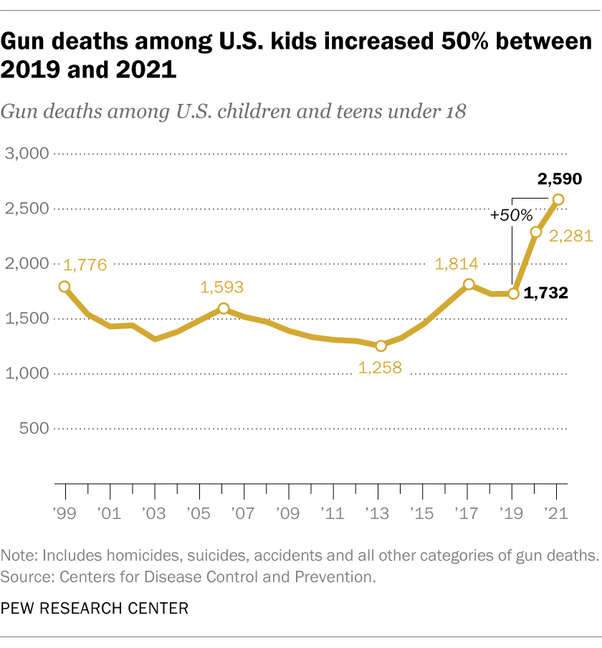
The COVID-19 pandemic shut down the entire world for fewer infectees than that, and we live with it every day in society instead by pretending it doesn’t exist or that it’s just normal — like almost daily mass shootings that extinguish the lives of thousands of children every year.

Gun Deaths Among Children — Pew Research Centre

Gun deaths among U.S. children and teens rose 50% in two years

How do the mentally ill who want this nightmare to continue deal with these horrifying facts?

They invent disparagements like a “woke ideology” or a “woke mind virus” because fixing these problems means they will no longer be able to enjoy watching people suffer. They will no longer be able to feel better about themselves if they can’t see other people suffering more than they do.

They can’t stand the idea that they have to work on themselves because they can’t accept how utterly broken they are as human beings. Some no longer even qualify for that distinction.

10 Symptoms of the Woke Mind Virus