Yes, because the entire market and the processes for hiring have been dumbed down to a series of checkboxes applied to humans in ways that devalue their experience and expertise to meet psychopathic parameters, allowing hiring personnel to envision unicorns while fixated on checkboxes and ignoring the human beings they’re evaluating for roles they don’t understand or care about.
No one seems willing or capable of hiring humans since they prefer hiring aesthetic packages they expect will meet the minimum requirements to function like a robot without agency or capacity for judgments outside parameters established by misanthropes with money who have no clue what they’re looking for and have no respect for what individuals are capable of offering.
Fewer and fewer people are willing to tolerate life as a robot, even if it means food insecurity, because at the end of one’s life, existence is not enough, and to destroy the ineffable character of one’s life to submit to a role to discover at the end of all that effort that rewards are less than meagre is just not worth perpetuating a parasitic system.
This is why “quiet quitting” has become a thing. This is why people are complaining that no one wants to work.
Of course, no one wants to “work” — sublimate themselves to a robotic existence that dehumanizes everything about them to maintain an unfulfilling and crushing existence.
People would otherwise throw themselves into their work if it brought them the value it promises.
Decades of these bait-and-switch manipulations of people can only naturally result in the wholesale rejection of a corrupt paradigm.
Capitalists should have taken more time to consider the benefits of destroying a working class that worked to elevate their lifestyles into the stratosphere before cutting them down to find themselves plummeting to their doom. They’re just getting what they wanted without realizing they didn’t want what they thought they wanted.
This post is a response to a question posed in its complete format: “Considering you’ll die without a job, why is being employed not a right? Can society really just ensure someone dies by refusing to hire them anywhere?”
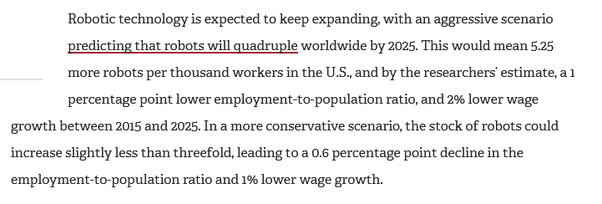
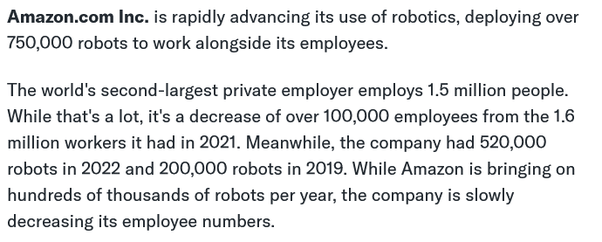
As the world of work becomes increasingly automated, the workplace dehumanization issue rapidly grows into a sociopathic dismissal of our essential qualities as living, breathing, thinking, and evolving beings. This pressing concern will affect more and more people in the future with increasing rapidity as workplace automation continues to adopt and incorporate an increasing rate of technological advancements into their operations.
Meet the Humanoid Robot Working at a Spanx Factory (18 minutes)
To be clear, the dehumanization of the workforce isn’t a consequence of automation but of aggregation into ever larger corporate entities now spanning the globe in their operational reach. Automation is merely a step toward increased efficiency and reduced operating costs. Automation is simply the formalized acknowledgement of transforming labour into a dehumanized function that benefits capital-infused decision-makers chasing profit. What was once an entity supporting community development within the “Mom-and-Pop entrepreneurial environment” has become industrialized economics.
Entrepreneurs of today are the artists of yesteryear who sought out patrons to support their initiatives and receive benefits in return for their support in a parasitic relationship that both drains value from the creative individual and shapes their creative output in their narrowly defined image to fit an increasingly homogenized production system.
The dehumanization of the workforce began when people became deemed commodities, and “Human Resources” departments were created as legal defence linebackers to protect corporations from the consequences of exposed liabilities.
The world of employment has become less about identifying skills and more about choosing appealing aesthetics and fetishes. One is no longer in a position of being hired to function in a role with an expected standard of performance in fulfilling the requirements of that role inasmuch as they’re selected like an attractive product on a shelf that will complement the rest of the pieces on a mantle.
The disconnect between the function one is intended to fulfill, the decision-maker determining the need, the department composing the requirements list, and the agency tasked to identify appropriate candidates has become so much of a production line that they cannot help but to regard all their people as narrowly defined replaceable cogs with limited capacity and range in an expense paradigm rather than as an investment and a partner in the enterprise. The only success an individual can contribute to a dehumanized function is to meet predetermined expectations in a static environment with an expected and finite lifespan.
Corporations may be deemed people, but they’re more machine than human. Unlike humans, they can only change course and be adaptive to evolution when the small number of myopically focused humans operating them can implement global changes that often involve complete retooling and rebranding or being incorporated into another corporate system.
Once that occurs, however, whatever unique nature or personality that may have existed in the original entity is subsumed into the more enormous beast.
The issue of jobs and employment is a critical metric only for those whose role in society is to diagnose the overall health of the “super beast” referred to as “the economy.” Individuals are irrelevant to their equations. Humans are no longer humans but cattle to be herded in a dehumanizing system that renders everyone only as valuable as accords the desirability of their functionality in a narrowly defined capacity within an inhuman entity.
One’s value as a human in society is determined only by the nature of the type of cog they can function as within the parameters of an acknowledged entity that deems them suitable for its overall operation.
Society doesn’t “ensure” anything because society is a collection of humans operating within a cultural framework. The corporate culture we have endorsed for society has, in return for our loyalties, suffused society with an apathetic disinterest in the human condition and the plights of individual humans.
UBI is the only path available to regain our humanity and create an economy that serves humans rather than modern dynasties comprised of a small handful of monarch-like beings. Without it, system-wide collapse is inevitable.
Many places advertising for employees aren’t actually looking to hire people inasmuch as conducting market surveys.
Many employers are so used to seeing hundreds of applications today that they narrow their vision for what they’re looking for on such strict parameters that they forget they are hiring people and not selecting machines.
Employers often over-rely on agencies who aren’t in the least interested in team building or cultural fits but in spotting skill sets to narrow their candidate lists by algorithms rather than people exercising their judgements.
Most applications are ruled out before any human sees them and are ruled out by humans if their applications aren’t formatted in the manner they expect.
Companies will often advertise for people “who think outside the box” but are so intimidated by outside-the-box thinkers when they interview them that they immediately reject that candidate.
Making matters worse for people in technical professions is having their skills evaluated by people without technical expertise, who judge the candidate based on the limits of their ignorance. They’re incapable of comprehending what skills are transferable and how they contribute toward success in a different area.
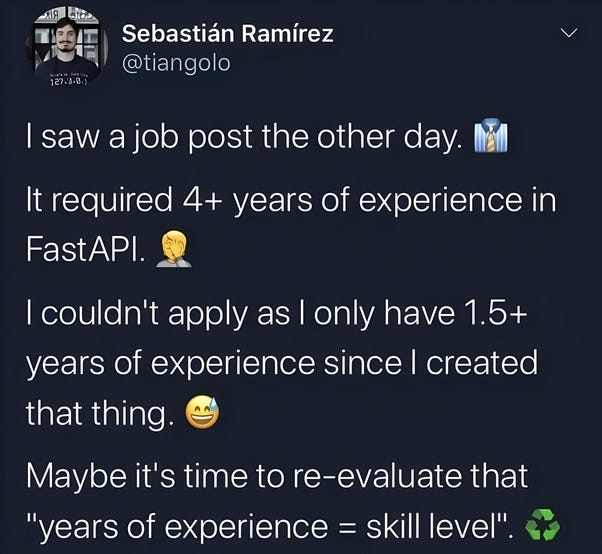
Even worse are companies that place upper limits on the experience they’re willing to accept, which rules out highly experienced candidates. Meanwhile, they also often advertise a requirement of years of experience in a technology that’s only been on the market for a few months.
Then they complain, after ruling out qualified candidates, that they can’t find anyone to hire because no one wants to work anymore.
Many unemployed people struggle to find work while being rejected outright because they don’t fit neatly into narrow boxes of expectations defined by ignorance and bias rather than insight.
GenZ may be experiencing struggles unique to their stage in the employment mill, but the overall employment system has massively degraded over the last several decades.
I’ve been struggling for ten years now to land a simple junior-level job in graphic production work to regain balance after having a thirty-year career as an independent professional destroyed by people who are supposed to protect and serve, not scapegoat for political gain.




 thotbag