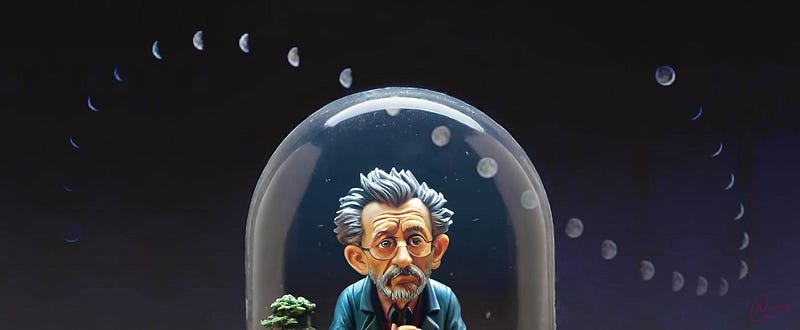
Why are we expected to accept mainstream science blindly?

This post is a response to a question posed in its complete format: “Why are we now expected to blindly accept mainstream science and not question it even though the way you make scientific breakthroughs is to question science in the first place?”

Science is about asking questions because every established scientific fact and theory accepted by “mainstream science” is a transparent data repository.

Let’s first address this notion of “mainstream science” for the abomination of prejudice it is. There is no distinction between “mainstream science” and “non-mainstream science.” There are not multiple streams of acceptable sciences. There is “fringe science,” which involves investigations into concepts not grounded in science, but at least attempts to follow the investigative methodologies of science to prove their conjectures. “Fringe sciences” conforming to this definition include investigations into aliens, the afterlife, and all the supernatural. These are specious leaps of the imagination without grounding in proven scientific principles.

Any of the many investigators who have looked into these phenomena could identify something previously undetected. They can then provide evidence of their discovery through a context conforming to scientific rigour. Their findings can then be validated by any party’s ability to replicate their results predictably. If third party tests validate the propositions made, then their discoveries are incorporated into what you want to refer to disparagingly as “mainstream science.”

In the media world, “mainstream” refers to popularity while “fringe” refers to often extremist and not-popular venues of presenting information. There exists no validation system within media to ensure accuracy of the information presented. Your use of “mainstream science” attempts to transpose the chaotic nature of information presented within a media context onto a discipline built upon rigorous processes to ensure accuracy and transparency.

You’re not “expected to believe anything” that has been accepted by “mainstream science” but if you have questions, you have every right to repeat the tests conducted to derive the results described within each scientifically accepted fact or theory.

Nothing within the discipline of science expects anyone to believe anything. The expectation is that you disbelieve and question everything. The problem lies in the degree of effort people put into their investigations before accepting or rejecting any scientifically credible fact or theory.

When people pose questions like this, they admit to a poor understanding of the scientific process and approach their criticism with an arrogant form of indignity — as if they’re being lied to. The harsh reality, however, is that they are admitting to wallowing in ignorance and expect the world and the science discipline to cater to their personal biases like profit-chasing enterprises in media do.

When such minds reject a scientifically credible fact or theory, they’re not rejecting valid science or identifying flaws within testing methodologies, data collected, or conclusions. They are indulging in a wholesale dismissal of an entire branch as an excuse for failing to study their subject sufficiently to identify flaws. They’re indulging in pure bias — subjectively driven drivel.

We see this nonsense play out in every space a believer indulges in dumping their biases onto the world while pretending to possess enough of an understanding of science to dismiss the work of an uncountable number of professionals dedicating their lives to discovery. Professional scientists adhere to principles of integrity that can reveal fundamental and profound truths about the universe we inhabit. We cannot learn anything without rigorous discipline practiced with integrity, no matter how much the ignorati wish to drag the only means by which we, as humans, have developed for acquiring knowledge into an abyss of prejudicial ignorance.

The garbage perpetually barfed up by the scientifically illiterate is obnoxious, and it seems never to be cured by our species as it recurs like a herpes virus. After all the years of addressing the fundamental misapprehension of humans evolving from apes and the multitude of memes and discussions online about how utterly idiotic that degree of ignorance is, someone posed that question yesterday — and with righteous indignity. I couldn’t believe my eyes. “If humans evolved from apes, then why do apes still exist?” — the degree of blind stupidity in this question is abhorrent on far too many levels to tolerate. We cannot afford to tolerate this threat of ignorance to our survival as a species.

Yet, this is the kind of mind that believes science is the equivalent of mainstream media, and they are entitled to regard a massive branch of science as a repository of opinions, not facts. They dare to be arrogant enough to believe themselves entitled to be angry with people lying to them. The ignorance in such a position is appalling. It’s like a two-year-old child telling an adult that two-plus-two doesn’t equal four — then they stamp their feet and demand to be told they’re right.

That’s how your question was perceived when I first read it.

That’s what prompted me to check out your profile because this screams ignorance of science and I suspected first, that you were a troll who knows better and barfs up provocative nonsense for the insipid sake of getting a reaction… but you’re not.

Your profile indicates that you’re sincere in your questions, and that’s horrifying AF. I can accept how you might be a youth still in grade school, but if you’re a high school graduate, this question is an indictment of your education.

I feel sorry for you, but worse, is that I’m horrified for a nation that is poised to start another world war that almost guarantees human civilization as we know it will be destroyed forever. If that happens, the main culprit won’t be utterly evil monsters vying for power, but the ignorance of the poorly educated.

How do you know if you are right and others are wrong?

This post is a response to a question initially posed on Quora, and can also be accessed via “https://www.quora.com/How-do-you-know-if-you-are-right-and-others-are-wrong/answer/Antonio-Amaral-1

The first place to start is to give up the notion that being “right” or “wrong” matters more than being accurate, informed, and knowledgeable.

“Right” and “wrong” are egotistical expressions that either stroke one’s sense of self or dismantle one’s self-confidence. Neither is helpful to oneself, others, or the issues at play.

As I often find myself checking out profiles to gain context into the querent’s mind, I did so with yours and am pleased to discover that you’re already on the right track.

Fundamentally, we’re all fumbling about in the dark and clueless, even about things we think we know. The worst thing we can do is believe we are “right” because that perspective contributes nothing to one’s growth and kills one’s ability to explore beyond that point.

No matter how “right” we might feel about something or how complete we think our knowledge of something, there is always something to learn about it that will be new to us. There is always a different perspective on that thing that we have not yet encountered.

If we could all adopt the perspective of being clueless, our world would experience far fewer conflicts because people would be more open to the perspectives of others.

Unfortunately, we live in a world built upon the foundation of exploiting insecurity at all levels throughout society — whether selling hair products or climbing corporate ladders. Insecurity has been weaponized as a tool of manipulation for personal gain over and above benefiting society as a whole.

We have never been more fortunate than we are today when confronted by the limits of our knowledge and understanding. Solving the problem of being unsure about one’s position means simply whipping out one’s means of accessing a comprehensive knowledge base to conduct basic research to verify if one’s position contradicts facts.

There is no real point in engaging with others to determine if one’s compass setting on knowledge is on true north by triangulating it with the settings of others because one is just engaging in an egotistical fencing match at that point. Online “debates” are often more about egotistical masturbation than they are about deriving an objective apprehension of issues to determine pragmatic resolutions.

Sharing information obtained through research efforts is far more rewarding and less prone to conflict over subjectively defined notions of being “right” or “wrong.”

One can still certainly derive flawed conclusions on matters, but that’s also a function of incomplete information that may be deemed “wrong.” Adding to one’s information base is less about determining “right” or “wrong” and more about ensuring the completeness of knowledge in a subject domain.

Knowing the difference in a dynamic with someone else on this level is essentially determined by whether or not the critic of one’s knowledge adds to one’s information base or disparages one’s person as a reaction to the information conveyed.

To directly answer your question, after all the verbiage I packed into this long-winded answer, is that you will know by the content of your critics’ arguments.

You can always deem yourself “not wrong” if the other party adds nothing to your position. If they can add valuable information to expand your knowledge base, you can still consider yourself “not wrong” while learning to be “more right” by their contribution.

This is how you can preserve your superior perspective of evolved humility by remaining confident in being clueless.

Congratulations on achieving a higher level of awareness than most of us monkeys ever attain throughout our very challenging lives.

Cheerios.

Do atheists believe in fate, good and evil, or alien life?

This post is a response to a question posed in its full format as follows: “Do atheists believe in fate, good and evil, or some other supernatural beliefs? Like do some atheist believe in alien life?”

This question embodies the problem with the notion of belief among believers.

Believers often need help understanding the difference between knowledge and belief. Blurring the distinction between two different but similar concepts makes it challenging for them to adopt a third option between their binary perspective on life.

To a believer, one either believes or does not believe.

Knowledge isn’t even a factor in their perceptions because knowing, to them, is just another form of belief. Belief supersedes knowing because one cannot know if their prayers are being heard by a “Father Cosmos,” so they must have faith that he is listening. This places an undue burden on the concept of belief that breaks its meaning in their minds.

They have no choice but to relegate knowledge to a subordinate relationship with belief because belief is everything to a believer.

Ironically, they have no problem with aspects of belief that require little to no consideration, such as “suspension of disbelief” because that occurs autonomically while engrossed in an entertaining fiction, as does “disbelief” when it applies to every belief system that isn’t theirs.

The notion of belief being subordinate to knowledge is like heresy, which induces a fear of straying, resulting in an eternal punishment for failing to adhere to their faith. This is why they often suffer crises of faith due to excessive cognitive dissonance.

The seemingly fearless attitude of atheists placing knowledge above belief attracts believers’ attention to notions of non-belief, like a moth to a flame. Since they fear eternal retribution for disbelief, they view atheists roaming around free to live their lives in terms not too dissimilar from how many people view a convicted felon roaming about freely to campaign for one of the most influential roles on the planet. It’s like witnessing a horrible accident. One would prefer to avert their gaze but cannot as they stand transfixed over the intense drama playing out for their unwilling minds to process.

The cognitive dissonance this generates explains the obsessions believers demonstrate over atheism every day on social media.

We see in this question how they fabricate presumptions about atheists that fit within their cognitive boxes of belief determination.

They cannot think beyond their belief paradigm to interpret reality beyond a binary state. One must either believe something or reject believing something. The meaning behind the concept of disbelief itself is lost on them. It’s like interpreting absence as a form of invisible presence.

To address the presumptions of belief in this question and many like it, one either presents a dismissive response like they would with a persistent child that fails to comprehend nuance but requires something of an answer to quell their curiosity or one burns through several boxes of crayons to bring them up to speed on basic concepts that will fly past their perceptions to leave them even more confused than before answering their questions.

This is the rub with knowledge.

Every question answered that contributes to our overall understanding of ourselves, others, and the universe we inhabit generates dozens of additional questions we never realized were questions before getting that answer we thought we wanted but sometimes regret getting.

To address the basic but flawed presumptions within the questions above, one must judiciously parse the information in ways that ignore large parts of what is implied within the question and attempt to focus on constructing a simplified answer they will understand, just like one does with a child.

For example, “Atheists don’t “believe in” alien life. Atheists know the universe is vast beyond belief, and the existence of life on this planet within a Brobdingnagian (I love this word) ocean of countless planets means the odds are beyond simply excellent that life has emerged elsewhere. We have been getting new evidence supporting that conclusion, such as the discovery of RNA embedded in spacefaring meteorites we’ve examined.”

All RNA and DNA Base Types Are Found in Meteorites, Study Claims

This answer won’t be interpreted as stated, though. It will be construed as “Atheists believe in alien life.”

The same applies to concepts like “good” and “evil”. We can explain and re-explain repeatedly until the proverbial cows come home that “good” and “evil” are subjective concepts requiring context for meaning. However, their interpretations of these concepts are apprehended as objectively as one would a physical cow within their field of vision.

“Supernatural beliefs” are also subjective constructs that we can explain “exist outside of nature” because that’s what “supernatural” literally means — “beyond nature.” To accept subjectively defined notions as true, one requires belief, and that’s why one interprets these concepts in terms equivalent to knowledge.

To “believe in fate” is to subordinate one’s knowledge derived from empirical experience through an objective lens to a subjective interpretation functioning like a soothing narrative rather than a concrete mystery to resolve. This dilution of one’s senses is essentially the core of the threat to human thinking that religion poses to humanity and that limits our potential as a species.

Do you ever wonder where consciousness originated from?

This post is a response to a question posed in its full format as follows: “Atheists, do you ever wonder where consciousness originated from? Do you sit back and think ‘maybe science doesn’t have the answer to everything?’”

Based on the fleeting interest in the topic demonstrated by the wording in this question, I have wondered that likely more than most. I’m obsessive that way. It’s a curse I must have been born with because I remember thoughts as a toddler that may not have been quite as sophisticated as now but definitely within the ballpark.

20–20 hindsight leads me to believe my life would have been far easier if I had realized I could create a vocation and a “normal life” around the formal pursuit of knowledge in that realm. I had to get this far on my own before I could think about options I didn’t realize could have been available to me then.

Even as a kid, I valued my mind more than my body, and I found myself attracted to any reading material, fact or fiction, that expanded my views on the mental realm. This led me to explore myths at an early enough age to understand how religion is also just mythology, except that people believe it’s more than that.

I should have been more focused on exploring the sciences, but I was more interested in exploring self-knowledge, which led me straight to the arts. Economically, it was the worst decision I could have made. Insofar as personal development is concerned and surviving the nightmares I’ve endured, it has been my only means of making it this far.

By the time I went to art school, I had already consumed many subjects from various realms. I have enjoyed material from scientific objectivity and metaphysical subjectivity. The arts have enabled me to process abstractions such that when Carlos Castaneda, Jane Roberts, or Edgar Cayce wowed me, I never interpreted their material from a literalist perspective. I still love and am affected by the imagery they evoked within me. People like Joseph Campbell were an incredible inspiration to me from the standpoint of cognitive discipline and the “hard sciences modality of thought,” but discovering Douglas Hofstadter’s “Gödel, Escher, Bach: an Eternal Golden Braid” was like being hit with a hammer to crack open a hard shell surrounding my awareness of consciousness.

I highly recommend “The Mind’s I” as an “easier-to-consume” piece of his writing.

At any rate, my pitiful comprehension of the sciences allowed me to understand, on at least a basic level, that science itself isn’t an answer to anything. Unlike religion, however, “science doesn’t lie” about being an answer to everything.

Science itself isn’t even a source of knowledge — people are.

Science is just a process of determining facts, leading some incredible minds to discover amazing facts about our universe.

One recent proposition arrived at through the scientific discipline of inquiry is that we may be on the verge of identifying a connection to or a source of consciousness within the quantum realm. That’s exciting news to me.

Not too long ago, I chanced upon this image:

This set my imagination on fire as an analogy for 3-dimensional existence created by consciousness itself. I had already been aware of issues like the “Thermostat Problem,” “Integrated Information Theory,” memory structures stored in 11-dimensional space, and microtubules in our brains that directly interact with quantum space. This image was like another crack in a shell obscuring my view of consciousness.

The analogy I draw from this image is that “consciousness shines through” our physicality to take shape in a three-dimensional structure we understand as reality. The shadow in this image represents physical reality, while our biology shapes the nature of consciousness within the context of a three-dimensional space.

Recently, much more intelligent people with dedicated minds have been exploring realms outside my comprehension in ways that filter down to hope within me that we will eventually solve the mystery of consciousness — even though it still feels far too distant to believe we’ll manage to create artificial facsimiles of actual consciousness. We can’t map quantum space, and I’m not knowledgeable enough to know if that’s possible or how we could do that.

How the hell do we establish a coordinate system for virtual particles? At this point, all I can think of is that we can’t and likely never will; if we can, it won’t be in any near future.

At any rate, anyone with any basic understanding of science knows science is not a magical source of all knowledge like religion pretends to. It’s at least testable and verifiable knowledge rather than the ludicrous fictions concocted by religious nonsense that leave reality far behind in its rearview mirror as it gallops into fantasyland.

Here’s some additional reading on the subject of consciousness by people far more advanced in their explorations than I am.

Quantum mechanics and the puzzle of human consciousness

https://alleninstitute.org/news/quantum-mechanics-and-the-puzzle-of-human-consciousness/

Study Shows Consciousness May Be Product of Quantum Effect

https://www.gaia.com/article/study-shows-consciousness-may-be-product-of-quantum-effect?gad_source=1

Quantum Physics Could Finally Explain Consciousness, Scientists Say

https://www.popularmechanics.com/science/a40898392/quantum-physics-consciousness/?gad_source=1

Oh… let’s not forget a valuable source of primers on almost every subject imaginable — good ol’ Wikipedia — please donate if you can to this marvellous resource that thumbs its nose at the parasitism of capitalism and generates knowledge for its true value to humanity.

Quantum Mind

https://en.wikipedia.org/wiki/Quantum_mind

Temet Nosce