How to Best Help People Solve Their Issues

This post is a response to a question posed in its complete format: “How do you listen to people open up about their issues without trying to solve them? How do you just comfort people?”

One of the first things a first referral counsellor learns is that you cannot solve other people’s problems for them. Even more so, you don’t want to solve their problems because what you might see as a solution for yourself is likely not a solution for them.

What you end up doing is creating a dependency relationship with someone who now has a scapegoat to blame when your solutions backfire on them.

You end up giving them permission to take the easy route of blaming you for their problems instead of learning how to solve their problems for themselves.

You don’t want that kind of monkey on your back because it could haunt you for life.

Most people want to be heard without judgment. The act of actively listening to them while validating their emotions and the struggles they are experiencing is often the only thing they want or need.

Being able to openly express oneself without fear of being misjudged for their struggles or how they deal with them is all the healing most people need most of the time. That opportunity often gives them enough space to hear themselves through your perspective and devise solutions for themselves by being able to speak freely about their problems.

If you sincerely want to help people solve their problems, you must understand that the best way to accomplish both your goal and theirs is to listen and acknowledge their struggles while validating their feelings and who they are as people.

You almost cannot help someone more thoroughly than by letting them know they matter. Most people only want to know that someone hears them and sees them as a living, breathing, independent human being with a core of reality all their own, just like how you think of yourself. People often only need assurance that they can achieve their goals if they apply themselves.

At most, you can offer ideas for where assistance is available, identify resources they may not be aware of, or repeat their statements to them in your own words. Often, simply saying something they said in different words is enough for them to see their problem with different eyes and in ways they can more easily identify solutions.
It may feel especially tough if you can spot what appears like a simple solution to you, that you would rather hand it to them so that you can continue with other matters, but it’s more important to realize how this is a learning process for both of you. Both of you can learn more about yourselves by allowing the process to evolve naturally and without trying to push it to a conclusion you see as the most optimal outcome.

A solution may appear simple to you, but you can’t know all the underlying variables, and many of which they often don’t recognize themselves. No matter how simple the solution may appear, they must find it themselves before it can succeed.

The challenge this creates for you, which you use to your benefit, is that it takes the focus off your desire to fix their problem for them quickly and puts you in a position of thinking about a strategy for helping them to see their problem from different perspectives, including how you imagine is a solution. As long as they can feel that they have identified their solution on their own and without being given instructions to follow by rote, they will be more able to apply their creativity when implementing their solution without holding you accountable for their failures.

I hope this helps you in helping others.

Cheerz

What makes people elect corrupt candidates?

This post is a response to a question posed in its complete format: “What makes people elect candidates for influential government positions while knowing them to be corrupt?”

Sadly, corrupt agents in government and media have succeeded in appealing to cynical minds enough for a significant proportion of people to believe everyone is corrupt, that there is no difference between parties or people in each party.

Misanthropic cynicism has always existed, but it began to define politics when Ronald Reagan claimed the government was the enemy.

It was a half-truth which appealed to enough people to begin choosing political leaders based less on who they supported and more on who they disliked.

As our societies have evolved from primitive states, most people have consistently found themselves at odds with those wielding the most powerful in society. Before arriving at our current state of global reach by a handful of centibillionaires and multinational corporations, the most powerful in society were always represented by the governing body of a society.

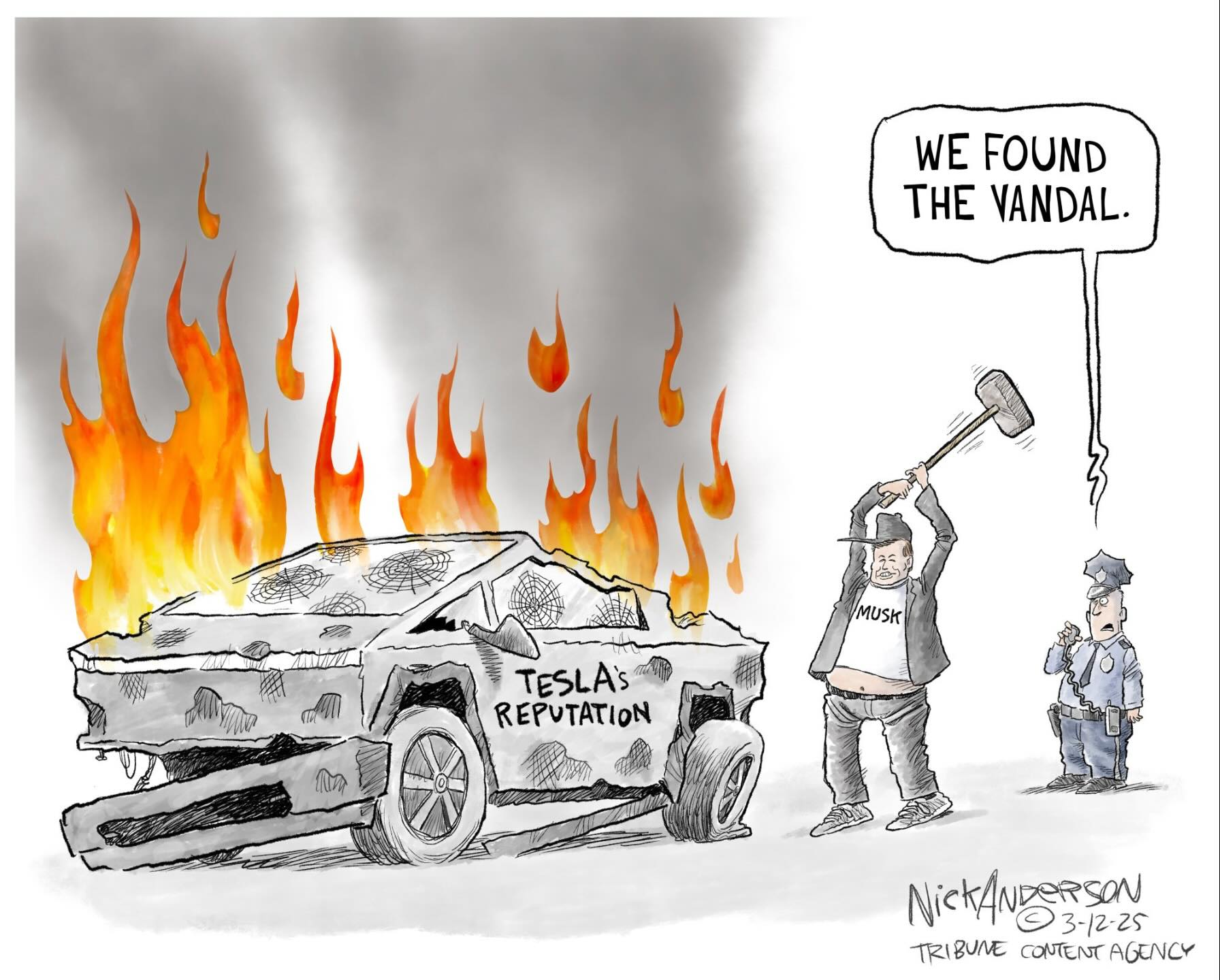
It has been relatively easy to convince people that the most powerful enemy in their lives is the government they comprise as individuals in a system of democracy. It is nearly impossible for people to grasp how a lone individual with a global reach can pull the levers of many governments worldwide. Even though this has been happening for decades now, we have been fortunate to have been given a glimpse behind the curtain when news of Musk’s meddling in the affairs of multiple nations around the globe reached our attention.

On a “quieter level,” Canadians have been experiencing the corruptive influence of oil billionaires such as the Kochs, which has resulted in the creation of an almost national crisis with a separatist movement in Canada originating within the province of Alberta.

Canada is not the first, but only one among many nations around the globe that have been assaulted by mostly American billionaires seeking to extend their reach and control the resources of other countries.

Example upon example of this corruption endorsed by the most powerful among us who transcend governments and destroy governments can be found almost everywhere, from Venezuela, to Iran, Iraq, Panama, and Vietnam.

Understanding how democracy is a system of the people remains challenging for a significant proportion of the population, who also remain susceptible to propaganda through their ignorance of governance today.

Many people still think of government as a ruling authority rather than a servant of the people.

The complexity of the dynamic and its layers throughout society, such as the distinctions between federal, municipal, and state/provincial governments, create barriers to understanding. Meanwhile, our corporate environments have grown to such degrees of influence that they, more than governments, shape our daily lives.

They have, since being permitted to rule by corporations supporting right-wingers throughout the world, defined life for all of us, and that has meant stealing the necessary time, resources, and education the people need to understand how our world functions.

The harsh reality of electing puppets to enable the corruption of the powerful among us is as simple as participating in an auction to establish ownership of a politician who wins their election primarily based on how much funding they get.

When 80 %+ of election winners win because they raise more money than their competitors, we create a feedback loop of corruption in our electoral systems. If winning a cushy job that one can leverage to become a millionaire is as simple as catering to billionaire whims, then we are inviting the most corruptible citizens among us to benefit from screwing us all over.

This dynamic, in turn, reinforces the perception that all candidates are corrupt.

By creating a two-party dynamic, the wealthy and powerful billionaires among us establish a see-sawing dynamic of opposites in our elections that makes it easier to manipulate the people while creating a horse race for their entertainment as they compete among themselves instead of allowing the people to exercise their democratic rights to self-governance.

Their deliberate manipulations of electoral dynamics turn political gamesmanship into a sporting event where those lacking the time, education, and energy to be vigilant dominate the political landscape. This leaves us all to be led by the whims of the most cynical, undereducated, and emotionally unhinged mental health patients among us.

Unless we change this dynamic on a fundamental level by eliminating the influence of the powerful among us, we will continue a trajectory of increasing conflicts, such that we will no longer be able to ignore the widespread destruction of modern society.

We are on a path to chaos, and the people standing in our way are the people we must retrain, but won’t because too many among us envy their wealth and power to such a degree that they fantasize about acquiring such wealth for themselves to empower them in acts of retribution toward their neighbours.

Will remote jobs eventually require you to be on camera all day?


This post is a response to two questions posed on Quora. Question 1 can be viewed at: “https://www.quora.com/How-can-remote-workers-maintain-focus-and-productivity-while-working-from-home-with-distractions/answer/Antonio-Amaral-1” and Question 2 can be veiwed at: “https://www.quora.com/Will-remote-jobs-eventually-require-you-to-be-on-camera-all-day/answer/Antonio-Amaral-1“ — For answers to additional questions, my profile can be accessed via “https://www.quora.com/profile/Antonio-Amaral-1/

Question 1: How can remote workers maintain focus and productivity while working from home with distractions?

Depending upon one’s home environment and mindset, it’s much easier to maintain focus while working from home than in a work environment where random interruptions must be regarded as necessary enough to set aside what one is working on.

At home, especially if one is single and lives alone, there is no better environment for focusing on one’s work.

Being motivated enough to finish a task means being free from the metronomic effect of paying attention to a clock. There is no “gearing down” before the end of one’s workday. One can continue working on something until it’s finished.

The consequence of that kind of focus can result in working the equivalent of a double shift to finish a task. That then earns a time bonus of taking the next day off, which is a straightforward means of contributing towards one’s psychological well-being due to having the time to deal with personal issues that would otherwise become a stress-inducing time-management problem.

Remote work is the only work arrangement I will accept now, primarily because I don’t want to endure toxic people jockeying for position through politicking nonsense. If I’m hired to do a job, I want to be focused on the work and not be distracted by egotistical nonsense to make life unbearable.

Don’t get me wrong, I enjoy collaboration and work well with others, but there is always a difficult person in a crowd. Unless the relationship is one in which I am their superior (because I can mitigate their toxicity), I want to minimize my interactions with such types and “grey rock them” if the work requires interacting with them. I’m not interested in becoming embroiled in the social politics of a work environment, particularly not if it’s an environment rife with cliques and silos. In such environments, I prefer the role of mysterious social outcast. AFAIAC, I already share enough of my personhood and life online here on Quora as I care to share within any public context.


Question 2: Will remote jobs eventually require you to be on camera all day?

There isn’t any point in doing that if you understand the tasks being performed and the time expectations that can be estimated for them. Establishing a mutually respectful communication style with staff means one develops a trusting relationship with them. They will then provide updates and progress reports that you can verify based on the deliverables.

Your role as a leader is to ensure you are available to facilitate production, and if your employees trust you and your judgment, they will be open about their activities. They will often approach you with questions about direction, confirm decisions you can ratify or offer helpful insights into improving their work process. A good leader is a coach whom people want to learn from.

The only kind of leader who feels a need to micro-monitor their staff is an incompetent leader. That characteristic alone should be enough justification to replace that leader.

Whether onsite or remote, performance should be easy to assess. If not, the problem isn’t the employee but the management.

Why doesn’t Elon Musk reverse climate change?

This post is a response to a question posed in its complete format: “Why doesn’t Elon Musk or someone else develop a big project for reverse climate change by 2045–2100?”

There are no “big projects” that can reverse climate change occurring due to a cumulative consequence of many different aspects of human society — from energy production and usage to our diets and the homes we live in.

The closest we can get to reversing the effects with a single solution would be through carbon capture technologies, which currently have power requirements that exacerbate the energy contribution to climate change. It’s also nowhere near mature enough to capture enough carbon to reverse the damage.

Until we can generate energy through cold fusion, it won’t be anything close to a solution.

He should, however, use his platform to encourage the changes we need in society that would mitigate the destruction we are doing to our environment. He began his trek to global recognition of that very potentiality through the success of electric vehicles.

He has since shown us that his concerns have always been opportunistic parasitism and is more interested in fleecing hundreds of millions of victims into destitution and early graves than he is in furthering humanity or securing our future on this planet.

He has the power of a global bullhorn that can be marshalled toward uniting humanity in the common cause of saving our planet and societies. Instead, he’s pissing it all away on ego masturbation at the expense of our future as a species.

He could have chosen to be revered like a god among humans for centuries by leveraging his resources to benefit humanity. Instead, he will be remembered as one of history’s most pathetically egotistical villains… assuming we survive his feckless recklessness.

How can the concept of authority be explained?

This post is a response to a question initially posed on Quora, and can also be accessed via “https://www.quora.com/How-can-the-concept-of-authority-be-explained/answer/Antonio-Amaral-1

There appear to be two distinct perceptions that dominate public responses to authority.

On the one hand, an authority is an entity with the power to issue demands, impose edicts, and enforce compliance. On the other hand, an authority is a trusted entity that serves as a resource for empowering people and enabling their ambitions.

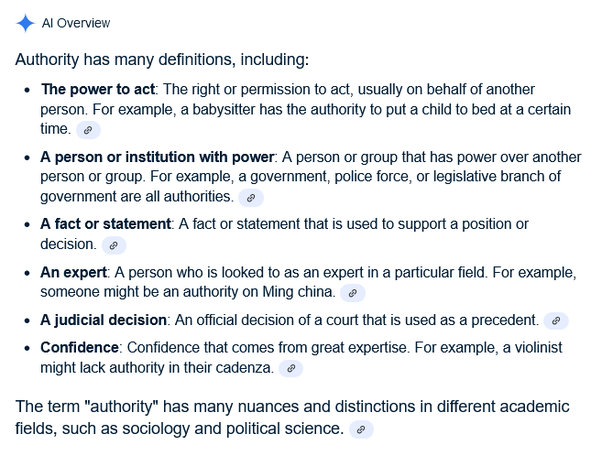
Our good friend and authoritative source of plagiarized information, AI Bot (Ayebot? iBot? EyeBot? — It needs a name so that it can be further anthropomorphized. “Gemini” seems a bit too much like impersonal woo.), provides a bit more detail:

Wikipedia has this definition, which appears to favour an interpretation based on an exercise of power:

Authority is commonly understood as the legitimate power of a person or group over other people.[1][dead link][2] In a civil state, an authority may be practiced by legislative, executive, and judicial branches of government,[3][need quotation to verify] each of which has authority and is an authority.[4] The term “authority” has many nuances and distinctions within various academic fields, from sociology to political science. ”

Let’s comb the world of language authorities to see how they interpret authority:

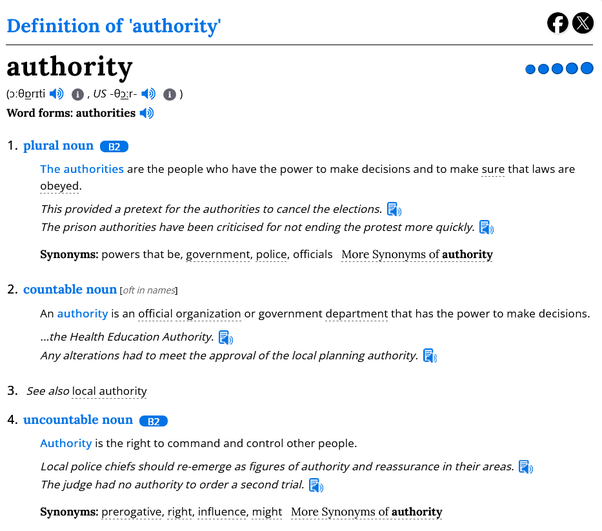
Collins has this to say about authority:

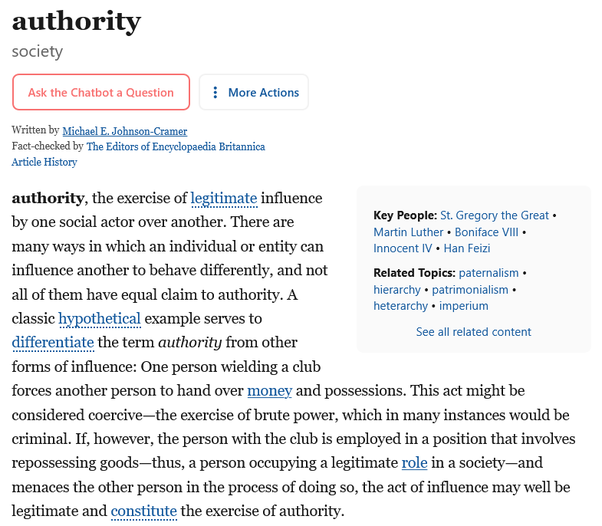
Britannica attempts a more concise definition favouring “influence” over “imposition” like Collins.

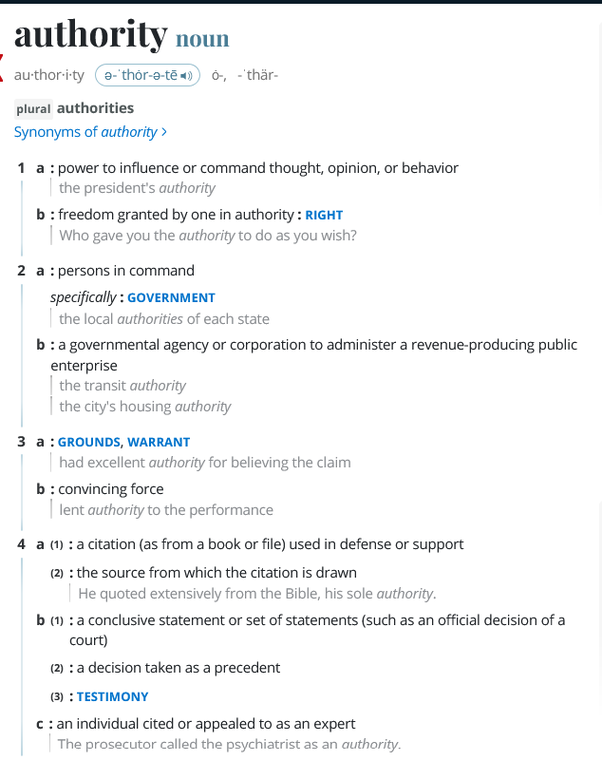
Merriam-Webster provides a more comprehensive overview of how “authority” is apprehended and implemented in society — although imposition precedes influence in its hierarchy of interpretations.

Interestingly, two of the world’s premiere language authorities place a profit premium on sharing basic definitions for words… which begs the question of the value of definitions versus profit and whether these institutions actually are authorities in realms beyond basic definitions.

Oxford at least asks for personal information to be granted access to elementary information, while Cambridge’s efforts are laughable.

These last two efforts suggest to me that their authority is entirely contingent upon reputation — part of the “old boy’s club” of authoritative prestige in the world, which essentially shuts out the plebians among us who must wrestle with “inferior language authorities.”

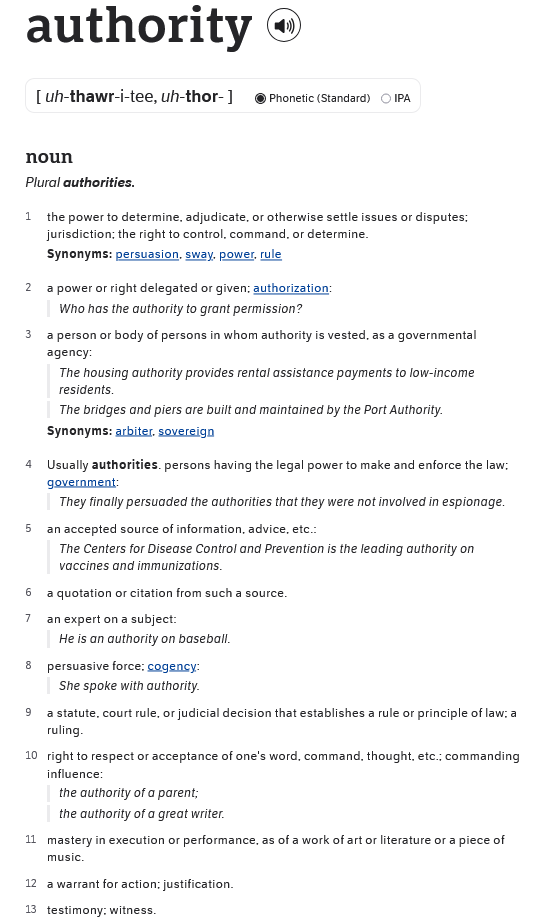
Meanwhile, freebie entity Dictionary dot com presents itself as a superior authority in marketing and business development to the two staid elements of anachronistic society above and provides an even more comprehensive set of definitions than Merriam-Webster.

This tells us that authority is actively cultivated by those who desire it and then, once achieved, is actively protected and zealously guarded beyond levels resembling reason. At the same time, newcomers overturn established authorities who fade into oblivion as the barbarians at the gates no longer storm them out of existence but supplant them through more effective forms of adapting to an ever-changing world.

In short, “authority” can be explained entirely by the dynamics of ego, power, and how much one is addicted to asserting their prominence in a chaotic world.

Interestingly, the most respected authorities throughout history have rejected the impositional form of authority flowing from within in favour of empowering the people at large by serving as a resource for enabling their assertions of personal authority within their relative spheres of influence.

For example, people still recognize the names of rare individuals who embodied humility, such as Gautama Buddha — or even a more modern instance like Nelson Mandela. Still, few outside dedicated historians can remember the many “authorities” throughout history who imposed their will upon the public. Those remembered are often anomalies serving as massive engines of destruction whose names are whispered rather than revered. Few among those whose authority was impositional in nature are remembered for their introspective wisdom, like Marcus Aurelius and Sun Tzu, but are revered for their insights in contrast to those of the conquerors like Alexander the Great or Genghis Khan, who are studied for their strategies (and often critiqued for their human failings).

For example, I predict that if humanity survives in some form resembling the humanity we know today, Jimmy Carter will be remembered with deep reverence and respect one thousand years from now. In contrast, Donald Trump will be remembered as the cautionary tale of a bull in a china shop whose lesson for humanity is the necessity of restraint and accountability.

Should we conclude America can be first only by weakening everyone else?

This post is a response to a question posed in its complete format: “Should we conclude that the only way America can be first is by making everyone else weaker and second including American citizens?”

If that’s considered a valid conclusion, it is derived from a mindset that fails to comprehend how strength arises from unity, not division. Such a conclusion is a recipe for weakening all parties, especially the U.S.

I would argue that it is this insular and protectionist mindset that has produced a Trump presidency that will end U.S. dominance as a global power.

The best way to think about this is to remember Clinton’s words: “The world is more impressed by the power of our example than by the example of our power.

Playing at being the toughest on the block in a childish King of the Hill game is an invitation to be knocked off one’s throne — and that’s precisely what Putin will leave behind as his legacy when he gets “retired” by one of his insiders.

Since the U.S. wants to be viewed as worthy of leadership, it faces the daunting task of making up for severely grievous misjudgments. Electing Trump for a second term is merely the final straw that broke the proverbial camel’s back.

The U.S. still needs to put Bush and Cheney in front of an international tribunal to face war crimes.

That’s how far off the mark this question is.

You are in for seriously rough times ahead, and it would be easy to write you off to face your self-fulfilling prophecies alone. Still, you’re going to disrupt the entire world’s economy during your downfall, and that truly sucks big time.

The consequences of being a global leader mean having to live up to being a leader, and you’ve just proven to the world that was utter horseshit… utterly dangerous horseshit.

Your days as a global power are numbered. You’re going to become the United Kingdom for the next century. You may as well start practicing your “sorries” now.

Is paying at the market rate ethical even if it constitutes poverty?

This post is a response to a question posed in its complete format: “Is it ethical for employers to pay workers at the market rate even if it constitutes wage slavery and lets them barely survive?”

If you’re getting paid the market rate for a position you’re filling, that’s the highest level of ethics you should expect from an employer.

I worked for a government-related agency (part of the government Stewardship program of pseudo-outsourcing) for almost five years and was paid 40% below the market rate. I was stuck with that for reasons that will take this answer in an entirely different and unrelated direction. Suffice it to say that my options were radically reduced due to another arm of government choosing malfeasance to manipulate politically based optics in their favour at my expense.

At any rate, I found myself in this environment in a less-than-challenging role, which worked for me for a time as I had suffered a severe degree of trauma and needed mental space to learn how to cope with a new reality.

When I began working in this operation, management was so pleased with my performance and capability that they wrote an entirely new job description and offered me a full-time position within my first three weeks as a temp. Since my engagement before this one involved physically hauling 16 metric tons daily (at 52 years old) at an hourly rate less than one-quarter of what I had been used to as a professional, I jumped at an opportunity to function in a leadership capacity.

As much as I was surprised to enjoy the role and the people I worked alongside, I was shocked to discover that my rate was below the least-paid staff who reported to me. I was told I had to prove myself when I expressed my dissatisfaction. I responded that I already had, or they would not have created a new position for me. That changed nothing for the better for me, and I continued working there because I was more concerned with struggling through an ugly state of mind at the time and in no shape to be successful in professional interviews. I had already been bombing the ones I managed to get during that period.

During the first company Christmas event hosted by that employer, I had an opportunity to meet the Finance VP. I first witnessed him in his speech, declaring everyone was family. I was later introduced to him by an exceptionally proud supervisor and manager. The VP’s initially positive reaction indicated he had heard abundant good news about my performance.

He smiled and asked me a question. I managed six words before he turned around like I didn’t exist and walked away in another direction. I thought his behaviour was rude, which ended my thoughts on the matter as I continued to enjoy the event. As it turned out, that was my first indication of a sustained round of abuse I was to endure from him.

For the next five years, he played a game of “You look familiar, but I don’t know your name” with me. He enlisted his HR executive in his game as they behaved like they didn’t know me each time they visited the facility, averaging about twice yearly. His HR sidekick seemed to enjoy the game as she furrowed her brow each time she was introduced to the staff when she showed up on average once per year.

Throughout that period, I found myself constantly mitigating the incompetence of the leadership in the facility and saving thousands of dollars in lost productivity per week. I remember being given a production design assignment the manager couldn’t resolve, causing him great stress. The number of errors generated by his inability to deploy an effective production system seemed to stress him to the breaking point, and he thought I would make an appropriate scapegoat.

He offloaded responsibility for his job onto me under threat of losing my job if I couldn’t resolve his problem for him. It was pretty laughable in retrospect because I already had plenty of experience designing more complex production flows within a technical environment, so the system I devised resulted in a complete turnaround and a successful production flow that everyone appreciated, as stress levels among production staff also significantly dropped.

The short of this is that although I routinely exceeded expectations far beyond the role I was paid to fulfill, beyond management-level functions, and well into director-level functions, I could not find myself being paid the market rate for the job I had on paper. I was being paid 40% less than the market rate. I remember quoting that figure to a different HR personnel, and her response was an expression of surprise: “How did you know that?” I was more shocked by her question than I think she was about my knowledge of the market. It’s pretty easy to find out what the market pays for roles. However, the standing directive from company leadership was that discussing salaries was strongly frowned upon.

This environment had all the hallmarks of a highly incompetent and corrupt environment, and I’ve barely scratched the surface of examples I can provide. Do keep in mind, after all of this, that this environment represents government by proxy and the degree of corruption displayed was criminal. My constitutional rights were violated, and I had no recourse beyond the court system in which I could not afford to participate. I did, however, file a suit against them, so that’s on record if I can finally afford to take them to court.

After eventually receiving an agreement that I would have my income adjusted to near market rates, I experienced a gradual moving of the goalposts where my expectations degraded from an agreement they made to a realization they had negotiated in bad faith. My attitude degraded over time, and I stopped offering extra-curricular solutions to issues I had worked on during my off-work hours. I stopped stepping forward to volunteer for tasks above the role I was hired for, and the response was an attitude that I was being derelict in my job.

They eventually decided to terminate my position by claiming they were going in a different direction. This is an “at will” environment, and they were within their legal rights to terminate me at their discretion. I was entitled to six months of severance and received only four.

Workers have no protections in the modern workplace without the strength of union membership and the resources it provides.

Ethics is a matter of individual character; the shame is that ethics are not a universally held standard of conduct. The primary reason for people quitting their jobs is due to abusive environments. That means that most work environments are unethical, which aligns with my experience as an independent professional who has been stiffed by many people who hired my services to extoll their satisfaction with what they received and then denied me my compensation.

A LOT of employers and people who hire other people to work for them are entitled assholes who will screw over anyone they can get away with. It might be the case that I just had shitty luck, but it was far and above more than half of the people I encountered who lacked ethics.

This is only one reason that when people like Donald Trump or Elon Musk brag about stiffing their contractors, I see red. None of those people would want to brag about such horrid behaviour around me because, after a lifetime of enduring it, I doubt I could restrain myself. I would rather avoid a prison sentence for losing my shit over some psychopath’s gloating over how they screwed someone over.

If you’re looking for ethical behaviour from your employers, good luck because if you do find an ethical employer, hang onto them like they’re a prized treasure. They’re just as rare.

Getting paid at a market rate is at least better than getting paid less than the market rate and being expected to perform at higher levels of responsibility than those who get paid more to supervise your work. They don’t set the market rate, while most employers deliberately seek young and inexperienced people because they don’t want to pay the market rate.

A LOT of jobs I see posted indicate an upper limit of experience precisely because older workers know when they’re being ripped off or manipulated by an unethical employer.

What percentage of Kamala’s voters are actually just “anti-Trump” voters?

This post is a response to a question initially posed on Quora, and can also be accessed via “https://donewiththebullshit.quora.com/What-percentage-of-Kamalas-voters-are-actually-just-anti-Trump-voters-17” (complete with typos because the space it was posted in doesn’t permit edits — dang — and the reason I chose to “upgrade” this answer to a broader audience).

So, you’re trying to separate “anti-Trump” voters from “pro-Harris” voters as if that bears any relevance to this election.

You’re doing that because it’s easier for you to write off people with your go-to dismissal of “Trump Derangement Syndrome.”

Do you recall how conservatives did the same thing with Bush when he lied to the American people and the world at large to justify invading Iraq and embroiling the nation in two costly wars?

Bush Derangement Syndrome” was your go-to dismissal then.

That’s what conservatives do: invent a fake disease and accuse people of suffering from that “disease” to avoid having to deal with the very valid criticisms they have over the leaders you bend over backwards to protect. You don’t care in the least about examining, much less acknowledging, how utterly corrupt the actions or how incompetent the people you defend are.

For you, loyalty is everything… and you’re proud of your loyalty to such a degree you cannot fathom, much less accept how it’s precisely that sentiment being played against you.

You’ve been conditioned since childhood to value loyalty above all else and beyond reason.

This is not to say that your loyalty isn’t a precious sentiment. It is. It’s an essential ingredient for maintaining community cohesion. It isn’t, however, anything but a tool for people like this.

They don’t respect your loyalty or value it beyond how they can use it to benefit themselves.

The worst thing is that you don’t directly view your loyalty as loyalty to a convicted felon. You have convinced yourself to believe your loyalty is to your country. Why do you think he indulges in performative kisses of the flag if not to tweak your loyalty and use it against you?

The sad thing about your unwavering loyalty to this disloyal monster is that you’re the girlfriend in the stereotypical scenario played out by millions of teens throughout the decades.

You’re the girlfriend who’s being lied to so that he can get in your pants.

Once he’s done with you and decides there’s nothing more he can extract from you, then you’re his ex, and he treats you like he treats the memory of his ex-wife and mother of his children.

This is what you mean to him, yet you have convinced yourself that he won’t do the same thing to you. Do you know how many teenage girls follow that rationale to learn a powerful lesson in regret? Countless.

You’re so loyal that you’re willing to overlook the deaths of your fellow citizens while he generously shares equipment that would save American lives with the leader of an enemy nation.

… and while overlooking this betrayal of the American people, you still want to think of yourself as a loyal patriot of the nation you love.

You’re so lost in your team spirit haze that you want to believe the only reason he might lose the election is because your fellow citizens are suffering from an imaginary mental condition.

You have to think that way because the alternative is frightening.

If you can’t believe that “Trump Derangement Syndrome” is real, then you have to admit to yourself that you’ve been wrong about this monster for years.

You fell into a trap in which you liked what he had to say because he hates the same people you have struggled with that piss you off every day. After all, they don’t seem to respect what’s important to you.

The trouble is that they do, but they do so equally for everyone, not just the insiders or fellow team members. That’s what makes you struggle with being loyal to your team. You can’t ignore all your many reasons for doubting this man’s integrity. It nags at you from the back of your mind like a splinter.

He’s just given you too many reasons to wonder if maybe… just maybe, he doesn’t intend to deliver an America that serves your needs. He intends to deliver you like a pig on a roast to the nation’s enemies and destroy the Republic you believe yourself a patriot of.

You know what the truth is.

Everyone voting for Kamala is anti-Trump. It doesn’t matter if that’s the only reason to support her because that’s enough of a reason for millions of people who also think of themselves as patriots. You know they think of themselves as loyal patriots, too… right? Except they’re not loyal to a person but a country, a constitution, and the spirit upon which the nation was founded. Your brand of loyalty is called a “cult of personality.”

If your suspicions are correct, someone besides Trump would mean fewer votes for Kamala and a better chance for your team to win. Those anti-Trump people who can switch sides based on the quality of character representing the candidates are more loyal patriots than you are because they are patriots loyal to the country and not the personality.

Your loyalty is a fraud. It’s the same type of “loyalty” a teenage girl who is desperate to be loved will show the people they hope will love them back. Like you, she’s willing to believe anything a charming young boy with promise for a future will tell her.

Ask yourself this question: If Trump could return your loyalty, why has he done nothing to help the people who are in prison today on his behalf? Why did he not do something for the family of the supporter who was shot and killed during his first assassination attempt? Why did he not even contact the family to pass on his condolences if their loyalty meant anything to him?

The sad reality is that you’re just a box of Kleenex to him.

Once he’s done wiping himself with your sacrifice, then you’re just garbage.

Is your loyalty worth that little?

Do you know who gets a greater reward for that kind of sacrifice?

Saddam Rewards Suicide Bombers’ Families

That’s right… Islamic suicide bombers get better treatment for their sacrifice than Trump’s loyal supporters.

Are you okay with being treated with less respect than an Islamic suicide bomber?

Is your sacrifice worth the cost of destroying the nation you want to think of yourself as a patriot of?

Here’s another thought: The loyal patriots who hated what the Republicans did to embroil the U.S. in two pointless wars weren’t just temporarily reacting for the sake of team performance. They weren’t suffering from some temporary mania called “Bush Derangement Syndrome.” They believed strongly then and still believe those who sent the nation into that hellscape should be held accountable for their actions — even if they switch sides and cheer for the same team. They’re not let off the hook for the damage they did to the nation. To them, being loyal to principles matters more than team loyalty.

Loyalty to a country means holding monsters accountable for their actions, no matter how they switch gears later.

Dick Cheney announces support for Kamal Harris

That’s the difference between genuinely patriotic loyalty to a country and misguided loyalty to someone who’s using you like a teenage boy eager to get in your pants.

Why has the UK’s economy grown so slowly under the Tories?

This post is a response to a question initially posed on Quora.

lol… but not lol

It’s sad.

It’s frustrating.

It’s maddening.

It’s a bang your head against the wall to relieve the pain of blind ignorance kind of thing.

It seems that no matter where one travels on this tiny blue pearl adrift in a lightless ocean, one universal constant that science does not accommodate is the obliviousness demonstrated toward a long and less than venerated history of fiscal incompetence by those branding themselves as fiscally competent by virtue of their propensity for preservation.

As the old adage goes, “It takes money to make money,” while the CONs among us lack the spine to explore beyond their survival instincts, which favour hoarding among the favoured class.

It’s always the little people who get stuck with the honourable burden of austerity, never the luxury recliner class. They deserve their effetes, after all, because they are superior to the little people. That’s why they’re considered “royalty,” and by God’s good graces, they have a divine Reich to rule.

They should not be expected to lift heavy fingers to make manifest a reality catering to their sensibilities. That’s what the little people are for.

The little people are the beasts of burden by divine decree, and no one should ever question that wizdumb.

Conservatives are fiscally conservative, and that makes them better money managers than the swarthy class, which demands to be paid for the value they contribute to society and the luxuries of the pampered class.

If the uncouth class manages power, then debts and deficits will be deemed horrendous failures in leadership. If they hold the keys to the halls of power, then debts and deficits are a feature, not a bug.

If the tree-hugging barbarians wish to spread the wealth around to their peers, that’s a grievous violation of overreach for which they must be punished. The trillions in wealth generated by the sweat of hundreds of millions of brows rightfully belongs to their natural rulers.

When they Reichfully sit upon their thrones, then they are empowered by the lard almighty to share it with their peers, and if it so happens that one of them over-indulges, they are permitted to trickle down the excess to the wanton waifs beneath them. They must be careful, however, not to release too much of a flood because that would embarrass their peers by revealing the extent of their gluttonous obscenities.

They cannot afford that sort of smear to their optics because that would incite the little people into another of their tizzies to make heads literally roll.

No one wants any more cake. It’s too disruptive to their digestion.

At any rate, their inability to peer past their navels and acknowledge themselves as members of the same species as the rabble they exploit into early graves makes it impossible for them to notice opportunity when it knocks on their over-filled bladders.

They would rather piss into their chamber pots than allow any of their precious golden treasure to be used to elevate the lot of humanity.


If they did that, they would soon run out of heads to trod upon and lose track of who was a worthy peer by birth or an anomaly by self-made fortune.


If this seems a bit cynical, it’s because it is quite cynical toward a movement that has steadily reversed the course of capitalism to raise a world out of poverty by weaponizing it as a means of establishing power. The economy belongs to everyone while our systems undergo a consolidation of power that has historically been the cause of systemic collapse and widespread chaos.

In the words of economist Dean Baker,

The market is just a tool, and in fact a very useful one. It makes no more sense to lash out against markets than to lash out against the wheel. The reality is that conservatives have been quite actively using the power of the government to shape market outcomes in ways that redistribute income upward. However, conservatives have been clever enough to not own up to their role in this process, pretending all along that everything is just the natural working of the market. And, progressives have been foolish enough to go along with this view.

The economy should serve the social contract, not subjugate it while Conservative politics the world around have never quite accepted the reality that we are, all of us, in this together. A successful and prosperous future requires a mindset that accommodates all needs, not just those one can personally benefit from. The fundamental difference between the conservative “me” mentality versus the liberal “we” mentality is the cause of poor economic performance. It always has been and it always will be because it constitutes myopic and self-serving thinking favouring power to the few, and not the people at large.

How to Restore, Strengthen and Preserve a Democracy

Democracies are strengthened by the degree of engagement by the people. The more people become informed, engaged with, and involved with their government and its activities, the more secure the democracy.

A disengaged and apathetic citizenry makes a government susceptible to corruption.

Restoring and reinforcing the stability of democracy begins in the classroom with a comprehensive civics-oriented strategy for equipping students with the skills and insights to achieve success in effective governance and their personal lives.

As it turns out, the overlap in skills for effective governance and success in one’s personal life are represented as an almost clean circle in a Venn diagram.

The range of interpersonal skills one can and should develop are core competencies for life. Communication skills, negotiation skills, and conflict resolution skills are all universally valuable skills. Developing competencies in areas like Robert’s Rules of Order and understanding the nature and process of effective legislation (rules to live by) may be more niche but are transferable skills that can be applied in other areas of life, particularly when they’re not considered obscure skills by a majority like they are now.

The more people who know how to declare a point of order, the fewer conflicts could escalate into violence.

Of course, the development of logic and critical thinking skills should be included in the curriculum, if not as courses but as strategies for delivering an existing course load.

Applying critical thinking skills development within a history class, for example, would increase student engagement simply by structuring the information delivery process through a means that challenges one’s thinking skills.

On an entirely different and equally crucial level is the reinforcement of a commitment to the role of the Fourth Estate in society. The profit motive must be removed to protect objectivity in the information delivery process, ensuring the public is adequately informed of relevant news in the most agnostic way possible.

Breaking corporate media into community-based employee co-ops will create a culture of checks and balances that approach the self-regulating effectiveness of the peer review process within the scientific community.

The election process is another area that must be made as agnostic as possible. Removing the undue influence of money in elections and reducing the tribalism of the currently corrosive culture in politics is critical to mitigating ideological bias. First-past-the-post elections should be replaced with proportional representation and ranked-choice voting.

With these measures, an exceptionally stable democracy can emerge on level ground with inbuilt resistance to corruption.

Leon Wieseltier — Quote on Democracy