To what extent do profound ideas reach high levels of popularity?

This post is a response to a question posed in its complete format: “To which extent do novels, or manga, conveying deep idea, or talking about social issues, relate to them given global awards, or high global popularity, to which extent does this depend on how smart the creator is, why only few reach to this level?”

Popularity and recognition are primarily not determined by intelligence, creativity, or any value generally associated with degrees of quality, skill, or craftsmanship but by timing and resonance.

The kind of popularity attributed to intelligence and creativity is recognized only through endurance throughout the ages. It is the rarest form of popularity that remains consistently in the shadow of most other forms of popularity. It does receive the occasional boost because it can garner enough of a niche following to emerge on the populist stage for a time. Still, it then retreats to becoming a niche once again.

A book like “Fifty Shades of Grey” was a literary mess on every level, from the writing to the butchered subject matter to the horrid values it sensationalized.

It was a massive success because it appealed to a repressed and widespread imagination responding to an increasingly darkening reality by retreating into dark fantasies that most would not have the courage to explore in real life.

I’m certainly not claiming that I would or have the courage or the slightest interest in exploring this area of the human condition for myself. Still, I am at least aware enough of the dynamics to understand how the story itself represents more of an expression of a mind suffering from Stockholm Syndrome indulging in titillation rather than providing realistic insights into the dynamic it attempts to portray. It’s more of a study of mental health in society than a literary masterpiece.

This leads me to my point that, as a people, we have been enduring a staggering decrease in the quality of our lives over the last several decades, shocking most of us. A piece of schlock like this validates feelings shared by a large audience and titillates the imagination through sensationalized imagery.

It became popular, not because of any enduring qualities but because it fulfilled a need for an outlet.

“The Secret” is another example of appealing to repressed sentiment, but instead of validating the repressive darkness people have been suffering through, it capitalized on a need to restore hope.

Ultimately, both literary productions created more harm than good in the same way that trolls undermine the social contract.

Once materials like these run their course, they begin to resemble porn in that a temporary titillation is an insufficient mitigation for addressing underlying causes, and like cocaine, once it’s run its course through one’s body, one is left feeling drained and hungry for more of that emotion that gave them a temporary boost in life.

There is, sadly, no real cure to this phenomenon of populism beyond two different strategies. The first strategy is the sanest, but it is also the most long-term and invisible strategy for addressing this need to bottom feed while racing toward an ever-receding bottom. It’s a strategy that will make many eyes roll once I write it as a one-word summary: education.

Education is the “magic pill” that will mitigate most of humanity’s ills — at least, it will once we address the economic roots of humanity’s ills.

It won’t ever be a cure because there is no final state to education. There is no finishing an education. Only lifelong learning exists for our species if we wish to survive anywhere near as long as the dinosaurs did.

The alternative to education is our current self-destructive trajectory, which risks the end of human civilization and, quite possibly, our species if our rock bottom is deep enough.

The alternative track to education we are on is to continue our descent into worshipping the superficially constructed Holy Grail of attention for the sake of attention. We will continue to behave like addicts drawn toward the chaos of feeding an insatiable hunger until we consume all of what we value through superficial titillations that temporarily distract us from an otherwise horrifying existence.

Surviving the nightmare ahead of us means our future progeny will have slim pickings to choose from as representations of the best human potential to pick out from the forgettable detritus of populism. The future will be as we experience it today when looking back on history and forgetting how Leonardo DaVinci had many contemporaries competing for the same artisanal benefits he remains remembered for.

We don’t remember the easily forgotten mass, but we do remember the outliers, and that’s the broad lesson of history.

If we exist as a species and civilization in another two hundred years, no one will know who or what a Kardashian is. They will note, however, how rampant superficiality characterizes this primitive and barbaric state in which we live.

No one will remember any of the Harry Potter books or the trans-hating hypocrite who fraudulently represented hope within her discardable stories. They will, however, continue to be influenced by Tolkien.

No one will remember much of anything notable about the products of this era beyond the horrid worship of excess.

Not one talking head from Fox will be given a nod of acknowledgement for their contributions to society. Rupert Murdoch might earn a passing reference as a key player in corrupting human civilization. Even he will be regarded as a side note contributing to corruption. At the same time, his success at making it so widespread will be considered a global failure in ethics that permitted monstrosities like centibillionaires to exist.

Donald Trump will be remembered as this century’s Hitler, no matter how many may find that offensive today. It’s just where we are as a species, and history has given us enough hindsight information to make such predictions with great confidence.

Those who may be offended by this prediction would do well to consider how that’s an optimistic outcome to the trajectory we are on right now because if he succeeds in achieving the maximum potential of his efforts, then we may not have much left of humanity to be capable of studying the history we make today in any way resembling our current capacity for exploring our history from yesterday.

Suppose we don’t rein in society’s current excesses of distorted power. In that case, we will be lucky to exist in any state resembling anything other than a primitive existence at the mercy of nature.

Why can’t I accept failure?

This post is a response to a question posed in its complete format: “Why can’t I just accept failure? Like if I fail on something I always almost grandiosly believe that there is no way that’s the end and begin comming up with a whole palet of things to do that could potentialy “fix the situation”?”

Instead of asking why you can’t accept failure, you should ask whether failure is acceptable within specific contexts. You should also ask yourself what you might learn from what you perceive as a failure, which also begs the question of why you perceive a specific outcome as a failure.

For example, if you’re interested in someone and wish to develop an intimate relationship with them, and your advances are met with rejection, do you perceive that as a failure? If you perceive that as a failure, does that motivate you to persist in your advances, hoping you can convince them to change their mind?

Suppose your approach is to persist in pursuing a relationship after being rejected because you can’t accept what you perceive as a failure. In that case, you are failing to understand the dynamic in play.

Lack of success in achieving a goal does not equal failure.

Being rejected by someone else isn’t a situation you can fix.

Let’s move on to a different context commonly associated with a perception of failure, such as not achieving the goal of becoming a millionaire. The paths one can take to achieve such a goal are innumerable, while the variables affecting the outcomes are more easily quantifiable. For example, elements in achieving this goal amount to the degree of opportunity extant within a particular strategy, the material resources one has on hand to help them achieve their goal, their interpersonal relationships and the successes and advantages one may gain through their networking efforts, timing, market reception and demand for their product or service, their competitive difference, the uniqueness of their offering, the quality of their branding, and how they can leverage media to maintain a top of mind that contributes toward steady growth.

These combined can almost be a prescription for guaranteeing one can become a millionaire in time. However, any single tragedy or traumatic life-altering event in their lives can derail all of that.

Failing to achieve their goal of becoming a millionaire doesn’t mean they have failed because it’s impossible to predict random events in one’s life that can dramatically alter its trajectory.

In this case, to contrast against the former example, one can return to pursuing their original goal of becoming a millionaire while being entirely hobbled in all the areas one initially relied on to achieve their success at the outset of working toward their goal. What can happen at a point where one realizes their goal is not only much more difficult, if not impossible, to attain after so much had been lost, is that their initial goal is no longer as important as it once was, or at least no longer defined by the same parameters or reasoning one applied at the outset. Instead of becoming a millionaire, they adjust their goal to a more modest level of meeting needs and fulfilling some desires while realizing how some choices they made the first time are no longer acceptable.

The nature of their goal will have changed in ways that make its first interpretation moot.

That process is called learning — growing as an individual and adapting to a reality that one has a limited capacity for influencing.

One hasn’t failed if they can succeed in adapting to new circumstances. Quite frankly, the opposite is true in such a case because such tragedies often result in even worse tragedies from being unable to cope with traumatic losses. People frequently commit suicide when faced with intense trauma that destroys what they had accustomed themselves to accept as true about their lives.

The point is to help you understand the genesis of failure lies within one’s perceptions. If you struggle intensely against what you perceive as a failure, you fail to understand your circumstances’ deeper level.

IOW, your perception of failure is a failure to restrain your ego because it assumes you have complete control over outcomes when you don’t.

Sometimes, “failure” is failing to accept failing to achieve a goal. Failing to achieve a goal is an opportunity to learn something about reality and oneself. If people can walk away to continue living their lives while learning something they did not understand before their experience of failure, then they haven’t failed at all.

The point of life is learning, not achieving.

Temet Nosce

Is eccentric introversion masculine and extroverted conformity feminine?

This post is a response to a question posed in its complete format: “Why do some people say that eccentric introversion is masculine while extroverted conformity is feminine?”

The rule of thumb when referencing “some people” is that it means nothing more than individual bias.

Here’s an example of “some people” — one person in this case whose attitude is entirely predicated on bias and without effort in researching a topic to develop a deeper understanding of the subject they’ve indicated an interest in.

Digging deeper into the mind that seeks validation for their bias, one notices several examples of fact-free bias that they’re mining validation for instead of educating themselves on the topics they express a fraudulent interest in while disguising their biases as concerned questions.

If you look through all these questions, you’ll notice that they are all mining for validation for their biases. I won’t share this profile’s identity because it doesn’t matter. This person is just one of the “some people” you’re wondering about with your question.

The last two questions in this list highlight the nature of a subjectively focused mindset.

First, they’re interested in relieving their boredom but don’t realize the most effective way to accomplish that goal is to educate oneself. If they did that, they’d find their minds too occupied with information to be bored.

Admittedly, this conclusion is a bias that I developed early on in my life when I encountered an assessment of the statement “I’m bored,” which described that declaration as a way of saying “I’m boring.” It is pretty accurate because none of these questions reflect any depth of consideration for the topics raised.

The last question sums up their attitude toward learning as a limited benefit that fails to go beyond acknowledging value within applied knowledge that can be leveraged for pragmatic applications.

The consequence of this attitude toward learning is to limit one’s understanding of subjects one seeks insight into. In the example of the first question, they’ve already decided that “laziness” is a valid presumption upon which to build their biased views of the world.

For example, an answer they received likely skipped past their perceptions beyond the level of novelty.

It would not dawn on them to reconsider their definition of “laziness” because of this answer beyond possibly acknowledging that laziness isn’t a universally undesirable characteristic. I sincerely doubt they would be prompted into researching causes of motivation and apathy or even bother to investigate mental health issues like executive dysfunction.

“Laziness” is “laziness” to this person and will remain so because they’re not interested in expanding their understanding. They’re interested in being entertained at a shallow and briefly distracting level to escape boredom in the most practical manner they know by catering to their ego.

This is now where I get back to your question and point out the nature of the broad brushes used in the presumptions formed by the attitudes you’ve identified.

The telltale sign to knowing whether someone is interested in developing depth in their understanding of subjects or whether they’re simply mining for confirmation bias lies in the size of the broad brush they use to smear demographics that are largely undefinable beyond a generic level.

Terms like “eccentric introversion” and “extroverted conformity” are subjectively defined biases that are not scientifically valid. For example, psychological authorities recognize different forms of introversion but don’t use judgmental terms like “eccentric.”

Here’s an example of four types of introversion as described by an authority in the field:

Anxious introversion includes staying home from the party but for a reason. The anxious introvert feels self-conscious, and even when they’re alone, they ruminate about their social interactions.

Social introversion is a person who always says no to going to a party. They’d much rather be home doing some solitary activity. When they do socialize, they keep to small groups. This probably ties into that feeling of exhaustion. Introverts derive energy from solitary time, whereas extroverts feel energized being with others.

Thinking introversion means you’re pensive and introspective. You look inside yourself and self-reflect often. “People with high levels of thinking introversion don’t share the aversion to social events people usually associate with introversion,” writes Melissa Dahl. This rings true for me (and it’s where I score the highest on the quiz).

Restrained introversion means it takes you a while to get going. You don’t jump out of bed, ready to embrace the day. I can imagine this translates to being quiet or standoffish in social situations but would later blossom into more participation in socialization. “It takes her a while to warm up,” my mother always said.

What Kind of Introvert Are You?

The descriptive terms used are non-judgmental observations of distinctions between characteristics.

“Eccentric” is a value judgement, not an objective description of a behavioural trait.

“Extroverted conformity” is the same kind of value judgement of a behaviour, not a clinically valid description of the behaviour they’ve identified.

By associating these judgments with genders, they’ve described their gender biases in full detail with few words.

The short answer to your question is what I indicated in my first sentence, “some people” are biased. They pass off their biases as valid judgments to entrench those biases within the public consciousness in society, and we end up with stereotypes built upon pre-existing biases.

Another characteristic of bias is when people preface their presumptions with a logical fallacy called the “bandwagon fallacy.” It appeals to the suggested popularity of a concept to grant it authority that otherwise does not exist. We’ve seen this behaviour often with the less reputable pseudo-news media outlets. They’ve overused it so much that it’s become a popular trigger for people to recognize that what follows is a bogus claim.

The expression “some people” has become a running joke that “some people” instinctively react with skepticism. I doubt you’ve heard “some people” make those statements and that they are fabrications you’ve made yourself to displace responsibility for the biases they invoke.

Your profile and question history lend credibility to my hypothesis because many of your questions wallow in subjective bias. You indicate that you’re 23 years old, making your logic errors much more forgivable than someone somewhat senior to you who should know better than to wallow in stereotypes.

Hopefully, this long-winded answer gives you some insights into how to be more objective and authentic within your future querying while realizing that people often reveal far more of themselves than they realize.

As a bonus, here’s a poster for a few common logical fallacies that many people are often guilty of committing.

Temet Nosce

Has humanity only just begun to scratch the surface understanding of the fundamental nature of reality?

This post is a response to a question posed in its full format as follows: “As clever as humanity considers itself to be, has it only just began to scratch the surface of a true understanding of the fundamental nature of reality?”

This question reminds me of the Epistemology course I took at a local university over a summer off from art school. I was accepted into a third-year program without prior university-level philosophy course experience. I successfully leveraged my art school experience toward my application.

This was my introduction to understanding how language can be utilized with the same disciplined approach toward meaning as mathematics. The course material I read felt more like I was interpreting algebraic formulae than English text.

During this period, I realized access to new knowledge domains began with mastering the grammar that defined a domain.

At first, I read and reread sentences until the language made sense. I plodded slowly through the material and expanded beyond spending upwards of half an hour reading sentences to over an hour reading paragraphs and several hours reading entire pages to ensure I had developed what felt like an adequate understanding of what I had read.

This was not my first time having such an experience. Many would be surprised to discover the art world is also filled with jargon and concepts that require an equal measure of effort at the outset to comprehend the information conveyed. However, the grammar defining the art world can be even more complicated and confusing than intermediate philosophy.

Unlike the disciplined rigour of mathematical precision found in the language of philosophy, art world jargon is often subjectively defined and expressed through abstractions rather than through concrete concepts based in a material world. It makes for mixed messaging among instructors, where one adopts interpretations of concepts based on interpersonal dynamics rather than objectively defined definitions of concepts. I remember often tripping over the concept of chiaroscuro because it seemed no matter how I interpreted what is arguably one of the objective terms in art, every instructor had a different definition. I chose to favour the art history instructor’s definition over the conflicting definitions offered by my painting instructors.

At any rate, my painstaking journey through reading my philosophy assignments left me tired enough at the end of the day to sleep soundly at night and wake up feeling like I was prepared for the class discussion of what we had all read. I would attend class feeling confident that I understood the material — until the class discussions began and the instructor interjected with dialectical curveballs to illustrate limitations on some of the arguments forwarded by students.

About halfway through the class, I felt utterly overwhelmed, as if I had no idea what I had read. I felt like my confidence was entirely misplaced and that I should have started my formal training in philosophy at a more junior level.

Then it happened — the discussion veered back onto the topic I thought I had read. I couldn’t fathom how the conversation took a journey to an alternate dimension, but I was happy to see it return to the reality I was most familiar with.

By the end of the class, I was dumbfounded to discover that I was correct about understanding the material at the outset before becoming completely confused. I expressed my frustration publicly. My instructor’s response to my confusion was to say simply, “Yes, but now you know it better.”

This was a lesson for me to understand that knowing what I know is merely a product of my confidence in believing I know what I know, while what I know constitutes only the tip of an iceberg of what is possible to know about what we think we know.

For a real-world example, I still recall my experience in an interview with a recruiter who seemed impressed with me when he remarked, “Wow. You quoted Voltaire. I’ve never heard anyone quote Voltaire in an interview before.” He presented his surprise in a way that made me feel he would be in my corner and support my candidacy. As it turned out, that was the moment he decided I was disqualified as a candidate. He ghosted me after that, and I never got another opportunity presented to me through that agency.

It took me a while to figure out what had happened, but when I did, I connected that experience with a much earlier one in which I was on the phone with someone about a temporary labour assignment. I remember asking specifically, “What does the job entail?” The response I got was a very dry, “Welllll…. it entaaaaaaaails moving stuff.” I lost out on that opportunity, and the memory of that experience lingers as a reminder of my language choices and their impact on others.

I’ve had to learn to become very aware of how my natural self is interpreted from a young age when I deliberately chose to use the shortened form of my name to fit in. As a kid who became fat to gain approval from an abusive mother, I had to become aware of responses to my natural state of being from a very young age.

I know that my language choices can be offputting for some. I know that when some stranger uses the short form of my name to address me, it’s a form of disparagement that speaks volumes about their attitude. I’m pretty aware of subtleties many miss, even if I don’t catch them immediately — mainly because I’m not naturally focused on the underlying cynicism many naturally wallow in, so it can take me some time to tune myself into their frequency.

I’m using myself as an example to answer this question because I know I’m pretty self-aware and more than most, but it doesn’t matter how much I know about myself; I’m still discovering new things about myself. This isn’t to say that I’m primarily interested in myself for the sake of knowing myself, but knowing myself is a conduit to a better understanding of the world I live in — for several reasons.

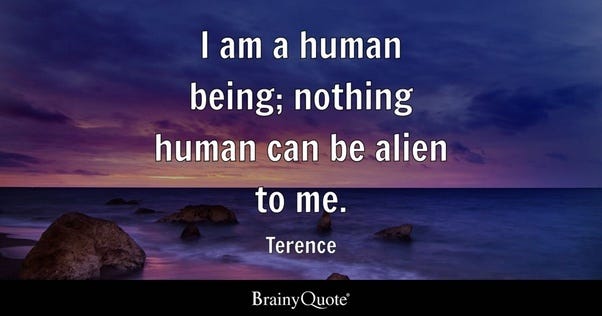
One of those reasons is inspired by an expression I’ve been primarily familiar with as an attribution to Voltaire — yes, precisely the quote I referenced above:

After being inspired by this quote for about thirty years, I discovered it wasn’t a quote by Voltaire. These are words from someone far earlier in history, Publius Terentius Afer, a Roman playwright otherwise more popularly known as Terence.

“Homo sum, humani nihil a me alienum puto.”

These are words from a play entitled “Heauton Timorumenos” (The Self-Tormentor) — Act 1, scene 1, line 77, written in 165 B.C.

The Wisdom of a Former Slave

I had lived with these words, inspiring my pursuit of knowledge of the world through the understanding of self for more than half my life before learning the truth of their origins. I’m still learning new things about it — even though I deeply value what they imply — to me.

This brings me to another quote I treasure by Picasso that he uttered in his 60s after already transforming the art world with his visions, “I am only just learning how to paint.

I loved these words the moment I encountered them because they confirmed that I was on the right track in wanting to become an artist in this world and this life. I understood that what one does to find fulfillment in one’s life is contingent upon loving what one does. The fact that there was no end to learning within art, as expressed by a historical giant, inspired me.

I would never get bored by being an artist. I would never find myself outgrowing what exceeded my grasp, and I could give myself wholeheartedly to its exploration — infinitely — or at least within the context of a finite life.

There was no way I could become complacent and detached from life by choosing a vocation of exploration of life itself. The fact that I would never learn all there could be to know wasn’t a deterrent but an inspiration and a challenge to motivate me to learn as much as possible within the finiteness of time available to me in this life.

Within this microscopic pool of choice available to me as an individual, I found enough inspiration to carry me through a life of discovery. When I imagine the vastness of a universe, we have no clue how large it is or what there may be to discover, and it seems to me that the human species can find millions, if not billions, of years of motivation for discovery.

We have certainly learned a lot about the nature of reality, from a psychological to a physiological to a physical and materialist nature, and beyond, while exploring reality on a quantum level. The fundamental characteristic of learning is that with each answer to a question answered, many more questions emerge. Answers to questions about the nature of reality appear like fractal algorithms that can spawn infinite questions.

No matter how long or how well we succeed in surviving — mostly the challenges posed by our hubris, we’ll never run out of room for discovery.

This, to me, defines the very core of the most basic lesson in life: it’s not the destination which matters; it’s the journey.

Temet Nosce