
This post is a response to a question posed in its complete format: “What is the role of contract law in regulating business transactions?”
Donald Trump has a reputation for bragging about and laughing about stiffing contractors. He’s been getting away with it because he has had the financial clout to bully his victims out of their earnings.
It may seem such behaviour is anomalous in the business world to someone clueless about its prevalence.
Working as an independent professional puts one in a position of being the lowest-hanging fruit for predators. That often means accepting jobs from people you can’t trust and who are abusive in their treatment.
Anyone starting as an independent contractor learns to navigate this predatory minefield as best they can while developing a professional reputation that allows them to increase the quality of their clientele.
Over time, one is exposed to fewer predators, but the period in which one must survive at the outset is a make-or-break gauntlet of survival because most people will try to stiff you if they think they can get away with it.
The many people I worked with over the decades that I can trust can be counted on one hand.
Many will try to weasel bonuses out of you. Many will try to move the goalposts by having you retouch and redo your work because they’re not quite pleased with the idea they were excited about before. Many will extol the greatness of your work and how their clients love it but then tell you to sod off when you want to collect remaining payments.
I had one client for whom a project that could have been completed in three months extended well past eight months because they kept changing their mind about what they wanted while they tried to figure out what their superior wanted, when that supervisor of theirs had no clue what he wanted. (That business no longer exists. Most of my former clients no longer exist as the entities I did business with.)
Much of the cost of that overrun was borne by me as I worked an inhuman number of hours (two months of overtime within three months) trying to mitigate their incompetence. I was concerned about how long the project was taking to complete.
I lost a lot of money on that project, and as an independent contractor, that means a double-whammy of loss; the loss of compensation for the work done and the loss of work I could have done for another client that (theoretically) would have paid me for other work. I have easily lost more than several hundred thousand in direct losses due to being stiffed by clients (which doesn’t factor in much greater losses from indirect losses).
I have no idea how many people I have encountered who expected my work for free while extolling the benefits of a piece to add to my portfolio.
Contract law is like a rope holding back a tide.
It indicates where the boundaries of responsibility exist between parties, but it is as effective a barrier as one has the resources to defend their entitlements.
If you can afford court costs, winning a case often means simply outspending and outlasting the other party.
This is why, after decades of struggling through that kind of nightmare and encountering abusively parasitic sociopaths after abusively parasitic sociopaths from well more than fifty percent of people one does business with, that burnout becomes a common problem for independent contractors.
This is why I could never be in Donald Trump’s presence as he brags about stiffing people who have worked for him. This is also why the business relationships one develops must be based on trust, because, unless you’re a millionaire with deep pockets, most people can’t afford to bully people into paying them or bully people out of holding them to account in meeting their contractual obligations.
Contract law is a line in the sand that protects the vulnerable from signing their rights away because no contract can contravene established laws. The catch is defending one’s rights and holding the other party accountable for the agreement made within the contract between the parties.
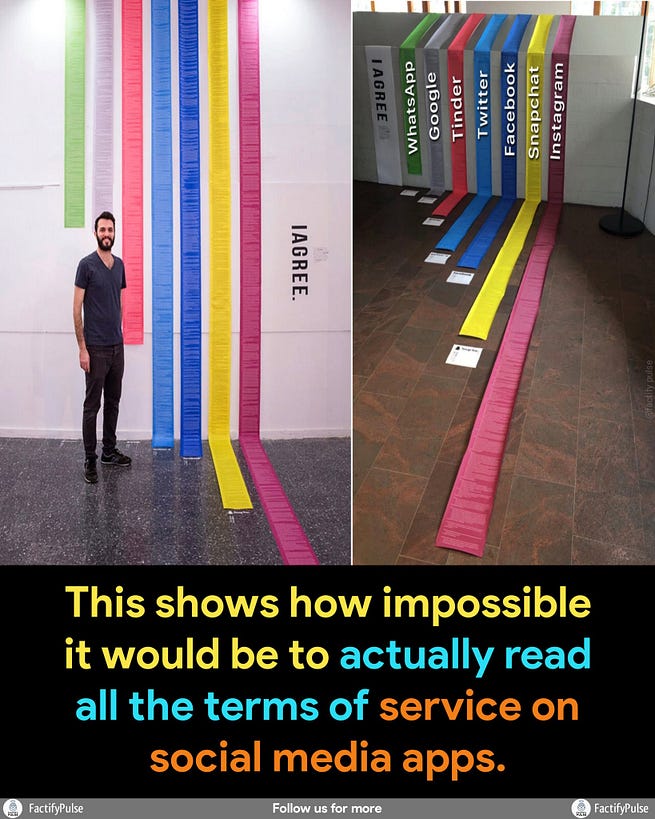
Large organizations, such as software developers who employ onerous contracts that are so overwhelming to average users, who almost uniformly never read them, can entrap people into signing away rights to ownership of their creative content. For this reason, it’s important to post only lower-resolution copies of their work. They can never assume ownership of or resell without your permission while never posting work.
Here’s an example art installation piece by Dima Yarovinsky entitled “I Agree,” which shows how entirely exploitative a contractual agreement can potentially be for creatives who rely on social media to gain exposure to their work.


 thotbag