
This post is a response to a question posed in its full format as follows: “As clever as humanity considers itself to be, has it only just began to scratch the surface of a true understanding of the fundamental nature of reality?”
This question reminds me of the Epistemology course I took at a local university over a summer off from art school. I was accepted into a third-year program without prior university-level philosophy course experience. I successfully leveraged my art school experience toward my application.
This was my introduction to understanding how language can be utilized with the same disciplined approach toward meaning as mathematics. The course material I read felt more like I was interpreting algebraic formulae than English text.
During this period, I realized access to new knowledge domains began with mastering the grammar that defined a domain.
At first, I read and reread sentences until the language made sense. I plodded slowly through the material and expanded beyond spending upwards of half an hour reading sentences to over an hour reading paragraphs and several hours reading entire pages to ensure I had developed what felt like an adequate understanding of what I had read.
This was not my first time having such an experience. Many would be surprised to discover the art world is also filled with jargon and concepts that require an equal measure of effort at the outset to comprehend the information conveyed. However, the grammar defining the art world can be even more complicated and confusing than intermediate philosophy.
Unlike the disciplined rigour of mathematical precision found in the language of philosophy, art world jargon is often subjectively defined and expressed through abstractions rather than through concrete concepts based in a material world. It makes for mixed messaging among instructors, where one adopts interpretations of concepts based on interpersonal dynamics rather than objectively defined definitions of concepts. I remember often tripping over the concept of chiaroscuro because it seemed no matter how I interpreted what is arguably one of the objective terms in art, every instructor had a different definition. I chose to favour the art history instructor’s definition over the conflicting definitions offered by my painting instructors.
At any rate, my painstaking journey through reading my philosophy assignments left me tired enough at the end of the day to sleep soundly at night and wake up feeling like I was prepared for the class discussion of what we had all read. I would attend class feeling confident that I understood the material — until the class discussions began and the instructor interjected with dialectical curveballs to illustrate limitations on some of the arguments forwarded by students.
About halfway through the class, I felt utterly overwhelmed, as if I had no idea what I had read. I felt like my confidence was entirely misplaced and that I should have started my formal training in philosophy at a more junior level.
Then it happened — the discussion veered back onto the topic I thought I had read. I couldn’t fathom how the conversation took a journey to an alternate dimension, but I was happy to see it return to the reality I was most familiar with.
By the end of the class, I was dumbfounded to discover that I was correct about understanding the material at the outset before becoming completely confused. I expressed my frustration publicly. My instructor’s response to my confusion was to say simply, “Yes, but now you know it better.”
This was a lesson for me to understand that knowing what I know is merely a product of my confidence in believing I know what I know, while what I know constitutes only the tip of an iceberg of what is possible to know about what we think we know.
For a real-world example, I still recall my experience in an interview with a recruiter who seemed impressed with me when he remarked, “Wow. You quoted Voltaire. I’ve never heard anyone quote Voltaire in an interview before.” He presented his surprise in a way that made me feel he would be in my corner and support my candidacy. As it turned out, that was the moment he decided I was disqualified as a candidate. He ghosted me after that, and I never got another opportunity presented to me through that agency.
It took me a while to figure out what had happened, but when I did, I connected that experience with a much earlier one in which I was on the phone with someone about a temporary labour assignment. I remember asking specifically, “What does the job entail?” The response I got was a very dry, “Welllll…. it entaaaaaaaails moving stuff.” I lost out on that opportunity, and the memory of that experience lingers as a reminder of my language choices and their impact on others.
I’ve had to learn to become very aware of how my natural self is interpreted from a young age when I deliberately chose to use the shortened form of my name to fit in. As a kid who became fat to gain approval from an abusive mother, I had to become aware of responses to my natural state of being from a very young age.
I know that my language choices can be offputting for some. I know that when some stranger uses the short form of my name to address me, it’s a form of disparagement that speaks volumes about their attitude. I’m pretty aware of subtleties many miss, even if I don’t catch them immediately — mainly because I’m not naturally focused on the underlying cynicism many naturally wallow in, so it can take me some time to tune myself into their frequency.
I’m using myself as an example to answer this question because I know I’m pretty self-aware and more than most, but it doesn’t matter how much I know about myself; I’m still discovering new things about myself. This isn’t to say that I’m primarily interested in myself for the sake of knowing myself, but knowing myself is a conduit to a better understanding of the world I live in — for several reasons.
One of those reasons is inspired by an expression I’ve been primarily familiar with as an attribution to Voltaire — yes, precisely the quote I referenced above:
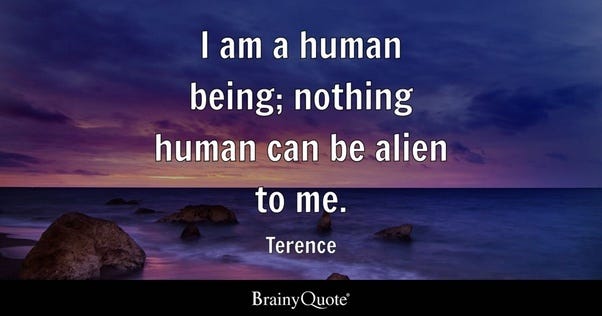
After being inspired by this quote for about thirty years, I discovered it wasn’t a quote by Voltaire. These are words from someone far earlier in history, Publius Terentius Afer, a Roman playwright otherwise more popularly known as Terence.
“Homo sum, humani nihil a me alienum puto.”
These are words from a play entitled “Heauton Timorumenos” (The Self-Tormentor) — Act 1, scene 1, line 77, written in 165 B.C.
I had lived with these words, inspiring my pursuit of knowledge of the world through the understanding of self for more than half my life before learning the truth of their origins. I’m still learning new things about it — even though I deeply value what they imply — to me.
This brings me to another quote I treasure by Picasso that he uttered in his 60s after already transforming the art world with his visions, “I am only just learning how to paint.”
I loved these words the moment I encountered them because they confirmed that I was on the right track in wanting to become an artist in this world and this life. I understood that what one does to find fulfillment in one’s life is contingent upon loving what one does. The fact that there was no end to learning within art, as expressed by a historical giant, inspired me.
I would never get bored by being an artist. I would never find myself outgrowing what exceeded my grasp, and I could give myself wholeheartedly to its exploration — infinitely — or at least within the context of a finite life.
There was no way I could become complacent and detached from life by choosing a vocation of exploration of life itself. The fact that I would never learn all there could be to know wasn’t a deterrent but an inspiration and a challenge to motivate me to learn as much as possible within the finiteness of time available to me in this life.
Within this microscopic pool of choice available to me as an individual, I found enough inspiration to carry me through a life of discovery. When I imagine the vastness of a universe, we have no clue how large it is or what there may be to discover, and it seems to me that the human species can find millions, if not billions, of years of motivation for discovery.
We have certainly learned a lot about the nature of reality, from a psychological to a physiological to a physical and materialist nature, and beyond, while exploring reality on a quantum level. The fundamental characteristic of learning is that with each answer to a question answered, many more questions emerge. Answers to questions about the nature of reality appear like fractal algorithms that can spawn infinite questions.
No matter how long or how well we succeed in surviving — mostly the challenges posed by our hubris, we’ll never run out of room for discovery.
This, to me, defines the very core of the most basic lesson in life: it’s not the destination which matters; it’s the journey.
Temet Nosce
 thotbag