This post is a response to a question posed in its complete format: “Why did people work for demanding leaders such as Steve Elon Musk? If they do not like them, why couldn’t they change their job?”
Jobs are not items in a grocery store that one can pick and choose at leisure.
Each job is a springboard to a better job or a deep dive into an abyss.
It cannot be stressed enough how critical it is to career success that one always has an exit strategy and a place to go if one’s job turns sour.
Jobs often go sour for reasons unrelated to performance and often due to abusive behaviours by management.
A personal case is one in which I was often extolled for my leadership skills while my supervisor would say to me, “You run a tight ship.” He would say these words to me while appreciating how much easier his life was due to my contributions. When I asked him for a reference letter, he wrote me a generic description of my length of employment as an act of spite to limit my options. He deliberately wanted to make it harder for me to make a vertical or even a lateral move away from an abusive environment in which he fraudulently presented himself as an ally who empathized with the abusive treatment I received from his supervisor.
Making matters more challenging is that jobs often go sour to such a degree that they are worse than not having a reference to support one’s candidacy for the next job. In my case, the Senior VP decided it would be fun to play a game of pretend I don’t know you each time we encountered each other. This went on for five years while I struggled with a salary 40 percent below market for my role on paper as I performed at levels higher than the manager and director above my role. They were happy to have me around, while I often saved their bacon and changed their tunes quickly when I chose not to go above my role and intervene to fix their mistakes.
A job relationship gone sour can become a barrier to continuing one’s career. More people than one would like to believe will easily choose spite to justify sabotaging a person’s career development efforts.
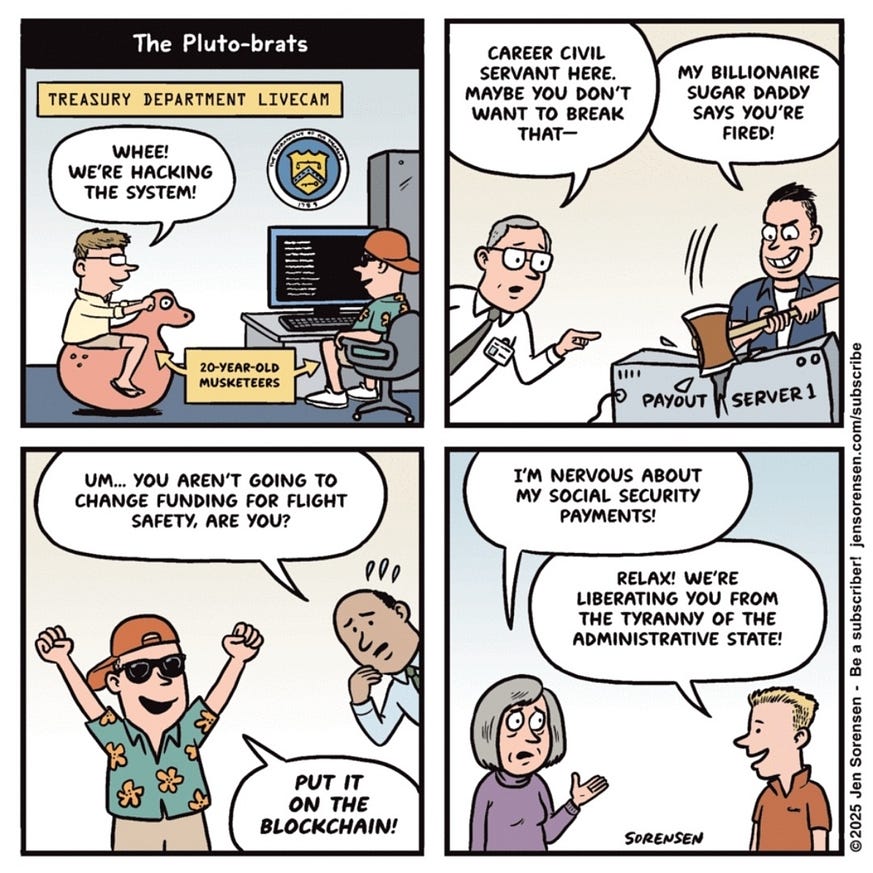
Someone as petty as Elon Musk could easily justify going to cartoonish lengths to destroy a person’s career on a whim. In his case, his reasoning is a consequence of the corruptive effects of too much power for anyone to possess.
Changing one’s job was much easier when we had a thriving middle class and various job options outside the structured and incestuous corporate world. Job options have become severely limited throughout the last several decades, in which one’s only choice for a stable career has mostly become a choice of serving as a cog in a multinational organization while hoping restructuring efforts don’t result in it vanishing overnight — like what happened with Twitter when Musk fired most of his staff on a whim.
Musk’s latest attempts at accessing the personal data of three hundred and fifty million Americans are precisely for controlling their lives by leveraging their histories against them. Our choices in working for leaders we don’t like are becoming increasingly restricted to either that or homelessness and destitution. That’s not much of a choice.
If this nonsense continues, no one will be free to do anything without his oversight and the oversight of a fascist oligarchy.
This post is a response to a question initially posed on Quora, and can also be accessed via “What could be the main reasons some people experience stagnation, even if they aren’t lazy?”
Trauma and burnout are immensely impacting causes of inertia in one’s life. Burnout often precedes depression, and severe trauma can result in Executive Dysfunction. Depression can be debilitating, and Executive Dysfunction is scary AF.
Imagine waking up daily with a laundry list of activities you sincerely want to do, but your “round-to-it” never makes it off the couch for some indiscernible reason. “Yeah, yeah, yeah — I’ll get around to it.”
Weeks later… that five-minute job of daily housecleaning is a prohibitive three-day adventure you decide is no longer worth the effort. It’s better to return to doing nothing while thinking, “Tomorrow’s another miserable day when it can be done.”
Loss of hope for one’s future is a terrible thing to experience that can lead to all sorts of ugly and tragic outcomes. Restoring hope is the fastest way to cure one’s depression and worse.
Our economic dystopia is the main culprit of many of our social ills today, and it’s leading us down a dark road just like it did last century when it gave rise to fascism and the Nazi scourge to ignite a global war.
It’s mind-boggling to me that both the victims and perpetrators of this centuries-long class war so easily overlook such a prominent issue that it never seems to stop being waged against the little people.
It’s harrowing to realize how conceptually straightforward it is to avoid chaos and how impossible it is in practice to prevent it.
There is something so intoxicating about having power that people think of themselves as insulated from all the harm they do to countless others with impunity.
The worst thing about Trump, for example, isn’t the damage he’s doing with his decisions and actions. That he can continue wreaking havoc while he should, by all forms of reason that claim to value the concept of justice, be rotting behind bars right now — that causes us all the most harm. His freedom is the grossest of violations of the social contract imaginable.
His freedom confirms that there is no value in decency, integrity, honesty, trust, or responsibility. His freedom is an encouragement of every rotten behaviour and attitude imaginable by humans. It’s a veritable permission to be our worst selves. His freedom is a purge of our humanity.
Why TF should anyone think they have a future if that future means having to become a grotesque monster who is willing to destroy lives to get some money for themselves?
When push comes to shove, I doubt few people would trade having a loving family and being surrounded by a community of people who care for you as a person for a gold toilet.
Since that’s the world we live in today, that’s deeply depressing. What kind of person can believe a hopeful future awaits at the top of a garbage heap? It certainly isn’t the best of humanity.
It’s the kind of world most decent human beings don’t want to live in. With that in mind, it shouldn’t surprise anyone that birth rates are plummeting because what decent human being wants to tell their kid to learn how to manage their plastic intake enough to minimize the health risks it poses while admitting they did as little as they could to prevent this shit from getting worse.
“Yes, kids… I decided not to vote because I didn’t care enough to know the difference between parties and just decided to believe they’re all the same, so I said fuckem, let them turn this world into a shithole for my kids.”
In short, the main reason people are experiencing stagnation is the same reason they experienced it during the fall of communism as a system of governance. We are failing ourselves because we are failing to demand better from our leadership instead of holding their feet to the fire. After all, that requires risking one’s perks and benefits in life; w may as well let them do whatever they want so that we can complain about how shitty things are and be able to say, “I told you so.” when it all turns to shit.
This post is a response to a question posed in its complete format: “Why won’t rich people just donate a tiny bit of all their wealth to poor people?”
Some of them do. MacKenzie Scott, the ex-wife of Amazon founder Jeff Bezos, has donated over $17 billion to charitable causes since 2019. Our problems, however, can’t be fixed by relying on a few donations by the small percentage who care about other human beings beyond themselves.
People need to stop thinking about ways to guilt the few rich capable of feeling guilt into ponying up on behalf of those who don’t care in the least about the poor as long they shut up and die quietly and out of sight.
Why do you think “hostile architecture” exists?
A lot of people don’t want to help the poor. They want them gone out of sight and out of mind. They want to blame the poor for creating their conditions of poverty.
They want to think of them as lazy addicts who irresponsibly ruined their own lives.
It’s no different than shaming a woman for her clothes or behaviour for inviting a rapist.
It’s like shaming a mugging victim for paying cash for their drink in broad daylight.
People don’t want to think about why things go wrong for other people because it means dealing with the possibility that things can go wrong for them. If people believed they could also become one of “those people.” many would just give up, while others wouldn’t be able to function past their anxieties.
Although the existence of centibillionaires is a huge symptom of a system so broken that so many poor exist, no one wants to change anything because it means having to do things differently than they’ve become used to.
Look at how impossible it’s been for Americans to adopt a universal metric system — even though it would save them money.
Look at how impossible it’s been for Americans to adopt universal healthcare — even though it would save them money and lives.
People may demand change, but they hate change. Many people prefer complaining about how bad things are to doing something different because they fear change will be worse than what they’ve gotten used to.
My province of BC has had three referendums on electoral reform that would have made our elections more representative of the people. We would have become a more democratic province that more effectively addressed the needs of the people if the people could vote for what they want rather than vote against a change they don’t understand. Even worse, the change is easy to know if one makes a small effort to educate themselves, but they don’t and won’t understand something until they’ve lived it. When people are unsure, they consistently vote to maintain a corrupt status quo instead of voting to change it.
Americans are going to continue voting for corrupt leaders until they realize their lives are at so much risk that the choice is no longer “change or continue suffering” but “change or die.”
That’s where we are right now… or at least, those who refuse to read the writing on the wall will eventually figure out that’s the case when they start seeing the suffering around them can no longer be denied. They will change only when they become more afraid of maintaining a destructive status quo than the change they can’t understand until they’ve made their change.
Rich people won’t give up their wealth, even in part to sustain a failing system until it fails so badly that they start running and hiding for their lives from the mobs who are angry enough to repeat history. They won’t change what they’ve gotten comfortable with, even if it means they’ll end up more prosperous.
This is why “woke” is such an important concept these days — because we are at the stage where a lot of people are sick and tired of screaming “Wake up!” to people who insist on ignoring the threat they’ve become to our future.
The bullying Nazis among us still think they can play their bullying games endlessly while laughing at the “librul” tears they imagine are being shed out of frustration without realizing those tears are being shed because of what comes after those tears… the mourning of having to do what could have been avoided.
The few wealthy people cannot, through donating portions of their money, fix what’s broken.
The system needs to change on fundamental levels enough to force the greedy sociopaths to acknowledge the critical importance of maintaining a universally sustainable social contract. They need to understand the benefit of giving up some of their money to pay back into a system that allowed them to become rich in the first place.
Allowing a small number of elite few to grow hoards is not how to develop a sustainable economy or lift people out of poverty.
People like Musk know this. They don’t care because they see themselves as entitled to rule over the rest of us like we were herd animals.
Eventually, someone like Musk will push society far enough for the guillotines to come out and put his head on a pike. He doesn’t believe that’s what he’s inviting into his life. He thinks he is untouchable… just like Trump thinks he’s untouchable — that no one would dare do the unthinkable.
Suppose Trump decides to start a war with Canada, and NATO steps in. In that case, the chances of an American military officer putting a bullet in his head on the brink of launching a nuclear attack against a long-time partner becomes a very real possibility. Just because he’s the “commander in chief” doesn’t mean he has carte blanche to do whatever he wants. Everyone has limits. That’s just life. We must acknowledge that and protect them for everyone, for all our sakes.
We don’t know right now what those limits are and what it will take to cross that one bridge too far… but if or when it does happen, there will be chaos in the streets. We’ll be spending the next hundred years dealing with profound regret while armed with microscopes to examine in micro-detail how it could be that we allowed this nightmare to go on as long as it did.
We will be kicking ourselves with the kind of regret that will change us forever in ways that will horrify us deeply if this happens again. We should be paying attention to how the German people have had to cope with their recovery from the madness that overtook them. We should be learning from history, but 76 million people voted for a repetition, while another 80 million said they didn’t care enough to do anything different but pretend it wasn’t their problem to solve… so they made it their problem and everyone’s problem.
Meanwhile, it’s unfair to the few wealthy who are generous and care about humanity to put the onus on them alone to solve the problems we all have a responsibility to solve.
If that means we have to start punching Nazis to get them to develop enough humility to behave like human beings, then we need to start swinging as if our lives depend on it because they do.
Nothing will change until we take this dystopia seriously enough to deal with the threats we face in the form of hatemongers who feel themselves entitled by God to rule this world.
If there’s one thing we can learn from Luigi Mangione, it’s how overwhelming this problem is and how overpowering the enemy is. They’re not taking any breaks now that they’ve been given the keys to transform the landscape radically. They’re putting the pedal to the metal, and if it means running over millions of homeless people with a bulldozer, then so be it.
They don’t care about the poor. They are happy to destroy the easily victimized among us.
Why do you think they’re starting with schoolchildren?
This post is a response to a question posed in its complete format: “Do you feel that Wal Mart employee’s lack of performance could be due to the fact that welfare literally forces people to accept a job offer or lose benefits that provide Food and Housing? Support #UBI”
When employers don’t care about their staff, their staff stops caring about them.
When employees stop caring about their employers, they disengage and produce the minimum they can get away with. They focus less on productivity and more on toxic politicking to gain personal benefit over others in an increasingly misanthropic culture that pits people against each other.
The sociopathic Walton family is teaching their people to hate them, their operation, and the society which permits them to exploit the vulnerable. Their people, staff and customers are being virtually trained to devalue everything about human life and modern society. This naturally results in the disengagement that every other historic failure of society has experienced preceding widespread systemic collapse.
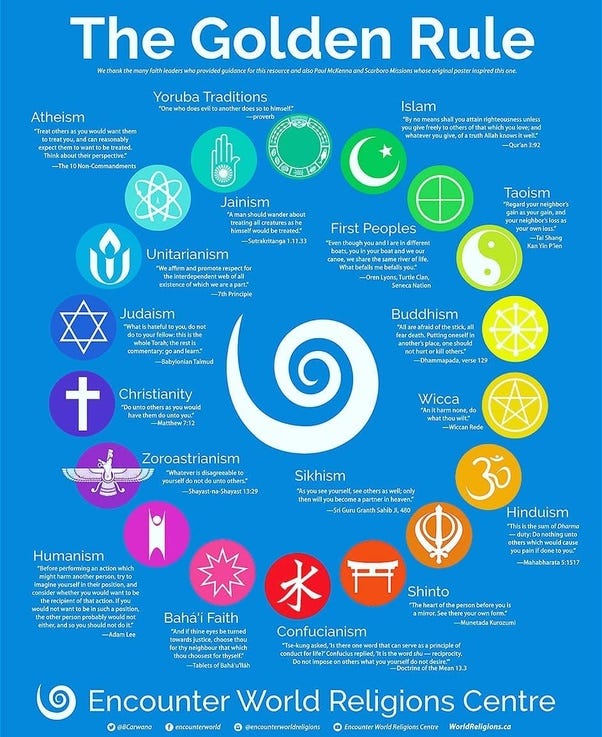
This isn’t rocket science. It’s reciprocity.
Most people understand it clearly as “you get what you give.”
Sadly, we’ve allowed our societies and our systems to forget the most critical principle to acknowledge and characteristic of the human condition to preserve within everything we do. Strangely, it’s also a core principle within almost every religion throughout the history of religion.
It’s not complicated in the least.
Even science acknowledges it.
It’s cause and effect.
“Do Unto Others As You Would Have Them Do Unto You.”
It’s only a matter of time before the greedy, misanthropic Walton family finds themselves confronted with the bill for the consequences of their sociopathic and parasitic disdain toward society. In effect, they are no different than this person who justifies shoplifting.
They are responsible for breeding this kind of thinking because this is precisely their reasoning as they disempower their people and force them to rely on government assistance so that they can increase their hordes in an escalation of the misanthropic decay of society.
They are spitting on the social contract from the comfort of their luxurious mansions.
They are no different from this person and are responsible for validating this skewed justification.
UBI is a basic correction to veering off-course in the last several decades. UBI is insurance for the transition toward automation, which is well underway. UBI is a stabilizing societal element that will eliminate poverty, homelessness, and various social problems that create conflicts from which we all suffer.
This post is a response to a question posed in its complete format: “Is it okay to not be okay after all people have put you through like the damage has been done?”
Either yes or no, depending upon how one interprets the perspective behind this question.
It’s not okay that you’re not okay, but it’s not okay because of anything you need to be ashamed of. It’s not okay that people have done what they have done to make you not okay.
You don’t need permission to be not okay in the same way you don’t need permission to eat when you’re hungry or use a bathroom when you have to go.
Being not okay with damage done to you is a natural consequence of the damage.
No one escapes being damaged to feel okay, no matter how much they try to shake it off.
Damage is damage.
If your car gets a punctured tire and is flat, you can’t ignore that damage without doing more damage to your car.
Your body and mind are the same.
If you can’t heal and you try to ignore the damage done to you, you will damage yourself and others along with you.
Your highest priority should be to heal, just as if you’ve broken a leg and need to give your bones time to mend.
The mind is no different.
You can’t continue like nothing happened.
It’s not okay that you’re not okay; you need to give yourself time to become okay again.
It’s also not okay for someone else to make you feel like something is wrong with you for needing time and space to heal from your damage.
If that’s the expectation you are facing and what prompted your question, then be aware that such an expectation by others only harms you more.
It’s called victim-shaming, and it’s a heinous attitude and behaviour indulged in by broken people who are not okay themselves. They never took the time to heal, and because of that, they don’t know how to respond to you by doing you damage.
It’s evil behaviour that you should not not tolerate. It would help if you told them that it’s not okay to make you feel not okay for not being okay.
This post is a response to a question posed in its complete format: “Why do some people say that eccentric introversion is masculine while extroverted conformity is feminine?”
The rule of thumb when referencing “some people” is that it means nothing more than individual bias.
Here’s an example of “some people” — one person in this case whose attitude is entirely predicated on bias and without effort in researching a topic to develop a deeper understanding of the subject they’ve indicated an interest in.
Digging deeper into the mind that seeks validation for their bias, one notices several examples of fact-free bias that they’re mining validation for instead of educating themselves on the topics they express a fraudulent interest in while disguising their biases as concerned questions.
If you look through all these questions, you’ll notice that they are all mining for validation for their biases. I won’t share this profile’s identity because it doesn’t matter. This person is just one of the “some people” you’re wondering about with your question.
The last two questions in this list highlight the nature of a subjectively focused mindset.
First, they’re interested in relieving their boredom but don’t realize the most effective way to accomplish that goal is to educate oneself. If they did that, they’d find their minds too occupied with information to be bored.
Admittedly, this conclusion is a bias that I developed early on in my life when I encountered an assessment of the statement “I’m bored,” which described that declaration as a way of saying “I’m boring.” It is pretty accurate because none of these questions reflect any depth of consideration for the topics raised.
The last question sums up their attitude toward learning as a limited benefit that fails to go beyond acknowledging value within applied knowledge that can be leveraged for pragmatic applications.
The consequence of this attitude toward learning is to limit one’s understanding of subjects one seeks insight into. In the example of the first question, they’ve already decided that “laziness” is a valid presumption upon which to build their biased views of the world.
For example, an answer they received likely skipped past their perceptions beyond the level of novelty.
It would not dawn on them to reconsider their definition of “laziness” because of this answer beyond possibly acknowledging that laziness isn’t a universally undesirable characteristic. I sincerely doubt they would be prompted into researching causes of motivation and apathy or even bother to investigate mental health issues like executive dysfunction.
“Laziness” is “laziness” to this person and will remain so because they’re not interested in expanding their understanding. They’re interested in being entertained at a shallow and briefly distracting level to escape boredom in the most practical manner they know by catering to their ego.
This is now where I get back to your question and point out the nature of the broad brushes used in the presumptions formed by the attitudes you’ve identified.
The telltale sign to knowing whether someone is interested in developing depth in their understanding of subjects or whether they’re simply mining for confirmation bias lies in the size of the broad brush they use to smear demographics that are largely undefinable beyond a generic level.
Terms like “eccentric introversion” and “extroverted conformity” are subjectively defined biases that are not scientifically valid. For example, psychological authorities recognize different forms of introversion but don’t use judgmental terms like “eccentric.”
Here’s an example of four types of introversion as described by an authority in the field:
“Anxious introversion includes staying home from the party but for a reason. The anxious introvert feels self-conscious, and even when they’re alone, they ruminate about their social interactions.
Social introversion is a person who always says no to going to a party. They’d much rather be home doing some solitary activity. When they do socialize, they keep to small groups. This probably ties into that feeling of exhaustion. Introverts derive energy from solitary time, whereas extroverts feel energized being with others.
Thinking introversion means you’re pensive and introspective. You look inside yourself and self-reflect often. “People with high levels of thinking introversion don’t share the aversion to social events people usually associate with introversion,” writes Melissa Dahl. This rings true for me (and it’s where I score the highest on the quiz).
Restrained introversion means it takes you a while to get going. You don’t jump out of bed, ready to embrace the day. I can imagine this translates to being quiet or standoffish in social situations but would later blossom into more participation in socialization. “It takes her a while to warm up,” my mother always said.”
The descriptive terms used are non-judgmental observations of distinctions between characteristics.
“Eccentric” is a value judgement, not an objective description of a behavioural trait.
“Extroverted conformity” is the same kind of value judgement of a behaviour, not a clinically valid description of the behaviour they’ve identified.
By associating these judgments with genders, they’ve described their gender biases in full detail with few words.
The short answer to your question is what I indicated in my first sentence, “some people” are biased. They pass off their biases as valid judgments to entrench those biases within the public consciousness in society, and we end up with stereotypes built upon pre-existing biases.
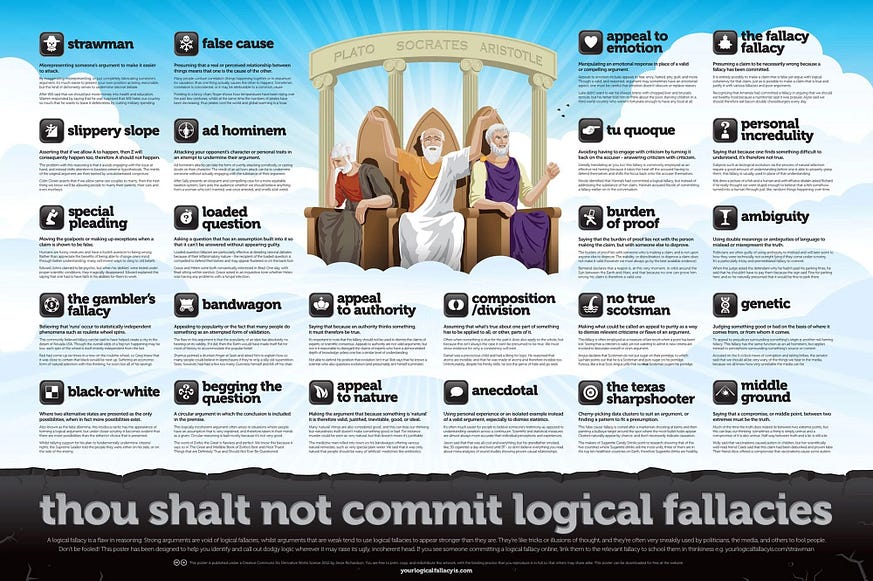
Another characteristic of bias is when people preface their presumptions with a logical fallacy called the “bandwagon fallacy.” It appeals to the suggested popularity of a concept to grant it authority that otherwise does not exist. We’ve seen this behaviour often with the less reputable pseudo-news media outlets. They’ve overused it so much that it’s become a popular trigger for people to recognize that what follows is a bogus claim.
The expression “some people” has become a running joke that “some people” instinctively react with skepticism. I doubt you’ve heard “some people” make those statements and that they are fabrications you’ve made yourself to displace responsibility for the biases they invoke.
Your profile and question history lend credibility to my hypothesis because many of your questions wallow in subjective bias. You indicate that you’re 23 years old, making your logic errors much more forgivable than someone somewhat senior to you who should know better than to wallow in stereotypes.
Hopefully, this long-winded answer gives you some insights into how to be more objective and authentic within your future querying while realizing that people often reveal far more of themselves than they realize.
As a bonus, here’s a poster for a few common logical fallacies that many people are often guilty of committing.
The concept of truth spans both the objective and the subjective.
“Truth” is “the sun will rise tomorrow.”
“Truth” is also “I am the master of my destiny.”
The former version of truth can be objectively measured and experienced in equal terms of empiricism by all.
The latter is a subjective determination of one’s capacity and is essentially different for everyone.
What this means is that this question requires context for precision and clarity, but it can also be answered by simply saying, “Nothing is the same for all people, not even the colours we see.”
Perception can be considered a form of experiencing “truth,” but no two people share an identical experience of a perception of an event that both will have simultaneously experienced.
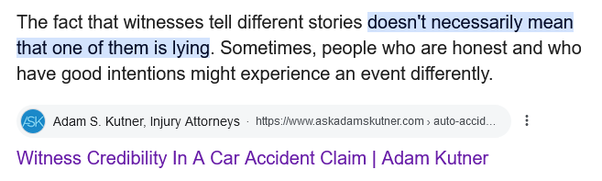
Witnesses to an accident, for example, will often recount vastly different descriptions of the event.
This leads us to another answer, “Truth is what we can agree on. The greater the agreement between the greatest number of parties is most likely the closest form of truth we can attain.”
This is also problematic, however, because this entails the evocation of a logical fallacy of populism — or the “Bandwagon Fallacy” — “Ad Populum Fallacy” — and is precisely what we are struggling with in society today with the consequences of having our perceptions deliberately massaged to create an interpretation of a truth which abandons objective clarity and retreats into subjective bias to affect the world.
This is problematic because popularity is a metric for bias, not truth, and it can be highly destructive to society — as we’re about to learn in a very uncompromising fashion.
This leads us to a third answer, “Truth is a combination of an agreement upon perceptions as supported by empirically tested and proven realities.”
In short, the scientific method is the most accurate means for deriving an objective “truth” for our species — because it requires testability and predictability to determine its degree of accuracy in a rendition of reality.
At this point, we arrive at a final answer: “Truth is an accurate depiction of reality which exists independently from people.”
The same “truth” is available to all people, but all people must make the same trek to arrive at an objectively supportable perception of truth — otherwise, their “truth” is a self-serving delusion.
They use slogans and soporifics to reinforce tribal associations and loyalties while motivating them to unite in solidarity over perceived common causes.
“Low taxes” “Small government” “Fiscally conservative” “Save the unborn babies”
They use slogans to ignite passions driven by anger, envy, fear, and hatred to motivate them to act in solidarity against perceived enemies.
As long as they can convey their ideas within a few syllables and tweak people’s emotions while doing so, they never have to bother with nuance, insight, context, complexity within grey areas, or even hypocrisy, for that matter.
None of their positions are consistent in any way. They can’t be, but it doesn’t matter to the uneducated because they don’t want to parse their slogans for meaning. They want to remember them well enough to hurl them as weapons, while the extent of their political arguments amounts to the level of a cheerleader for a sports team.
They hate the “nanny state” but demand draconian government measures to rule their lives.
They want a government that’s so small it fits inside every woman’s vagina and monitors everyone’s lives with Big Brother oversight without realizing how that bloats the government. They demand government expansion to incorporate unnecessary and paranoia-quelling functions that increase the problems that would otherwise not exist without their efforts to make issues manifest as problems.
Trans people pose no problem to society, but because they don’t fit preconceived notions of what is an acceptable definition of a human, they’re rendered as threats without any justification for the unimagined threat they allegedly are. Ask them how another’s marriage impacts them, and they immediately resort to abstractions rather than concrete reasons why their personal lives are threatened. Wisps of the imagination threaten them because that’s the natural consequence of ignorance.
They want low taxes and think it’s only fair to lower taxes on the wealthy. They believe the rich people they envy will trickle down their wealth to them and improve their lives because they both hate intelligence and revere what they interpret as intelligence in the accrual of riches. They can’t discern between the two because they can see wealthy people all around them who are just as intelligent and under-educated as they are. That prompts them to believe they’re smart enough to become just as successful. In this case, they’re not far from the truth but overlook variables like privilege, luck, and association as primary influences of wealth acquisition.
Fortunately, the primary solution to the problems they cause in society is already presented within the question. Education.
We can improve our education systems so that people are not intimidated by education simply by teaching them to love education.
It’s not that daunting a challenge.
Much of education is a process of rote remembering rather than teaching critical thinking skills.
Education should equip all learners with the appropriate attitude of education as a lifelong process. Once people understand and embrace the value of an education-oriented mind, they become less prone to being led around like lost sheep and begin to parse information in greater depth. Once one learns to love education, they also learn to love nuance because they appreciate the subtle shifts in perspective the mostly invisible aspects of communication convey.
For example, people are fascinated by and love learning how scams are set up to exploit the naive because the insights they get improve their sense of security. Once one knows how a grift works, one feels less intimidated and more secure when encountering a grifter.
Most people no longer fear Three-card Monty because they know how the game works and often partake for the sole pleasure of spotting the trick moment that swaps out the card to fool people.
The problems in today’s world are far more daunting than a simple game, and the complexities we have to deal with in modern living are overwhelming to the undereducated. Without bringing them up to speed, we’ll see an increasing division between those who are privileged enough to gain a proper education and those who resent them for being deprived of life skills they’re daunted by but innately understand are necessary advantages in today’s world.
They will often mistrust the educated because they can’t figure out the game being played, and the paranoia of being manipulated by someone whose education intimidates them drives them away from the potential assistance they can gain from them. It’s much easier for the under-educated to affiliate themselves with others who echo their struggles. It’s much easier for the under-educated to trust someone who speaks in the same simple language they do because it makes them feel like life hasn’t left them behind.
Until we improve our education systems such that education is universally viewed as a fundamental support for a stable nation and make it universally accessible at all levels, we will continue to struggle with the impact of our failure to equip our citizens with the skills necessary to develop a fully manifested democracy. As long as we continue to abandon the under-educated to the wolves, there will always be a political party seeking power through the exploitation of their ignorance.
This post is a response to a question posed in its complete format: “How do you deal with people who belittle you and try to sound like they’re smarter than Einstein?”
I think it’s important to separate how one feels about the language a person uses to communicate with others and their expressions of intent.
If one is being condescending, it’s generally quite clear in their word choices and the subject they focus on when conveying their thoughts.
In other words, instead of focusing on the subject, they focus on the person, which, in this case, would mean you.
In a communication dynamic, a person’s estimation of a relative degree of intelligence between oneself and the other results in a subjective interpretation of the other’s intent. In other words, when people feel insecure and conversing with someone whose language choices are intimidating, they can often misinterpret the other’s intent.
They may feel that person is choosing “big words” to puff themselves up when that’s not their intent. It would be a misinterpretation of another’s actions due to one’s insecurity. It is important to separate one’s feelings from the interaction to ensure one’s reading of the dynamic isn’t coloured by one’s biases.
They may not be condescendingly treating them and merely use language they are most comfortable with when attempting to communicate with someone else. (As someone who has been accused of using pretentious language myself, I appreciate the opportunity to explain how my language choices are primarily intuitive and from an attempt at being as accurate in my communications as possible. I cannot speak differently any more than I can change my vanishing hair. It’s just who I am. Every one of us has a natural style of communication that works for each of us, and it doesn’t mean you have to “read between the lines” to ascertain what I “really mean.” — This brings to mind a favourite song of mine by The Animals, “Don’t let me be misunderstood.” –
)
Often, a person isn’t “trying to sound like they’re smarter than Einstein” but instead chooses words they believe are the most accurate representations of their thoughts.
As mentioned above, their focus is the key to spotting the difference. If they focus their responses on you as a person while choosing obtuse language to try to confuse you, then you know they are being condescending.
It might help to know that when someone is condescending, they also convey their intimidation through the discussion. They may feel that the effort spent in communication is not worth their time, or their goal is to make themselves feel better at your expense. In such a case, you will know that whatever information they have to convey could be more credible.
A naturally intelligent and well-informed person is usually happy to share their insights with others in an agnostic manner — as long as the other party is respectful in their attitude.
You can see that everywhere here on Quora. Some brilliant people here patiently explain simple concepts in great detail because they want to share what they have learned. Sharing is caring in this context.
When a person behaves condescendingly, they’re not interested in sharing or caring about others and let that be known in many different ways, while condescension is just one.
Another example of disparagement is providing hints of insights and then turning the tables on the person they’re speaking to, informing them that they should know the rest, and filling in the conceptual gaps on their own. If they can’t, they imply something is wrong with their victim’s character.
If you are uncertain whether someone is condescending, the most effective strategy is playing dumb.
Seriously.
It may sound counter-intuitive, but it works as a strategy.
Straight up, ask them what they mean with a confused expression to make it clear you’re not following their words and piecing them together in a way that makes sense to you. Be sincere in wanting clarification, and that will allow them to reflect on their attitude.
By playing dumb, you can defuse their defence mechanisms. You can encourage them to re-evaluate their communications in ways where their internal defences are not on alert to bring out condescension as a dialectical weapon to (pre-emptively) defend themselves.
This means that condescension and abusive attitudes are generally all born of insecurity on their own, and they often occur through subconscious responses to the person they are interacting with.
That person may not realize they’ve been condescending or abusive, and playing dumb is like knocking the wind out of their defence sails.
If they can be assured you’re not a threat, they are forced to re-evaluate their communications and make an effort to focus on the subject at hand.
Ultimately, by playing dumb, you may gain their trust and develop a valuable pipeline to an insightful source of information.
If playing dumb doesn’t work, then you know their information isn’t worth the effort to parse. They’re too caught up in their egotism to share their insights and are best left alone.
The first place to start is to give up the notion that being “right” or “wrong” matters more than being accurate, informed, and knowledgeable.
“Right” and “wrong” are egotistical expressions that either stroke one’s sense of self or dismantle one’s self-confidence. Neither is helpful to oneself, others, or the issues at play.
As I often find myself checking out profiles to gain context into the querent’s mind, I did so with yours and am pleased to discover that you’re already on the right track.
Fundamentally, we’re all fumbling about in the dark and clueless, even about things we think we know. The worst thing we can do is believe we are “right” because that perspective contributes nothing to one’s growth and kills one’s ability to explore beyond that point.
No matter how “right” we might feel about something or how complete we think our knowledge of something, there is always something to learn about it that will be new to us. There is always a different perspective on that thing that we have not yet encountered.
If we could all adopt the perspective of being clueless, our world would experience far fewer conflicts because people would be more open to the perspectives of others.
Unfortunately, we live in a world built upon the foundation of exploiting insecurity at all levels throughout society — whether selling hair products or climbing corporate ladders. Insecurity has been weaponized as a tool of manipulation for personal gain over and above benefiting society as a whole.
We have never been more fortunate than we are today when confronted by the limits of our knowledge and understanding. Solving the problem of being unsure about one’s position means simply whipping out one’s means of accessing a comprehensive knowledge base to conduct basic research to verify if one’s position contradicts facts.
There is no real point in engaging with others to determine if one’s compass setting on knowledge is on true north by triangulating it with the settings of others because one is just engaging in an egotistical fencing match at that point. Online “debates” are often more about egotistical masturbation than they are about deriving an objective apprehension of issues to determine pragmatic resolutions.
Sharing information obtained through research efforts is far more rewarding and less prone to conflict over subjectively defined notions of being “right” or “wrong.”
One can still certainly derive flawed conclusions on matters, but that’s also a function of incomplete information that may be deemed “wrong.” Adding to one’s information base is less about determining “right” or “wrong” and more about ensuring the completeness of knowledge in a subject domain.
Knowing the difference in a dynamic with someone else on this level is essentially determined by whether or not the critic of one’s knowledge adds to one’s information base or disparages one’s person as a reaction to the information conveyed.
To directly answer your question, after all the verbiage I packed into this long-winded answer, is that you will know by the content of your critics’ arguments.
You can always deem yourself “not wrong” if the other party adds nothing to your position. If they can add valuable information to expand your knowledge base, you can still consider yourself “not wrong” while learning to be “more right” by their contribution.
This is how you can preserve your superior perspective of evolved humility by remaining confident in being clueless.
Congratulations on achieving a higher level of awareness than most of us monkeys ever attain throughout our very challenging lives.























 thotbag