This post is a response to a question posed in its complete format: “Sometimes I cry inside myself that I’m not like other intelligent people in my school and it hurts me every single day. I want to do my best but it just feels hard and my motivation dies off quickly. How can I motivate myself and feel less miserable?”
You joined Quora about three years ago and appear to have only two questions, including this one. The other question is about the lack of support and apparent abuse you endure from your parents.
It seems you are dealing with some intense emotional struggles that you do not deserve. However you perform in your academics and to improve yourself and achieve your goals, your parents have a moral obligation to be supportive.
Since they are not, you get saddled with the doubly hard challenge of finding your way through life’s confusing mess.
It’s not fair to you, but it may help you to understand how utterly broken most of the world is. We live in a world where a whopping majority (70%-80%) of families are dysfunctional.
You are not alone.
You can overcome your challenges.
A few things to consider while struggling to make something worthwhile of your life include;
Focus on doing what you love doing. By investing your energies into something that brings you joy, you can create successes that will help you develop the confidence and motivation to succeed in other areas of your life.
Find people who can empathize with your struggles — mainly because they endure similar struggles. Develop friendships with them to experience the emotional support your parents cannot give you.
Read and read a lot to experience life through different eyes and learn to understand the complexities of life and its struggles through perspectives different from your own. Learn from what other minds have to teach you, and you will find strength within that you cannot feel now.
Get a pet, if you can — a dog or a cat that can fill your heart with unconditional love and give you a reason to carry on through your toughest challenges.
Spend as much time as you can with nature to feel that you belong here and to something much greater than the box of sorrow you have been given to bear.
Know that nothing matters more than your ability to grow and change and adapt to an increasingly chaotic world undergoing a dramatic change that is pushing all of us to our limits. If we can survive this period of change, we will find a much friendlier world awaiting us on the other side of these challenges.
Believe in yourself even when you make mistakes. Indeed, feel good about recognizing your mistakes because they are lessons you have succeeded in learning. It is much worse to make mistakes without identifying them as mistakes. It means you will repeat them like banging your head against a wall and hurting yourself even more.
Allow yourself to see your parents as human beings like all other human beings. All of us have been damaged in some form or another by life, and it is a consequence of having undergone generations of struggle to emerge from a darkness of barbarism.
Whatever you do, if you approach it with honesty, you are doing your best. You don’t have to try to do your best. You will always do your best if you are honest with yourself about what you do. Expect nothing more from yourself than complete honesty because knowing yourself matters most in your life. Knowing yourself is where you will find the strength to endure all the many challenges your life has in store.
I wish you all the best in your journey through this madness called “life.”
This post is a response to a question posed in its complete format: “Why does the right wing complain about the left wing far more on the internet than the left complains about the right on internet podcasts, etc.?”
I haven’t performed any surveys, nor am I aware of any statistics on the matter. I have, however, noticed a distinct difference between the nature and characteristics of the criticisms levelled.
The “left” generally identifies toxic characteristics from the right that erode or betray the social contract through blatant forms of bigotry, hypocrisy, projections, generic hatred, and unfocused rage.
The “criticisms” from the “right” are generally simplistic accusations one would expect from grade-school children. Very little thought is put into their concerns while choosing to wield broad brushes of hatred that are often confessions disguised as accusations.
I’ve used a broad brush to describe these general differences but am hard-pressed to think of criticisms from the right that are not embarrassments to the concept of critical thinking. It’s not that they don’t exist. They’re so rare that one has to focus on dredging up examples through a mountainous garbage heap of blatantly childish spite that they appear almost entirely non-existent.
Another salient difference between the two polarities is the concern for the victims of horrifically bad policy expressed by the left and a maddening sociopathic disdain and even Machiavellian pleasure taken in the notion of victims of bad policy justified through a lens of righteous indignity.
At almost every step and instance, whenever conservatives talk about the victims of bad policy, they seem to gloat their pleasure over the thought of people suffering needlessly.
Another characteristic that distinguishes political polarities is how willing and eager the right is when defending the 1% responsible for trillions in theft and the destruction of the middle-class quality of life. The right seems entirely oblivious to the causes of their anger and prefers to victimize further the victims of those responsible for their misery. One can only conclude that another characteristic common to conservatives is intellectual cowardice.
They would rather crap on the weakened and easy victims than hold the people responsible for their misery accountable. It’s like watching someone beat up on the victim of a mugging rather than go after the mugger because they’re too afraid of the mugger and would rather cozy up to them while hoping to have a few pennies thrown their way for how well they lubricate their anuses.
The reason why that would be the case is quite simple and referred to as “overcompensating behaviour.” It’s a widespread psychological phenomenon when someone subliminally recognizes the implications of their behaviour and instinctively reacts to mitigate the consequences of their actions.
This post is a response to a question posed in its complete format: “Why is the MAGA cult proud of being ignorant? Is it a lack of self-awareness and/or emotions dictating their every thought over any logic?”
That’s a mischaracterization. They’re not “proud of being ignorant” because no one is ever “proud of being ignorant.”
They are proud of feeling they were right because they got their way and got the guy they wanted. They are pleased to beat those they view as their enemies.
They are proud of what they perceive as winning.
They are proud of what they perceive as defeating their enemies.
They are driven by emotion because reasoning at high levels is confusing, frustrating, and tiresome. They tend to despise reason when it is used in ways that make them feel inferior.
They tend to mistrust people capable of using reason in ways that confuse them and contradict their intuition. They will often misinterpret what is being conveyed through reason by simply adopting a polar extreme to what they experience.
Their reaction is no different than a familiar dynamic between an emotional child and an adult.
Here’s an example I discovered as I have been poring through texts I’ve written (many to myself as a way of coping with reality), which typifies the mentality in question:
Loren,
Let’s walk back through our last conversation.
(paraphrasing)
You: “Should I peel the apples and put them in water?”
Me: “No. Just sprinkle a little lemon juice on them.”
Later, when I came downstairs:
Me: “You didn’t need to put them in water.”
You: “Sorry. They’re not perfect because you didn’t do them.”
Now I’m wondering how I can have respect for someone who responds to me with the emotional development of a teenager. The sad thing is that this is VERY typical of what I often experience with you.
In retrospect, I should have given this note to this person, but I wrote it to myself, as I stated, to record my frustrations so that I could learn to manage my emotions better.
This dynamic is precisely the nature of dealing with a MAGA mentality that refuses to see past their insecurities to focus on a rational apprehension of the reality they are dealing with.
There aren’t many options to dealing with this mentality if they’re not a literal child who can be given a dose of negative reinforcement to ponder the consequences of failing to think through their position on any given matter.
The dynamic of parent and child is the most straightforward form of addressing such negative behaviour because there are many options to how one approaches the emotionality of their response. One can be supportive in how they deal with it, such as by using the Socratic method and turning their thoughts inward to question their motivations while guiding them through reasoning. This is impractical in most cases because it requires significant time, concentration, and strategic evaluation of the direction in which their mind goes.
With an adult, there is no wiggle room for conveying the implications of such thinking because they will have already perfected their entrenchment while having no obligation to respond to a parental dynamic in their conversation. Just like the example above. Any attempt I would have made to have that person understand how utterly toxic her thinking was would have escalated a conflict between us.
If you ever try to have a MAGAt understand how the notion of “small government” is an entirely irrational statement, you will quickly realize how fruitless such a conversation is. The problem lies in their adherence to principle and an inability (mainly a lack of desire, not capacity) to process reasoning. Any criticism of the soundbite they’ve planted as a territorial flag in their mind is interpreted as an assault against their principles, not a critique of the concept they haven’t bothered to flesh out in detail.
Every issue they champion is practically the same approach to standing fast on principle and counter-attacking any criticism like they were defending a great fortress from barbarians at their gate.
Their self-worth is derived from the strength of an adherence to their principles and loyalty to whomever they pledge allegiance to. They are proud of standing fast on their principles.
This mentality has long been a template for any cult leader to exploit.
Anyone who can communicate with them in the same atavistic language of emotion, appealing to their egos and baser instincts with soporifics that soothe their defences and confirm their biases, will be able to convert that person into a willing puppet on a string who will kill one’s enemies on their behalf. That’s why January 6th occurred without them questioning the irrationality behind storming the nation’s capital. None of them considered what would have happened had they succeeded in taking control of the building and its grounds. Fortunately for them, they didn’t succeed.
This post is a response to a question posed in its complete format: “People tell me I’m being defensive, when I’m really only explaining the literal facts that happened. How do I do that without being called defensive?”
Examine your motives.
Why do you feel a need to explain facts to people?
Has someone asked you for those details?
If they haven’t, they will interpret your input as motivated by a personal agenda, often defensiveness.
Your facts may be necessary to defend an action or correct a misinterpretation, in which case, your perspective may be critical to ensuring that the clarity and accuracy of events are maintained so as not to negatively affect someone unfairly due to a misjudgment or biased conclusion.
What also often happens is that when someone does offer clarifying information that an abuser doesn’t want to be made known, they will attempt to gaslight the messenger with accusations like they’re being defensive.
If you’re constantly explaining facts and that’s causing many people to accuse you of being defensive, then that could be a compulsion you developed from an abusive environment where you were constantly disbelieved and have overcompensated for that accusation by feeling compelled to explain facts, whether they’re relevant or not to resolving whatever dynamic you’ve been caught up in.
What people tell you is a clue either to the behaviour of yours you’re not entirely clear on or a clue to their attitudes. There is no universal answer as to which it would be, but your best bet is to be mindfully clear about your actions and why you chose them.
Other people will always say something; often, that thing they say has less to do with you than it does about them.
Your environment may be one where you feel compelled to offer explanations to defend yourself while being told that you’re being defensive. If that’s the case, then it’s most likely an abusive environment, and some abuser is deliberately gaslighting you to make you feel insecure about yourself.
Only you can know what the truth would be in this case.
This post is a response to a question posed in its complete format: “Is it okay to not be okay after all people have put you through like the damage has been done?”
Either yes or no, depending upon how one interprets the perspective behind this question.
It’s not okay that you’re not okay, but it’s not okay because of anything you need to be ashamed of. It’s not okay that people have done what they have done to make you not okay.
You don’t need permission to be not okay in the same way you don’t need permission to eat when you’re hungry or use a bathroom when you have to go.
Being not okay with damage done to you is a natural consequence of the damage.
No one escapes being damaged to feel okay, no matter how much they try to shake it off.
Damage is damage.
If your car gets a punctured tire and is flat, you can’t ignore that damage without doing more damage to your car.
Your body and mind are the same.
If you can’t heal and you try to ignore the damage done to you, you will damage yourself and others along with you.
Your highest priority should be to heal, just as if you’ve broken a leg and need to give your bones time to mend.
The mind is no different.
You can’t continue like nothing happened.
It’s not okay that you’re not okay; you need to give yourself time to become okay again.
It’s also not okay for someone else to make you feel like something is wrong with you for needing time and space to heal from your damage.
If that’s the expectation you are facing and what prompted your question, then be aware that such an expectation by others only harms you more.
It’s called victim-shaming, and it’s a heinous attitude and behaviour indulged in by broken people who are not okay themselves. They never took the time to heal, and because of that, they don’t know how to respond to you by doing you damage.
It’s evil behaviour that you should not not tolerate. It would help if you told them that it’s not okay to make you feel not okay for not being okay.
That’s an utterly ridiculous idea for many reasons. Probably the best example for showing how utterly absurd this idea is is not the devastating impact it would have on the economy.
The best example of why this idea represents a monolithic level of naivety is what happens when people win lotteries.
Massive lifelong windfalls are often mismanaged because people have no experience managing large sums and overestimate how far that will take them.
It’s much better to adopt the approach the wealthy class adopted with their children.
Providing people with enough to meet their needs until they can manage their affairs intelligently.
If they are responsible and resourceful, they will find they won’t need to rely on their entire inheritance to survive when it becomes available.
We are all part of a system into which we were born and collectively form a social contract by which our cumulative efforts guarantee the health of the whole.
Since we produce more than we consume, society is accountable to all its members to ensure everyone benefits enough to meet their basic needs.
The government should not participate in and create upward wealth redistribution schemes but spread the cumulative wealth to ensure people can survive with dignity.
We are at a point where it is not only feasible but inherently a superior form of economic management than we have in place now.
It will become ever more clear to ever more people as we march headlong in our transition to a fully automated society and entire classes of jobs vanish to be replaced by robots and AI.
Creating a sustainable lifeline gives people the space to be innovative because people are naturally creative problem solvers. Allowing people to determine their life course based on their interests is the quickest and most effective way to motivate them to invent new solutions to innumerable problems we all collectively face daily.
The solution is not a windfall because that is entirely counterproductive and a short-lived benefit with dramatically adverse effects on our economy that would radically increase poverty.
The solution to our economic and social issues is to provide for the basic survival needs determined by Maslow’s Hierarchy of Needs.
Food, shelter, clothing, security, and the ability to invest in oneself to build a future with dignity for oneself and one’s family.
Most people’s needs are modest and don’t require a radical sum of money to transform their lives without effort magically.
Most people rise to the challenge of building a better life if they can access systems instead of being barred from access because of prohibitive costs.
For example, instead of giving away money to drain into a sinkhole, provide free access to education, and people will take advantage of that to create better opportunities for themselves on their own and without any prodding.
The difference between thinking of supportive solutions and cynical solutions like this question is between a disparagingly misanthropic view of humanity and one’s neighbours and a caring and supportive view of one’s fellow citizens as human beings simply trying to live their best lives.
The sooner we can cure ourselves of this wholly destructive attitude toward each other that we have allowed to fester and grow in society, the sooner we can progress in making this a better world for everyone.
This wholly cynical view of humanity is cultivated mainly within the MAGAt crowd. It is deliberately cultivated by a small percentage of sociopathic billionaires who routinely dehumanize people and pit us all against each other so they can continue stripping us all of our dignity while ripping us off by the tens of trillions of dollars to send us into poverty and destitution while they laugh at our misery.
This post is a response to a question posed in its complete format: “How do you deal with people who belittle you and try to sound like they’re smarter than Einstein?”
I think it’s important to separate how one feels about the language a person uses to communicate with others and their expressions of intent.
If one is being condescending, it’s generally quite clear in their word choices and the subject they focus on when conveying their thoughts.
In other words, instead of focusing on the subject, they focus on the person, which, in this case, would mean you.
In a communication dynamic, a person’s estimation of a relative degree of intelligence between oneself and the other results in a subjective interpretation of the other’s intent. In other words, when people feel insecure and conversing with someone whose language choices are intimidating, they can often misinterpret the other’s intent.
They may feel that person is choosing “big words” to puff themselves up when that’s not their intent. It would be a misinterpretation of another’s actions due to one’s insecurity. It is important to separate one’s feelings from the interaction to ensure one’s reading of the dynamic isn’t coloured by one’s biases.
They may not be condescendingly treating them and merely use language they are most comfortable with when attempting to communicate with someone else. (As someone who has been accused of using pretentious language myself, I appreciate the opportunity to explain how my language choices are primarily intuitive and from an attempt at being as accurate in my communications as possible. I cannot speak differently any more than I can change my vanishing hair. It’s just who I am. Every one of us has a natural style of communication that works for each of us, and it doesn’t mean you have to “read between the lines” to ascertain what I “really mean.” — This brings to mind a favourite song of mine by The Animals, “Don’t let me be misunderstood.” –
)
Often, a person isn’t “trying to sound like they’re smarter than Einstein” but instead chooses words they believe are the most accurate representations of their thoughts.
As mentioned above, their focus is the key to spotting the difference. If they focus their responses on you as a person while choosing obtuse language to try to confuse you, then you know they are being condescending.
It might help to know that when someone is condescending, they also convey their intimidation through the discussion. They may feel that the effort spent in communication is not worth their time, or their goal is to make themselves feel better at your expense. In such a case, you will know that whatever information they have to convey could be more credible.
A naturally intelligent and well-informed person is usually happy to share their insights with others in an agnostic manner — as long as the other party is respectful in their attitude.
You can see that everywhere here on Quora. Some brilliant people here patiently explain simple concepts in great detail because they want to share what they have learned. Sharing is caring in this context.
When a person behaves condescendingly, they’re not interested in sharing or caring about others and let that be known in many different ways, while condescension is just one.
Another example of disparagement is providing hints of insights and then turning the tables on the person they’re speaking to, informing them that they should know the rest, and filling in the conceptual gaps on their own. If they can’t, they imply something is wrong with their victim’s character.
If you are uncertain whether someone is condescending, the most effective strategy is playing dumb.
Seriously.
It may sound counter-intuitive, but it works as a strategy.
Straight up, ask them what they mean with a confused expression to make it clear you’re not following their words and piecing them together in a way that makes sense to you. Be sincere in wanting clarification, and that will allow them to reflect on their attitude.
By playing dumb, you can defuse their defence mechanisms. You can encourage them to re-evaluate their communications in ways where their internal defences are not on alert to bring out condescension as a dialectical weapon to (pre-emptively) defend themselves.
This means that condescension and abusive attitudes are generally all born of insecurity on their own, and they often occur through subconscious responses to the person they are interacting with.
That person may not realize they’ve been condescending or abusive, and playing dumb is like knocking the wind out of their defence sails.
If they can be assured you’re not a threat, they are forced to re-evaluate their communications and make an effort to focus on the subject at hand.
Ultimately, by playing dumb, you may gain their trust and develop a valuable pipeline to an insightful source of information.
If playing dumb doesn’t work, then you know their information isn’t worth the effort to parse. They’re too caught up in their egotism to share their insights and are best left alone.
Thank you for the a2a, Jozefina. I have to say, however, that I’m a little confused, not because Jenn wrote an excellent answer complete with all the steps to take in a strategic, deliberate, and rational process, but when I dug a little deeper beyond that, I found your answer to the question on the parent level.
“Cut all ties with her. Silence is the best revenge. Distance is the answer to disrespect.”
I have to say that’s a strategy that has worked but not worked for me. Creating distance between myself and those who cause me unnecessary or unwarranted stress has been my primary strategy in dealing with them.
I suspect the results of that strategy have been why you sought more answers from more people — to find some balance between the extreme of cutting contact and the often frustrating process endorsed by professionals who frequently fail to account for real-world dynamics.
Jenn’s answer is excellent from a strategic perspective. However, it’s a textbook approach that doesn’t adequately account for the extremes in behaviours that bullies can indulge in.
One of my complaints and why my strategy has echoed yours is due to my experience; not once has a bully made any effort to consider the impact of their toxic behaviours.
I have never asked anyone for anything beyond being treated fairly. I have used the following words verbatim, “Please just try to be a decent human being.” — “I’m just asking for fair treatment.” — “I just want the same thing everyone else gets and is entitled to.”
Whenever I appealed to a bully for fair treatment, it was interpreted as a challenge, followed by escalation. Not a single bully in my life has ever behaved in the manner that a counsellor anticipates in the scenarios they recommend.
I suspect you may have discovered something similar in your experience, and that’s why you answered this question the way you did. After reading some of the other responses and thinking about your experience, you may wonder if a different perspective can shed some light on this issue.
I don’t know if I can give you one that addresses your specific situation because I know nothing about it, but there certainly is a wide range of approaches that people can take. Some may work for them but not others because their dynamic is different. Their personalities are different. Their bullies are different.
There is no universal solution to addressing the issue of bullies, and I suspect that’s why it remains unresolved in society.
There are some common traits that bullies display, and it may be helpful to view one’s issue from the perspective of understanding bullies rather than from the perspective of a generic approach one should take.
For example, all bullies are cowards at heart. If one can strike fear into them, they will back off. Self-preservation is, ironically, one of the reasons they are bullies in the first place. They’re cowards because they’re afraid of everything. Finding someone they can intimidate helps them cope with their natural fears of everything.
The challenge, however, is to instil a genuine fear of repercussions they shudder to contemplate. It can’t be a temporary fear they experience that may or may not manifest but a guaranteed consequence that instills an intense fear that gives them chills.
That’s not always possible for some to accomplish and will never be feasible for many because they’re not built in a way or possess the character or leverage to do that. In many cases, the only real solution is distance. Use the grey rock method if one can’t avoid their bully. — (Essentially, this means avoiding conversations with them and giving them one-word answers while concocting an excuse for why you have to leave. Display no emotion whatsoever because bullies like to trigger emotions in their victims. Be utterly disinterested in what they have to say. If they’re upset by that, apologize for being distracted. You’ve got a lot on your mind. If they ask what it is, answer them that it’s private. Shut down any attempt at a conversation and try to display being bored rather than anxious.)
Distance is the best solution in many cases — emotional distance if you can’t succeed at maintaining physical distance.
That may not work in some situations, especially if it’s a work situation and the bully is the boss. The grey rock method, in that case, will work.
You may now see a pattern in that negotiation is only possible with some leverage in your favour.
If your situation is precisely like the question, then it is incumbent upon your husband to “run interference” with his sister. He needs to keep her away from you, put his foot down, and inform her that he doesn’t appreciate having his wife intimidated. Doing that is an implied marital obligation. He married you, and if his sister makes it a choice between you or her, then he had better choose you, or you know what your choices are then because he’s not much of a partner if he won’t defend you to his sister and shut her down.
She must treat you with respect if she has any respect for her brother, your husband.
This dynamic may not work if your husband is desperate to keep the peace in a dysfunctional family or is the family scapegoat. You may find yourself having to draw firm boundaries with your husband and put him in a position to choose between you, his sister, and his entire family.
It won’t feel fair to him if he’s pushed into doing that, and giving him an ultimatum could very well backfire, making you look like the bully in the dynamic.
The challenging part of this situation is that you will find it increasingly difficult to maintain respect for your husband, and your relationship will fracture over time.
Perhaps you’ve discovered this and are seeking more input on this issue.
It will be vital for him to understand that you will feel undervalued if he doesn’t intervene in addressing his sister’s behaviour. That may or may not be sufficient to motivate him, but it might open his mind to the possibility that you two can work together to devise a solution that works for both of you.
The most crucial goal within such a dynamic is to have a partner you can work with and rely on for supportive advice and assistance without being dismissive or critical of you or your feelings. Your relationship with your husband matters, and by working together against “a common enemy,” you may strengthen your relationship. You will undoubtedly have a better chance of dealing with his toxic sister.
It may be necessary to work through your issues with the assistance of a counsellor, and it will be essential for him to understand if you offer to go to one as a suggestion, that it’s not to be critical of him but to find a way to work together to resolve the issues his sister creates.
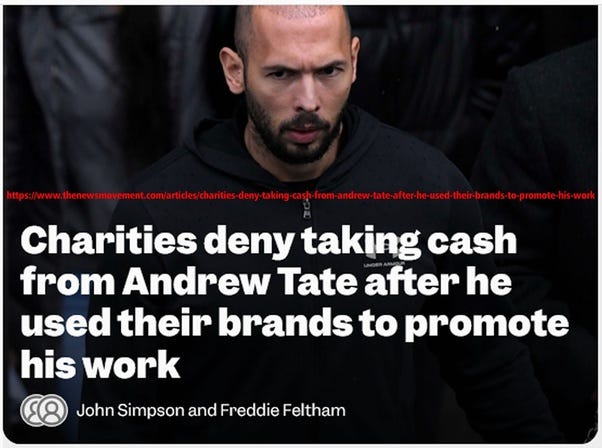
I had to double-take on this question. “Tate Pledge”? … WTF? Is this a reference to Andrew Tate? Sure enough… it is!
Holy 30 Pieces of Silver, Batman!!!
I want to ignore this question from this querent because I already feel slimy. However, I think it would be a disservice to those who still can’t understand the difference between an authentic human being and the lowest of predatory and parasitic scum.
It breaks my heart that people can see this:
… and yet, NOT see it for what it is.
The branding alone screams it’s a scam. For someone desperate to repair their reputation on the level of optics, even if he doesn’t care about substance, he’s being quite moronic to dress up like a pimp-gangster and peddle himself as a caring member of a community he earnestly wishes to contribute positively toward.
Take a moment to reflect upon the title, “The Pledge of the Tate.” That’s like someone speaking about themselves in the third person while elevating their image of that person to mythical status. He’s not “just Andrew Tate,” one of the dozens of other “Andrew Tates on the planet,” but “THE TATE.” There is no need for “Andrew” because that softens the hammer of the single vowel “TATE” a bit too much for his ego to consider it worthy of inclusion in his pledge title. He is a legend in his imagination — even after being busted for sex trafficking — for dehumanizing women as vessels for his amusement.
This egotistically bloated idiot is so full of himself that he has no clue that his presentation already turns off anyone who isn’t a naive gumba incel with machismo wannabe fantasies.
What’s worse is the amount of digging to determine the legitimacy of this scam requires a whole bunch of seconds that almost add up to one full minute of research effort to dig up how much he’s willing to sink into the depths of inhuman psychopathy.
Since you asked me what I think of this, then this is what I think of this:
These are examples of psychopathic predators in our society whose aspirations for justifying their pampered existence rely on the parasitic strategy of bottom-feeding by preying on the naive sentiments of the most vulnerable in society.
These monsters should be rotting behind bars, not roaming free to wreak more havoc while destroying lives in their wake.
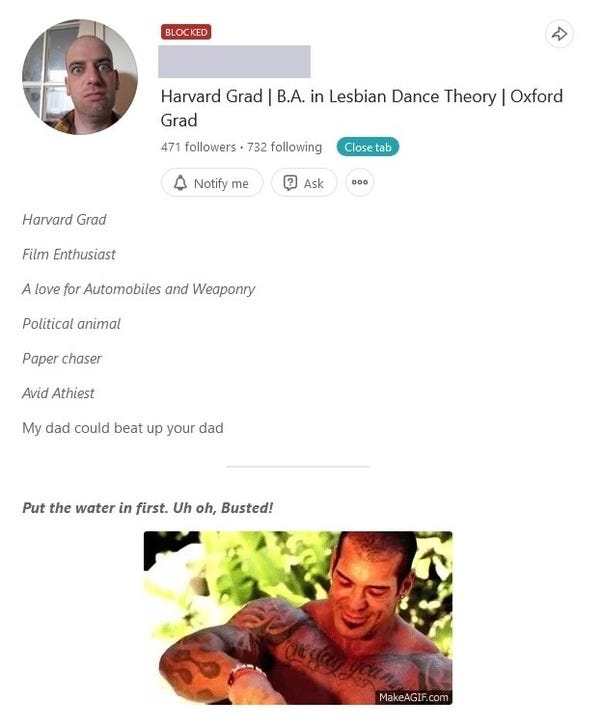
After having a look at your profile, Keith, it seems rather clear from a cursory glance why you might be interested in following the antics of a disgusting example of the worst of humanity, but that’s because you present yourself as someone desperate to assert your individuality without actually developing the critical thinking skills to understand what that means enough to make it manifest.
You seem drawn toward stereotypes of masculinity to promote your image, and I’m sure that works within a limited demographic, but that’s also why you’re doomed to perpetual bottom-feeding for the rest of your life.
This mindset is built upon the cynical quicksand of a misanthropic take on fellow humans with whom one wishes to engage in a profit-generating venture. There is no motivation for a real connection being sought, nor solutions or assistance offered that benefits others. It’s an egocentric view of the world that regards relationships as forgettably transactional on the most superficial levels: “Pay attention to meeeee!!!! — and give me money while you’re at it.”
This leads me to one of my biggest complaints with our currently toxic and religious-like fervour of regard toward the economic system we call “Capitalism.”
Our capitalist system of today breeds misanthropy in a race to the bottom while celebrating the most superficial of parasitic characteristics of humanity.
We were warned at the outset by great thinkers from history that we would be struggling through the late stages of a corrupted system and have now arrived at their predicted destination.
What we once championed as the fertile ground of innovation has become a stale mockery within a puerile homogeneity.
What matters is expedience over substance. The why of what we do with our lives has been distilled into achieving above minimal survival at the expense of relationship depth and community.
The sad consequence of prioritizing expedience over substance is that we breed out the requisite sensitivities toward nuance that would immediately understand that orange abomination of a homepage with Rush Limpballs overtones is a front for yet another scam by an, at best, ethically challenged sociopath.
Lacking the cultivated sensitivity required to interpret nuance correctly exposes people to con artists who capitalize on personal insecurities that have been conditioned to revere toxic role models in a sub-culture characterized by Stockholm Syndrome cases.
The odds are excellent that anyone who can interpret anything positive within the embodiment of toxic masculinity has been a victim of it their entire lives and was broken by it in childhood.
Your profile screams that you’ve been more of a victim of it than a perpetrator, but you can’t seem to extricate yourself from this toxic cognitive prison. I can see that you believe humour is how you view your access to success, and I commend you for trying to be charismatic in such a way.
Making an impression in this world is tough, primarily if one seeks to be liked, if not admired. We need that kind of reinforcement to survive. It’s an essential component within Maslow’s Hierarchy of Needs.
Belongingness is right up there and wedged between basic physical and psychological survival. The trouble is the choice of role models one makes in one’s efforts to achieve what one aspires to.
It’s easy to see from your profile that you’re not a troll so broken as to define your existence through childish provocation, and I suppose that’s why I felt compelled to provide an in-depth answer to your question. You seem to be trying, and you deserve credit for that.
Questions like this one I’ve been answering and this one below:
…indicate to me that you’re picking your ideas from sources who are, at best, kludges, who cannot help but become toxic influences in your thinking processes. I’m not going to advocate dropping these idiots from your radar because you need to understand better where they’re coming from so that you can better triangulate your position in society. I highly recommend expanding your horizons by adding more nuanced and evolved thinkers to your information consumption efforts.
It’s easy to see by the rest of your questions that you have a sincere curiosity about the world and are not obsessed with toxic role models. I suppose that’s what gives me hope that you will rise above being swayed by or taken in by despicable monsters who present a fraudulent image of themselves to appeal to a toxic set of presumptions about personal identity that were cultivated within you by a dysfunctional society.
I wish you all the best of luck in your journey through this madhouse. I hope you improve your abilities to discern between substance and fraudulence while continuing to challenge yourself to rise above the antics of superficial idiots.
“Humanity” is from the late 14th century and derived from the Latin word “humanitatem” or “humanitas” for “human nature, humankind, life on Earth, the human race, mankind,” and Old French “humanité, umanité.” “Humanity” includes all humans but can also refer to the feelings of “kindness, graciousness, politeness, consideration for others,” which humans often have for each other.
Variations of the term, such as the adjective “humane,” which arose in the mid-15th century, refer to the ineffable qualities of being human rather than the physical characteristics of human existence. By the early 18th century, it evolved from meaning “courteous, friendly, civil, and obliging” into “tenderness, compassion, and a disposition to treat others kindly” and evoke “kindness” within the sphere of the human condition.
By the 1700s, the plural of humanity — “humanities” was adopted as a description of the study of “human culture” through the literature branches of rhetoric and poetry and from a secular perspective rather than religious via “literae divinae.”
“Humanism” emerged from that evolution in meaning from the Latin “humanitas” or “education benefitting a cultivated man” while supporting the notion of humanity as symbolic of the best qualities of our species.
Much of this evolution in meaning is derived from a history stretching long before prehistory to a time when our survival as a species was contingent upon working together to feed and clothe ourselves as we hunted in packs.
Successful interdependence requires supporting one another; thus, empathy was given rich soil to grow.
I suspect, however, that none of this constitutes new information for you even though your question misses the point altogether — and to such a degree it screams severe psychopathy, even as an entertainment-seeking provocation.
From initially reading it in my notifications for questions I’ve been asked to answer, my first thought was that it’s an apparent provocation from a misanthrope and most likely a troll. What I discovered upon encountering your profile is something far more insidious.
Let’s begin with the presumption in this question, “Why should I feel it?” etcetera.
There is no “should” in that you are not “obligated to feel” anything. That’s not how emotions work. You appear somewhat educated — or at least literate — based on the number of publications you’ve written and have posted on Amazon.
Somehow, though, a fundamental comprehension of oneself as an “intelligent” member of an interdependent species escapes your notice. You rely on others to feed, clothe, and house yourself through literary endeavours and can’t acknowledge how you already “feel it, need it, and want it.”
Even this provocation attempts to cater to those basic needs by identifying people who can respond in ways that support egotistically defined goals.
Most literate people develop a basic comprehension of emotions and the atavistic precursors making them manifest. On my behalf, this could be a flawed presumption, but I’m pretty sure you’re no stranger to “darker” emotions such as fear and anger, and you have no misapprehension about their manifestations within you. The sarcasm in your writing indicates your preference for wallowing in those emotions and is consistent with the attitude displayed within your provocation disguised as a question.
The problem you struggle with is that you hate your interdependence and deny that it exists within you — most likely due to having found yourself disappointed and hurt repeatedly by people who failed to live up to your expectations from a very young age.
Sadly, in a world where a whopping majority 70%-80% of the population is raised within a dysfunctional family unit, your experience is far from being a minority. Unlike some lucky few who can cope with their pain to the degree that can transcend it on levels that allow them to minimize the transmission of a toxic mentality characterized by misanthropy, you have chosen to embrace the cynical view that humanity is beyond hope.
Whether or not that’s true is irrelevant to me because my biased perspective shudders at the prospect of living in a world where one broadly hates all of humanity to such a degree they fail to see or experience the gestalt of existence within each of us.
To live a life without comprehending the value of joy is the equivalent of living a life deprived of meaning. It’s like a walking death. Even if one’s life circumstances necessitate a deprivation of joy, knowing it exists can often be enough to overcome the most painful hurdles.
Even the briefest taste of love in a fleeting life characterized by its absence or a prevalence of fraudulent forms of love is enough to sustain one’s spirit for a lifetime.
That’s the power of living on the side of light those who wallow in the dark fail to comprehend.
Once one understands that power, one no longer feels pushed into seeking something out of conceptual reasons but from an atavistic need to partake in as much as one can, like struggling for breath while deprived of oxygen because of a plastic bag covering one’s head.
Sadly, you’ve never tasted it, or you would know why you are drawn to it while feigning a disinterested rejection. As much as your ploy may feel like a shield protecting you from further disappointment, it’s a cry for help heard echoing its way around the world, crying out in pain.
If nothing else, in your case, it merely reveals you as a product of a wholly dysfunctional era in which we exist today as a species suffering from generation upon generation of transmissible trauma.
In other words, you asked this question because, on some level, you realize your struggle. Although it may be easy to peg you as a statistic identified as part of “the one in five” visible sufferers of a mental health condition in society, you’re not. Instead, the psychopathic dysphoria you struggle with is made invisible by its type of dysfunctionality and how it fits within the accepted definition of a psychologically well-adjusted individual within a maladaptive system (by which I mean our environment and economies are not suitable for cultivating the best of humanity).
As unhealthy as your expressions are, their implications exist outside the boundaries of what the psychological sciences deem unhealthy because you seem capable of functioning at a high enough level to adapt to the rigours of your day. In my view and statistically speaking, of the remaining four in five who do not display visible signs of an inability to adapt, three of those four are still victims suffering from degrees of stress that remain invisible to a triage mentality characterizing the state of our species today.
Your wallowing in cynicism is not your fault. You’re a victim of an entirely dysfunctional world. You happen to be smarter than the average bear, making a positive adaptation to a broken world much harder.
If you’re lucky and can make yourself willing and available to receive the cream of humanity, you’ll feel the answer you seek that words alone cannot give you.















 thotbag