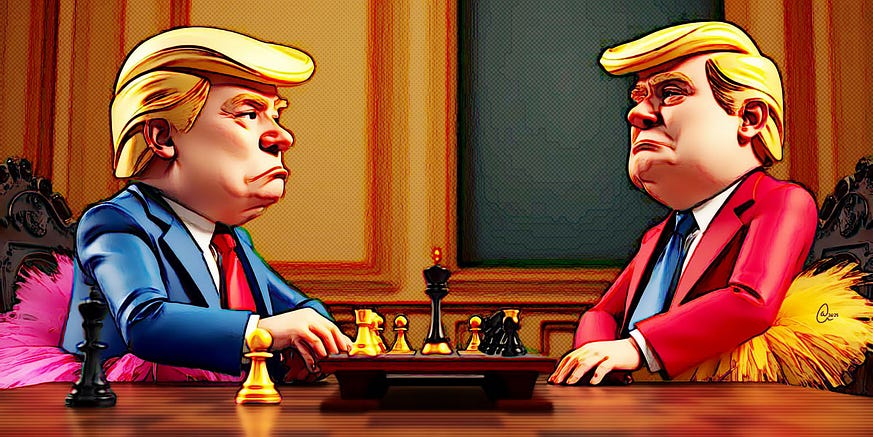
This post is a response to a question posed in its complete format: “Isn’t it important, and even necessary to have presidents with morals? Regardless of party affiliation, or none, religion, or none, can an ethical America ever be restored if truthful leaders, and humane officials are elected?”
People will elect leaders who echo their standards, and that leader will validate those standards. That dynamic becomes a feedback loop that pushes a society to evolve in a particular direction.
A political duopoly creates a dynamic of competing standards that pulls a society in opposite directions.
In the case of the U.S., and the emergence of a Neo-Liberal sensibility, the nation’s standards toward the accrual of material wealth put the oppositions in alignment, and the consequence has been a nation that has become increasingly sociopathic over the decades.
Since both Republicans and Democrats embraced power through wealth, there was no room for any competing morality to maintain any semblance of a compassionate society.
This dynamic is how they managed to create such moral abominations as instituting privatized prison systems, blocking universal healthcare, and eliminating the right to claim bankruptcy on student loans.
The U.S. morality has evolved completely around the veneration of wealth and the worship of greed. Due to that perversion of humanity, they have evolved into a corporatocracy to become a kleptocracy on the way to becoming a full-blown fascist state whose national character is defined by gluttony and an attitude of entitled expansionism.
“Greed is good” is the morality that the U.S. has embraced and the character that its leaders cultivate within the people.
The morality they have embraced throughout the decades since Ronald Reagan has put them on a path of becoming a nation defined by a narcissistic character, and that makes them an enemy to the world. Even their current “friends” aren’t actual friends but fellow sociopaths who will exploit them for their benefit.
The record-breaking “gift” of a $400 million plane that would require up to $1 billion to inspect and convert into an appropriate means of air travel for the nation’s leader is a manipulation tactic by those the current American leader views through envious eyes.
Although this question presumes “morality” to describe a state of being beneficial to all citizens, that’s not the case with what the word means. People do vote for and elect a president with morals. Those morals, however, are entirely self-serving for the current American president and would make people consider him “amoral” or “immoral,” but that’s because the nation has lost track of which morals they value.
Currently, the opposition to the extraordinarily corrupt Republicans who enable and empower the malignant narcissist in charge is also struggling with the same form of corrupt morality as they deny the truth of being lulled by their failure to represent an opposition to a materialistic morality adequately.
The DNC’s old guard is as responsible for the monstrously corrupt morality ruling the nation as the RNC for installing Trump as their party leader. The DNC continues to show that they have not learned their lessons, and because they’re not as willing to “join the dark side” as the RNC, they suffer internal struggles which turn their supporters away.
At the moment, there exists a younger sensibility of opposition toward established morality within the DNC, and the old guard seeks to excise what they view as a threat rather than a necessary evolution for their party to survive.
Had they not been so corrupted as a party, they would not have prevented Bernie Sanders from having his opportunity to lead the nation back from the brink of a sociopathic morality. They have not yet learned their lessons and seem to presume their Neo-Liberal beliefs are still sustainable in a world that crumbles around them.
One-third of the electorate stayed home and abstained from voting because they saw no difference between the RNC and the DNC. To some extent, that’s very much true because both parties continue to embrace a materialistic morality that has been responsible for the destruction of the middle class throughout the last several decades.
Many people have reasoned that if both parties are the same, the only solution is widespread chaos that causes their society to crumble. By refusing to vote, many voted for the current state of protesting nationwide in every city every day until the problems they see being ignored begin to be addressed.
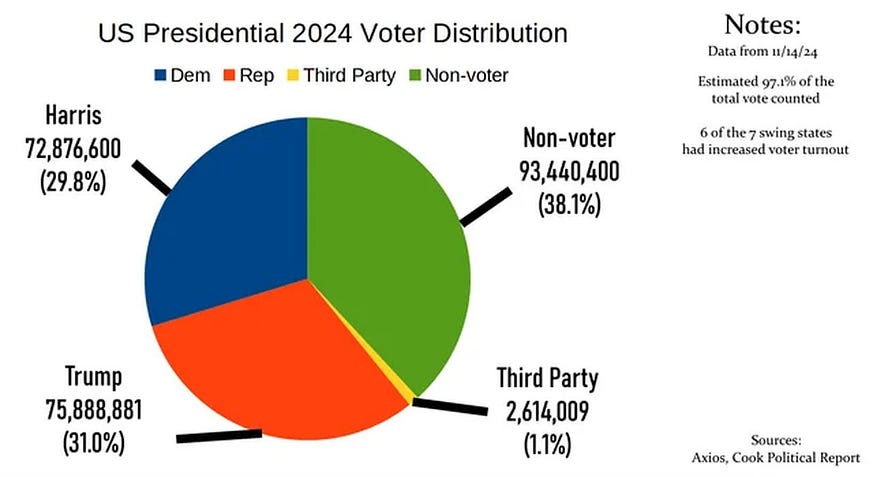
The DNC is undergoing internal strife, and the more the old guard resists giving way to the new who fight for a morality that represents the people, the more that party will become fractured and ineffectual against the trajectory of a nation becoming a full-fledged fascist state or autocratic rulership.
People like Chuck Schumer need to be pushed out of the party, and the DNC must start paying attention to the goals that David Hogg has been promoting. They desperately need a cleansing of the morality that fully characterizes their opposition’s morality of being sycophants to the wealthy in society if they want to preserve some form of dignity as a party that can install leaders who have enough backbone to lead the nation out of a dark morality and toward an enlightened one.
The notion of a “dark enlightenment” currently characterizing the RNC and Conservatives worldwide is a morality of misanthropic cynicism which embodies an Ouroboros that ultimately consumes itself. Adherents of this worldview of rulers and serfs are so primitive and barbaric in their thinking that they cannot fathom a world not characterized by a zero-sum game of winners and losers.
We are all responsible for allowing this sensibility to become a threat to the world order because we have worshipped the wealthy to such a degree that when the term “centibillionaire” was first coined, we celebrated it instead of becoming horrified by the abomination we allowed to come into being.
In short, having presidents with morals is neither essential nor necessary because they all have some form of morality, even if it’s considered an “anti-morality” or destructive morality. What matters is selecting leaders whose moral fibre is such that they place the good of all people above the whims of the few.
The morality we all desperately need now to lead us out of our darkness is the morality that acknowledges the necessity of placing upper limits on wealth and power. The morality we must embrace to restore sanity to this world is to recognize how, if someone possesses the wealth of a small nation and can afford to buy themselves a private army, they are a clear and present danger to society.
We must establish a rational and community-based view of social engineering rather than allow a chaotic approach toward our social evolution. We cannot afford to continue allowing the wealthy to shape our morals as a people while empowering the most psychopathic among us to define our character as human beings.
If we want an ethical society to re-emerge as our guiding vision for humanity, we must cleanse the misanthropic darkness clouding our sight.

 thotbag