As humans, it is vital that we all work together to make a better world for all of us today and for those who come after us.
After all, we are currently enjoying many freedoms and luxuries we would otherwise not have had it not been for the contributions of those who came before us.
Failing to do our part to make this a better world makes us a parasitic element that erodes the social fabric.
Working against the betterment of humanity is a betrayal of the social contract. Today’s dynamic resembles a tribe that survived a primitive existence by everyone working together. Having one person in that tribe work against the tribe’s survival was viewed as a threat to that tribe.
They had much more efficient ways of dealing with such betrayals then.
A utopia is otherwise just a setting on a compass that keeps us on track. Utopia is a concept and a direction, not a destination.
Hiding one’s misanthropy behind a political ideology is the polluting act of an intellectual coward and a morally depraved psychopath.
As you can see from how people are united in support of Luigi Mangioni, it’s not about left versus right. It never has been. It’s always been the top attacking the bottom, while people like you who play into that divisiveness are just useful idiots keeping us all distracted from saving ourselves from disaster.
Framing this question within the context of a political ideology only adds to the chasm between political polarities, imbues it with passive-aggressive disparaging implications, and is irresponsibly divisive nonsense.
This post is a response to a question posed in its complete format: “As an atheist, how do you deal with the fact that there is no ultimate moral arbiter and that all morals are determined inter-subjectively and without an objective foundation?”
Have you taken any time to consider how, if a god existed, its morality would also be subjective to it?
If morality had an objective foundation, it would be intrinsic to the object itself. One could essentially “read” morality from within every instance deemed to bear moral implications. If morality were objective, everyone would read and identify identical moral qualities within every situation subject to moral judgments.
It would be no different than having everyone agree that the sun shines and its effect warms us. No one or authority is required to serve as an arbiter for these qualities. We know these facts to be confirmed individually from everyone’s direct experience with the sun.
For the sake of this exposition, let’s refer to those qualities of heat and light emanating from the sun as “metadata.” This description can help us draw some clear distinctions on the language we’re using to resolve discussions on objectivity as it applies to the concept of morality.
For instance, if theft were objectively determined as immoral, then the characteristics defining its morality would be immutably intrinsic to that act of theft. All forms of theft would be considered immoral without condition. It can easily be argued that the metadata ascribing immorality within the act of robbery lies within the harm done to those against whom the theft is perpetrated.
Stealing food to feed one’s family would always be consistently judged as immoral. There would be no distinction between stealing food from a starving person and stealing food from someone with such abundance that most of their food is spoiled from the lack of consumption.
One can argue that stealing food to feed one’s family is not immoral if the person one steals from still has plenty of food to feed themselves. One can say that stealing food that would end up being spoiled from lack of consumption to feed one’s family is moral.
How can both scenarios be valid if morality is objective?
If morality were objective, it would be contained within the object, but as we can see in this simple example, morality is contextual. Morality within this simple case is contingent upon the judgements of those who choose to ascribe varying degrees of value to the individual aspects of the case of stealing food.
Some may determine that stealing food, in any event, is immoral. In contrast, others may determine that stealing food to feed one’s family is an act of self-sacrifice that exposes them to a life-destroying reprisal, which represents the embodiment of morality.
If morality were objective, then it would be immutable, but how many things deemed immoral at the time of the writing of scripture have since been reconsidered irrelevant to the concept of morality?
No one balks today about wearing clothing made of mixed threads. It’s almost impossible to find any clothing that doesn’t mix threads to some degree today. Yet, this practice is no longer considered a moral violation that would anger any ultimate authority such that a reprisal would be forthcoming.
Did God change its mind? If so, how do we know, and when did that occur? By what process are we being informed by an ultimate authority of updates to morality? If morality is subject to updates, how could it be objective?
Morality can’t be objective if an ultimate authority changes its mind and renders updated decisions on what constitutes morality because they are simply conveying (if we can set aside the mechanics of that conveyance) a perspective unique to their apprehension of a situation.
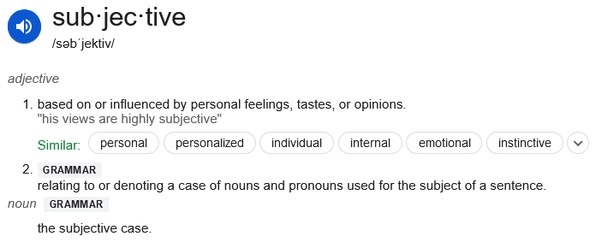
Perhaps you’re still struggling to comprehend the difference between “subjective” and “objective,” and that’s why you insist morality is “objective?”
Let’s look at some definitions to help frame the explanation above:
Any situation in which an authority must intervene to render a decision to settle differences between competing perspectives cannot, by definition, be considered “objective.”
It doesn’t matter whether that authority is omniscient or not; they are still rendering a decision derived from their perspective on the issue in question.
The necessity of an authority to determine morality already renders morality a subjective construct.
Morality cannot be objective by any stretch of the imagination and, most notably, not by arguments ascribing ultimate morality to an ultimate authority on morality — mainly when that authority is not available to provide any direct input into any state requiring a moral judgment to be rendered.
Indeed, the need to render a moral judgement eviscerates the notion of an objective morality.
The appropriate context for perceiving morality is a public dialogue in which we learn to develop our moral paradigms to understand ourselves and our world more clearly. The dialogues we have on morality serve the purpose of developing compassion toward issues outside our frames of experience and help us to apply a moral paradigm to the whole of our existence as individuals and as a species struggling to achieve its potential.
The reality is that objective morality would destroy our capacity for morality because an essential learning process for developing one’s humanity is reduced to rote memorization. In contrast, the human capacity for creativity necessitates means by which moral loopholes can be exploited.
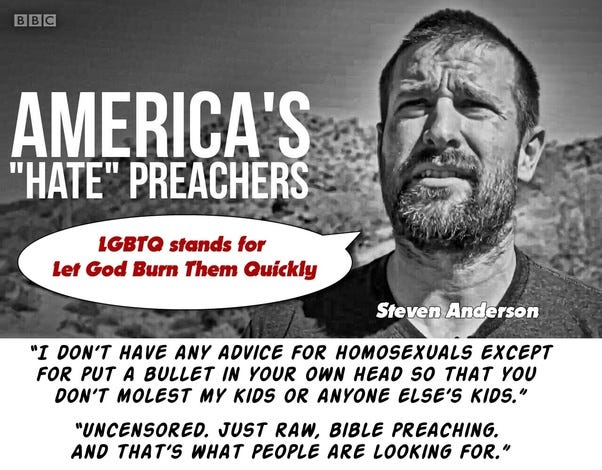
We see this behaviour routinely exhibited by those who claim to be representatives of moral authority betraying their self-appointed statures in society.
This post is a response to a question posed in its full format as follows: “Why are there so many degenerates in this world that lack a moral compass, namely in 1st world countries where most learn this by the family that raised them, school, sports, being in public, etc?”
The problem with this question is that it’s impossible to construct an objective answer to address its core concern. This question is more of an emotionally driven complaint than a question.
The reason is that it’s built upon subjectively defined presumptions like “degenerate” and “morality.” Neither of these concepts has any objective metric to identify differing degrees of degeneration or morality between any two random people.
Adding to the subjective complexity, universally accepted standards for the definitions of these terms do not exist.
What can be deemed “degenerate” to one person is celebratory to another. What is viewed as “morality” to one person is heinous to another.
Making matters even more complicated is that a word like “degenerate” constitutes a value judgment. Regarding its use, what that person views as “degenerate” is already a visceral rejection of the object of their judgment. There is no wiggle room for the interpretation of an individual’s value. No description of the specifics of the behaviour in question leads to the value judgment of “degenerate” because “lacking a moral compass” is just as subjective a judgment as “degenerate.”
This question is an example of circular reasoning permitting no room for objective examination nor any means by which one can identify alternative conclusions to the objects of such visceral criticism.
The only way to address this question is to search one’s memories for emotional reactions one may have had that can dredge up conclusions about different experiences one can align with the question based on a similar degree of emotional intensity governing one’s biased findings.
This style of generic language relies upon the subjectively defined feelings of others to function more like a dog whistle than a critical analysis of the issues in question.
This kind of “loose language” is a breeding ground for bigotry to evolve in a landscape characterized by pure emotion and which lacks grounding in any shared physical reality.
For example, if someone were to mug someone else and witnesses talked about the event while sharing similar emotions and a similar view of the event in question, they could quickly dredge up a similar degree of emotional intensity to this question. Their views would be predicated upon a shared experience, while their particular reactions to the event would be grounded in a shared physical reality.
In the case of this question, that shared reality exists only within the realm of individual imagination and dredged-up memories of different events. Here’s a generic dialogue of an imaginary sharing of emotional intensity to highlight this dynamic:
First Person:“I was supremely pissed at this one thing this one person did. Be as angry as I am about this thing you didn’t experience.”
Second Person:“I didn’t experience what you experienced but let me tell you, I also got supremely pissed about this other thing that you didn’t experience, but because we’re both supremely pissed, we share a common ground of agreement.”
First Person:“So, you agree that we both have good reason to be supremely pissed to the point of sharing a mutual hatred for something?”
Second Person:“Yes. We both hate something very much.”
First Person:“What do we hate together?”
Second Person:“How about that thing over there? It’s pissing me off right now that I’m in a sour mood.”
First Person:“I agree. Let’s both hate that thing. That way, we can forget what we hated separately and find camaraderie in a shared hatred for something else.”
This dynamic is how bigotry spreads throughout a population to function like a transmissible disease.
This is why language choices are crucial for objectively apprehending the realities we react to.
Allowing another person’s subjective responses to dictate one’s attitudes toward a subject abdicates their free will and subordinates their opinions to whoever demonstrates the most significant force of personality.
This is the process by which identity politics emerges.
This is precisely the dynamic that Donald Trump has built his political collateral upon.
It is a means by which critical thinking is killed, and people like Rupert Murdoch capitalize on it as a vehicle for personal enrichment at the expense of the social contract.
This is why we have “so many degenerates in this world who lack a moral compass.”
Why does morality exist independently of human opinion?
This post is a response to the question posted on Quora as written above.
Morality IS “human opinion.”
Many differences exist between opinions on morality and on practically everything else people have opinions on — which makes opinions on morality somewhat unique in how they are perceived.
People generally do not equate a moral opinion on murder, for example, with an opinion on a fashion accessory.
Part of the problem is that it is the cultivated opinions of religious folk to believe morality is an objectively established standard of conduct determined by an invisible authority. If the claim of objective jurisdiction to develop and institute a moral framework existed, morality would essentially be identical and unchanging over time. That’s not the case for anyone who has made even a tiny effort to understand people or human history.
The most significant problem with establishing a universal acceptance of a moral opinion is that no one ever receives direct confirmation from an unassailable authority governing judgment over any specific behaviour. Complicating matters further are the subjectively supported morals of believers who do not share a consistent moral framework — even though religious institutions do their best to homogenize morality among their flocks.
Institutions that once endorsed slavery and have moved on to repudiating it cannot, without justified criticisms, claim to receive their moral framework from an omniscient entity.
This and all the many other changes made to institutional policies regarding morality throughout the centuries have eroded religious claims of authority in moral matters. Making things worse for them has been allowing their credibility to be assaulted by many heinous scandals, such as the institutional endorsements for victimizing countless children through sexual predation and murder and the subsequent protections of institutional leaders guilty of immoral actions.
We, as a species and as a collection of diverse societies, all governed to some degree by the notion of morality, have undergone a tremendous number of and severity of degree in the assaults on our definitions for what constitutes morality that we are struggling to unify a fractured vision of the concept.
We can no longer trust our authorities, be they religious, political, industrial, or familial, which puts us in a quandary for resolving our moral differences as a species.
The upside is that we are turning inward to identify our internal sources of moral development.
Morality is most simply defined as an extension of empathy, but the issues it encompasses make that an oversimplification. At best, empathy is merely a compass guiding actions that many hope serve to achieve moral outcomes. Some will define morality within a self-serving context, while others consider self-sacrifice an embodiment of morality. Neither is necessary to achieve some form of widely acceptable definition of morality.
We can grasp a history of morality from academia, giving us context and perspective on what we have learned about morality. That approach leads us down deep and convoluted rabbit holes of (arguable) “subclassifications” like ethics, conscience, integrity, standards, and principles. At the same time, simple definitions escape a universal simplicity promised by our examples of failing leadership because morality is itself nuanced, multifaceted, and contextual.
We may never transcend subjectivity within the context of our interpretation of morality, but that’s a feature, not a bug.
Morality as an opinion forces us to share the diversity in our views, and that’s a superior form of morality to any authoritatively imposed dogma because we must each learn to develop our apprehensions of morality to learn how to better succeed in living together under a shared social contract to achieve a peaceful and prosperous co-existence.
We’ve seen enough artificially imposed forms of morality claiming objectivity as an unassailable standard for uniting people to know it’s a fraudulent approach to morality that invariably fails us as much as we fail to adhere to universally defined, generic, and external imperatives.
To accept morality as human opinion puts us in a position to define human character along a spectrum of universally acceptable, unacceptable, and inspiring behaviours that can adapt to an ever-changing landscape.
Morality may be more messy to manage as an opinion. Still, like the principle of a democracy, it’s the only form that can maintain coherence within the context of longevity.







 thotbag