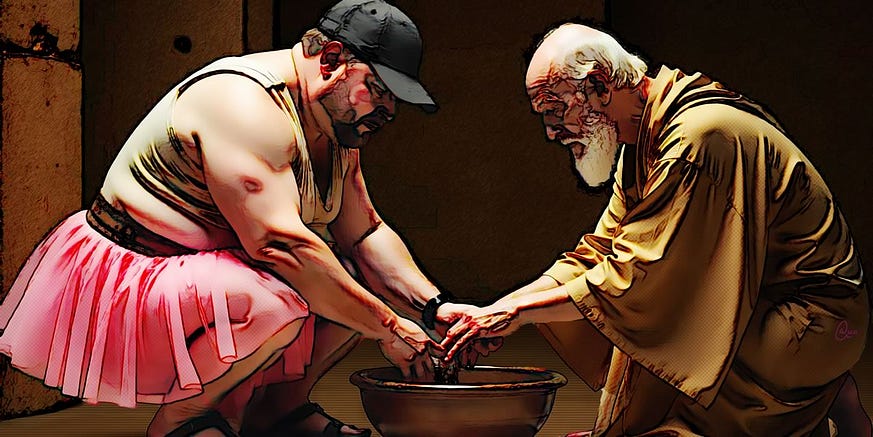
This post is a “twofer.” It’s a response to a question posed in its complete format: “What do you think about Elon Musk saying “The fundamental weakness of Western civilization is empathy”? https://www.snopes.com/fact-check/elon-musk-empathy-quote/“ — In this case, I’m setting up my answer with an answer to another question: “What role does empathy play in understanding and connecting with the thoughts of others?”
Empathy is a conduit to understanding and connecting with others.
Empathy is like an additional sense or language allowing more profound insights into people than a typical means of sharing information about oneself with others.
“How you say something is as important as what you say.”
I assume you’ve encountered this above phrase or similar ones to understand how meaning is conveyed in ways beyond the definitions of the words one uses.
Empathy is similar in that one identifies more closely with the emotions of others, which makes it easier to connect with people on much deeper levels much more quickly than most people are used to.
Empathy is otherwise the glue that keeps human civilization together.
“Evil is a lack of empathy.”
This sentence above is the simple answer that most have already presented, so I had intended to ignore this question. Tomaz Vargazon’s answer, however, has motivated me to provide my input by the inclusion of the full quote he provided from Musk’s interview with Joe Rogan:
Musk: Yeah, he’s [Gat Saad] awesome, and he talks about, you know, basically suicidal empathy. Like, there’s so much empathy that you actually suicide yourself. So, we’ve got civilizational suicidal empathy going on. And it’s like, I believe in empathy, like, I think you should care about other people, but you need to have empathy for, for civilization as a whole, and not commit to a civilizational suicide.
Rogan: Also don’t let someone use your empathy against you so they can completely control your state and then do an insanely bad job of managing it and never get removed.
Musk: The fundamental weakness of Western civilization is empathy. The empathy exploit. They’re exploiting a bug in Western civilization, which is the empathy response. So, I think, you know, empathy is good, but you need to think it through and not just be programmed like a robot.
- “Suicidal empathy”
- “Don’t let someone use your empathy against you.”
- The “empathy exploit.”
These three statements indicate that these sociopathic morons don’t understand empathy because they are conflating “ compassion” with “empathy.”
These are not the same thing. Not by a long shot.
Empathy operates like a sensory receiver, while compassion is a cognitive process of identifying with another life.
Empathy cannot be “used against someone” any more than one’s eyes can be used against them.
The ability to experience another’s emotions is not a weakness but a strength.
Another issue is how we process our understanding of the emotions we detect.
The only vulnerability to exploit is the trust connection between individuals, and that exploit exists regardless of either party’s empathetic capabilities.
Their arguments are the equivalent of claiming one can be susceptible to being robbed because they know more about the criminal attempting to rob them.
It’s a bloody ludicrous argument forwarded only by sociopaths who have no clue what empathy is.
The harsh reality in today’s world is that empathetic people are victimized precisely because they’re walking, talking, living, and breathing lie detectors.
Anyone with advanced empathetic sensitivities understands precisely what I’ve just said. Every sociopath on the planet would otherwise vehemently deny this is the case while using this statement to vilify anyone who reveals this truth to the public.
Only sociopaths would ever dare to consider empathy a weakness because they recognize empathy as a superpower wielded by people who always default to showing compassion toward others, especially toward those like them, who comprise the most broken humans among us.
The lesson of today’s age and of this garbage pronouncement by the most destructive sociopaths we have seen emerge in society has pushed the tolerances and compassions that empathetic people experience toward humanity past the brink of decency and forces us to realize how our species is in a severe struggle for survival.
If we allow these sociopathic monsters to continue defining humanity for us, civilized society as we know it will crumble.
Now is the time for empathy to assert itself as humanity’s superpower and end the scourge of sociopathy before it’s too late.
Now is the time for the meek to inherit the Earth because these monsters have no respect for life beyond their fleeting whims.
These are expressions from people who have no reverence for anything outside their navels.
The more we allow them to assert dominion over humanity’s character, the more they teach us they will relent only when we break and repeat history.


 thotbag