Why do people think I should feel guilty about shoplifting?

This post is a response to a question posed in its complete format: “Why do people think I should feel guilty shoplifting, when literally so many people in the world want to use other people for what they have?”

You seem to want to justify shoplifting as a form of protest.

Meanwhile, protesting is a means by which systemic injustices are challenged by publicizing grievances. The point of doing that is to garner widespread support and enough momentum to make a systemic change that addresses a grievance over a condition which victimizes many people.

Sometimes, protests must be escalated to such a degree that some form of tradeoff between victimizing an aggressor and sacrificing someone in an act which alerts an otherwise unaware public of the severity of a grievance.

The incident between Luigi Mangioni and Brian Thompson from United Health qualifies as a situation in which escalation was deemed necessary (by Luigi) to sacrifice one’s life to alert the public to the severity of a systemic injustice.

Most often, protestors sacrifice only time and effort to address injustices. The goal of protesting, however, is to help people other than themselves who may or may not participate in the protest itself.

The purpose of a protest that can successfully gain support and make meaningful change is never to benefit an individual at the expense of victimizing someone else because that’s just another form of victimization.

It may be true that the degree of victimization is practically invisible to the victim such that they suffer a loss on an unnoticeable level, but they remain victims nonetheless.

It may very well be that the stores absorb their losses from your thefts with little impact on their operations, but that’s mostly because they amortize their losses across their operations. That means that a proportion of the cost of their products contains a piece of math they’ve determined recoups their shoplifting losses through every product sold.

Your thefts as an individual may be unnoticeable. Cumulatively, however, with others who think the same way you do, your thefts contribute to the increased cost of products that everyone bears while the store factors in a profit margin for managing those losses. Your thefts contribute to their net revenue while further victimizing those who pay full price for their products.

You may view your theft as a personal protest, but it’s an act that solely benefits you and injures all other consumers more than it injures the store you steal from. For this reason, your behaviour is considered selfish, over and above being a crime that contributes no benefit as a protest to the issue you criticize.

Your reasoning shares more in common with the stores you steal from when they add surcharges to an expected percentage of loss that’s padded enough to profit from.

Your reasoning and theirs are based on misanthropic, spiteful, and opportunistic thinking to justify an essentially parasitic behaviour.

You may not feel guilty about your choices, but they are neither justifiable nor actions to be proud of. However, the risks you take will one day result in criminal charges against you, while no one will be interested in empathizing with your reasoning.

You will carry a stigma of shame for the rest of your life once that happens, and no one will be sympathetic to whatever suffering you might experience as a consequence of your criminal choices.

Furthermore, your shame will be compounded by the reality that you will have become exactly the type of person that you justified harming through your thefts.

In short, your reasoning makes you a hypocrite, and you may not feel guilty about stealing from a greedy operation. You might still want to consider alternative forms of protesting to make your point — assuming, of course, that you believe your reasoning instead of just making excuses for being precisely the same as the people you criticize.

The circular and self-serving nature of your reasoning is precisely the same reasoning every criminal uses to justify their behaviour.

After all, in their minds, they also believe “everyone else does or would do the same in the same situation they’re in.”

Try to imagine the chaos that would ensue if everyone made the decisions you have made for yourself using the same reasoning you employ.

Society would shut down, and that’s why you will get no mercy when you inevitably get caught. After all, it’s never an issue of “if” with repeat offences but “when.”

Your luck will eventually run out, and you will be caught. If guilt isn’t enough to motivate you, then understanding how impossible it is to shoplift indefinitely might help you to reconsider your choices.

Security systems are improving every day. It’s already impossible enough for security experts to keep up with all emerging technologies, let alone someone like yourself. Cameras are cheap nowadays and tiny. You won’t know where you might be recorded, and it’s only a matter of time before you won’t know about the GPS tracker hidden in the liner of the coat you steal.

Good luck, though. Maybe you’ll convince a billionaire to give their people a decent raise just to convince shoplifters to stop shoplifting… which will happen after cows learn to fly. 😜


Why don’t people realize our plutocracy causes our problems?

This post is a response to a question posed in its complete format: “Why don’t people realize that it is plutocracy (our country being governed by the wealthy elite) that is causing our economic problems?”

People don’t magically “realize things.”

People must be educated, informed, and aware of circumstances and details.

They need to be walked through the information presented to them as if one functions as a guide on a tour, answering questions.

People also don’t respond to laments, particularly when entrenched in counterfactual bigotries that prevent them from apprehending reality through an objective lens.

In essence, if this is an issue of concern for you, which I’m glad to see it is, then you need to start banging drums and sharing information and details because there are at least 76 million people in the U.S. alone who are entirely so oblivious to what you’ve determined for yourself that they contribute to the problems caused by the plutocracy.

There are many reasons why many people support self-and-socially destructive agendas, and most of those reasons can generally fall into only a few camps:

  1. They benefit directly from the corruption,
  2. They interpret the economic problems of the victims of a corrupt system as personal failings,
  3. They imagine themselves as potential beneficiaries of corrupt powers by supporting them,
  4. They lack the wherewithal to do anything about the corruption, so they cope with what they don’t believe they can change by resigning to hate the more easily victimized,
  5. They support what they believe is a natural state of a zero-sum existence encapsulated as a butchered interpretation of life often referred to as the “law of the jungle,” in which there are only predators and prey in this world,
  6. They’re psychologically dysfunctional — which is an explanation that applies to all the preceding points,
  7. Their education is woefully lacking — which also applies to all preceding points and leads back to the onus placed on those who know better by providing the support necessary to make positive change while also receiving a reminder that lamenting the sad state of affairs does nothing to change them. It does, however, give the broken among us a target to jeer and mock and use as an example to justify their corrupt interpretations of life.

Now, arm yourself with the information you need to fight as a keyboard warrior and do something more productive than issue lamentations to elevate humanity from this dank pit of misanthropy.

Good luck in this war for basic human decency.

Are far-left and far-right ideologies inherently about hating people with different lifestyles?

This post is a response to a question initially posed on Quora, and can also be accessed via “https://www.quora.com/Are-far-left-and-far-right-ideologies-inherently-about-hating-people-with-different-opinions-of-lifestyles/answer/Antonio-Amaral-1

The presumption in this question is an oversimplification. It’s like saying the flu is about the sniffles, the chills, the sneezing, and the perpetual flow of mucus when it’s inherently about a virus infestation.

The hatred is the symptom of an underlying cause, or set of causes, as it were. The first cause is always the same and has always been the same throughout history, driving every public conflagration: living insecurity. In today’s world, that translates into economic insecurity.

We’ve had an odd confluence of events occurring throughout this modern phase of the class war we’ve been undergoing for centuries now and since the dawn of human civilization, as the small group of the most powerful among us seek (and have always sought) to sublimate the majority in service to their will.

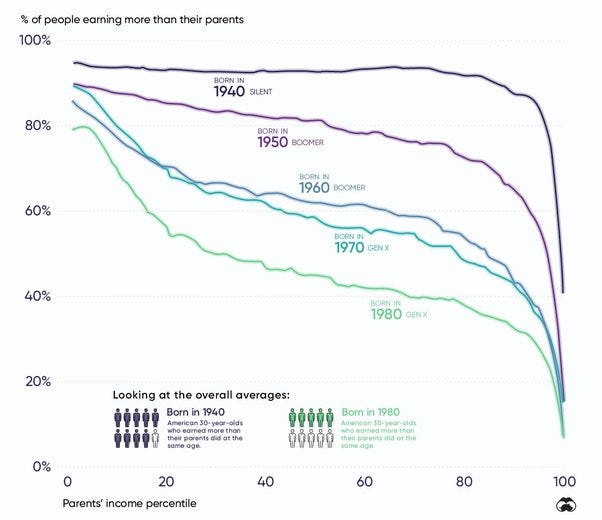
Quality of life for the middle class has been steadily tanking while the ownership class has been leveraging the benefits of technological progress to ameliorate and offset the increasing hardship they’ve been imposing upon the rest of us.

For example, poverty only one-half-century ago was evident in that the appearance of failing to meet essentials like clothing for appearance was a hallmark indicating poverty. That’s no longer the case, as many of the most impoverished among the working class avail themselves of systems that allow them to maintain an appearance of modest living while enduring severe degrees of economic insecurity.

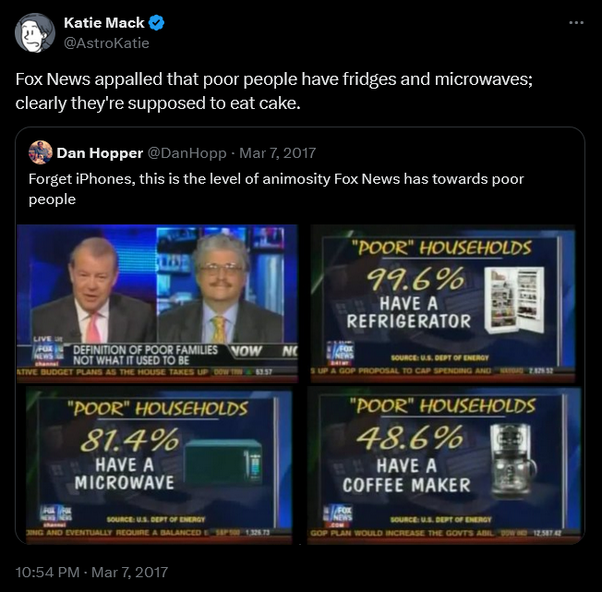
The Fox network made a big deal about people not living in poverty because they had refrigerators and microwaves. It is that kind of difference between poverty today and the poverty of last century that allows the ownership to more easily shame the victims of their efforts at impoverishing the majority in service to their hoards.

The harsh reality, however, is that most essential components of psychological health and emotional stability have been steadily stripped from the middle class in a stream of primarily invisible and ignored cuts over time.

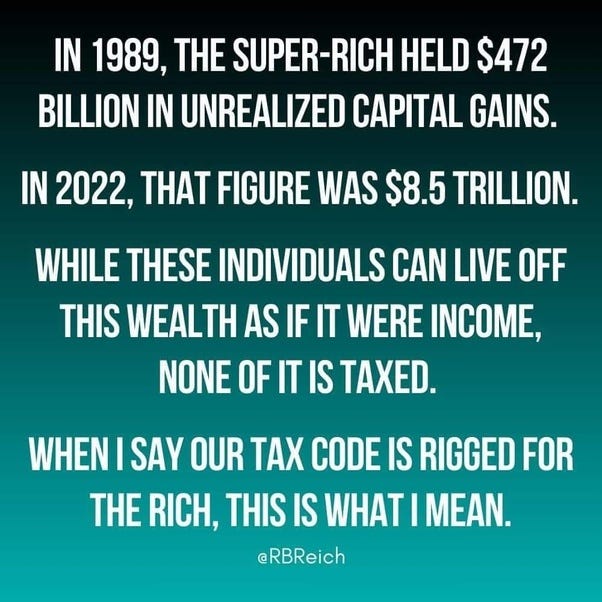
Compensation increases virtually halted for the middle class (and have even experienced shrinkages due to inflation), while income has skyrocketed for the ownership class.

The promise of capitalism raising people out of poverty from good ol’ fashioned elbow grease and modest living has vanished. The age of the Wealthy Barber lasted only a couple of decades before it was stripped from the people.

What we are left with now is a perpetual struggle for survival that has been steadily increasing year by year in the number of victims and the scope of theft perpetrated. The most privileged among us have had enough of an economic buffer to weather the storms that have destroyed the lives of millions victimized by the economic war waged by the ownership class against the working class. For many of those who would have qualified as being “upper middle class” fifty years ago and whose wealth would be more than double what it is today had the economy continued growing as it did during the heyday of Eisenhower tax rates, the economic war has remained largely invisible to them because they have not had to face the threat of food and housing insecurity that millions of working poor do today.

They may still face medical bankruptcies because those are huge bills that could and should be non-existent in a nation as wealthy as the U.S. However, the percentage of victims of that particular form of theft is relatively rare compared to the general population. We would otherwise have already had many Luigis acting out on their frustrations by now.

Instead, we have extremist right-wing groups on terrorist watch lists because they align themselves within their tribes and stoke their hatred toward those they blame for their woes. Occasionally, their outbursts gain public attention, but mostly, they’re made manifest in the ongoing and almost daily mass murders of innocent citizens and schoolchildren.

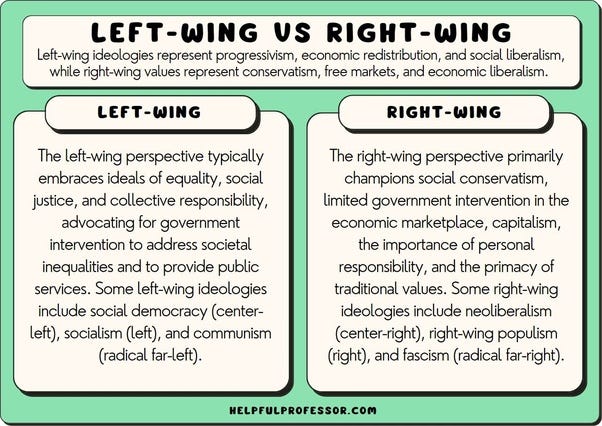
While the extreme right acts out their anger in unfocused ways, the left is targeted specifically on the causes of their anger. While the right victimizes anyone who doesn’t capitulate to their dogmatic adherence to the power wielded by those most responsible for victimizing them, like Stockholm Syndrome candidates, the mostly non-existent “extreme left” campaigns for economic justice through programs that restore equity.

Conflating the two as being identical is worse than oversimplifying a complex issue; it’s empowering the conditions that give rise to the hatred one seeks to demonize. It serves the narrative of a culture war perpetuated by the ownership class to divide the people further and distract them from the thefts perpetrated against them.

The irrational conflation made within this question merely functions as a self-fulfilling prophecy in which one declares a bullet wound fatal while stabbing the patient in the heart with a hunting knife to dig out the bullet.

This question is like accusing people of being jealous of Elon Musk’s money when the reality is that they hate white supremacists who install puppet rulers to destroy nations to attain their goal of empowering themselves at the expense of impoverishing the world. It’s a rather short-sighted attack on reality and the countless victims suffering needlessly in service to gluttonous powers.

Should there be fact-checking on social media platforms?

This post is a response to a question posed in its complete format: “Do you support Meta’s (Zuckerberg’s) decision to end third-party fact-checking on Facebook? Should there be any fact-checking at all on social media platforms? Why?”

Social media appears to be entering a stage where its profit-based model is “eating itself out of existence” as the latest in end-stage capitalism’s string of “Ouroboroses” (Ourobori?).

Along with stripping costs for an expensive venture, Mark is also adding AI bot profiles to create the appearance of engagement.

This reminds me of why I lost interest in dating sites. The easiest way to know a site’s ethics is when they create bot profiles to entice people into paying membership fees to engage with non-existent people.

As much as Zuckerberg flaps the trappings of community within Facebook and social media, none of his views are legitimately about community or supporting community development.

If social media were authentically social, its focus would be community development, not profit generation.

It is precisely the model of profit generation that puts social media into a death spiral of profit chasing to the bottom of the bottom-feeding barrel.

Their metrics for engagement are derived from a superficial analysis of what engagement means. As long as someone clicks something or posts something, that counts as “engagement,” and that interpretation of engagement counts as justification for advertising rates.

Meanwhile, no one gets anything from the deal but a massive case of blue balls.

Without a mission of serving a higher purpose of community development, social media and society, by extension, cannot but devolve into the technological equivalent of a pack of stray dogs begging strangers for treats.

We will experience social anarchy in the virtual world before it greets us in the real world. Hopefully, that will create enough pressure to do something proactive to support community development before the real-world communities devolve into chaotic monstrosities of “former civilization.”

All of this is an argument in favour of social media, on some level and in some capacity, being a publicly owned and managed enterprise that exercises its self-restraint divorced from the misanthropic profit-chasing model that dehumanizes people while pretending to serve human social needs.

As much as our dialogues focus on almost everything but community development, they all serve a community needs focus.

For example, all of the discourse surrounding AI and its replacement of human labour may be considered an economic, political, or labour issue, and it’s essentially a community response to a significant change transforming human society on a fundamental level.

All social media forms the basis of community development because all social media is public discourse. However, our problems with social media stem precisely from its growth being motivated by profit over principles.

At this stage, growths in profit that can satisfy hungry boards and investors justify cutting costs to the degree that whatever spirit was initially capitalized on that prompted the development of any particular social media site has been stripped from its operation.

The justifications for stripping costs have ironically been derived from concerns about the costs of managing social engagement. Who woulda thunk it’s too expensive to properly manage human behaviour to afford the cost of developing a media enterprise focused entirely upon squeezing profits from social engagement?

People need social media. It won’t go away, but social media proves today that profiting from human interaction is the wrong way to think about social media.

We have been watching the effects everywhere as social media has been devolving into a dynamic I remember from what I used to refer to as “usenut” — that many may be more familiar with as “Google Groups,” for example. I remember this as the gutter of human interaction — where the most extreme of the extreme was its primary denizens who were free to indulge in the most hateful of behaviours and attitudes.

I still “fondly remember” one character I used to refer to as “Grog” — which wasn’t their real name, and I’m not going to publish it because he’s still active on what shreds still exist of Usenet groups. He’s still advocating for the death penalty for gay people. It turned out that his father came out of the closet late in life, and that had a devastating impact on his psychology.

At any rate, this underground dynamic of toxic attitudes has slowly been seeping into an above-ground and public state of dialogue over time. If one had not ventured into the gutters of human detritus to discover its prevalence, one would not realize it’s an undercurrent that has always existed.

We will continue witnessing a devolution to the level of bottom-feeding slugs in human interaction characterized by social media as this trend of cost-cutting and profit-squeezing continues. It’s an inevitable characteristic of the capitalist chase for profits.

At some point, we’ll experience a confluence between the demand for social media interaction and restraint on toxic behaviours that normalize the intolerable throughout society. People will grow to hate people like Zuckerberg more than they do now, as one can already see an influx of disparaging posts about him beginning to flood the social media space everywhere.

Accountability and restraint on social media will become a widespread demand because social media fulfills a human need for interaction and dialogue that has always been present in less technologically based forms, such as letters to the editor in every newspaper that once littered the landscape.

Social media won’t disappear but will require transforming from a privately profitable industry into a public service. Nations like China are already ahead in this game by using their social media enterprises as tools for managing public dynamics through social credit scores and demerits.

If we’re not careful, social media will transform from a chaotic enterprise focused on chasing profit into a tool of oppressive control over the people in a much more pernicious way than media enterprises like Fox do now with their disinformation campaigns.

How is dissent the foundation of democracy?

This post is a response to a question initially posed on Quora, and can also be accessed via “https://www.quora.com/How-is-dissent-the-foundation-of-democracy/answer/Antonio-Amaral-1

  1. The opposite of dissent is subordination.
  2. Subordination is the foundation for authoritarian regimes.
  3. Authoritarian regimes are rigidly hierarchical.
  4. Rigid hierarchies are inflexible and abusive toward all people downward in the power hierarchy.
  5. Authoritarian regimes eventually break because humans have limits on the abuses they can tolerate.
  6. Democracies survive because they are fundamentally adaptable to change.
  7. Democracies are fundamentally adaptable to change because they accommodate individuality.
  8. Individuality empowers self-determination to maximize flexibility and adaptability.
  9. Flexibility and adaptability are contingent upon responsiveness to succeed.
  10. Responsiveness demands input and engagement from diverse perspectives to be effective.
  11. Dissent filters out ineffective processes that inhibit adaptability.
  12. Navigating change requires dissent to ensure that adaptation initiatives succeed.
  13. Without dissent, changes are made blindly to make adaptability impossible and guarantee failure.

Hence, dissent is the foundation of a democracy.

Furthermore, embracing dissent improves all of us, particularly in the essential skills area of critical thinking.

The greater our embrace of dissent, the better our thinking skills become.

The better our thinking skills become, the more robust our democracy.

Democracies are being threatened worldwide because we have been failing to equip citizens with the skills they need to build a better world together.

We have been failing to equip our citizens because arrogant assholes with too much of a desire for power wish to reduce citizen efficacy in self-governance systems because they deem themselves superior humans entitled to their power and to lord over the little people.

It’s past time they begin to relearn their lessons in humility.

Is there a way for those who have lost their jobs to declare war on AI?

This post is a response to a question posed in its complete format: “Imagine that millions lose their jobs due to AI. Is there a way for those who have lost their jobs to effectively declare war on AI?”

Well, that’s pointless.

People will not lose their jobs because of AI but because corporations save money on labour costs.

AI is a tool, and the argument that ammosexuals love to barf up applies here: “Guns don’t kill people. People kill people.”

AI doesn’t kill jobs. Capitalists kill jobs because they can and are incentivized by it within a system that worships personal wealth above all.

We, as citizens, kill jobs through our apathy and through our empowerment of those who prioritize their material benefits at the expense of the many they can exploit.

We bring this upon ourselves by not having a coherent social development roadmap. We allow our societies to grow by chaos rather than responsible systems management strategies.

We empower our leaders through a reactionary process of social development rather than a strategically reasoned and proactive process.

Sadly, authoritarian regimes are far more successful along this vector than democracies because their decision-making is limited to small, centralized powers.

This is part of the reason that the public has been increasingly questioning the value of democracy while looking toward authoritarian models to solve our problems for us.

Sadly, the solution for democracies to be far more effective in mobilizing social development in a coherent and unified direction is entirely contingent upon the quality of the education the public receives.

For instance, the transition to a fully automated society is an inevitability. There is no point in resisting it. We would all be much better off by leaning into it and demanding we adapt our systems to manage the transition better so that we can mitigate collateral damage.

Instead, we are experiencing a chaotic transition led by random powers following personal visions motivated by personal benefit rather than social good.

If our education systems provided a more comprehensive insight into social development, much of the public would be engaged in the political process in strategic rather than reactionary ways.

We would be more unified as a people in identifying trends and developing coherent strategies for successfully managing the challenges we face.

Instead, we are burdened by a dearth of education that reduces a population into cheerleading camps driven by emotionality that can be characterized as juvenile reactions against authorities. Considering how democracy means each person is a governing authority member, this is beyond an asinine apprehension of how one’s government works or how it can be made effective.

Democracy demands engagement, yet our apprehension of engagement is limited to how many likes one gets on one’s post. That’s not even remotely resembling engagement.

That’s like claiming every celebrity walking a red carpet and waving at the throngs is socializing with friends.

Sadly, part of the problem has been deliberately cultivated by the capitalists who want us distracted enough from the sausage-making process to allow them to remake human society into their image.

They have been succeeding remarkably within the U.S. as it has become a dystopian corporatocracy that prioritizes gun sales over the lives of children and billionaire profits over the healthcare needs of citizens.

The public has been so conditioned to prioritize profit at all costs that they will fight to preserve a billionaire’s right to kill people for profit.

We can’t govern ourselves in a democracy if all of our time is focused on survival and profit-churning. Most of us don’t care to be involved in the decision-making process, which would be okay if we could trust our information systems to prioritize informing people over chasing profits.

Instead, we have media that has become a singular, massive entity of public influence predicated upon churning conflict to maintain attention justified by revenue increases.

Instead of informing the public on issues of criticality to the future of the people, we have this kind of incendiary rhetoric from an attention whore indulging in shock stupidity to justify their salary increases by ginning up the rubes to create conflict.

Less than one hundred years ago, this kind of crap would be shut down immediately because it would be considered a precursor to war.

Instead, the attention-seeking mentality justified by the profit (and power-seeking) motive does not care about the casualties created by irresponsible language.

The value of human life has been downgraded, if it ever mattered to society, to a level that’s no greater than the Roman arenas when people were killed for entertainment.

If we don’t start asserting some standards on coherent behaviour that cultivates the best of us as a species, we will continue careening headlong into chaos.

Humans can take only so much abuse before they break. Everyone can break, and people like Watters are playing with fire. There’s no way he will be safe again crossing the border into Canada because of his disgusting language. Some might argue that any aggressive response against him is unjustifiable, and that may be valid, but it doesn’t change how humans behave when aggrieved. I’m confident few Canadians will give him a warm reception for his remarks if he ever crosses the border. At best, at least from my perspective, he’s earned a bloody nose for his garbage.

This kind of bullying rhetoric is toxic to society and is a betrayal of the social contract.

The acceptability of this nonsense and its prevalence is why we have no coherent strategy for managing our transition into a fully automated society. The acceptability of this kind of incendiary distraction from critical information the public needs to make proper decisions to minimize casualties in our transition will create unnecessary casualties. This kind of thinking is what permits bigotry to determine outcomes that dramatically affect lives.

This kind of nonsense is why this question exists in so many forms everywhere and why I’ve already answered this question in several forms by now.

The issues are not complex, but they are made so because we’re not talking about them where we need to be talking about them. We’re allowing jackasses to troll for reactions in “respectable mainstream media” that we would mute and block online if they were individuals and not expensively dressed and cosmetically pampered media personalities.

We are being betrayed by the Fourth Estate each and every day — and to the degree that a majority of the world now believes the U.S. is a tragic case of end times for a nation that has become so corrupt, it can never be trusted for leadership in the world again. However, anyone may parse the 2024 election, and one cannot ignore the role of the media in installing a monster in the top job for the nation.

If you genuinely want to declare war against the loss of jobs, then you need to take it to those who benefit from displacing jobs. You need to start pressuring the billionaires and the corporations they benefit from while ripping off the public through tax avoidance schemes.

Instead of war, you should demand responsible management for an unavoidably dramatic and traumatic societal transition by insisting on the only sane solution to this period in human history, UBI, as a starting point toward sanity in our social development.

The worst thing about where the world is at in this transition is that the next four years are being defined by a parasitic presence seeking to empower further those who are disempowering the working class while replacing workers with automated solutions to toss millions out onto the streets to fend for themselves.

We must stop blaming AI for job losses because it’s just a gun in the hands of mercenaries.

Why don’t they outright ban loopholes in modern law?

This post is a response to a question posed in its complete format: “Why don’t they outright ban loopholes in modern law? I get how humans are, and how literal laws can be, but still it’s like it doesn’t account for human nature and the laws written for robots.”

This question is like asking why can’t every bluish-coloured pebble of sand on a massive beach be removed.

Loopholes in law are bits of legal logic in which the language can be interpreted in multiple ways. At the same time, some of those interpretations constitute an escape from consequences, also known as a “technicality.”

The only things that can be done are to write laws in such ways as to make their interpretations as unbiased, neutral, and clearly defined as possible and to ensure the spirit of those laws is adequately conveyed within their construct.

Sadly, in a distorted environment where power imbalances influence the construction, application, enforcement, and rendering of decisions based on established statutes, loopholes are a feature, not a bug.

In the corporatocracy known as the U.S., loopholes are intentionally incorporated into laws to allow those with means an ability to access technicalities and avoid accountability for their actions. The highest court in the land has been deliberately shaped to serve the interests of power over and above the interests of the people. The Citizens United ruling would have been much different if that had not happened. The same is true of the overturning of Roe v. Wade.

With an organization like the American Legislative Exchange Council, laws are written specifically to benefit the wealthy and disenfranchise everyone else.

ALEC Exposed

Unbiased and neutral laws are impossible to write and enforce within such a toxic and anti-justice environment.

You may get “how humans are,” but few Americans truly understand how dire their circumstances are. With this level of corruption throughout their “justice” system, Americans have no hope of restoring justice without the people mobilizing and “pulling an Iceland manoeuvre in the extreme.” Americans are now well past the point of achieving justice in a just society without severe chaos ruling the land long enough to cull the monsters responsible for the corruption.

In short, Luigi was just the first shot back across the bow by the little people quickly reaching their breaking point. There will likely be riots nationwide before Trump’s term has run its course. Sadly, he’s not the problem, but a symptom of the problem and attacking him won’t solve the core problems. In some ways, he’ll be doing the nation a favour by making it impossible for the people to ignore just how prevalent the corruption issue is.

The MAGAts intuit this on a visceral level, and they voted for the symptom of the problem to deal with the situation. Still, their support is very much like pouring gasoline on a fire to make the apathetic among the nation wake TF up and pay attention to the freedoms they’re allowing to erode and be taken from them.

It is mind-boggling, for example, to outsiders to see a nation struggle to rein in mass murders and establish universal health care. You’ve had movies indulging in revenge fantasies against the corruption, but few of you seem willing to commit yourselves to fixing it. You seem to have settled in with having your children attend school while fearing for their lives and pretending there’s nothing horrifically surreal about that.

Americans are way, way, way past the point of fixing a few loopholes to restore sanity to your nation.

Why does the right wing complain more than the left?

This post is a response to a question posed in its complete format: “Why does the right wing complain about the left wing far more on the internet than the left complains about the right on internet podcasts, etc.?”

I haven’t performed any surveys, nor am I aware of any statistics on the matter. I have, however, noticed a distinct difference between the nature and characteristics of the criticisms levelled.

The “left” generally identifies toxic characteristics from the right that erode or betray the social contract through blatant forms of bigotry, hypocrisy, projections, generic hatred, and unfocused rage.

The “criticisms” from the “right” are generally simplistic accusations one would expect from grade-school children. Very little thought is put into their concerns while choosing to wield broad brushes of hatred that are often confessions disguised as accusations.

I’ve used a broad brush to describe these general differences but am hard-pressed to think of criticisms from the right that are not embarrassments to the concept of critical thinking. It’s not that they don’t exist. They’re so rare that one has to focus on dredging up examples through a mountainous garbage heap of blatantly childish spite that they appear almost entirely non-existent.

Another salient difference between the two polarities is the concern for the victims of horrifically bad policy expressed by the left and a maddening sociopathic disdain and even Machiavellian pleasure taken in the notion of victims of bad policy justified through a lens of righteous indignity.

At almost every step and instance, whenever conservatives talk about the victims of bad policy, they seem to gloat their pleasure over the thought of people suffering needlessly.

Another characteristic that distinguishes political polarities is how willing and eager the right is when defending the 1% responsible for trillions in theft and the destruction of the middle-class quality of life. The right seems entirely oblivious to the causes of their anger and prefers to victimize further the victims of those responsible for their misery. One can only conclude that another characteristic common to conservatives is intellectual cowardice.

They would rather crap on the weakened and easy victims than hold the people responsible for their misery accountable. It’s like watching someone beat up on the victim of a mugging rather than go after the mugger because they’re too afraid of the mugger and would rather cozy up to them while hoping to have a few pennies thrown their way for how well they lubricate their anuses.

The reason why that would be the case is quite simple and referred to as “overcompensating behaviour.” It’s a widespread psychological phenomenon when someone subliminally recognizes the implications of their behaviour and instinctively reacts to mitigate the consequences of their actions.

Overcompensation and the Inferiority Complex: Delving into Adler’s Theory

The Psychology of Compensation

Is the entire world moving further to the right?

This post is a response to a question initially posed on Quora, and can also be accessed via “https://www.quora.com/Is-the-entire-world-moving-further-to-the-right/answer/Antonio-Amaral-1

The entire world is undergoing a massive transformation that has steadily escalated in speed and scope year by year for decades. Although the world has constantly been changing, this degree of change is unprecedented.

I remember Alvin Toffler’s predictions on this in Future Shock from when I was a kid in school, and we had the opportunity to watch his documentary in the classroom. Among the many predictions, this rate of escalating change has always stood out for me as a consequence of being repeatedly reminded of it throughout my lifetime. I thought the beginning of the Information Age represented a peak of speed of change, but that was just the beginning of ramping up the rate of change to come.

With great changes come great uncertainty, and that fires up anxiety levels everywhere.

Making matters worse has been the class warfare reaching new peaks of disparity driven by thefts of the working class by the tens of trillions over the last few decades as world politics began shifting rightward.

Before Reagan and Thatcher, many of the democracies in developed nations around the globe still viewed the government as somewhat of an ally, even after experiencing perceived betrayals through global events like the war in Vietnam and Britain’s mishandling of the IRA in Ireland and “Sunday Bloody Sunday.” JFK’s assassination shocked the world. Labour strikes rocked the world.

People were fed up then with disruptive elements and had developed a level of comfort with their daily lives and their expectations for their future that they lost touch with the value of disruptive events like strikes. No one then realized how a disruption to their air travel plans was a positive and necessary event in a healthy democracy when negotiations broke down. The general attitude of entitlement to expectations of service became an easy wedge to force between the public and the labour organizations fighting to maintain equanimity between the classes.

Demonizing government became a path to power within government because the people in democracies began believing corruption was also as endemic to the government as unions. Political systems began being viewed through a cynical lens, while conservative politicians have since leveraged that sentiment to gain political power for themselves.

Regan’s firing of air traffic controllers was accompanied by a cheering public who saw their travelling conveniences disrupted rather than their quality of life being protected. People had begun forgetting almost a couple of centuries of sacrifice in fighting for fundamental rights and protections like weekends off, overtime pay, and healthcare benefits.

Employers had begun implementing progressive strategies for supporting staff, so the protections provided by unions began to seem redundant and perceived as an unnecessary cost for supporting a political organization that often ignored the needs of its constituents. Unions began being viewed as corrupt organizations rather than protectors of the middle class that they helped build and grow.

Conservatives took advantage of this new embrace of the ownership class and cultivated a belief that it was within reach of everyone who worked hard and lived responsibly. The American dream was possible by the beginning of disassembling the structures that gave rise to the middle class.

Reagan’s tax cuts and the heyday of spending, which characterized the 1980s, made it seem like the wealthy were just like everyone else and were equal members of a human community willing to share in the prosperity.

It was easy to support conservative ideology because it seemed the most pragmatic. Even today, people will describe themselves as “conservative” more out of an avoidance of needlessly attracting unwanted and disparaging public attention and appearing reserved than out of an embrace of a political ideology.

When people refer to themselves as “conservative,” they usually do so to appear “normal,” “predictable,” and “approachable,” while those who are not are generally viewed as “erratic” and “disruptive.” This perception is what has made conservativism most popular. It is easy to equate “fiscal conservativism” with sound financial management strategies, even though political conservatives constitute the worst among the worst economic managers. We have had decades of conservatives blowing up debts across every nation they held leadership roles in and are still publicly viewed as fiscally competent.

Conservativism represents an imaginary form of stoicism in which people hunker down and do what needs to be done because that’s the only way to survive adversity.

In times of stress and fear, withdrawing from positions of risk seems generally the safest approach toward surviving adversity. We’ve had countless generations learning to do without to make ends meet. Our forefathers lived during times of scarcity while production efforts scrambled to keep up with demand.

Most people lived independently and without the social support fought for and won by the progressives in society who demanded equitable treatment from the ownership class. They also responded to adversity by hoarding their assets as a survival strategy through adversity. Scarcity was a fact of life until only a few decades ago when our means of production exceeded our demand.

We are already living in an entirely new world, while most people born before the advent of the information age still live as if scarcity were a challenge for the human species. Most do not understand how dramatically opportunities have shrunk for people starting today like they did yesterday. Many, if not most, perceive today’s complaints and social disruptions as a consequence of overreach by attitudes of unearned entitlement.

Many live in today’s world as if it were still the 1980s without realizing how much they once took for granted has been stolen by the ownership class. What they see is increasing disruption to the predictable life and world they once knew, and they seek to blame progress itself as the culprit responsible for their anxieties. This causes people to turn inward in a protectionist strategy for survival.

The attitude of protectionism has been steadily rising while being stoked by conservative politicians as they have cultivated a cynically misanthropic attitude among their supporters toward their fellow neighbours. They take every opportunity to demonize concepts that make people feel uncomfortable and politicize them for personal gain.

Everything about the conservative ethos today has been geared toward hating anyone and anything that can potentially disrupt the sanctity of a predictable existence. Fear and hatred have been the weapons of choice wielded by conservative power mongers, and it works because people respond to threats on a visceral level before they can afford the risk of examining them for their rationale.

Conservativism is a “shoot first and ask questions later” approach to anxiety, and that used to work on some levels in a simpler world with simpler problems. Unfortunately, it only exacerbates the issues we face today.

Fortunately, within the hard swing to the right throughout these last several decades exist the seeds for reversing the course of a political pendulum that has been perpetually swinging to either extreme before being yanked back to an inevitable centre where stability lies.

It may be that we will continue swinging further rightward, but the further we go to the right, the more powerful the backlash becomes. If we find ourselves facing full-blown fascism as a clear threat to our democracies, then we may be in for some seriously chaotic times, but that’s when the voice of reason becomes influential as a guide out of madness.

We desperately need bold leadership that can press for the necessary changes we must make to our systems to ensure our transition into a fully automated society creates minimal casualties, or we will risk warfare. We can no longer afford capitulating gestures because the conservative opposition has been clear that it doesn’t negotiate in good faith. Like all situations with bullies, the only solution to their entrenchment is to meet them on their level and overpower them to such a degree that they relent.

This is the prisoner’s dilemma in game theory, where tit for tat is the only way out of this mess right now. We can face the issues head-on or watch everything collapse, hoping some miracle saves our assets. We are most definitely at a crossroads as a species, and the right appears hellbent on subjugating everyone not approved as core representatives of their tribe.

Would hastening societal collapse do more harm than good?

This post is a response to a question posed in its complete format: “Attempting to increase global problems to bring societal collapse sooner, would that do more harm than good?”

Societal collapse is, by definition, the most harm that can be done.

It may seem like the easiest way to address the rampant corruption we see today, but there is no guarantee against a new and next-generation form of corruption taking root in the ashes of the old. The odds are greater that a new form of corruption will be even more corrupt because they will have better learned how to protect themselves from reprisals.

If you look at the responses to Brian Thompson’s execution for crimes against humanity, there is no remorse being displayed by the monsters among us. They feel righteous anger at having been assaulted so violently.

Their response to a situation where their victims strike back is to hunker down with increased security measures.

They learn nothing from random acts of violence.

It may be the case that destroying all of them at once will eliminate the currently most powerful of the corrupt among us. There are always new generations following who are eager to outdo their forerunners.

Indeed, this generation of corruption defining the ownership class is a case study of learning from their prior mistakes. It is precisely why they have essentially co-opted all media.

The best thing we can do is build from where we are while learning to embrace values and contribute to solidifying the social contract we share.

We must stand up against the corrupt in whatever way we can. We must also be evident in our statements so that the world understands how violence is treated as a last resort after all other options have been exhausted. This is the only way to minimize the destruction of everything we have built together. This is the only way to preserve and protect the best of what we want for our society and our children’s future.

From Marvel’s Loki Series