Where is heaven for you?


This post is a question twofer of responses to two questions initially posed on Quora as written here.

It’s in the same general area where “Utopia” exists.

It’s right next to “Avalon,” which isn’t far from Valhalla and just around the bend from Asgard and down the road from Shangri-la, but more than a stone’s throw from Agartha while one can easily get lost on their way if they get distracted by the gold in El Dorado and miss their left turn at Alfheim. Try not to stay too long admiring the great fields of Elysium, or you’ll never leave. Be sure to avoid the talking snakes if you take the shortcut through the Garden of Eden, and carry a flashlight or gas lantern if you cross Thule. Agartha can get a bit warm if you fall into a deep chasm, so be sure to have spare clothing and have a spear or sword on hand to defend yourself against errant knights while crossing the lands of Camelot.

At any rate, if you make it to Cockaigne, you’ll find anything you need, which should help you if you have to climb Mount Olympus and travel through Arcadia.

Otherwise, keep your compass pointing upward toward hope; eventually, you’ll reach heaven.


Question 2: Is it okay to believe in ancient gods?

If you need permission from others to choose your beliefs, then your issues involve your self-image and self-confidence.

If you already believe fantasies can be real and magic is, then you’re not that different from much of the rest of the world, sadly.

That you ask if it’s okay to believe what you want to believe speaks to a lack of confidence in your beliefs, and that means you’re not sure if that’s what you should believe, and you’re hoping some confirmation by others will help you decide what to believe.

That may be a valid strategy for getting confirmation when lost. Still, it also shows you’ve allowed your beliefs to arise from wandering about without paying attention to the path you’ve taken. Your mind has wandered in an aimless direction, and now you’ve arrived at a place of wondering where you are.

You might want to retrace your steps to understand better why and how you arrived at the place of belief preceding what’s popular today. That you’re aware of earlier paradigms shows you’ve done some investigation into your beliefs. You’ve been curious to learn for reasons that have meaning for you.

Choosing to rest on a particular set of beliefs is just that. You may find your curiosity compelling you to investigate further.

In any case, the ability to choose to adopt or discard any belief at any moment is an exceptional reason to pay attention to how and why one chooses either way, because failing to do so leads to the sort of loss of self you’re experiencing now.

Ultimately, your beliefs are yours to do with what you will. They are “tools” — “useful implements” that allow you to maintain a consistent heading of self-discovery. The more authentic they are as an expression of profound insight into oneself, the more genuine they become as beliefs.

Good luck on your journey.

Can empathy be overdone and detrimental?

This post is a response to a question posed in its complete format: “Can a person be highly empathetic and think empathy can be overdone and in many cases detrimental to better outcomes? Can being conscious of empathy and in control of your emotions be called for to create more realistic circumstances?”

No. You’re conflating empathy with other unrelated characteristics such as sympathy or pity.

Empathy is a complex phenomenon, more adequately described as an additional sense, not entirely unlike intuition or your other five senses. It’s a blend of cognitive parsing, information gathering, and processing, adding a layer of intellectual stimulation to our understanding.

There are three types of empathy: “affective empathy” (or “emotional” — feeling what someone else feels), “compassionate empathy” (recalling one’s feelings from similar situations and re-experiencing the emotion), and “cognitive empathy,” (intellectually identifying the emotions and connecting them to stimuli to comprehend the context in which the feelings are expressed).

The people most prone to being overwhelmed by an empathetic response to stimuli, often referred to as “hyper-sensitive,” struggle to discern between original feelings generated within and feelings they pick up from external stimuli. Their empathetic natures are primarily derived from the emotional form of empathy, akin to a radio tuned into a station while the volume is set to maximum. It can be overwhelming to find oneself tuned into powerful signals.

It can take a lifetime to cope with one’s sensitivity, primarily because of a lack of social support for such sensitivity. More often than not, highly sensitive types tend to be targeted by bullies because they are perceived as easy victims who are also usually shunned by their peers. This lack of support can lead to feelings of isolation and exacerbate the challenges that sensitive individuals face in society.

These have been socially acceptable attitudes toward highly sensitive people, while many still doubt that empathy is genuine and is not a personality dysfunction. The first of these two questions is an example of misunderstanding empathy on that disparagement vector.

The second question, however, points toward a somewhat effective solution or means of coping with one’s sensitivity. Learning to discern between one’s natural feeling and those one receives from others on a subliminal level is crucial to maintaining one’s composure, if not sanity.

On the upside, once one learns to master the all-too-rare skill of self-awareness, they discover they possess a “superpower” and become “human lie detectors.” It can be frightening to learn that they are talking to a stranger who almost instantly knows their deepest secrets and more about them than they know about themselves.

Empaths who have mastered their emotional regulation and awareness skills also learn to conceal their awareness of others, as they generally don’t want to create enemies who are intimidated by them. Making matters more complicated is that one’s empathetic sensitivities are not infallible and can often be mistaken about other people. Much of this judgment error is due to unresolved personal growth issues. In essence, what I referred to as a “superpower” is more about “power over oneself” rather than over others.

Highly empathetic people tend to be the most honest because they must learn to be honest with themselves to maintain their internal equanimity. Living with the lies one tells oneself is much harder to do when one’s cognitive dissonance escalates rapidly, much more so than for those with diminished sensitivities to empathy.

The two other forms of empathy, “cognitive” and “compassionate,” generally complement affective empathy, but there may be cases where they don’t. I don’t know of such cases, nor see how that’s possible. Still, I’m not a professional who has spent a lifetime studying the manifestations of empathy in thousands of patients and volunteers.

Emotional regulation is otherwise a skill that anyone can benefit from, regardless of their sensitivities or empathetic capabilities.

Why do people work for leaders they don’t like?

This post is a response to a question posed in its complete format: “Why did people work for demanding leaders such as Steve Elon Musk? If they do not like them, why couldn’t they change their job?”

Jobs are not items in a grocery store that one can pick and choose at leisure.

Each job is a springboard to a better job or a deep dive into an abyss.

It cannot be stressed enough how critical it is to career success that one always has an exit strategy and a place to go if one’s job turns sour.

Jobs often go sour for reasons unrelated to performance and often due to abusive behaviours by management.

A personal case is one in which I was often extolled for my leadership skills while my supervisor would say to me, “You run a tight ship.” He would say these words to me while appreciating how much easier his life was due to my contributions. When I asked him for a reference letter, he wrote me a generic description of my length of employment as an act of spite to limit my options. He deliberately wanted to make it harder for me to make a vertical or even a lateral move away from an abusive environment in which he fraudulently presented himself as an ally who empathized with the abusive treatment I received from his supervisor.

Making matters more challenging is that jobs often go sour to such a degree that they are worse than not having a reference to support one’s candidacy for the next job. In my case, the Senior VP decided it would be fun to play a game of pretend I don’t know you each time we encountered each other. This went on for five years while I struggled with a salary 40 percent below market for my role on paper as I performed at levels higher than the manager and director above my role. They were happy to have me around, while I often saved their bacon and changed their tunes quickly when I chose not to go above my role and intervene to fix their mistakes.

A job relationship gone sour can become a barrier to continuing one’s career. More people than one would like to believe will easily choose spite to justify sabotaging a person’s career development efforts.

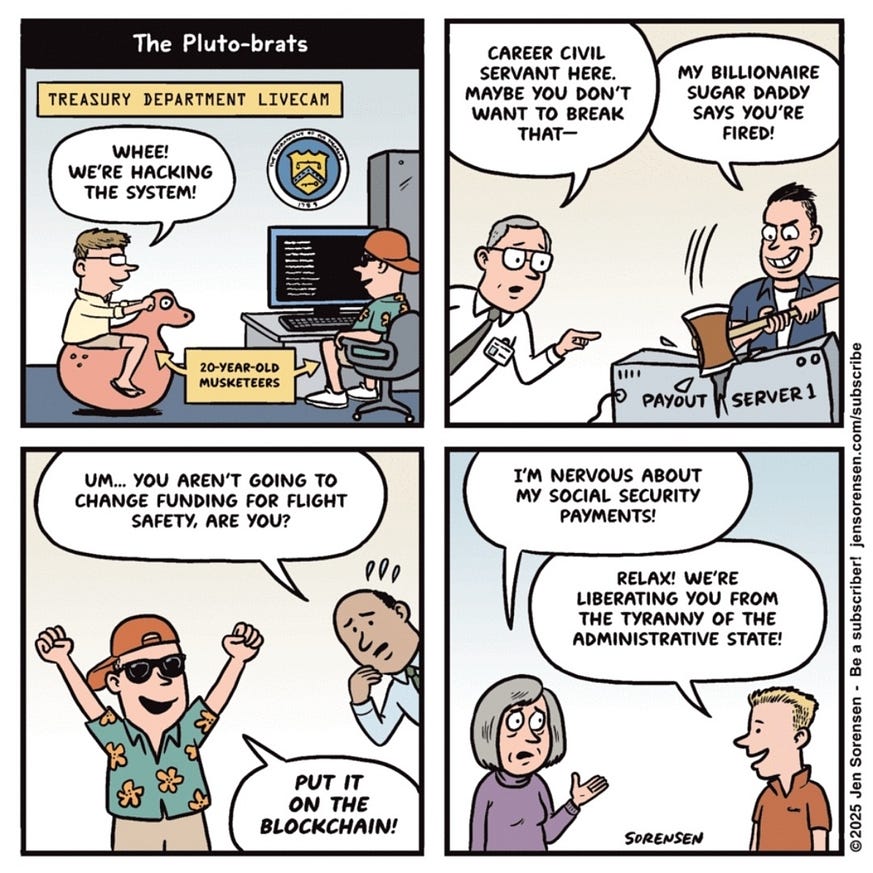
Someone as petty as Elon Musk could easily justify going to cartoonish lengths to destroy a person’s career on a whim. In his case, his reasoning is a consequence of the corruptive effects of too much power for anyone to possess.

Changing one’s job was much easier when we had a thriving middle class and various job options outside the structured and incestuous corporate world. Job options have become severely limited throughout the last several decades, in which one’s only choice for a stable career has mostly become a choice of serving as a cog in a multinational organization while hoping restructuring efforts don’t result in it vanishing overnight — like what happened with Twitter when Musk fired most of his staff on a whim.

Musk’s latest attempts at accessing the personal data of three hundred and fifty million Americans are precisely for controlling their lives by leveraging their histories against them. Our choices in working for leaders we don’t like are becoming increasingly restricted to either that or homelessness and destitution. That’s not much of a choice.

If this nonsense continues, no one will be free to do anything without his oversight and the oversight of a fascist oligarchy.

How can I motivate myself and feel less miserable?

This post is a response to a question posed in its complete format: “Sometimes I cry inside myself that I’m not like other intelligent people in my school and it hurts me every single day. I want to do my best but it just feels hard and my motivation dies off quickly. How can I motivate myself and feel less miserable?”

You joined Quora about three years ago and appear to have only two questions, including this one. The other question is about the lack of support and apparent abuse you endure from your parents.

It seems you are dealing with some intense emotional struggles that you do not deserve. However you perform in your academics and to improve yourself and achieve your goals, your parents have a moral obligation to be supportive.

Since they are not, you get saddled with the doubly hard challenge of finding your way through life’s confusing mess.

It’s not fair to you, but it may help you to understand how utterly broken most of the world is. We live in a world where a whopping majority (70%-80%) of families are dysfunctional.

You are not alone.

You can overcome your challenges.

A few things to consider while struggling to make something worthwhile of your life include;

  1. Focus on doing what you love doing. By investing your energies into something that brings you joy, you can create successes that will help you develop the confidence and motivation to succeed in other areas of your life.
  2. Find people who can empathize with your struggles — mainly because they endure similar struggles. Develop friendships with them to experience the emotional support your parents cannot give you.
  3. Read and read a lot to experience life through different eyes and learn to understand the complexities of life and its struggles through perspectives different from your own. Learn from what other minds have to teach you, and you will find strength within that you cannot feel now.
  4. Get a pet, if you can — a dog or a cat that can fill your heart with unconditional love and give you a reason to carry on through your toughest challenges.
  5. Spend as much time as you can with nature to feel that you belong here and to something much greater than the box of sorrow you have been given to bear.
  6. Know that nothing matters more than your ability to grow and change and adapt to an increasingly chaotic world undergoing a dramatic change that is pushing all of us to our limits. If we can survive this period of change, we will find a much friendlier world awaiting us on the other side of these challenges.
  7. Believe in yourself even when you make mistakes. Indeed, feel good about recognizing your mistakes because they are lessons you have succeeded in learning. It is much worse to make mistakes without identifying them as mistakes. It means you will repeat them like banging your head against a wall and hurting yourself even more.
  8. Allow yourself to see your parents as human beings like all other human beings. All of us have been damaged in some form or another by life, and it is a consequence of having undergone generations of struggle to emerge from a darkness of barbarism.
  9. Whatever you do, if you approach it with honesty, you are doing your best. You don’t have to try to do your best. You will always do your best if you are honest with yourself about what you do. Expect nothing more from yourself than complete honesty because knowing yourself matters most in your life. Knowing yourself is where you will find the strength to endure all the many challenges your life has in store.

I wish you all the best in your journey through this madness called “life.”

Temet Nosce

Is leader authenticity a matter of integrity?

The original question this article responds to in its complete format is as follows: “Is leader authenticity a matter of integrity? Should leaders behave similarly across different contexts and situations? Provide a specific example to explain your position.”

Authenticity IS integrity.

I often cringe when I read “Should” so-and-so do, be, or say such-and-such because that implies an externally imposed expectation.

One “should” do, be, or say whatever is required to accomplish or achieve whatever one seeks to accomplish or achieve by meeting externally defined expectations. That’s about it. All other motivation is derived from establishing and maintaining an inner equilibrium in which one can exist in a state of balanced compromise between the demands of the world and the needs of the self.

Authenticity is determined by a matching of one’s words and deeds. If someone is going to live an authentic life and be an authentic person, they’re not fulfilling an external expectation. They’re living in consistent alignment with who they perceive themselves to be.

Their ability to consistently maintain their authenticity while acknowledging the impact of their behaviours on others is how they are deemed to have integrity by others who make that determination about them.

One doesn’t decide to have integrity as if it’s an accoutrement to their lives. One chooses words and deeds that maintain one’s inner balance with one’s external self to be an authentic person with integrity.

A leader is just an ordinary person who lights a path or blazes a trail others can follow.

Some leaders are incredibly toxic and take people who follow them down dark paths that are absent of integrity.

I would argue that the most influential leaders we have in the world today are primarily psychopathic monsters who bleed their followers dry while being responsible for setting our world on a trajectory toward oblivion.

Followers are just as important as leaders within a leader/follower dynamic. Without followers, a leader is a solitary traveller.

The challenge we have in this world today is that those who seek leadership should have something other than followers. At the same time, too many followers must learn to distinguish between leaders who can elevate and inspire them to achieve their best and those who lead them to their slaughter.

An authentic person with integrity behaves consistently with their values across all domains, contexts, and situations. That’s what authenticity means. Be, say, and do what is right and good for you without compromising the balance permitting you to remain whole as a human being with your own functioning identity.

Integrity means others can trust you to be consistently authentic and that you will sacrifice whatever is necessary to maintain your authenticity of self.

Leadership means others recognize and value one’s consistency enough to derive value from it in whatever capacity brings them to a state of internal equilibrium.

Should followers be too broken to value integrity, so will their leaders.

Temet Nosce