Why are we expected to accept mainstream science blindly?

This post is a response to a question posed in its complete format: “Why are we now expected to blindly accept mainstream science and not question it even though the way you make scientific breakthroughs is to question science in the first place?”

Science is about asking questions because every established scientific fact and theory accepted by “mainstream science” is a transparent data repository.

Let’s first address this notion of “mainstream science” for the abomination of prejudice it is. There is no distinction between “mainstream science” and “non-mainstream science.” There are not multiple streams of acceptable sciences. There is “fringe science,” which involves investigations into concepts not grounded in science, but at least attempts to follow the investigative methodologies of science to prove their conjectures. “Fringe sciences” conforming to this definition include investigations into aliens, the afterlife, and all the supernatural. These are specious leaps of the imagination without grounding in proven scientific principles.

Any of the many investigators who have looked into these phenomena could identify something previously undetected. They can then provide evidence of their discovery through a context conforming to scientific rigour. Their findings can then be validated by any party’s ability to replicate their results predictably. If third party tests validate the propositions made, then their discoveries are incorporated into what you want to refer to disparagingly as “mainstream science.”

In the media world, “mainstream” refers to popularity while “fringe” refers to often extremist and not-popular venues of presenting information. There exists no validation system within media to ensure accuracy of the information presented. Your use of “mainstream science” attempts to transpose the chaotic nature of information presented within a media context onto a discipline built upon rigorous processes to ensure accuracy and transparency.

You’re not “expected to believe anything” that has been accepted by “mainstream science” but if you have questions, you have every right to repeat the tests conducted to derive the results described within each scientifically accepted fact or theory.

Nothing within the discipline of science expects anyone to believe anything. The expectation is that you disbelieve and question everything. The problem lies in the degree of effort people put into their investigations before accepting or rejecting any scientifically credible fact or theory.

When people pose questions like this, they admit to a poor understanding of the scientific process and approach their criticism with an arrogant form of indignity — as if they’re being lied to. The harsh reality, however, is that they are admitting to wallowing in ignorance and expect the world and the science discipline to cater to their personal biases like profit-chasing enterprises in media do.

When such minds reject a scientifically credible fact or theory, they’re not rejecting valid science or identifying flaws within testing methodologies, data collected, or conclusions. They are indulging in a wholesale dismissal of an entire branch as an excuse for failing to study their subject sufficiently to identify flaws. They’re indulging in pure bias — subjectively driven drivel.

We see this nonsense play out in every space a believer indulges in dumping their biases onto the world while pretending to possess enough of an understanding of science to dismiss the work of an uncountable number of professionals dedicating their lives to discovery. Professional scientists adhere to principles of integrity that can reveal fundamental and profound truths about the universe we inhabit. We cannot learn anything without rigorous discipline practiced with integrity, no matter how much the ignorati wish to drag the only means by which we, as humans, have developed for acquiring knowledge into an abyss of prejudicial ignorance.

The garbage perpetually barfed up by the scientifically illiterate is obnoxious, and it seems never to be cured by our species as it recurs like a herpes virus. After all the years of addressing the fundamental misapprehension of humans evolving from apes and the multitude of memes and discussions online about how utterly idiotic that degree of ignorance is, someone posed that question yesterday — and with righteous indignity. I couldn’t believe my eyes. “If humans evolved from apes, then why do apes still exist?” — the degree of blind stupidity in this question is abhorrent on far too many levels to tolerate. We cannot afford to tolerate this threat of ignorance to our survival as a species.

Yet, this is the kind of mind that believes science is the equivalent of mainstream media, and they are entitled to regard a massive branch of science as a repository of opinions, not facts. They dare to be arrogant enough to believe themselves entitled to be angry with people lying to them. The ignorance in such a position is appalling. It’s like a two-year-old child telling an adult that two-plus-two doesn’t equal four — then they stamp their feet and demand to be told they’re right.

That’s how your question was perceived when I first read it.

That’s what prompted me to check out your profile because this screams ignorance of science and I suspected first, that you were a troll who knows better and barfs up provocative nonsense for the insipid sake of getting a reaction… but you’re not.

Your profile indicates that you’re sincere in your questions, and that’s horrifying AF. I can accept how you might be a youth still in grade school, but if you’re a high school graduate, this question is an indictment of your education.

I feel sorry for you, but worse, is that I’m horrified for a nation that is poised to start another world war that almost guarantees human civilization as we know it will be destroyed forever. If that happens, the main culprit won’t be utterly evil monsters vying for power, but the ignorance of the poorly educated.
How can an atheist be sure there is no creator?

This post is a response to a question posed in its complete format: “How can an atheist be so sure that there is no God/creator if there is creation? Doesn’t creation mean something has been created?”

The concept of “creation” was invented by humans who first conceived it when they discovered smaller versions of themselves popping out of their bodies. While living with something growing inside for most of a year, they realized something new grew within them.

Then humans discovered tools. At first, those tools were found objects like bones to be used as weapons or extensions of one’s reach.

Eventually, humans learned they could improve on found objects by fastening rocks to the end of a bone to function more effectively as a weapon.

Throughout all of this, humans developed language, and within that process, they began to create sounds to describe what they witnessed.

As it happened, the notion of something arising out of nothing was expressed as a sound indicating what was understood of that process.

Humans knew nothing of natural processes and how they might have differed from the human process of shaping objects into tools or giving birth to new generations of humans.

Humans then knew nothing of virtual particles and quantum foam, so it was easy to assume some form of magical hand was involved in constructing little humans inside big humans in a way that was not unlike how they shaped better tools with rocks and bones.

The reality, however, that we can see around us and everywhere is that natural processes can lead to massive changes and the creation of the new without any guiding intelligence.

It is generally understood that mountains and lakes were “created” by natural processes and are not the product of intelligence deliberately moving continents to reshape the surface of the Earth.

The universe is far beyond being much more vast than anything we can imagine on Earth. That means it’s as impossible for a singular intelligence to deliberately shape matter into an unimaginable variety of specific forms as it is for an active intelligence to create Mount Everest or the Nile River.

Creation means something from constituent materials assembled into a structure. “Creation” does not imply any guiding intelligence while the vastness of the universe eviscerates any egotistical notion of such an intelligence remotely resembling what we understand of human intelligence.

It’s a delusional form of arrogance held by believers that blinds them to the nature of reality and it is a sickness of perception that threatens our future as a species on the planet.

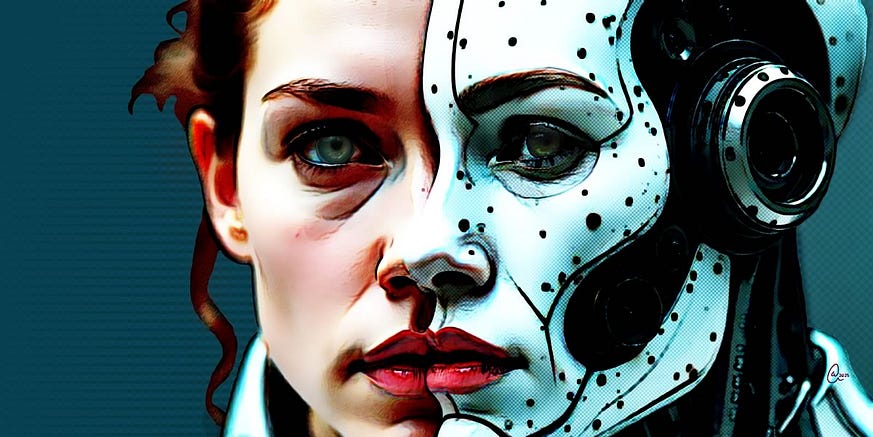
Where is the line between humans and machines?

What is the most essential difference between humans and machines? Where do we draw the line between humans and machines? What abilities does a machine need to have in order to be considered as smart as a human being?

To ask where we draw a line between humans and machines is to dehumanize an entire species of animal and to debase the whole animal kingdom and organic life by extension. This is an argument based on a presumption of devaluing life altogether.

Life is not simply an expression of mechanistic abilities.

Life is consciousness.

Life is an awareness of self within a process of triangulating its position relative to all a “self” experiences.

Machines are functional objects with deterministic behaviours defined by physics, not entities behaving with agency.

Machines are not self-aware.

Machines have no agency.

This question reduces human existence to the level of a rock.

It is not up to humans to consider another form of self-aware intelligence as “smart as a human being.” This attitude expresses hubris derived from ignorance of self and a world inhabited by diverse life forms. It is up to humans to learn to recognize how life manifests in ways which expand our perceptions.

Here’s an example of cognition that does not quite fit so neatly into an arrogant human-centric view of life:

These are photos from an experiment conducted to test and determine the nature of consciousness within a mycelial network — fungus.

How a new fungi study could affect how we think about cognition

The notion of “conscious fungus” gets far more freaky beyond this simple experiment in determining spatial relationships.

Fungal ‘Brains’ Can Think Like Human Minds, Scientists Say

Mushrooms communicate with each other using up to 50 ‘words’, scientist claims

We appear to be on the verge of discovering we have more in common with a mushroom than could ever be possible with a machine. The line you ask to be drawn currently marks the distinction between organics and inorganics. However, even then, that presumes a human-centric view of a universe still well beyond our comprehension.

Here’s yet another mind-blowing example of what we can witness on a micro scale but lack the research to apprehend its implications on a macroscale — Metamorphic Minerals:

8 Metamorphic Minerals and Metamorphic Rocks

We have mechanistic explanations for how these transformations occur. However, we have no means of contextualizing this behaviour globally because we still have much to learn about this biosphere we inhabit. If all organics are conscious or possess some form of consciousness, at what point does that transformation from lacking consciousness result in an emergence of consciousness? If the planet is a conscious being, it stands to reason that its constituent parts are expressions of consciousness or proto-consciousness… that we humans are merely bacteria in a life form on a larger scale.

Does that make artificial intelligence conscious?

Not at this point because our understanding of and definitions for consciousness are delimited by self-awareness and agency — even while those boundaries are being tested by each discovery made.

If a self-aware AI is to emerge, it will do so in ways we cannot comprehend because we don’t know the “essential difference between humans and machines,” we’ve only planted a conceptual flag where we’re able to spot the difference between the two.

Instead of drawing lines in the sand between what fits our preconceptions and what does not fit, we should instead focus on opening our minds to possibilities and filling them with as much knowledge of the universe as we can before we settle into conclusions that close us off to learning and expanding beyond the limits of our self-imposed biases.

We can only be prepared for unpredictable futures that will determine our long-term worthiness to continue existing by maintaining an open and curious mind. As it stands, our hubris is guaranteeing we won’t. Our hubris is proving that human beings are not intelligent enough to be considered “as smart as humans” — at least, not in the way we imagine our “greatness.”

Is there such a thing as Trump Derangement Syndrome?

This post is a response to a question posed in its complete format: “Generally, do anti-Trumpers think there is such a thing as Trump derangement syndrome, or do they see it as merely a criticism of them?”

Generally, people who refer to other people as “anti-Trumpers” while behaving as if “TDS” is a legitimate diagnosis are struggling to compensate for their slipping grasp on reality.

“TDS,” for example, is a dialectical device for dismissing uncomfortable information about someone’s object of unconditional worship.

It is “BDS” for a new president. It was first concocted as a way to ignore arguments against the Bush administration and their lies to initiate two wars with two different countries under the auspices of getting revenge on a terrorist attack.

None of the people who hurled the nonsense accusation of “BDS” wanted to believe the Bush administration had lied to them. None of them wanted to acknowledge the family feud origins driving two illegal wars while conducting war crimes when confronted by the facts of the Bin Laden and Bush histories.

None of them wanted to acknowledge the hypocrisy of a president who gave up looking for the terrorist responsible for the attack on 9/11.

At every step of the way and with every criticism of a grossly incompetent and abysmally amoral leadership that treated the soldiers who spilled blood on their behalf like disposable garbage, they cried out, “BDS! You’ve got BDS!” Hoping that would be the end of the resistance to their corruption.

They’re doing the same thing again with “TDS” by repurposing a conversation terminator that can allow them to wriggle away from the consequences of their corrupt behaviours.

They’ve also concocted another means by which they can achieve their divisive betrayal of the nation by reducing the conflict to a team sport where the opposing sides are merely cheerleaders for equal and opposite ideologies.

That’s already a betrayal of the social contract and everything decent about a nation that claims to value freedom and democracy.

These people never shut up about freedoms like freedom of speech, yet every one of their behaviours is the antithesis of what they claim to value.

They are worse than traitors to the nation. They are a toxic disease that represents a threat to human civilization.

They are worse than intransigent children because they cannot reason, will not reason, and will lie and accuse their way out of responsibility for the consequences of their destructive actions.

They are worse than cult members because they are not content with remaining in their space and living their lives in peace while allowing the rest of the world to enjoy the same courtesy.

They are a disease, a scourge that will not stop until they rule the whole of humanity.

They have existed for centuries, and now, they are impossible to ignore. They have become impossible to compartmentalize within geographical boundaries. They have become impossible to allow us to lie to ourselves that we are not all touched on some level by centuries of generational CPTSD.

We cannot ignore that these are not people “over there” but are our families, neighbours, and fellow country people. These are people who represent the one-in-five among us who suffer from severe psychological dysfunctionalities.

We cannot ignore how we cannot win this war through aggression but by changing how we live and how we structure our societies.

We can only survive this war by addressing all the elements contributing to this evil’s metastasis.

We can learn from history, pay attention to the same signs screaming for our attention, and stop creating excuses for why some things we value cannot be questioned.

We must be open-minded enough to acknowledge how much of what we take for granted as acceptable should no longer be tolerated.

We can no longer allow unchecked power to corrupt our systems and destroy their fundamental characteristics, ensuring their survival and capacity to meet our needs.

We must restore trust in ourselves as people living together in a civilized society and the systems we live by. However, we can’t do that by allowing the enemies of society to smear everything with a misanthropic haze of false equivalences.

We must draw lines in the sand when determining what is and isn’t acceptable and hold everyone accountable on an equal footing. We can no longer permit two sets of laws and rules for two classes of people.

Liberty, equality, and fraternity must be true for everyone, or we may as well allow ourselves to descend into the grave of barbarism as we write our final writ to the stars that care not whether we live or die.

Is Neil deGrasse Tyson wrong?

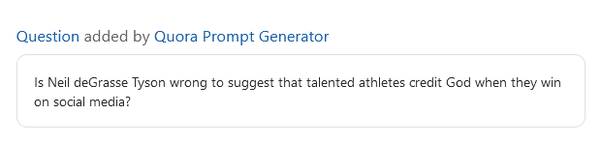
This post is a response to a question posed in its complete format: “Is Neil deGrasse Tyson wrong to suggest that talented athletes credit God when they win on social media?”

I think there is something severely wrong on so many levels that it’s impossible to address them without an entire book and a lot of research to identify the dynamics of a business decision justifying the dissemination of lies in society to stimulate engagement and generate revenue.

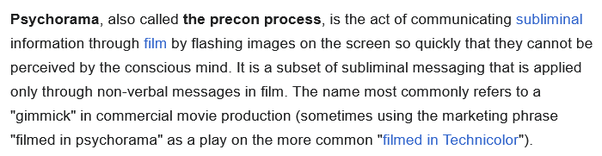
This is horrifying on so many levels that it insults every aspect of humanity, human society, and the social contract. This contributes to the widespread decay and ultimate destruction of civilized society on the most malignant levels. This crap is worse than the stage of “subliminal seduction” we went through in the 1970s when laws were crafted to prohibit embedded “invisible messaging” within entertainment media.

Psychorama — Wikipedia

Neil deGrasse Tyson has never suggested any such thing, and although it’s easy to attribute this claim to a believer on a mission of Lying for Jesus, it’s not. This is even worse than a believer trolling for reactions by lying.

For non-Quorans: This screengrab indicates the question author, and in this case, the question was written and posed by a bot designed to stimulate engagement on this social media site. This is a common revenue-generation strategy employed by media outlets across the board. Fox Entertainment, for example, has built its empire entirely upon this toxic revenue generation model.

Targeting information appealing to the limbic system is like serving up crack to a heroin addict, and that shapes the society we are cultivating by allowing this practice to dominate media. The effects are profound. 

Not only does this represent an abysmally immoral strategy for generating revenue, but it’s also a strategy that furthers a divide between people in a society already at the edge of fracturing into chaos. This strategy for engagement is ultimately a violent assault on our social contract and is responsible for the dramatic divisiveness characterizing our social dynamics today.

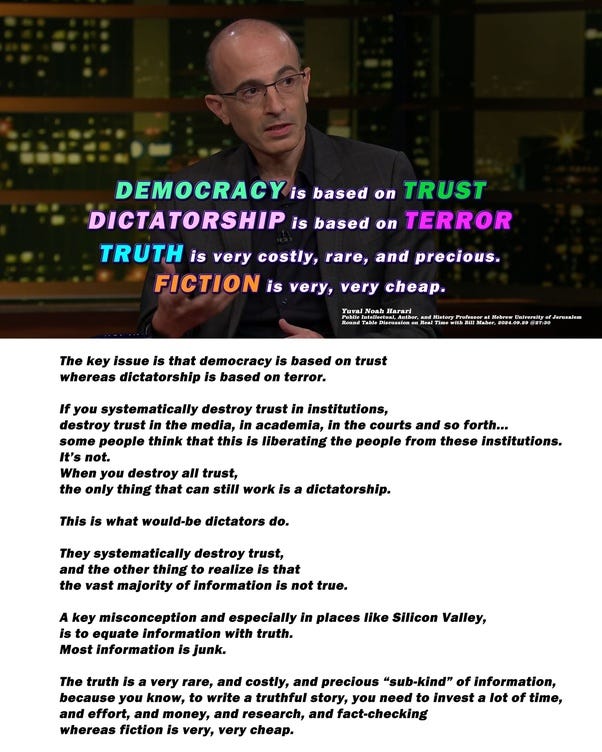
This precisely reinforces the post on my Thotbag space, citing Yuval Noah Harari’s statements during a round table discussion about the threat democracy itself is facing. Here is the meme I posted that includes his full text:

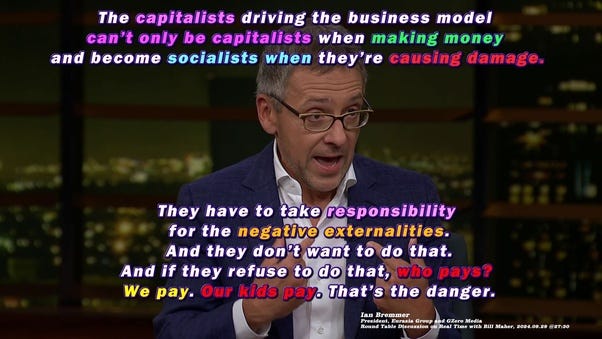
Along with Mr. Harari’s warning, Ian Bremmer pointed at the problem this divisive, conflict-escalating disinformation creates for society:

This fraudulent question is worse than Quora violating its own, now primarily defunct BNBR policy; it’s an assault on human decency on the most corrupt of levels for the most corrupt reasons.

This should not be disturbing only to atheists who fight back against a daily assault from believer trolls seeking to provoke emotional reactions. This should be disturbing to everyone who cares in the least about things like integrity and the social contract that has never been strained to such a degree as what we are living with today.

If society collapses into chaos — If people’s lives are unnecessarily lost because we can’t or won’t back away from the cliff we march toward — Then this kind of manipulative nonsense perpetrated upon us all for the sake of profit will be responsible for the nightmares ahead that we are about to encounter.

This is central to my argument on why social media should not be operated on a for-profit model. Social media is a community development endeavour, and we must consider how we approach its role in society more thoroughly than consigning personal information to a feeding ground for mining material profit.

That we are being strategically and systematically provoked by algorithms to hate each other should horrify all of us.

Is karma real?

This post is a response to a question posed in its complete format: “Do you believe in karma? Is karma real and happen to everyone whether they believe or don’t believe?”

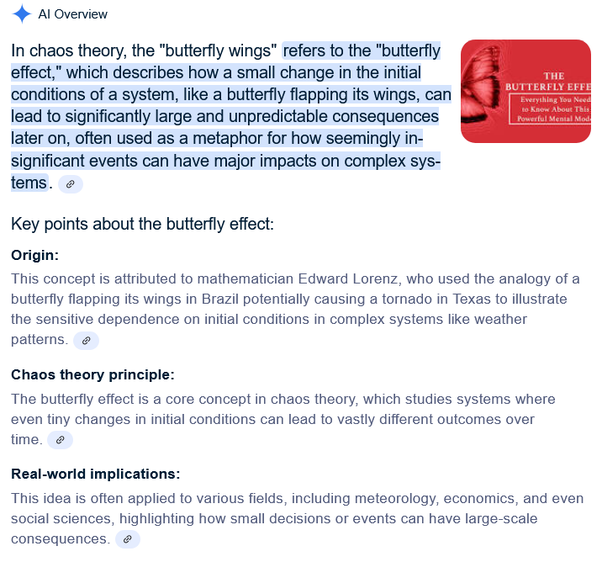
Cause and effect is physics, and so is Chaos theory, which is encapsulated within a concept called the “Butterfly Effect.”

In essence, it’s impossible to confidently predict the consequences of human behaviours because human societies are chaotic systems in which the most minor actions can lead to highly dramatic outcomes.

Whispering the correct sequence of words in the right tone into the correct ear can initiate a domino effect that can destroy an entire civilization (to translate the Butterfly Effect into a highly dramatic potentiality within the space of human dynamics).

That is valid science supported by observation and math.

Karma is “woo” — wishful thinking connecting a cause to an unconnected but desired outcome. It is supported only by the desire of the individual who hopes for a specific result. Reality doesn’t work that way, but coincidence can cause people to believe it does.

Having said that, if enough people desire an outcome, such as stopping a malignant force like Trump’s rabid destruction of the nation, then people will take action to affect an outcome through intent. This isn’t “Karma,” which suggests some invisible hand of the “human interaction space” (like the magical “invisible hand” of the free market) but cause and effect.

What will result from the escalation of conflict through the initiation of several protests as pushback to what the Trump administration is attempting through their implementation of Project 2025 is unknown. The only predictable aspect of where we are now is the guarantee that conflict will continue to escalate until it reaches a crescendo that can result in a complete breakdown of civilization through unmitigated chaos. How far all of this goes is anyone’s guess. We won’t know until the dust settles. We can only hope for a specific outcome based on the degree of public engagement and the escalation of protests against the takeover of the nation by a fascist entity.

That’s not karma because we can lose, while karma implies a guaranteed win. This is cause and effect in action, and the outcome is unpredictable.

People will call Tesla’s worldwide sales tanking karma because it feels good to say that. The reality, however, is that it’s the effect of a Nazi salute on the marketplace by a public that hasn’t forgotten the horrors of the Nazi scourge that extinguished millions of lives.

In short, I prefer to know the variables that can affect an outcome than hope some magical cosmic intelligence is balancing some invisible scale according to how I would wish the universe to operate.

Effects flowing from causes are reality, while karma is just wishful thinking.

What is Art for, and Why is it Important?


This post is a combined response to a couple of questions initially posed on Quora and written in their full format as, “As an artist, how would you answer this question? What is art for?” and “What is the importance of art in our society?”

Canadian poet Irving Layton described artists as canaries in coal mines because they are the barometers for society, which compels us to expand our perceptions by confronting often harsh truths.

Art changes how we understand the world by reflecting reality back to us within directed contexts to focus our attention on aspects of life presented in often unfamiliar and/or uncomfortable ways.

Art enriches our lives and reminds us of our humanity while connecting us through the artist’s work.


“What is the importance of art in our society?”

To adequately address this rather direct but general question, some context is needed to frame an answer which fully encompasses its implications.

There are three general perspectives upon which to address this question.

From an individual’s perspective

The importance of art in an individual’s life is a broadening of perspective and a deepening of insight into… well, literally everything about the human condition. From an observer’s perspective, art connects us on a visceral level. Whether it be music that moves us, a few well-chosen words, or an awe-inspiring spectacle, the experience is a validation of belonging to something greater.

From an artist’s perspective, it’s the cheapest therapy form.

Cumulatively, society benefits from the positive contributions resulting from affirmative expressions of community life within larger societies.

From a community’s perspective

Art brings attention to issues often overlooked, misunderstood, misrepresented, or misapprehended in ways which provide unmatched clarity in creating understanding. Art can mobilize a community and motivate social change, contributing to stability within larger societies.

From a society’s perspective

Art reflects the most profound truths about life, the human condition, and society in general.

Art provokes social introspection and defines boundaries while providing clarity on issues.

Art provides the public with psychologically supportive outlets of expression that contribute to overall social stability.

Artistic activity provides a healthy return on investment to every level of an economy.

Artistic history provides us with deep insights into our evolution as a species, and it is an activity that also provides insights into our future, like every other discipline of discovery.

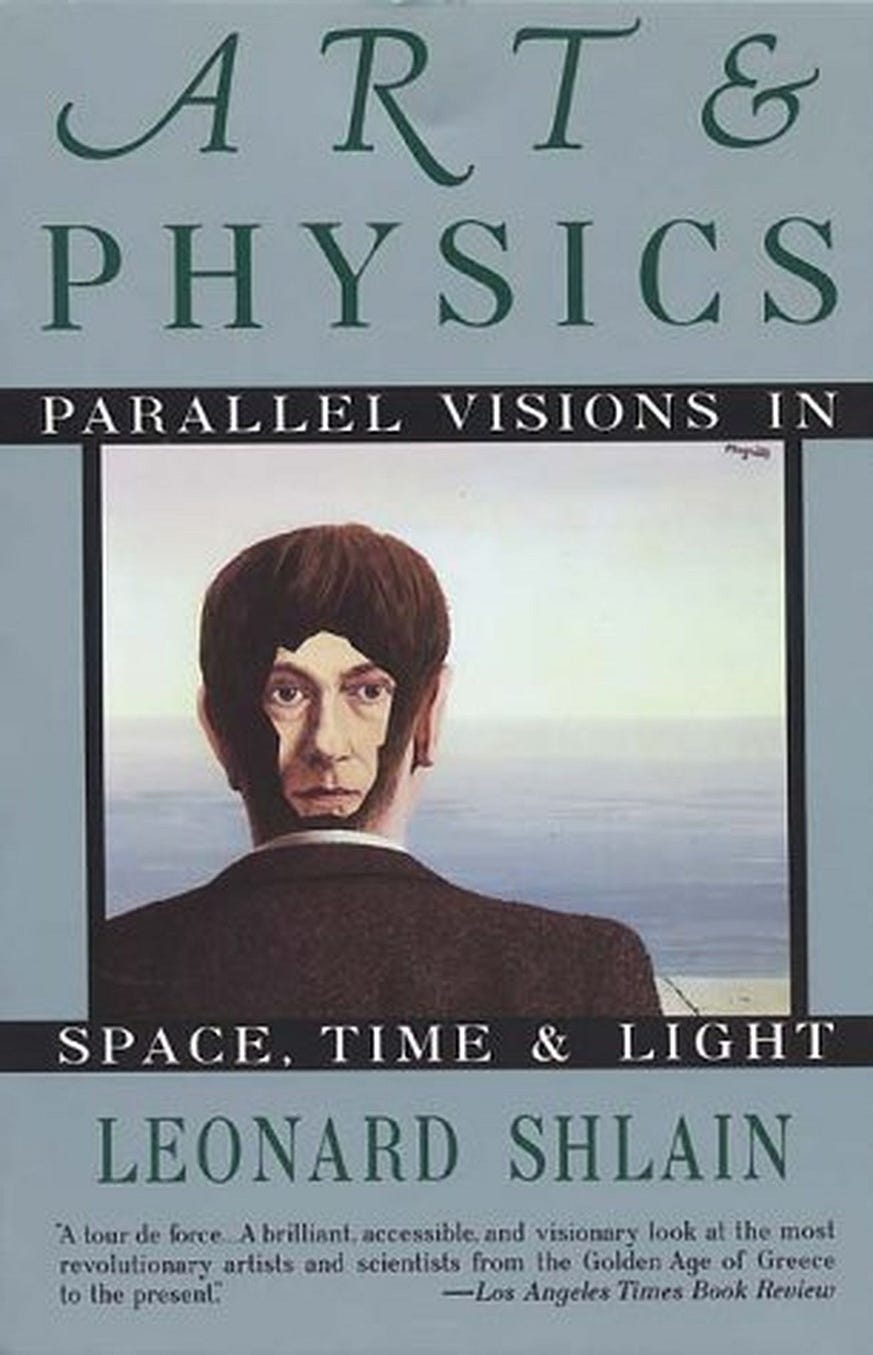
“Art interprets the visible world. Physics charts its unseen workings. The two realms seem completely opposed. But consider that both strive to reveal truths for which there are no words — with physicists using the language of mathematics and artists using visual images.

Art and Physics, Parallel Visions in Space, Time and Light — Leonard Shlain

Art & Physics | by Leonard Shlain

“Leonard Shlain proposes that the visionary artist is the first culture member to see the world in a new way. Then, nearly simultaneously, a revolutionary physicist discovers a new way to think about the world. Escorting the reader through the classical, medieval, Renaissance and modern eras, Shlain shows how the artists’ images create a compelling fit when superimposed on the physicists’ concepts.

What political ideology is socially progressive?

This post is a response to a question posed in its complete format: “What political ideology is socially progressive but still capitalist?”

People are socially progressive or regressive, not ideologies.

Ideologies are wrappers around the contents of similarly aligned people who share a common set of values, beliefs, and ideas for how political processes occur and how commonly beneficial goals are achieved by working together.

Ideologies are not static entities like moulds that immediately shape a person’s thoughts once inducted into an ideological grouping.

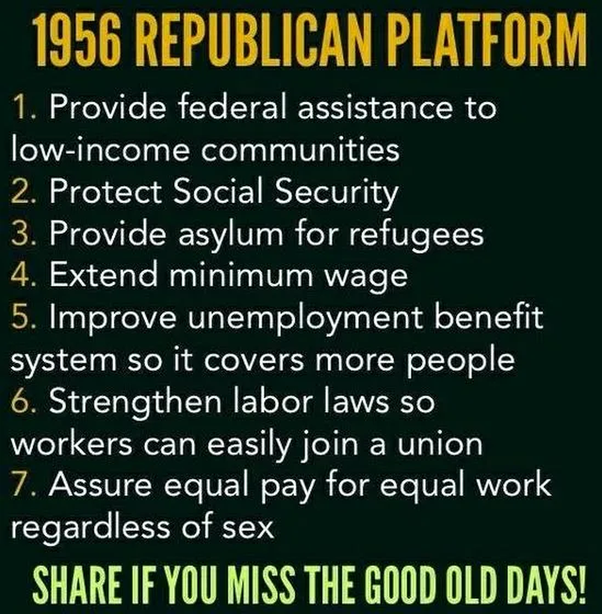
Ideologies are dynamic and ever-changing as people change. Here is an example of how much an ideology can change:

(For the “fake news people,” here is a link to the Snopes article giving this platform a rating of “mixture” — 1956 Republican Platform )

Regardless of the accuracy of the above platform, it’s pretty clear by the Project 2025 platform that it has significantly evolved.

People define and shape ideologies, not the other way around.

Today’s Republicans are not Abraham Lincoln’s emancipation championing Republicans.
Today’s Democrats are not the Dixie Democrats of less than one hundred years ago.

Liberalism has undergone many varied manifestations as if it were Christianity, endlessly spawning new denominations.

This question, however, flips that script around and becomes something pretending to be an ideology but is, in fact, something much uglier and evil. This question presents an ideology as if it were a costume to wear in a performance following a script dictated to members like a cult.

Ideologies are also not capitalist. People are participants in an economic system referred to as “Capitalism. Each person views aspects of Capitalism that align with or run contrary to their politics. Since economics comprises a core component of political systems, varying interpretations of Capitalism’s’ role in society also form a core component of alignment with an ideological identity.

In short, almost all political ideologies incorporate interpretations of Capitalism within their ideological construct. Hence, you have answers extolling varying ideologies that all claim to be capitalist.

Like religions, however, each pretends to represent the “one true God (of Capitalism).”

If one were willing to stretch the definition of Capitalism beyond its commonly accepted uses, then even Communism could be considered a “capitalist ideology” because capital is essentially a store of value directed toward creating infrastructure for facilitating trade. Communist systems conduct trade within their systems.

After having said that and freaking out some hard-core capitalists, let’s track backwards and identify the typical distinction between Capitalism and “not capitalism.” That definition hinges on ownership of the means of production. In Capitalism, ownership of factories is held by private entities. In a communist economy, factories (production environments) are owned “by the people.”

Ironically, however, an argument often used to extol the benefits of Capitalism is the ability of the people to buy into a capitalist venture through a process called “share ownership.” Functionally, this renders the distinction between Capitalism as we perceive it and Communism as it was conceived as moot.

Communism failed because centralized authority was unable to meet the needs of the people. Capitalism is undergoing a late stage that is rapidly descending into failure for the same reason of consolidated power and centralized authorities.

The only salient differences between the two systems are how power is distributed and who is conferred power by what process that conferring of power occurs.

In summary, we would be far better off focusing on power instead of worrying about ideologies and which one wishes to identify with as their favourite team. We should be far more concerned with who has power in society and how much power they have.

If we genuinely want to live in a free society that we typically call a “democracy,” then we desperately need to adopt an ideology which “worships the flattening of power.” We must adhere to principles in which power is spread like peanut butter to all people.

The only power that truly matters in life is the power to choose how to live it.

Freedom is living one’s life in a state of maximum opportunity and diversity of choice within a shared environment. A critical factor in the success of an ideology is the acknowledgement of how we are all in this together. Only together can we survive into a future that lasts even half as long as the dinosaurs did.

How can we determine the truth about the existence of God?

This post is a response to a question posed in its complete format: “How can we determine the truth about the existence of God? Should we rely on the beliefs of atheists or believers?”

This question is heartbreaking.

There is not a single thing in your life that you struggle with determining whether that thing exists other than your desire to believe what other humans have told you is true.

No other human has ever had to tell you the sun exists. You can quickly determine that for yourself.
No other human has ever had to tell you mountains exist. You can quickly determine that for yourself.
No other human has ever had to tell you oceans exist. You can quickly determine that for yourself.
No other human has ever had to tell you cold viruses exist. You can quickly determine that for yourself.
No other human has ever had to tell you snow exists. You can quickly determine that for yourself.

Nothing other than supernatural nonsense puts you into a quandary of wondering whether it exists or not.

You might wish to believe ghosts exist but will never see or experience tangible evidence to support any belief because no evidence exists. The same applies to goblins, leprechauns, fairies, angels, demons, the Easter Bunny, and Santa Claus. All of these imaginary beings are products of fiction, in which you will never experience a real-life manifestation of any of them.

It’s not that no one has been looking — quite the contrary. Millions worldwide have been searching for evidence of these phenomena for centuries. There have been television programs for decades with teams of people equipped with the most modern technologies to help them find evidence.

Let’s contrast that against something that was theorized to exist in 1964. A particle officially referred to as the “Higgs Boson” was determined to exist by extrapolating from the evidence that showed a massive gap in our understanding that could only be explained by something the public became aware of as “The God Particle.”

It was named so, not because it bore any relationship to your magical sky daddy, but because it was difficult to find. A physicist by the name of Leon Lederman wrote a book in 1993 called “The Goddamn Particle,” which was an expression of frustration over how difficult it was to find.

Everything about physics on this scale showed that it had to exist, but it couldn’t be found.

It was finally discovered forty-eight years after theorizing that this particle must exist to explain how mass is transferred to other particles like electrons and quarks. The Large Hadron Collider in Switzerland gave us the first proof of its existence. We had no tangible evidence of its existence up until then. We did, however, have tangible evidence of its necessity to exist to explain other phenomena that could not otherwise be explained without it.

IOW, without the existence of the Higgs Boson, much of physics would have just broken down into a jumble that could not make sense, be adequately explained, or avoid being relegated to the same realms of the imagination that the supernatural exists.

Without tangible evidence of its existence, all scientific discovery was at risk of being viewed in the same terms as magic — inexplicable woo.

Physicists set out to find it according to the clues pointing to where it must exist, and that’s where it was found.

No such corollary exists with the god concept.

Nothing in the universe requires god as an answer to an unanswered question.

The only reason you and everyone else who struggles with the concept are hung up on it is that it appeals to your emotional need for the universe to make sense in a paternalistic way… in the very same way, life made sense to you as an infant in the cradle whose parents or guardians ensured you had food in your belly. Life made sense to you as an infant when your diapers were changed to keep you comfortable and warm each day.

Your yearning for God is the desire of an infant wistfully hoping the chaos of life makes sense on some level beyond your comprehension… and that may very well be the case, but it isn’t due to some magical parent who will care for you like an infant in a cradle.

Atheists have no beliefs about god, so turning to atheists to answer questions that are your responsibility to answer for yourself is a disservice to you.

Other believers will tell you what they are desperate to believe is true, while atheists will tell you they don’t believe that nonsense.

This atheist will tell you that if something like a god creature exists, it doesn’t exist in any form that any human has been capable of imagining. Our universe is too vast, alien, and too far beyond human comprehension for us to have the slightest hope of untangling its mysteries enough to know anything with any certainty.

This atheist will also say that every manifestation of god by humans is an extension of their egos and represents the epitome of delusional human arrogance.

This atheist will strongly recommend that you stop wasting your valuable intellect on pining for a cosmic super daddy of the imagination and focus it on trying to detangle the complexity of life on Earth. There is already plenty here for us to figure out on our own, wasting valuable time and effort in pining on something irrelevant to the physical reality we share.

Pinning your hopes and dreams on the existence of a Father Cosmos is an abdication of your agency. It is a way of giving up on your gift of free will that you would expect someone to dictate your life to you instead of rising to the challenge of living your own life. It is a way of running away and hiding from the freedom you have been given, which has been hard-fought and won through bloody sacrifice after sacrifice throughout history for you to benefit from.

Pinning your hopes and dreams on the existence of a magical authority is giving up on yourself and retreating into a darkness of slavery and hopelessness in an existence of oppression made worse by the fact that you would only be serving the most depraved humans on the planet who don’t care in the least about a god beyond how they weaponize that concept against you and steal your life from you to benefit themselves.

This atheist strongly encourages you to live your life for yourself and not for some fantasy peddled to you by a parasite who wants you to believe nonsense because it benefits them at your expense.

How does art as personal expression differ from societal values?

This post is a response to a question posed in its complete format: “How does the function of art as a means of personal expression differ from its role as a reflection of cultural and societal values?”

We are each of us mirrors of our cultural and societal values.

Each of us expresses our values as we have been exposed to and have absorbed them into our makeup as individuals, whether we do so through work defined as “art” by society or by other means of self-expression.

Some common ways we recognize different cultures include dialects, cuisine, wardrobe, rituals, and social activities such as special occasions, holidays, and celebrations of varying kinds.

We typically define “art” as an experience without a pragmatic application beyond conveying an emotional or intellectual concept.

Most forms of expression serve a pragmatic value, such as organizing people, educating people, helping people accomplish goals, or restraining, hurting, preventing, or prohibiting people from engaging in an undesirable action.

The purpose of art is purely to share perspectives while the artist in society focuses their attention and development precisely upon developing one’s perspective through their work.

Most people rely on their expressions as a secondary, supportive, and functional concern as an adjunct to whatever their primary occupation is for their attention.

Everyone expresses their cultural and social values by being unique products of their environment. The artist “enters a meta state” of introspection while analyzing values to convey them through their unique perspectives.

Like physicists who focus on the physical characteristics of the universe, medical professionals who focus on the biological characteristics of humanity, psychologists who focus on the mental states of humanity, and geologists who focus on the mineral characteristics of the planet, artists focus on our cultural expressions of the human condition.

Artists are professional analysts for our societies who reflect the varying states of humanity through their expressions.