To what extent do profound ideas reach high levels of popularity?

This post is a response to a question posed in its complete format: “To which extent do novels, or manga, conveying deep idea, or talking about social issues, relate to them given global awards, or high global popularity, to which extent does this depend on how smart the creator is, why only few reach to this level?”

Popularity and recognition are primarily not determined by intelligence, creativity, or any value generally associated with degrees of quality, skill, or craftsmanship but by timing and resonance.

The kind of popularity attributed to intelligence and creativity is recognized only through endurance throughout the ages. It is the rarest form of popularity that remains consistently in the shadow of most other forms of popularity. It does receive the occasional boost because it can garner enough of a niche following to emerge on the populist stage for a time. Still, it then retreats to becoming a niche once again.

A book like “Fifty Shades of Grey” was a literary mess on every level, from the writing to the butchered subject matter to the horrid values it sensationalized.

It was a massive success because it appealed to a repressed and widespread imagination responding to an increasingly darkening reality by retreating into dark fantasies that most would not have the courage to explore in real life.

I’m certainly not claiming that I would or have the courage or the slightest interest in exploring this area of the human condition for myself. Still, I am at least aware enough of the dynamics to understand how the story itself represents more of an expression of a mind suffering from Stockholm Syndrome indulging in titillation rather than providing realistic insights into the dynamic it attempts to portray. It’s more of a study of mental health in society than a literary masterpiece.

This leads me to my point that, as a people, we have been enduring a staggering decrease in the quality of our lives over the last several decades, shocking most of us. A piece of schlock like this validates feelings shared by a large audience and titillates the imagination through sensationalized imagery.

It became popular, not because of any enduring qualities but because it fulfilled a need for an outlet.

“The Secret” is another example of appealing to repressed sentiment, but instead of validating the repressive darkness people have been suffering through, it capitalized on a need to restore hope.

Ultimately, both literary productions created more harm than good in the same way that trolls undermine the social contract.

Once materials like these run their course, they begin to resemble porn in that a temporary titillation is an insufficient mitigation for addressing underlying causes, and like cocaine, once it’s run its course through one’s body, one is left feeling drained and hungry for more of that emotion that gave them a temporary boost in life.

There is, sadly, no real cure to this phenomenon of populism beyond two different strategies. The first strategy is the sanest, but it is also the most long-term and invisible strategy for addressing this need to bottom feed while racing toward an ever-receding bottom. It’s a strategy that will make many eyes roll once I write it as a one-word summary: education.

Education is the “magic pill” that will mitigate most of humanity’s ills — at least, it will once we address the economic roots of humanity’s ills.

It won’t ever be a cure because there is no final state to education. There is no finishing an education. Only lifelong learning exists for our species if we wish to survive anywhere near as long as the dinosaurs did.

The alternative to education is our current self-destructive trajectory, which risks the end of human civilization and, quite possibly, our species if our rock bottom is deep enough.

The alternative track to education we are on is to continue our descent into worshipping the superficially constructed Holy Grail of attention for the sake of attention. We will continue to behave like addicts drawn toward the chaos of feeding an insatiable hunger until we consume all of what we value through superficial titillations that temporarily distract us from an otherwise horrifying existence.

Surviving the nightmare ahead of us means our future progeny will have slim pickings to choose from as representations of the best human potential to pick out from the forgettable detritus of populism. The future will be as we experience it today when looking back on history and forgetting how Leonardo DaVinci had many contemporaries competing for the same artisanal benefits he remains remembered for.

We don’t remember the easily forgotten mass, but we do remember the outliers, and that’s the broad lesson of history.

If we exist as a species and civilization in another two hundred years, no one will know who or what a Kardashian is. They will note, however, how rampant superficiality characterizes this primitive and barbaric state in which we live.

No one will remember any of the Harry Potter books or the trans-hating hypocrite who fraudulently represented hope within her discardable stories. They will, however, continue to be influenced by Tolkien.

No one will remember much of anything notable about the products of this era beyond the horrid worship of excess.

Not one talking head from Fox will be given a nod of acknowledgement for their contributions to society. Rupert Murdoch might earn a passing reference as a key player in corrupting human civilization. Even he will be regarded as a side note contributing to corruption. At the same time, his success at making it so widespread will be considered a global failure in ethics that permitted monstrosities like centibillionaires to exist.

Donald Trump will be remembered as this century’s Hitler, no matter how many may find that offensive today. It’s just where we are as a species, and history has given us enough hindsight information to make such predictions with great confidence.

Those who may be offended by this prediction would do well to consider how that’s an optimistic outcome to the trajectory we are on right now because if he succeeds in achieving the maximum potential of his efforts, then we may not have much left of humanity to be capable of studying the history we make today in any way resembling our current capacity for exploring our history from yesterday.

Suppose we don’t rein in society’s current excesses of distorted power. In that case, we will be lucky to exist in any state resembling anything other than a primitive existence at the mercy of nature.


How do atheists think this brief existence is all there is?

This post is a response to a question posed in its complete format: “How do atheists think this brief existence is all there is? Don’t you have a yearning in your heart that there must be something over the rainbow?”

That’s not exactly how that works.

This brief existence is all there is for this thing we call “ego.”

This thing we call “ego” is far from being “all there is” and is, in effect, as relevant to the universe as a speck of dust on our planet. The problem here isn’t the insignificance of ego but the ego’s addiction to being (or being perceived as) relevant beyond its existence.

There is much, much more to existence beyond the human ego, but as soon as each life ends, so too does that frail construct that demands immortality for itself on the sole basis of simply recognizing its own existence.

What we should be doing with human egos is learning how to train them to focus on the lives they get so that the benefits of existence are maximized for themselves and through others because that’s the only way for the ego to validate itself within the context of its limited existence.

Pissing away one’s life by catering to delusions of egotistical immortality is the most toxic form of grooming for one’s ego that invariably metastasizes it into a cancerous tumour for human society.

Whatever may exist “over the rainbow” is not for the human ego to experience.

This existence is all there is for the human ego.

The sooner the human ego can embrace that, the sooner it can grow to appreciate a gift that can vanish at any moment for any reason. Appreciation for the finiteness of one’s existence is precisely the point of a limited existence. There is no other way to transcend this limitation.

What should you never say to an atheist?

This post is a response to a question initially posed on Quora. For answers to additional questions, my profile can be accessed via “https://www.quora.com/profile/Antonio-Amaral-1/

“Atheism is a belief.”

“Atheism requires faith.”

“Atheism is a religion or cult or institution.”

“Atheists are a group which share characteristics or interests or views in common beyond disbelief in a God creature.”

“Atheists have no morals.”

“Atheists reject or hate God or worship Satan or any fictitious creature imagined by theists.”

“Atheists believe in science.” (No one, atheist or otherwise, who understands or has a basic understanding of science “believes in” science. Science is not a matter of faith, so please stop superimposing your insular paradigm onto others.)

“Creationism is an alternative to evolution.” (Also, don’t ever call people, atheists or otherwise, “evolutionists” because that’s just plain ignorance at an incredibly ignorant level of insular stupidity.)

Other statements like “God bless you” are contingent upon an individual atheist’s perspective on the matter. (I’m okay with people expressing positive sentiments in terms they are comfortable with and interpreting them as such.)

Atheists do not, as a whole, hate theists; they want them to stay in their lane and stop pretending like their beliefs trump facts because they don’t. Freedom of religion is the freedom to believe as you wish, not the right to impose your beliefs onto others. I don’t care if you think your interpretation of your scriptures causes you to believe homosexuality is wrong; you’re not God, and you have no right to pass judgment on people for how they were born… oh, and stay out of politics or start paying taxes like everyone else does.

By the way, Jesus wasn’t white, and his views were liberal. He did not support wealth but service to his fellow humans. He was not a narcissist who cared more for himself than the poor. His life was dedicated to peace, not war, nor to becoming wealthy or superior to others. He washed the feet of lepers to show you what that means, so betraying your saviour with your idiotic divisiveness and hatred will only send you to the hell you fear (if your beliefs pan out to be confirmed).

Even worse than simply betraying your beliefs, you make life hell for others — yes, I know, not all religious types are hypocrites. Still, all religious types must call out hate-mongering hypocrites like Steven Anderson, Kenneth Copeland, Jim Bakker, and the Westboro Baptist Church, who all prey upon your fellow believers by feeding on their insecurities. Make an effort to show the world you do believe what you claim to believe by raising a humungous stink over the very many atrocities committed by supposed religious leaders. There is no bloody way any religion can have any claim on morality when the predation of minors is institutionally protected. You must clean out the corruption in your own house first before you can hypocritically claim to care about so-called “unborn babies.” All this hypocritical crap makes people justifiably hate you and everything you claim to believe in — even the innocent ones among you; and worse for you, it makes people run away from your toxicity while eviscerating your credibility in everything you claim to believe.

That should cover most of the broad strokes I can identify from the top of my head (yes, it’s true, my references were Christian because that’s what I am most familiar with, but that doesn’t mean every other form of theist fantasy gets a pass because these sentiments apply to you, too.) We are living in a world characterized by disinformation and hatemongers to disenfranchise innocent people who cannot defend themselves. At the same time, hate crimes escalate as a monstrous hypocrite profits from selling autographed bibles.

(I wrote this five years ago and have been discussing these issues throughout my entire life, and instead of seeing any improvements with your lack of integrity issues, we’re seeing an increase in the kind of hypocrisy that would send chills down the spines of your venerated saviours. It’s horrifying just how little effort religious followers put into holding their leaders accountable for the hate they spread, and you dare to pretend you have a moral high ground. It is this kind of hypocrisy that’s driving people away from you.

If you want to be legitimately viewed as a moral people, then concentrate on feeding children in your schools instead of putting up fraudulent props like your Ten Dogmatic and repetitive Commandments. Kids need nutrition to focus on school and succeed at getting an education, not orders barked at them with threats of eternal punishment. This isn’t supposed to be the dark ages any longer. Those were over 500 years ago.)

All I can say as a summary is, Thank God I live in Canada because Americans are in for one helluva wake-up call over these next four years. What truly sucks, though, is how much of a negative impact you’re going to have on the entire rest of the world as you grapple with your lack of basic human decency.

Why don’t people realize our plutocracy causes our problems?

This post is a response to a question posed in its complete format: “Why don’t people realize that it is plutocracy (our country being governed by the wealthy elite) that is causing our economic problems?”

People don’t magically “realize things.”

People must be educated, informed, and aware of circumstances and details.

They need to be walked through the information presented to them as if one functions as a guide on a tour, answering questions.

People also don’t respond to laments, particularly when entrenched in counterfactual bigotries that prevent them from apprehending reality through an objective lens.

In essence, if this is an issue of concern for you, which I’m glad to see it is, then you need to start banging drums and sharing information and details because there are at least 76 million people in the U.S. alone who are entirely so oblivious to what you’ve determined for yourself that they contribute to the problems caused by the plutocracy.

There are many reasons why many people support self-and-socially destructive agendas, and most of those reasons can generally fall into only a few camps:

  1. They benefit directly from the corruption,
  2. They interpret the economic problems of the victims of a corrupt system as personal failings,
  3. They imagine themselves as potential beneficiaries of corrupt powers by supporting them,
  4. They lack the wherewithal to do anything about the corruption, so they cope with what they don’t believe they can change by resigning to hate the more easily victimized,
  5. They support what they believe is a natural state of a zero-sum existence encapsulated as a butchered interpretation of life often referred to as the “law of the jungle,” in which there are only predators and prey in this world,
  6. They’re psychologically dysfunctional — which is an explanation that applies to all the preceding points,
  7. Their education is woefully lacking — which also applies to all preceding points and leads back to the onus placed on those who know better by providing the support necessary to make positive change while also receiving a reminder that lamenting the sad state of affairs does nothing to change them. It does, however, give the broken among us a target to jeer and mock and use as an example to justify their corrupt interpretations of life.

Now, arm yourself with the information you need to fight as a keyboard warrior and do something more productive than issue lamentations to elevate humanity from this dank pit of misanthropy.

Good luck in this war for basic human decency.

How can the concept of authority be explained?

This post is a response to a question initially posed on Quora, and can also be accessed via “https://www.quora.com/How-can-the-concept-of-authority-be-explained/answer/Antonio-Amaral-1

There appear to be two distinct perceptions that dominate public responses to authority.

On the one hand, an authority is an entity with the power to issue demands, impose edicts, and enforce compliance. On the other hand, an authority is a trusted entity that serves as a resource for empowering people and enabling their ambitions.

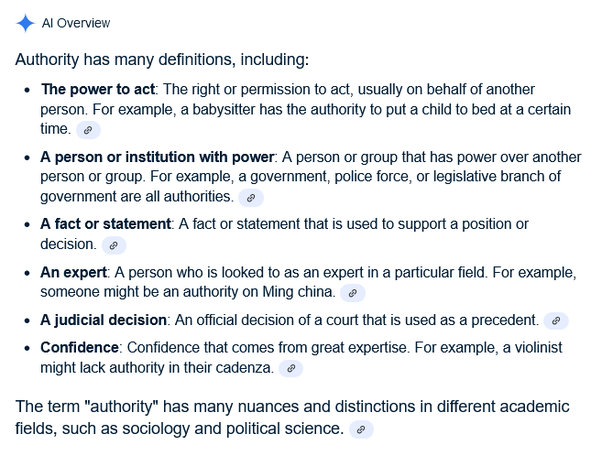
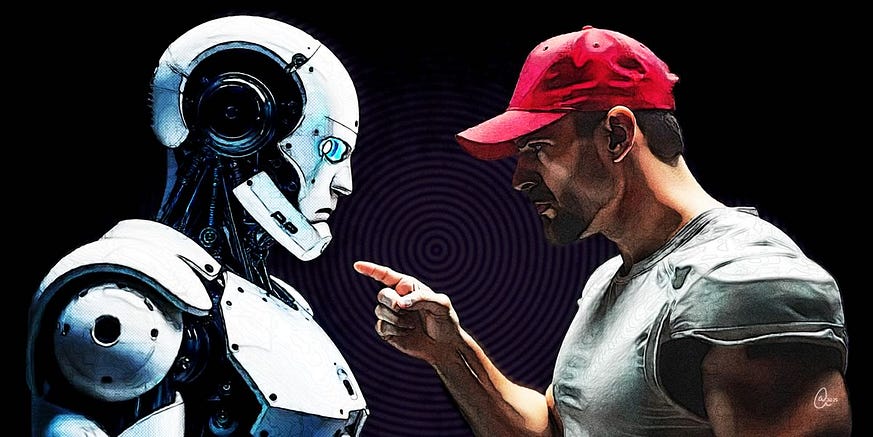
Our good friend and authoritative source of plagiarized information, AI Bot (Ayebot? iBot? EyeBot? — It needs a name so that it can be further anthropomorphized. “Gemini” seems a bit too much like impersonal woo.), provides a bit more detail:

Wikipedia has this definition, which appears to favour an interpretation based on an exercise of power:

Authority is commonly understood as the legitimate power of a person or group over other people.[1][dead link][2] In a civil state, an authority may be practiced by legislative, executive, and judicial branches of government,[3][need quotation to verify] each of which has authority and is an authority.[4] The term “authority” has many nuances and distinctions within various academic fields, from sociology to political science. ”

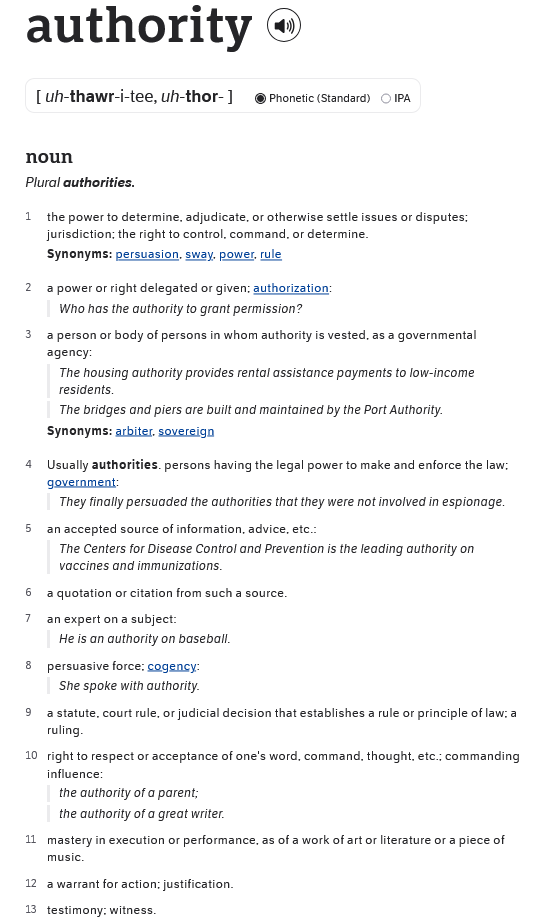
Let’s comb the world of language authorities to see how they interpret authority:

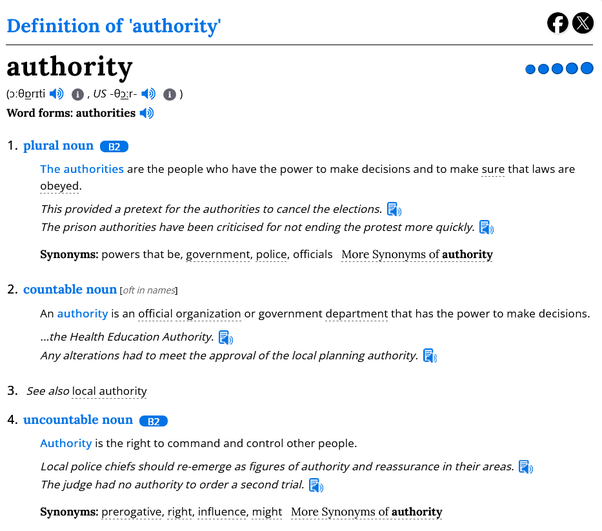
Collins has this to say about authority:

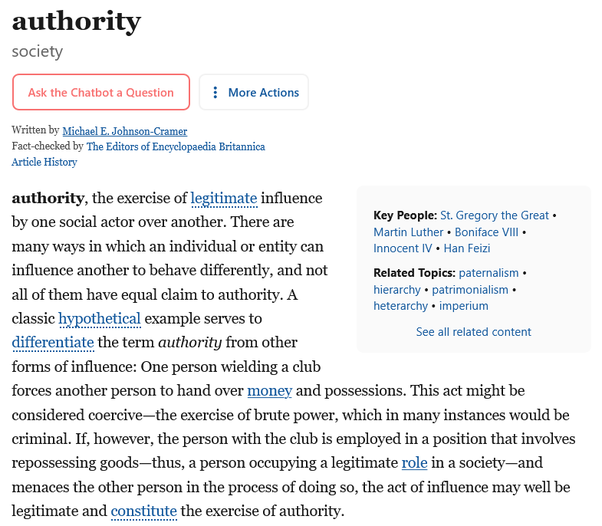
Britannica attempts a more concise definition favouring “influence” over “imposition” like Collins.

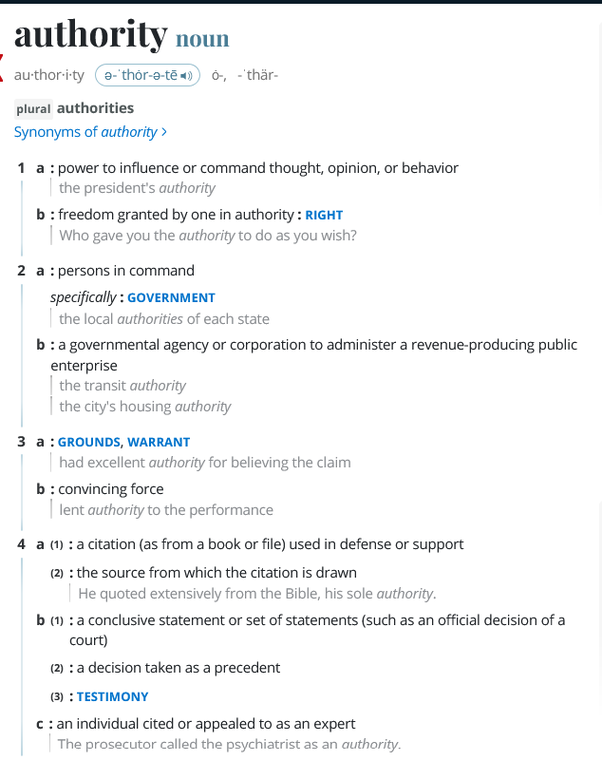
Merriam-Webster provides a more comprehensive overview of how “authority” is apprehended and implemented in society — although imposition precedes influence in its hierarchy of interpretations.

Interestingly, two of the world’s premiere language authorities place a profit premium on sharing basic definitions for words… which begs the question of the value of definitions versus profit and whether these institutions actually are authorities in realms beyond basic definitions.

Oxford at least asks for personal information to be granted access to elementary information, while Cambridge’s efforts are laughable.

These last two efforts suggest to me that their authority is entirely contingent upon reputation — part of the “old boy’s club” of authoritative prestige in the world, which essentially shuts out the plebians among us who must wrestle with “inferior language authorities.”

Meanwhile, freebie entity Dictionary dot com presents itself as a superior authority in marketing and business development to the two staid elements of anachronistic society above and provides an even more comprehensive set of definitions than Merriam-Webster.

This tells us that authority is actively cultivated by those who desire it and then, once achieved, is actively protected and zealously guarded beyond levels resembling reason. At the same time, newcomers overturn established authorities who fade into oblivion as the barbarians at the gates no longer storm them out of existence but supplant them through more effective forms of adapting to an ever-changing world.

In short, “authority” can be explained entirely by the dynamics of ego, power, and how much one is addicted to asserting their prominence in a chaotic world.

Interestingly, the most respected authorities throughout history have rejected the impositional form of authority flowing from within in favour of empowering the people at large by serving as a resource for enabling their assertions of personal authority within their relative spheres of influence.

For example, people still recognize the names of rare individuals who embodied humility, such as Gautama Buddha — or even a more modern instance like Nelson Mandela. Still, few outside dedicated historians can remember the many “authorities” throughout history who imposed their will upon the public. Those remembered are often anomalies serving as massive engines of destruction whose names are whispered rather than revered. Few among those whose authority was impositional in nature are remembered for their introspective wisdom, like Marcus Aurelius and Sun Tzu, but are revered for their insights in contrast to those of the conquerors like Alexander the Great or Genghis Khan, who are studied for their strategies (and often critiqued for their human failings).

For example, I predict that if humanity survives in some form resembling the humanity we know today, Jimmy Carter will be remembered with deep reverence and respect one thousand years from now. In contrast, Donald Trump will be remembered as the cautionary tale of a bull in a china shop whose lesson for humanity is the necessity of restraint and accountability.

Is there a way for those who have lost their jobs to declare war on AI?

This post is a response to a question posed in its complete format: “Imagine that millions lose their jobs due to AI. Is there a way for those who have lost their jobs to effectively declare war on AI?”

Well, that’s pointless.

People will not lose their jobs because of AI but because corporations save money on labour costs.

AI is a tool, and the argument that ammosexuals love to barf up applies here: “Guns don’t kill people. People kill people.”

AI doesn’t kill jobs. Capitalists kill jobs because they can and are incentivized by it within a system that worships personal wealth above all.

We, as citizens, kill jobs through our apathy and through our empowerment of those who prioritize their material benefits at the expense of the many they can exploit.

We bring this upon ourselves by not having a coherent social development roadmap. We allow our societies to grow by chaos rather than responsible systems management strategies.

We empower our leaders through a reactionary process of social development rather than a strategically reasoned and proactive process.

Sadly, authoritarian regimes are far more successful along this vector than democracies because their decision-making is limited to small, centralized powers.

This is part of the reason that the public has been increasingly questioning the value of democracy while looking toward authoritarian models to solve our problems for us.

Sadly, the solution for democracies to be far more effective in mobilizing social development in a coherent and unified direction is entirely contingent upon the quality of the education the public receives.

For instance, the transition to a fully automated society is an inevitability. There is no point in resisting it. We would all be much better off by leaning into it and demanding we adapt our systems to manage the transition better so that we can mitigate collateral damage.

Instead, we are experiencing a chaotic transition led by random powers following personal visions motivated by personal benefit rather than social good.

If our education systems provided a more comprehensive insight into social development, much of the public would be engaged in the political process in strategic rather than reactionary ways.

We would be more unified as a people in identifying trends and developing coherent strategies for successfully managing the challenges we face.

Instead, we are burdened by a dearth of education that reduces a population into cheerleading camps driven by emotionality that can be characterized as juvenile reactions against authorities. Considering how democracy means each person is a governing authority member, this is beyond an asinine apprehension of how one’s government works or how it can be made effective.

Democracy demands engagement, yet our apprehension of engagement is limited to how many likes one gets on one’s post. That’s not even remotely resembling engagement.

That’s like claiming every celebrity walking a red carpet and waving at the throngs is socializing with friends.

Sadly, part of the problem has been deliberately cultivated by the capitalists who want us distracted enough from the sausage-making process to allow them to remake human society into their image.

They have been succeeding remarkably within the U.S. as it has become a dystopian corporatocracy that prioritizes gun sales over the lives of children and billionaire profits over the healthcare needs of citizens.

The public has been so conditioned to prioritize profit at all costs that they will fight to preserve a billionaire’s right to kill people for profit.

We can’t govern ourselves in a democracy if all of our time is focused on survival and profit-churning. Most of us don’t care to be involved in the decision-making process, which would be okay if we could trust our information systems to prioritize informing people over chasing profits.

Instead, we have media that has become a singular, massive entity of public influence predicated upon churning conflict to maintain attention justified by revenue increases.

Instead of informing the public on issues of criticality to the future of the people, we have this kind of incendiary rhetoric from an attention whore indulging in shock stupidity to justify their salary increases by ginning up the rubes to create conflict.

Less than one hundred years ago, this kind of crap would be shut down immediately because it would be considered a precursor to war.

Instead, the attention-seeking mentality justified by the profit (and power-seeking) motive does not care about the casualties created by irresponsible language.

The value of human life has been downgraded, if it ever mattered to society, to a level that’s no greater than the Roman arenas when people were killed for entertainment.

If we don’t start asserting some standards on coherent behaviour that cultivates the best of us as a species, we will continue careening headlong into chaos.

Humans can take only so much abuse before they break. Everyone can break, and people like Watters are playing with fire. There’s no way he will be safe again crossing the border into Canada because of his disgusting language. Some might argue that any aggressive response against him is unjustifiable, and that may be valid, but it doesn’t change how humans behave when aggrieved. I’m confident few Canadians will give him a warm reception for his remarks if he ever crosses the border. At best, at least from my perspective, he’s earned a bloody nose for his garbage.

This kind of bullying rhetoric is toxic to society and is a betrayal of the social contract.

The acceptability of this nonsense and its prevalence is why we have no coherent strategy for managing our transition into a fully automated society. The acceptability of this kind of incendiary distraction from critical information the public needs to make proper decisions to minimize casualties in our transition will create unnecessary casualties. This kind of thinking is what permits bigotry to determine outcomes that dramatically affect lives.

This kind of nonsense is why this question exists in so many forms everywhere and why I’ve already answered this question in several forms by now.

The issues are not complex, but they are made so because we’re not talking about them where we need to be talking about them. We’re allowing jackasses to troll for reactions in “respectable mainstream media” that we would mute and block online if they were individuals and not expensively dressed and cosmetically pampered media personalities.

We are being betrayed by the Fourth Estate each and every day — and to the degree that a majority of the world now believes the U.S. is a tragic case of end times for a nation that has become so corrupt, it can never be trusted for leadership in the world again. However, anyone may parse the 2024 election, and one cannot ignore the role of the media in installing a monster in the top job for the nation.

If you genuinely want to declare war against the loss of jobs, then you need to take it to those who benefit from displacing jobs. You need to start pressuring the billionaires and the corporations they benefit from while ripping off the public through tax avoidance schemes.

Instead of war, you should demand responsible management for an unavoidably dramatic and traumatic societal transition by insisting on the only sane solution to this period in human history, UBI, as a starting point toward sanity in our social development.

The worst thing about where the world is at in this transition is that the next four years are being defined by a parasitic presence seeking to empower further those who are disempowering the working class while replacing workers with automated solutions to toss millions out onto the streets to fend for themselves.

We must stop blaming AI for job losses because it’s just a gun in the hands of mercenaries.

Why do people ignore the obvious proof of God?

This post is a response to a question posed in its complete format: “How come people ignore the mathematical proof of God, even when it is so obvious? How did humanity convince itself that the One cannot be proved mathematically?”

A general rule of thumb is when something seems “so obvious” to you, but the rest of the world fails to see what you see, it is incumbent upon you to do what you can to make what is evident to you obvious to others.

You may understand something so thoroughly that it’s evident to you, but you should have no difficulty explaining your observations in ways that will help others see them as you do.

There is one caveat, however, that sometimes things appear apparent only within the context of a misinformed and misperceived delusion.

For example, it may seem obvious that the world is flat because you see a horizon, but your conclusion would be flawed because you haven’t availed yourself of all the evidence that disproves a conclusion you formed in ignorance.

I say this to you because the entire world, believers and non-believers alike, have searched for evidence for thousands of years, yet no one has found any. To make such a claim as to consider obvious the proof that only you see is also to claim you’re more intelligent than most of humanity throughout the centuries. That’s a tall order of intelligence. Your claim of the proof you see as obvious also means you’re claiming to be more intelligent than Plato, Aristotle, Da Vinci, Kant, Socrates, Locke, Aquinas, Nietzsche, Descartes, Newton, Einstein, Galilei, Sartre, Copernicus, Lao Tzu, and thousands of other massive intellects throughout history.

You’re either a supremely knowledgeable human capable of solving numerous issues for humanity, or you’re just being arrogantly delusional.

Consider that whenever you stake a claim on understanding something that no one else does.

If you were that intelligent, you wouldn’t waste your energy making fantastical claims on social media. You would have already been recognized as a keen intellect through whatever writings you composed that show your intellect.

If you were that intelligent, you would already have the answer to your question.

The general rule of thumb for people online encountering such fantastical claims as what you pretend to have great insight into is that you’re a crackpot and will be considered a crackpot until you can prove otherwise.

Considering all of this, it might help you (and possibly others) avoid the public embarrassment one would experience when they soil themselves.

Your claim of the “mathematical proof being so obvious” is roughly the equivalent of peeing your pants in public and claiming it’s liquid gold.

What does the left mean by freedom?

This post is a response to a question posed in its complete format: “What does the left mean by freedom? When ever I see lefties passing around rankings of the “freeist” countries, inevitably the countries at the top are the type with heavy regulation, heavy taxation, low economic freedom.”

One of the hallmarks of a lack of freedom is ideological thinking that colours one’s perceptions in ways that interfere with one’s apprehension of reality to impede one’s critical thinking skills.

For example, the flawed presumption in this question presumes higher taxation equals less economic freedom when the obvious comparison between the U.S.’s health exploitation system is far more destructive to one’s financial freedom than the taxed version of universal health care offered by every other nation that has succeeded in providing higher quality care at a lower price.

There is no economic freedom when medical bankruptcies destroy lives.

There is no economic freedom for people who pay over one thousand dollars per month for insulin when the rest of the world pays only tens of dollars.

There is no freedom when one is murdered for profit.

There is no cognitive freedom for anyone who divides the world into ideological camps, just as there is no freedom from the mind-destroying forms of bigotry polluting this world.

Within the context of this question, the definition of freedom that addresses it is clarity of thinking, in which the querent proves their mind is so trapped within a toxic paradigm they can’t understand freedom when it’s presented to them in the most unambiguous of terms.

I fully expect this answer to whoosh past the querent’s mind and trigger them into an ideological quandary where they will dismiss these words as an ideological irrelevancy in much the same way that the people who think Donald Trump is an intelligent man are utter idiots.

Do laws, traditions, and social edicts introduce/produce more or less freedom?


This post is a response to a question initially posed on Quora, and can also be accessed via “https://www.quora.com/Do-laws-traditions-social-edicts-introduce-produce-more-or-less-freedom/answer/Antonio-Amaral-1

This is a leading question. Lumping all “social expectations” into a “freedom bag” produces only “freedumb” — the inability to distinguish between regulating destructive behaviour and encouraging positive behaviour to support the social contract.

Laws against murder can conceivably be considered restrictions on freedom, but they’re also a means of protecting freedom for the victims of predators in society.

There is no universal single-size-fits-all means of parsing this question. It’s just a nonsense question designed to appeal to those who already perceive society as children complaining about having to clean their rooms.

Here’s a counter-intuitive example for people who don’t quite understand the nuances of laws and social expectations.

It can be argued that in a Mad Max dystopia, one has the greatest “amount of freedom” possible because there are no such “restrictions” (parameters) as those in a world where anything goes. The harsh reality in such a case is that what constitutes freedom for some (the powerful) constitutes enslavement for the rest of “society” to a persistent fear of having one’s life snuffed out on a whim.

Sometimes, restrictions produce greater freedoms than would otherwise be the case.

In the art world, for example, the greatest creativity can be produced simply by putting parameters on one’s work and approach to doing one’s work. In a personal case, I restricted my palette to black and white for about half of a semester after being told by an instructor that my colours looked like Disney had barfed them up and onto my canvas.

I struggled with colour and all the many nuances of colour, so I had not developed the nuance of understanding how colours work in balance, just as shapes do in a composition. Removing colour from my palette allowed me to focus on developing harmonies between shapes and finding ways to establish compositional balance without the added complexity of colour as a dimension to throw me off.

That restriction allowed me to understand my work from an entirely different and much more free perspective. I discovered freedoms I did not know existed before my self-imposed colour restrictions.

Society is much like that because it has become so complex it’s difficult to parse which aspect is beneficial and which is toxic. We can no longer live with the simplistic view of the world we once nurtured through symbologies like a difference between white hats and black hats. We live in a world of anti-heroes, and that makes demands on our ability to apprehend nuance through developing critical thinking skills. We must learn to be capable of adequately parsing subtle distinctions that can threaten to transform freedom into subjugation within the slimmest of margins.

People find the freedom to be themselves within their tribal associations but can also find their freedoms stripped by the dogmatic application of tribal expectations.

Another example I’ll take from Isaac Asimov’s Foundation series (which I applied — or interpreted as Japan in the 1980s) was the planet Terminus. Hari Seldon’s group was consigned to a planet that was slim on resources to mitigate the potentiality of becoming a threat. Instead, what happened was that scarcity of resources encouraged their creativity such that over time, they produced faster and more powerful ships that were smaller than the Empire’s massive vehicles.

This means that freedom cannot be measured by its constraints but by the results of the limitations (or parameters) placed upon a society. Those constraints can facilitate freedom when they are balanced between the needs of the many and the individual’s desires.

The mythological free society in a harmonious state of anarchy is a pipe dream founded upon a delusional presumption that all humans value the social good above one’s benefit.

The U.S. is a case study for the ages over just how toxic extreme individualism is. For a nation that pretends to value freedom, its privatized prison population screams to the world how subjugated and servile its society is. The U.S. is so “free” that they allow children to be gunned down in schools, not just once but repeatedly. The U.S. is so “free” that people are killed for profit.

A football game with rules is a dynamic tension that draws engagement from an audience, while football without rules, for example, becomes a chaotic bloodbath that disperses an audience.

This question is a testament to how badly butchered the concept of freedom has become within this modern dystopia.

Perhaps this question should be reworded as “What is freedom?”


Bonus Question and Answer: To regulate and control human behaviour, what do you understand by that?

I understand that too many people think a valid strategy for accomplishing this is imposition and subordination to power under the threat of subjugation.

The positive, proactive, and ultimately democratic means of accomplishing the goals of regulation and control are through the development of a human capacity for self-regulation by encouraging the improvement of emotional management skills bolstered by critical thinking skills while addressing fundamental threats to personhood such as living insecurities and forms of persecution through the repression of rights and freedoms.

Showing people how to achieve their potential is a far more effective means of proactive regulation than the barbarism of reactionary punitive measures. This approach also leads to far more long-term stability in society and a much more engaged citizenry actively working toward supporting the social contract by choice.

We can achieve our potential as a species only by helping all of us to be better rather than forcing conformity to myopic structures made vulnerable by their inflexibility and inability to adapt to an ever-changing universe.


Happy New Year! — Here’s hoping your 2025 is a good one. Thanks for reading.

Why are GOP voters suddenly alarmed about the stances on H1-B workers?

This post is a response to a question posed in its complete format: “Why are GOP voters suddenly alarmed about Ramaswamy’s and Musk’s stances about H1-B workers compared to locally sourced ones? Weren’t they supporting them and voting knowing that these men would be involved in policy-making directly or indirectly?”

None of their supporters were interested in the sausages their leaders intended to make. All of them have been more wrapped up in being enamoured by the superficial trappings of personality politics.

They voted for Trump because they admire him as a human being, even though he is beyond apparent in his overtly abusive and criminal behaviour.

They believed the only people that Trump, Musk, and their entourage of parasitic human slugs were going to victimize were the people in their imagination that they hated.

They shut their eyes, ears, and minds off to the realities of their words and promises.

I doubt even one of them made the slightest effort to peruse Project 2025 as they dismissed complaints about it as fake news and propaganda.

It’s the same intellectual laziness at play that we see when they make vague references to The Constitution that show they’ve never read it themselves.

They operate purely on instinct, and their instincts tell them to hate the world because they are in pain. Meanwhile, the exploitative parasites in our midst that they trust point out to them who they should hate, and they mindlessly go forth hating the people who are fighting on their behalf to make this a better world for everyone, including them.

They are so lost in the throes of their hatred cult that many will not stop hating their fellow citizens even after significant damage has been done to the nation. They will insist on some nefarious entities, conspiracies, and machinations by their political “enemies within” who are responsible for their policy failures.

If kids get hauled off in cages again, they’re going to rationalize that as a public good in the name of national security. If those kids get sold off to wealthy couples for a profit, they will rationalize that as being a better solution for those kids than being raised by their “filthy illegal parents.”

They will destroy families and lives all over again because they operate on instincts tweaked by paranoia over manufactured fear because the things they should fear are just too overwhelming for them to grasp. It’s much easier to fear and hate defenceless people than to hate the powerful, particularly when they’re all focused on developing sycophantic relationships and worshipping the ground they walk on in the hopes that they, too, will be blessed with unfathomable wealth.