The concept of truth spans both the objective and the subjective.
“Truth” is “the sun will rise tomorrow.”
“Truth” is also “I am the master of my destiny.”
The former version of truth can be objectively measured and experienced in equal terms of empiricism by all.
The latter is a subjective determination of one’s capacity and is essentially different for everyone.
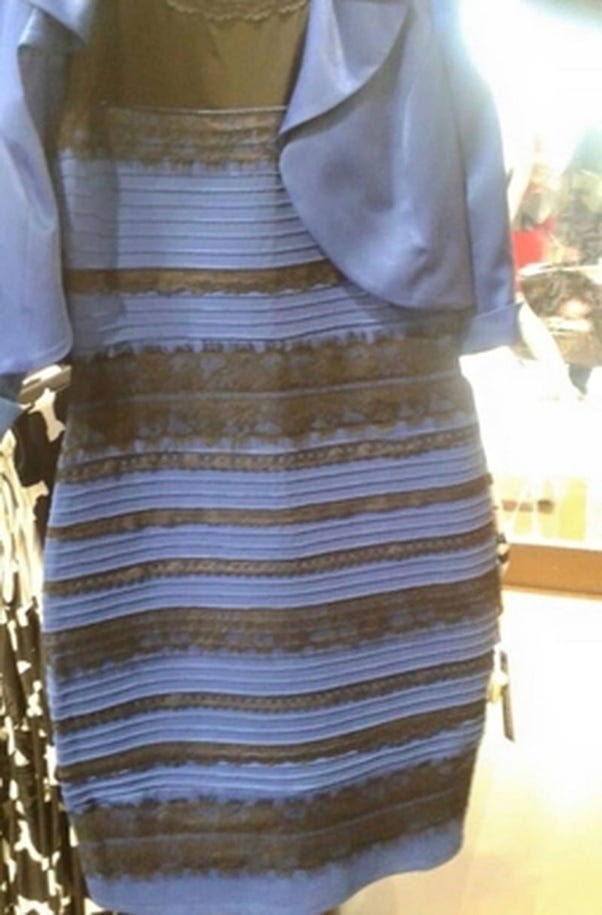
What this means is that this question requires context for precision and clarity, but it can also be answered by simply saying, “Nothing is the same for all people, not even the colours we see.”
Perception can be considered a form of experiencing “truth,” but no two people share an identical experience of a perception of an event that both will have simultaneously experienced.
Witnesses to an accident, for example, will often recount vastly different descriptions of the event.
This leads us to another answer, “Truth is what we can agree on. The greater the agreement between the greatest number of parties is most likely the closest form of truth we can attain.”
This is also problematic, however, because this entails the evocation of a logical fallacy of populism — or the “Bandwagon Fallacy” — “Ad Populum Fallacy” — and is precisely what we are struggling with in society today with the consequences of having our perceptions deliberately massaged to create an interpretation of a truth which abandons objective clarity and retreats into subjective bias to affect the world.
This is problematic because popularity is a metric for bias, not truth, and it can be highly destructive to society — as we’re about to learn in a very uncompromising fashion.
This leads us to a third answer, “Truth is a combination of an agreement upon perceptions as supported by empirically tested and proven realities.”
In short, the scientific method is the most accurate means for deriving an objective “truth” for our species — because it requires testability and predictability to determine its degree of accuracy in a rendition of reality.
At this point, we arrive at a final answer: “Truth is an accurate depiction of reality which exists independently from people.”
The same “truth” is available to all people, but all people must make the same trek to arrive at an objectively supportable perception of truth — otherwise, their “truth” is a self-serving delusion.
This post is a response to a question posed in its complete format: “Why is there so much misogyny or misandry online? Is it because of the internet being filled with socially outcasted people?”
What you see online doesn’t exist because of the Internet. It has always existed as “normal” and without being challenged throughout society.
Imagine what the Internet would be like if it existed before the Civil Rights movement. There would be “Whites Only” and “ Coloureds Only” websites. Facebook would be racially segregated, and so would genders. Any woman visiting an auto servicing site would be banned. They would be allowed only at sites that promoted the expectation of their role of being barefoot and pregnant in the kitchen. People would be penalized for visiting sites that violated segregation laws, and all those “wonderful sensibilities” from yore would permeate the virtual world in far greater degrees of hatred and bigotry than we see now… because they would be considered acceptable by the majority.
The virtual world has only allowed those “old sentiments” that we have deluded ourselves into believing we have grown past to remind us they still exist. They’re just not considered acceptable by the mainstream.
That’s why those attitudes stand out.
The upside, however, is that we can and do push back on that toxicity while social media enables us to talk about it directly.
We can confront racists and bigots directly now when, in real life, we would bite our tongues and walk away to let them believe there’s nothing wrong with them or their attitudes.
Complaining about the prevalence of such ugliness results from a naive view of the world and a Disneyesque vision of humanity through rose-coloured glasses.
In real life, you can associate with people you agree with and avoid those you find toxic, but it’s not easy to do online.
That’s a good thing because pretending this horror doesn’t exist is how it continues.
Over 5 billion people are online, so you can’t single out portions of the population you don’t like and pretend the Internet is a magnet for a small subsection of humanity. These attitudes are prevalent everywhere.
The online world is the only safe space to resolve them. We would otherwise find ourselves either trying to ignore them to let them metastasize and grow worse or joining along because of being pressured into it, like being pushed into a cult for fear of one’s life.
Use your voice online and speak out against the ugliness. Challenge the bigots you encounter. Make them accountable for their hatreds.
That’s the only way to deal with the horror. That’s the only way to make our species heal.
You have an obligation to yourself, your sanity, and the future of our species now that you have been empowered with a platform to fight back against what’s broken with humanity. If we don’t, we won’t have a human civilization by the end of this century. We’ll have a shattered smattering of primitive tribes struggling to survive a planet that has become hostile to human life.
“Humanity” is from the late 14th century and derived from the Latin word “humanitatem” or “humanitas” for “human nature, humankind, life on Earth, the human race, mankind,” and Old French “humanité, umanité.” “Humanity” includes all humans but can also refer to the feelings of “kindness, graciousness, politeness, consideration for others,” which humans often have for each other.
Variations of the term, such as the adjective “humane,” which arose in the mid-15th century, refer to the ineffable qualities of being human rather than the physical characteristics of human existence. By the early 18th century, it evolved from meaning “courteous, friendly, civil, and obliging” into “tenderness, compassion, and a disposition to treat others kindly” and evoke “kindness” within the sphere of the human condition.
By the 1700s, the plural of humanity — “humanities” was adopted as a description of the study of “human culture” through the literature branches of rhetoric and poetry and from a secular perspective rather than religious via “literae divinae.”
“Humanism” emerged from that evolution in meaning from the Latin “humanitas” or “education benefitting a cultivated man” while supporting the notion of humanity as symbolic of the best qualities of our species.
Much of this evolution in meaning is derived from a history stretching long before prehistory to a time when our survival as a species was contingent upon working together to feed and clothe ourselves as we hunted in packs.
Successful interdependence requires supporting one another; thus, empathy was given rich soil to grow.
I suspect, however, that none of this constitutes new information for you even though your question misses the point altogether — and to such a degree it screams severe psychopathy, even as an entertainment-seeking provocation.
From initially reading it in my notifications for questions I’ve been asked to answer, my first thought was that it’s an apparent provocation from a misanthrope and most likely a troll. What I discovered upon encountering your profile is something far more insidious.
Let’s begin with the presumption in this question, “Why should I feel it?” etcetera.
There is no “should” in that you are not “obligated to feel” anything. That’s not how emotions work. You appear somewhat educated — or at least literate — based on the number of publications you’ve written and have posted on Amazon.
Somehow, though, a fundamental comprehension of oneself as an “intelligent” member of an interdependent species escapes your notice. You rely on others to feed, clothe, and house yourself through literary endeavours and can’t acknowledge how you already “feel it, need it, and want it.”
Even this provocation attempts to cater to those basic needs by identifying people who can respond in ways that support egotistically defined goals.
Most literate people develop a basic comprehension of emotions and the atavistic precursors making them manifest. On my behalf, this could be a flawed presumption, but I’m pretty sure you’re no stranger to “darker” emotions such as fear and anger, and you have no misapprehension about their manifestations within you. The sarcasm in your writing indicates your preference for wallowing in those emotions and is consistent with the attitude displayed within your provocation disguised as a question.
The problem you struggle with is that you hate your interdependence and deny that it exists within you — most likely due to having found yourself disappointed and hurt repeatedly by people who failed to live up to your expectations from a very young age.
Sadly, in a world where a whopping majority 70%-80% of the population is raised within a dysfunctional family unit, your experience is far from being a minority. Unlike some lucky few who can cope with their pain to the degree that can transcend it on levels that allow them to minimize the transmission of a toxic mentality characterized by misanthropy, you have chosen to embrace the cynical view that humanity is beyond hope.
Whether or not that’s true is irrelevant to me because my biased perspective shudders at the prospect of living in a world where one broadly hates all of humanity to such a degree they fail to see or experience the gestalt of existence within each of us.
To live a life without comprehending the value of joy is the equivalent of living a life deprived of meaning. It’s like a walking death. Even if one’s life circumstances necessitate a deprivation of joy, knowing it exists can often be enough to overcome the most painful hurdles.
Even the briefest taste of love in a fleeting life characterized by its absence or a prevalence of fraudulent forms of love is enough to sustain one’s spirit for a lifetime.
That’s the power of living on the side of light those who wallow in the dark fail to comprehend.
Once one understands that power, one no longer feels pushed into seeking something out of conceptual reasons but from an atavistic need to partake in as much as one can, like struggling for breath while deprived of oxygen because of a plastic bag covering one’s head.
Sadly, you’ve never tasted it, or you would know why you are drawn to it while feigning a disinterested rejection. As much as your ploy may feel like a shield protecting you from further disappointment, it’s a cry for help heard echoing its way around the world, crying out in pain.
If nothing else, in your case, it merely reveals you as a product of a wholly dysfunctional era in which we exist today as a species suffering from generation upon generation of transmissible trauma.
In other words, you asked this question because, on some level, you realize your struggle. Although it may be easy to peg you as a statistic identified as part of “the one in five” visible sufferers of a mental health condition in society, you’re not. Instead, the psychopathic dysphoria you struggle with is made invisible by its type of dysfunctionality and how it fits within the accepted definition of a psychologically well-adjusted individual within a maladaptive system (by which I mean our environment and economies are not suitable for cultivating the best of humanity).
As unhealthy as your expressions are, their implications exist outside the boundaries of what the psychological sciences deem unhealthy because you seem capable of functioning at a high enough level to adapt to the rigours of your day. In my view and statistically speaking, of the remaining four in five who do not display visible signs of an inability to adapt, three of those four are still victims suffering from degrees of stress that remain invisible to a triage mentality characterizing the state of our species today.
Your wallowing in cynicism is not your fault. You’re a victim of an entirely dysfunctional world. You happen to be smarter than the average bear, making a positive adaptation to a broken world much harder.
If you’re lucky and can make yourself willing and available to receive the cream of humanity, you’ll feel the answer you seek that words alone cannot give you.
You may think similarly to many others. You may like similar things. You may do similar things. You may believe similar things. You may be so similar in so many ways that it’s hard to differentiate your identity from the group identity you are affiliated with, but you are different.
You don’t have any choice in the matter because you see through your own eyes, hear through your ears, think with your mind, and have different experiences, even if your experiences are defined by strict adherence to a group protocol.
You are different because no one else can live your life. Your experiences, thoughts, and feelings are irreplaceable, making you a unique and significant individual.
You can share as many details of your life, thoughts, beliefs, ideas, and dreams as you want, as much as anyone else is willing to tolerate, but they will never know life through your eyes.
Here is an example of how different individual perspectives are through an issue that went viral about a decade ago. It was a photograph of a dress which, dependent upon the context of one’s biological composition of rods and cones in their eyes, their state of mind, and the lighting in the room at the time of examining this photo, people would see either a black and blue dress or a white and gold dress.
Physically, psychologically, geographically, and within the context of your environment, you ARE different. You cannot help but be different.
You should acknowledge and embrace that fact about yourself and the human condition before deciding how much you might want to be like everyone else.
Wanting to be like everyone else is a generally healthy desire to feel like one belongs somewhere, that they have a place in this world, a community, and a family that supports their existence and accepts them for who they are as they are.
Belongingness is a crucial component of a healthy psychology. Belongingness is a fundamental need we all share in different ways.
We have survived and prospered as a species because we are interdependent beings. We rely on our community bonds to achieve our potential. When we work together, we can accomplish miracles through a force multiplier called “synergy.”
To this degree, wanting to be like “everyone else” can be a healthy motivator to fit in with one’s community and explore one’s unique contributions to achieve one’s potential through support from one’s community.
The downside to being “like everyone else” is to subsume one’s identity to the group and lose one’s sense of identity. The negative consequences are many, varied, and often horrifying, as we have been exposed to numerous nightmares arising out of toxic conformism to a group’s identity and mandates.
Ranging from the inculcated fears of communism that hyper-capitalists invoke as their favourite boogeyman of doom to the cyanide-infused Flavour-Aid victims of cult conditioning, we have all been exposed to the inherent danger of toxic conformism.
Human societies and groups have all evolved along a vector resulting from the conflicts we’ve experienced between two oppositional poles in our thinking about which is the preferred option for a social contract — independence versus conformity.
Neither in their pure form is healthy for any society or group.
The major problem with wanting to be like everyone else is that you can’t be like everyone else precisely because you can’t know what everyone is like beyond the superficial characteristics you identify that make them appear similar to your perceptions.
Your unique perspective identifies similarities unique to your viewpoint. All your efforts to be like everyone else are attempts to be what you imagine everyone else in your group is like.
It’s a subjective approximation of what you perceive as reality, not an objective representation. It can’t be because everyone is just as unique as you.
No matter how hard you try to be like everyone else, you will fail because there is no “everyone else” outside the confines of your imagination. You may even associate yourself with large groups where everyone agrees that everyone else is like them. The reality is that they’re just agreeing with themselves and validating their bias with people who validate their own by acknowledging others who express a similar bias.
It’s a rabbit hole of agreement in which the similarities are no more profound than wearing similar clothing.
The worst part of all of the effort to be like what one imagines of everyone else is that one loses sight of one’s own identity, unique nature, unique path in life, and the unique nature of one’s potential contributions to the world.
It’s almost a paradox in which the more solidarity humanity can achieve, the more we all benefit from the synergy of united effort. At the same time, the more homogenized we become as individuals, subsuming ourselves into a group, the more exposed we are to decay and threat by systemic collapse.
As in all things, the answer to your question is that it is much better to consider this:
There is light within dark and dark within light. While acknowledging this, one arrives at the most crucial understanding of the nature of dichotomies: neither one nor the other is superior — or can even exist without the other because they both exist as a dynamic.
In essence, the best way to be okay is by finding a balance between the two that work best for your unique you.
This post is a response to a question posed in its full format as follows: “As clever as humanity considers itself to be, has it only just began to scratch the surface of a true understanding of the fundamental nature of reality?”
This question reminds me of the Epistemology course I took at a local university over a summer off from art school. I was accepted into a third-year program without prior university-level philosophy course experience. I successfully leveraged my art school experience toward my application.
This was my introduction to understanding how language can be utilized with the same disciplined approach toward meaning as mathematics. The course material I read felt more like I was interpreting algebraic formulae than English text.
During this period, I realized access to new knowledge domains began with mastering the grammar that defined a domain.
At first, I read and reread sentences until the language made sense. I plodded slowly through the material and expanded beyond spending upwards of half an hour reading sentences to over an hour reading paragraphs and several hours reading entire pages to ensure I had developed what felt like an adequate understanding of what I had read.
This was not my first time having such an experience. Many would be surprised to discover the art world is also filled with jargon and concepts that require an equal measure of effort at the outset to comprehend the information conveyed. However, the grammar defining the art world can be even more complicated and confusing than intermediate philosophy.
Unlike the disciplined rigour of mathematical precision found in the language of philosophy, art world jargon is often subjectively defined and expressed through abstractions rather than through concrete concepts based in a material world. It makes for mixed messaging among instructors, where one adopts interpretations of concepts based on interpersonal dynamics rather than objectively defined definitions of concepts. I remember often tripping over the concept of chiaroscuro because it seemed no matter how I interpreted what is arguably one of the objective terms in art, every instructor had a different definition. I chose to favour the art history instructor’s definition over the conflicting definitions offered by my painting instructors.
At any rate, my painstaking journey through reading my philosophy assignments left me tired enough at the end of the day to sleep soundly at night and wake up feeling like I was prepared for the class discussion of what we had all read. I would attend class feeling confident that I understood the material — until the class discussions began and the instructor interjected with dialectical curveballs to illustrate limitations on some of the arguments forwarded by students.
About halfway through the class, I felt utterly overwhelmed, as if I had no idea what I had read. I felt like my confidence was entirely misplaced and that I should have started my formal training in philosophy at a more junior level.
Then it happened — the discussion veered back onto the topic I thought I had read. I couldn’t fathom how the conversation took a journey to an alternate dimension, but I was happy to see it return to the reality I was most familiar with.
By the end of the class, I was dumbfounded to discover that I was correct about understanding the material at the outset before becoming completely confused. I expressed my frustration publicly. My instructor’s response to my confusion was to say simply, “Yes, but now you know it better.”
This was a lesson for me to understand that knowing what I know is merely a product of my confidence in believing I know what I know, while what I know constitutes only the tip of an iceberg of what is possible to know about what we think we know.
For a real-world example, I still recall my experience in an interview with a recruiter who seemed impressed with me when he remarked, “Wow. You quoted Voltaire. I’ve never heard anyone quote Voltaire in an interview before.” He presented his surprise in a way that made me feel he would be in my corner and support my candidacy. As it turned out, that was the moment he decided I was disqualified as a candidate. He ghosted me after that, and I never got another opportunity presented to me through that agency.
It took me a while to figure out what had happened, but when I did, I connected that experience with a much earlier one in which I was on the phone with someone about a temporary labour assignment. I remember asking specifically, “What does the job entail?” The response I got was a very dry, “Welllll…. it entaaaaaaaails moving stuff.” I lost out on that opportunity, and the memory of that experience lingers as a reminder of my language choices and their impact on others.
I’ve had to learn to become very aware of how my natural self is interpreted from a young age when I deliberately chose to use the shortened form of my name to fit in. As a kid who became fat to gain approval from an abusive mother, I had to become aware of responses to my natural state of being from a very young age.
I know that my language choices can be offputting for some. I know that when some stranger uses the short form of my name to address me, it’s a form of disparagement that speaks volumes about their attitude. I’m pretty aware of subtleties many miss, even if I don’t catch them immediately — mainly because I’m not naturally focused on the underlying cynicism many naturally wallow in, so it can take me some time to tune myself into their frequency.
I’m using myself as an example to answer this question because I know I’m pretty self-aware and more than most, but it doesn’t matter how much I know about myself; I’m still discovering new things about myself. This isn’t to say that I’m primarily interested in myself for the sake of knowing myself, but knowing myself is a conduit to a better understanding of the world I live in — for several reasons.
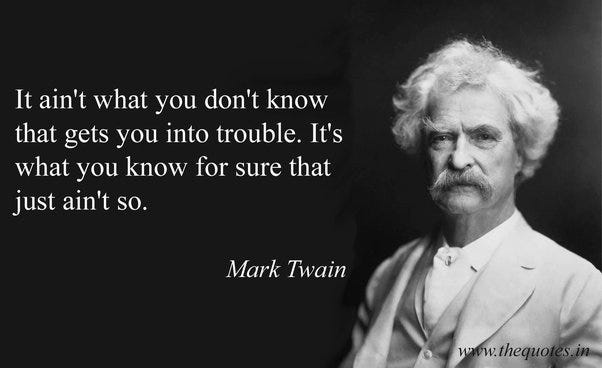
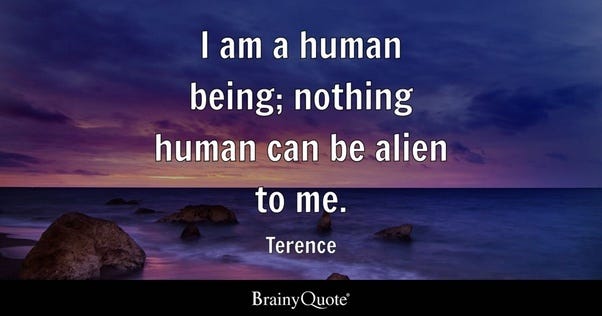
One of those reasons is inspired by an expression I’ve been primarily familiar with as an attribution to Voltaire — yes, precisely the quote I referenced above:
After being inspired by this quote for about thirty years, I discovered it wasn’t a quote by Voltaire. These are words from someone far earlier in history, Publius Terentius Afer, a Roman playwright otherwise more popularly known as Terence.
“Homo sum, humani nihil a me alienum puto.”
These are words from a play entitled “Heauton Timorumenos” (The Self-Tormentor) — Act 1, scene 1, line 77, written in 165 B.C.
I had lived with these words, inspiring my pursuit of knowledge of the world through the understanding of self for more than half my life before learning the truth of their origins. I’m still learning new things about it — even though I deeply value what they imply — to me.
This brings me to another quote I treasure by Picasso that he uttered in his 60s after already transforming the art world with his visions, “I am only just learning how to paint.”
I loved these words the moment I encountered them because they confirmed that I was on the right track in wanting to become an artist in this world and this life. I understood that what one does to find fulfillment in one’s life is contingent upon loving what one does. The fact that there was no end to learning within art, as expressed by a historical giant, inspired me.
I would never get bored by being an artist. I would never find myself outgrowing what exceeded my grasp, and I could give myself wholeheartedly to its exploration — infinitely — or at least within the context of a finite life.
There was no way I could become complacent and detached from life by choosing a vocation of exploration of life itself. The fact that I would never learn all there could be to know wasn’t a deterrent but an inspiration and a challenge to motivate me to learn as much as possible within the finiteness of time available to me in this life.
Within this microscopic pool of choice available to me as an individual, I found enough inspiration to carry me through a life of discovery. When I imagine the vastness of a universe, we have no clue how large it is or what there may be to discover, and it seems to me that the human species can find millions, if not billions, of years of motivation for discovery.
We have certainly learned a lot about the nature of reality, from a psychological to a physiological to a physical and materialist nature, and beyond, while exploring reality on a quantum level. The fundamental characteristic of learning is that with each answer to a question answered, many more questions emerge. Answers to questions about the nature of reality appear like fractal algorithms that can spawn infinite questions.
No matter how long or how well we succeed in surviving — mostly the challenges posed by our hubris, we’ll never run out of room for discovery.
This, to me, defines the very core of the most basic lesson in life: it’s not the destination which matters; it’s the journey.
This post is a response to a question initially posed on Quora.
Human rights are essentially an agreement between humans to protect a characteristic or behaviour of all humans within their community.
Human rights exist only by virtue of the agreement itself and the degree of commitment by other humans to protect those rights.
This is a global issue, with human rights being violated all the time and everywhere on the planet. It’s a problem that demands our immediate attention and action. This is why human rights are violated all the time and everywhere on the earth.
We have far too many humans who view rights as scalable according to their essentially misanthropic perceptions of humanity — because we are suffering from a mental health pandemic affecting at least one in five among us. We are only now beginning to realize that we are a species that has been suffering for centuries from generational trauma from our barbaric origins.
The fight for universal human rights is a fundamental building block in a healing process that will require centuries to emerge from.
We are far better off today than we were one century ago simply because of our increased awareness of the issues we are dealing with and an emerging appropriate context from which we interpret our experiences.
Human rights are crucial to preserving the social contract and ensuring systemic stability.
Without human rights as a concept enshrined into law, we descend into barbarism.
After writing this answer and posting it, I realize I’m doing a disservice to the concept by providing such little context.
Human rights have a long and bloody history of development in which their inklings as concepts we should value as a species were responses to centuries of brutal violence characterizing human life.
The earliest examples of human rights enshrined in local laws date back to circa 2350 BC in Asia as the reforms of “Urukagina of Lagash,” which evolved into more well-known examples of legal documentation such as “The Code of Hammurabi” from circa 1780 BC.
Ancient Egypt also supported fundamental human rights through documents such as “The Edicts of Ashoka” (c. 268–232 BC). Other principles of human behaviour emerged during this period, while one such principle has been incorporated throughout most living religions today and is popularly known as “The Golden Rule.”
Fast forward to 622, and “The Constitution of Medina” functioned as a formal agreement between Muhammad and the tribes and families of Yathribe, which included Muslims, Jews, and pagans. This agreement was an early means of uniting all peoples of the land under a common identity referred to as “Ummah” and incorporated several changes to how slavery was defined and limited.
Early Islamic laws from this period incorporated principles of military conduct and the treatment of prisoners of war that became precursors to international humanitarian law.
Moving forward into the Middle Ages, the most influential document establishing the modern basis for human rights was the creation of the “Magna Carta,” itself heavily influenced by early Christian thinkers such as St Hilary of Poitiers, St Ambrose, and St Augustine.
The Magna Carta of 1215 influenced the development of “common law” and several constitutional documents following, all related to human rights, including the (1689) “English Bill of Rights” and the (1789) United States Constitution.
Some may remember from the Iraq War and the establishment of Guantanamo that the Bush administration suspended the writ of “Habeas Corpus” — the right to know what one has been accused of — was a right established in the Magna Carta. This was a fundamental violation of a basic right that set the nation back in time to an era of barbarism — and they hypocritically leveraged that violation to commit war crimes for waterboarding that the U.S. itself forced Japan to face an international tribunal for war crimes over the same behaviour decades earlier.
This is a stain on the American people that will not wash off their conscience while they do nothing to own responsibility for their grotesque violation. This dark moral failing of the nation has become a slippery slope of moral failures permitting the monstrosity of immoral behaviour. We — as in the world- are now on the verge of potentially falling entirely into a pit of immorality because of their “leadership” in this area.
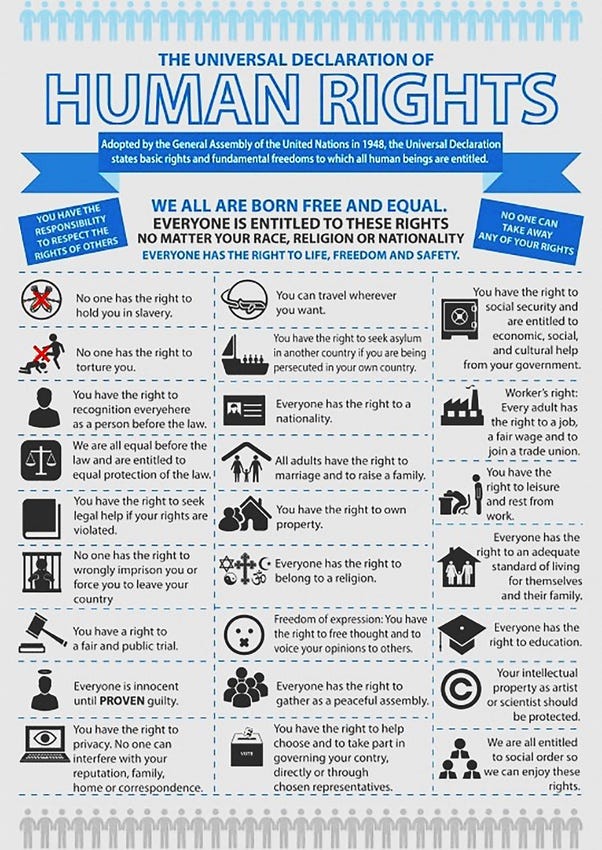
At any rate, I’ll avoid proselytizing further and get to the goods of reading material and a “pretty picture” at the end with a chart of the Universal Declaration of Human Rights:
This post is a response to a question posed in its full format as follows: “Why are there so many degenerates in this world that lack a moral compass, namely in 1st world countries where most learn this by the family that raised them, school, sports, being in public, etc?”
The problem with this question is that it’s impossible to construct an objective answer to address its core concern. This question is more of an emotionally driven complaint than a question.
The reason is that it’s built upon subjectively defined presumptions like “degenerate” and “morality.” Neither of these concepts has any objective metric to identify differing degrees of degeneration or morality between any two random people.
Adding to the subjective complexity, universally accepted standards for the definitions of these terms do not exist.
What can be deemed “degenerate” to one person is celebratory to another. What is viewed as “morality” to one person is heinous to another.
Making matters even more complicated is that a word like “degenerate” constitutes a value judgment. Regarding its use, what that person views as “degenerate” is already a visceral rejection of the object of their judgment. There is no wiggle room for the interpretation of an individual’s value. No description of the specifics of the behaviour in question leads to the value judgment of “degenerate” because “lacking a moral compass” is just as subjective a judgment as “degenerate.”
This question is an example of circular reasoning permitting no room for objective examination nor any means by which one can identify alternative conclusions to the objects of such visceral criticism.
The only way to address this question is to search one’s memories for emotional reactions one may have had that can dredge up conclusions about different experiences one can align with the question based on a similar degree of emotional intensity governing one’s biased findings.
This style of generic language relies upon the subjectively defined feelings of others to function more like a dog whistle than a critical analysis of the issues in question.
This kind of “loose language” is a breeding ground for bigotry to evolve in a landscape characterized by pure emotion and which lacks grounding in any shared physical reality.
For example, if someone were to mug someone else and witnesses talked about the event while sharing similar emotions and a similar view of the event in question, they could quickly dredge up a similar degree of emotional intensity to this question. Their views would be predicated upon a shared experience, while their particular reactions to the event would be grounded in a shared physical reality.
In the case of this question, that shared reality exists only within the realm of individual imagination and dredged-up memories of different events. Here’s a generic dialogue of an imaginary sharing of emotional intensity to highlight this dynamic:
First Person:“I was supremely pissed at this one thing this one person did. Be as angry as I am about this thing you didn’t experience.”
Second Person:“I didn’t experience what you experienced but let me tell you, I also got supremely pissed about this other thing that you didn’t experience, but because we’re both supremely pissed, we share a common ground of agreement.”
First Person:“So, you agree that we both have good reason to be supremely pissed to the point of sharing a mutual hatred for something?”
Second Person:“Yes. We both hate something very much.”
First Person:“What do we hate together?”
Second Person:“How about that thing over there? It’s pissing me off right now that I’m in a sour mood.”
First Person:“I agree. Let’s both hate that thing. That way, we can forget what we hated separately and find camaraderie in a shared hatred for something else.”
This dynamic is how bigotry spreads throughout a population to function like a transmissible disease.
This is why language choices are crucial for objectively apprehending the realities we react to.
Allowing another person’s subjective responses to dictate one’s attitudes toward a subject abdicates their free will and subordinates their opinions to whoever demonstrates the most significant force of personality.
This is the process by which identity politics emerges.
This is precisely the dynamic that Donald Trump has built his political collateral upon.
It is a means by which critical thinking is killed, and people like Rupert Murdoch capitalize on it as a vehicle for personal enrichment at the expense of the social contract.
This is why we have “so many degenerates in this world who lack a moral compass.”
This post is a response to a question posed on Quora
Upon encountering this question, I thought, “Who is ‘we’?”
My second thought is that this is a typical question by someone who doesn’t understand what “free speech” means.
People often misconstrue “free speech” as a right to say whatever they want wherever they go without suffering the consequences of the content of their speech.
That’s not even remotely close to what “free speech” means.
“Free speech” means only that you will not be hauled off in the middle of the night by your government for saying something that a government authority doesn’t like.
That’s it.
That’s the extent of “free speech” in society.
“Free speech” has never been, nor will it ever be, anything more than a protection against a dictatorial government determining acceptability for the concepts people publicly discuss.
Here’s an example of a violation of the principle of “Free Speech” in society:
This is a politician who has already announced to the world that they are willing to strip fundamental rights from a people based on being personally offended over the presentation of their own words repeated verbatim.
Here is an example of how a self-declared “Free Speech Absolutist” regards “Free Speech.”
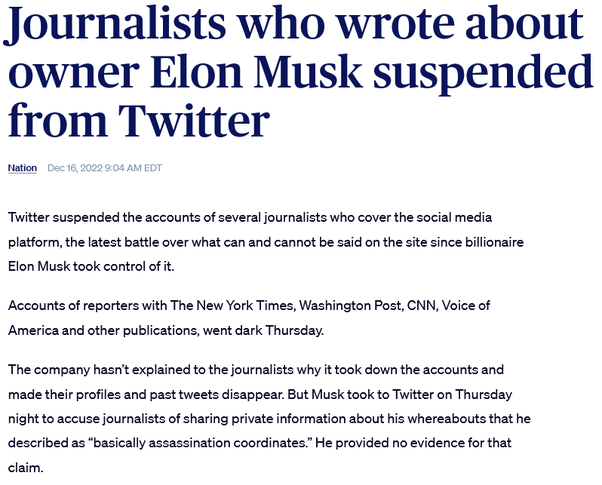
This is NOT a “Free Speech” violation because Xitter is a privately owned space, not a government entity. Elon is well within his rights to ban anyone he pleases in the same way you are entitled to kick anyone you don’t like out of your house for no reason you would need to use to justify kicking them out of your house. Your home is yours. You have every right to enforce any rule you like, whether irrational or contradictory.
All Quora answers are the property of all the authors of those answers, and that’s a HUGE draw for people because it means we can delete abusive comments or turn off comments altogether. After all, “freedom of speech,” in practical terms, also means “freedom from speech” — just like “freedom of religion” also means “freedom from religion.”
“Freedom of speech” is NOT an entitlement to be heard. It is a protection from a malicious entity with the power of a government to enforce the homogenization of a public under an autocratic system.
When people reject stupidity barfed up by people they don’t want to hear from, they’re not “cancelling” anything. They’re simply exercising their right to refuse to subject themselves to personally offensive speech.
When it comes down to the notion of being cancelled as a criticism of what happens in society, if one were to create a ven diagram of the people who complain about “cancel society” and the people who endorse banning books, it would be a circle.
Otherwise, the reality of “cancelling a voice” while violating the concept and principle of “free speech” literally means hauling someone off in the dead of night because they offended some government official like Drumpf by repeating their own words to the public in the way that journalism is supposed to in society.
I think the people who complain the most about this issue should spend more time educating themselves on what “Free speech” means. The most impactful lesson one could undergo and never forget is to take a trip to North Korea. Set up a soap box on a street corner. They can then begin criticizing the North Korean government to see exactly what it means to “cancel a voice.”
Otherwise, the tiresome whining about “cancelling voices” on social media is interpreted much like enduring nails on a blackboard.
Chances are excellent that if you have to ask strangers online, you’re already concerned about their reactions.
That should be a huge red flag, especially after reading some of the horror stories in the answers already given.
Your parents have spent a lifetime being who they are and believing what they do.
Their vision for having children was miniature versions of themselves who they could accept may take a different path than they took for themselves but would at least hold the same values they do.
As you may have noticed, religious beliefs are not like most other beliefs people have about different things in life.
Religious beliefs are personal identities, group associations, and a support structure where opportunities in life are found.
They will view their religious beliefs as a prescription for success in life and a symbol of unity within their family. All their children sharing in their beliefs means they will have become successful parents who have given their children their best chances at leading a happy and rewarding life like they feel religion has done for them.
Rejecting their religious beliefs will be interpreted as a rejection of their parenting.
It may not make sense to think of religious beliefs you don’t share on this level in that way. The reactions you will get from them if you insist on having them see you on a different path to self-development, self-discovery, and self-discipline than they took will show you what a wedge in your relationship will feel like.
They may initially show some acceptance because they love you more than their adherence to their beliefs, but that acceptance will grow into a distance between you.
You will eventually discover their open embrace of you, and your accomplishments will be responded to with increasing disinterest.
During periods of conflict, they may claim they no longer understand you and will blame your straying from their beliefs as the cause. They will look for scapegoats to blame and begin criticizing your choice of friends, the school you attend, or the video games you play.
Anything they can use to justify how you are not choosing to betray them willingly, they will weaponize during open conflicts you might have. If you have never experienced open conflicts with them before, you likely will afterwards.
To answer your question directly, it’s okay to be who you are, and it’s even recommended in a world where you will spend your entire life fighting to preserve who you believe yourself to be, but you will have to learn to pick your battles in life, and some are just not worth fighting.
Eroding one of the most important relationships you will ever have is not a battle anyone should take lightly, particularly in a world where a whopping majority (70%-80%) of families are dysfunctional. Suppose you have a happy family life as it currently stands. In that case, you might want to accept how that’s already a treasure beyond what most experience. It may not be worth giving that up to have them accept what you believe in yourself because your assertion could very well end up in your rejection.
You can certainly continue to question your views on religious beliefs, and you should continue to do that for the rest of your life because that’s how you will grow as a person. Understand, though, that it is always a personal journey one takes. As much as one would like to share every intimate detail of that journey with others, it’s impossible with almost every other person one will encounter.
Your personal development journey will always be your journey. The rest of everything you encounter will be about how to get along with the people in your life so that your life isn’t made any more complicated than it already is or will be.
Good luck with your journey through this nuthouse.
This post is a response to a question posed in its full format as follows: “Atheists, do you ever wonder where consciousness originated from? Do you sit back and think ‘maybe science doesn’t have the answer to everything?’”
Based on the fleeting interest in the topic demonstrated by the wording in this question, I have wondered that likely more than most. I’m obsessive that way. It’s a curse I must have been born with because I remember thoughts as a toddler that may not have been quite as sophisticated as now but definitely within the ballpark.
20–20 hindsight leads me to believe my life would have been far easier if I had realized I could create a vocation and a “normal life” around the formal pursuit of knowledge in that realm. I had to get this far on my own before I could think about options I didn’t realize could have been available to me then.
Even as a kid, I valued my mind more than my body, and I found myself attracted to any reading material, fact or fiction, that expanded my views on the mental realm. This led me to explore myths at an early enough age to understand how religion is also just mythology, except that people believe it’s more than that.
I should have been more focused on exploring the sciences, but I was more interested in exploring self-knowledge, which led me straight to the arts. Economically, it was the worst decision I could have made. Insofar as personal development is concerned and surviving the nightmares I’ve endured, it has been my only means of making it this far.
By the time I went to art school, I had already consumed many subjects from various realms. I have enjoyed material from scientific objectivity and metaphysical subjectivity. The arts have enabled me to process abstractions such that when Carlos Castaneda, Jane Roberts, or Edgar Cayce wowed me, I never interpreted their material from a literalist perspective. I still love and am affected by the imagery they evoked within me. People like Joseph Campbell were an incredible inspiration to me from the standpoint of cognitive discipline and the “hard sciences modality of thought,” but discovering Douglas Hofstadter’s “Gödel, Escher, Bach: an Eternal Golden Braid” was like being hit with a hammer to crack open a hard shell surrounding my awareness of consciousness.
I highly recommend “The Mind’s I” as an “easier-to-consume” piece of his writing.
At any rate, my pitiful comprehension of the sciences allowed me to understand, on at least a basic level, that science itself isn’t an answer to anything. Unlike religion, however, “science doesn’t lie” about being an answer to everything.
Science itself isn’t even a source of knowledge — people are.
Science is just a process of determining facts, leading some incredible minds to discover amazing facts about our universe.
One recent proposition arrived at through the scientific discipline of inquiry is that we may be on the verge of identifying a connection to or a source of consciousness within the quantum realm. That’s exciting news to me.
Not too long ago, I chanced upon this image:
This set my imagination on fire as an analogy for 3-dimensional existence created by consciousness itself. I had already been aware of issues like the “Thermostat Problem,” “Integrated Information Theory,” memory structures stored in 11-dimensional space, and microtubules in our brains that directly interact with quantum space. This image was like another crack in a shell obscuring my view of consciousness.
The analogy I draw from this image is that “consciousness shines through” our physicality to take shape in a three-dimensional structure we understand as reality. The shadow in this image represents physical reality, while our biology shapes the nature of consciousness within the context of a three-dimensional space.
Recently, much more intelligent people with dedicated minds have been exploring realms outside my comprehension in ways that filter down to hope within me that we will eventually solve the mystery of consciousness — even though it still feels far too distant to believe we’ll manage to create artificial facsimiles of actual consciousness. We can’t map quantum space, and I’m not knowledgeable enough to know if that’s possible or how we could do that.
How the hell do we establish a coordinate system for virtual particles? At this point, all I can think of is that we can’t and likely never will; if we can, it won’t be in any near future.
At any rate, anyone with any basic understanding of science knows science is not a magical source of all knowledge like religion pretends to. It’s at least testable and verifiable knowledge rather than the ludicrous fictions concocted by religious nonsense that leave reality far behind in its rearview mirror as it gallops into fantasyland.
Here’s some additional reading on the subject of consciousness by people far more advanced in their explorations than I am.
Quantum mechanics and the puzzle of human consciousness
Oh… let’s not forget a valuable source of primers on almost every subject imaginable — good ol’ Wikipedia — please donate if you can to this marvellous resource that thumbs its nose at the parasitism of capitalism and generates knowledge for its true value to humanity.










 thotbag