Why does morality exist independently of human opinion?

Why does morality exist independently of human opinion?

This post is a response to the question posted on Quora as written above.

Morality IS “human opinion.”

Many differences exist between opinions on morality and on practically everything else people have opinions on — which makes opinions on morality somewhat unique in how they are perceived.

People generally do not equate a moral opinion on murder, for example, with an opinion on a fashion accessory.

Part of the problem is that it is the cultivated opinions of religious folk to believe morality is an objectively established standard of conduct determined by an invisible authority. If the claim of objective jurisdiction to develop and institute a moral framework existed, morality would essentially be identical and unchanging over time. That’s not the case for anyone who has made even a tiny effort to understand people or human history.

The most significant problem with establishing a universal acceptance of a moral opinion is that no one ever receives direct confirmation from an unassailable authority governing judgment over any specific behaviour. Complicating matters further are the subjectively supported morals of believers who do not share a consistent moral framework — even though religious institutions do their best to homogenize morality among their flocks.

Institutions that once endorsed slavery and have moved on to repudiating it cannot, without justified criticisms, claim to receive their moral framework from an omniscient entity.

This and all the many other changes made to institutional policies regarding morality throughout the centuries have eroded religious claims of authority in moral matters. Making things worse for them has been allowing their credibility to be assaulted by many heinous scandals, such as the institutional endorsements for victimizing countless children through sexual predation and murder and the subsequent protections of institutional leaders guilty of immoral actions.

We, as a species and as a collection of diverse societies, all governed to some degree by the notion of morality, have undergone a tremendous number of and severity of degree in the assaults on our definitions for what constitutes morality that we are struggling to unify a fractured vision of the concept.

We can no longer trust our authorities, be they religious, political, industrial, or familial, which puts us in a quandary for resolving our moral differences as a species.

The upside is that we are turning inward to identify our internal sources of moral development.
Morality is most simply defined as an extension of empathy, but the issues it encompasses make that an oversimplification. At best, empathy is merely a compass guiding actions that many hope serve to achieve moral outcomes. Some will define morality within a self-serving context, while others consider self-sacrifice an embodiment of morality. Neither is necessary to achieve some form of widely acceptable definition of morality.

We can grasp a history of morality from academia, giving us context and perspective on what we have learned about morality. That approach leads us down deep and convoluted rabbit holes of (arguable) “subclassifications” like ethics, conscience, integrity, standards, and principles. At the same time, simple definitions escape a universal simplicity promised by our examples of failing leadership because morality is itself nuanced, multifaceted, and contextual.

We may never transcend subjectivity within the context of our interpretation of morality, but that’s a feature, not a bug.

Morality as an opinion forces us to share the diversity in our views, and that’s a superior form of morality to any authoritatively imposed dogma because we must each learn to develop our apprehensions of morality to learn how to better succeed in living together under a shared social contract to achieve a peaceful and prosperous co-existence.

We’ve seen enough artificially imposed forms of morality claiming objectivity as an unassailable standard for uniting people to know it’s a fraudulent approach to morality that invariably fails us as much as we fail to adhere to universally defined, generic, and external imperatives.

To accept morality as human opinion puts us in a position to define human character along a spectrum of universally acceptable, unacceptable, and inspiring behaviours that can adapt to an ever-changing landscape.

Morality may be more messy to manage as an opinion. Still, like the principle of a democracy, it’s the only form that can maintain coherence within the context of longevity.


What do you think of a person who dismisses what you believe to be true?

I don’t.

I also don’t put much faith in my beliefs. I prefer facts and knowledge. If people dismiss them, they’re more likely to be trapped by their beliefs.

It’s their choice but also my choice to avoid dealing with people who dismiss facts in favour of whatever beliefs they may hold.

I think much more highly of a person who does not adhere to beliefs and of people who process facts in ways that contribute to our shared knowledge of a subject.

I am often happier when someone offers a rational response that increases my knowledge of a subject than if someone responds with beliefs to facts I may have provided. My goal is always to expand my knowledge rather than convince others to believe as I may. I prefer to transcend my beliefs with knowledge because that’s what I value most.

A lot of dialogue between people suffers because people conflate facts and beliefs. I think beliefs create barriers between people and kill one’s learning ability.

I think beliefs are egotistical and responsible for most, if not all, conflicts between people, but I’m willing to think otherwise if people can offer facts to contradict this belief.

I have otherwise lost almost all my tolerance for people who entrench themselves in beliefs they feel compelled to impose upon others.

I feel similarly to people who respond to facts by dismissing them. They’re not worth my time, nor do I care if that’s what they choose for themselves.

I am far more interested in engaging with people who offer facts than I am in engaging with beliefs.

To return to my first sentence, I have no thoughts about my beliefs being dismissed because I don’t value beliefs due to being skeptical of all beliefs. I also know that most people I encounter tend to favour beliefs over facts.

It’s like I don’t pay much heed to religious people or their beliefs until I find myself dealing with any specific one of them. I also don’t use much cognitive energy thinking about them as people when they express their beliefs because that would make me guilty of wallowing in my own beliefs.

People are entitled to their beliefs, and a big part of life is learning how to cope with the beliefs they hold.

There but for the grace of God go I.

I am amused that I can often quote religious references as an atheist, and that tells me how deeply penetrating beliefs can be.

It’s why I don’t trust beliefs.

There may be some wisdom in some beliefs, but they’re just temporary conclusions, while some have more staying power than others.

Once I’m dead, I won’t believe anything.

Why are progressives communist sympathizers?

Upon reading this question, I first thought you had no clue what communism is beyond maybe the bread lines. Even then, I doubt you would know why that happened or how unrelated it was to Marx’s vaguely defined description of communism.

I thought of you as just another Pavlovian dog who’s been programmed to barf up “communism” about everything you hate, like most MAGAts who don’t wash their panties often enough.

As part of my investigation into profiles I block, I often check out their followers because… Why TF do people follow morons? I also frequently get a chuckle over Chucklehead followers while finding many blockworthy candidates. I learned this practice from Billy Flowers because that idiot creates a LOT of profiles that follow each other. I doubt there are ever any real people in their sewing circle.

At any rate, beyond usually finding catfish to block so that I don’t get the typical message on my answers that goes something like this: “Gee. I loooooove your posts but can’t seem to follow you. Pleeeeeze follow meeeee and I promise to like you.”

You didn’t have many of those, but what you have as part of your follower group is quite sad. It makes me think about my latest sub-category of troll:

In this case, however, it’s not quite so funny because it’s a stereotype that’s a huge part of the reason why we have generational trauma running through the whopping majority (70%-80%) of dysfunctional families.

Almost all of your followers have suffered beatings as a child that you interpret in the downplayed term of “corporal punishment.” You seem to be part of that group who interprets the physical abuse you suffered as “normal” and that you “turned out fine” when the reality is that you haven’t.

Your question shows that, but I doubt you would understand why.

The clue is that it’s in the misanthropic nature of your attitude toward “progressives.”

Progressives want to see progress in society because they want a world where kids are disciplined through reason, not violence. There’s no need to be violent with a child. Ever. That’s a lazy parent’s approach to restraining a child’s behaviour when they don’t want to make the time to do it correctly and through words.

They don’t consider how what they’re teaching their children is that violence is acceptable. That’s what you and your followers have learned. That’s why generational trauma exists.

Although I used the term “lazy parent” above, that’s not a correct way to point out the perpetuation of trauma, but it’s a pointed statement done for an emotional effect. It helps to focus attention on a serious issue affecting all of society.

In your case, you’ve been taught that getting what you want through violence is not only acceptable but an effective means of achieving your goal. From the starting point of physical violence in your repertoire of imposing your will onto others, doing that with words becomes second nature.

That’s why you rely on trigger words like “communism” because you’ve been taught to react emotionally to something you don’t understand beyond “It’s bad, m’kay.

Since you can’t go around beating up on people who want to see progress in society, you restrain your angst by using words that can simulate the adrenalin rush you would otherwise get from physicality.

If you succeed in putting your “Idiotological Enemas™” in their place by calling them “commies,” then you’ve achieved your goal of giving them “the ol’ wut fer,” and that’s a win for you… at least an emotional win if they can’t come back with a witty response that shuts you up.

Chances are excellent that more and more of you “anti-commie” types are finding that happen these days. I remember only a few decades ago that it would be an effective conversation terminator that allowed people like you to feel like you’ve “won your debates.” I’ve never understood the value of that no-prize beyond a temporary dopamine high gained through ego-stroking. It was never my drug of choice because I grew up with idiots who couldn’t get enough of it at my expense.

At any rate, that’s the reason why you posted your question.

You have no clue what “communism” is, but you know you can use that word like a hammer.

You have no clue what a “progressive” is or what their goals for society are, nor do you care, even though those goals would benefit you directly and give you a life of dignity. The math is too hard on your hamster to add it up and see a plus to personal benefit on the bottom line. Besides, you’re too busy hating progressives because they drink lattes and eat avocado toast. You’re either jealous of the latte and disgusted by the avocado toast, or you don’t like their fashion sense.

It wouldn’t surprise me that you’ve yelled out, “Get a haircut, you hippy!” at least once in your life, or “Go back to where you came from!” because no one who isn’t a part of the cult you belong to deserves to live in your neighbourhood and get all of the benefits you take for granted.

For the record, “communism” has never really existed in the way that Marx vaguely described it as the next step in an evolution for governance beyond socialism.

Neither has democracy, for that matter.

Both are just concepts that different people define in various ways. While we, the leetul monkeys of society, argue what democracy is in reality among ourselves as we fling bananas and feces around to keep us distracted from the oligarchs pulling all our strings.

They love that you and so many of your tards barf up communism left, right, and centre like it’s your favourite rock song by Dead-Headed Zeppelins.

It’s much easier for them to keep stealing Trillion$ out of our pockets while you’re barking “commie, commie, commie” up and down the streets. That’s why they feed you “Anger Biscuits®” on TV while raking in billions from the morons who glue themselves to their favourite hate-porn channels.

I doubt you have ever watched a documentary in your life, but you think Idiocracy was one without realizing that if it were, you would be the main subject of that flick.

No one “sympathizes with communists” because whatever exists of people who support it are primarily academic in their support. There isn’t any real political movement toward communism, but I think that you would probably disagree while claiming North Korea and China are communist countries — even though they’re not.

As a political system, communism died last century as the authoritarian versions of it that were implemented proved themselves to be utter failures. I know you might think that communism failed, but it didn’t. It was an authoritarian government that failed like every authoritarian government throughout history.

This brings us back full circle to your upbringing because you endorse capital punishment, and that’s precisely the attitude of an authoritarian.

If we are to equate authoritarian governments with communism, then that means YOU have more of an affinity with communism than a progressive.

If anyone were to be described as a “communist sympathizer” based upon the style of communism, you’ve been taught to fear. It would be you and your fellow MAGAtards℠ who rationalize authoritarian approaches to government.

If you have a pipe, now would be the time to pack all of this into that dirty bowl and start smoking.

Cheerioz Numbnutz

How to Effectively Empower Individuals in Society

Good Information Leads to Good Decisions — Jack Welch

Let’s distill this issue into its simplest perspective.

Knowledge is Power

The most effective approach is also the approach that focuses on the most crucial responsibility for a democracy to fulfill if the people truly want to create a stable society capable of achieving its potential as a peaceful and prosperous community.

Education is the most effective way to empower people. It’s the only way to empower people.

Every other method involves coercion, imposition, and, ultimately, the subjugation and deterioration of a people.

Nothing empowers an individual more than learning to accomplish goals in ways they never thought possible before. Nothing brings society together in a common cause more than the information all members need to make good decisions for themselves.

Everything we see today recognized as toxic and destructive to democracy is directly due to an abysmal level of education. From the cheerleading to the taunts, to the entrenchments, to the emotionally unhinged betrayals of the social contract, can be traced back to a paucity of education.

Racism, misogyny, and all the bigotries eroding relationships and community cohesion to contribute to escalations in conflict to feed criminal behaviours can be cured with appropriate levels and forms of education and public awareness campaigns.

People can learn to protect themselves without relying on a nanny state if the nanny state could stop infantilizing its public.

Democracy has been perpetually criticized for its chaotic nature by people who judge democracy by its lowest common denominator, but that destroys every form of governance.

Democracy is an inspirational form of governance because it is built upon the initiative and ingenuity derived from the fruits of individual potential all benefit from.

Leaders and caretakers of the public good must serve as teachers and coaches for those who struggle to cope with challenges.

We should not strive to impose, direct, herd, or subdue people but show them the paths they can take to achieve their best selves and our best communities.

We have no problem taking this approach within our learning institutions because we have learned from experience how to motivate students to achieve their best.

Somehow, though, we reverse course once the educational curriculum is completed, and that’s to the detriment of everything we hold dear in society.

It’s because we do not extend a supportive, proactive, and growth-oriented approach to cultivating our societies that we have an escalating force of militarized subjugation of the people. Those tasked with the responsibility of protecting and serving the public have metastasized into a destructive force of militarized imposition on the people to become state-sanctioned terrorist operations.

It’s because we have not learned to appreciate what we learned from our institutions of learning that the state empowers its protectors with an attitude of entitlement to brutally abuse its people and be responsible for committing homicides of the people and being protected by the state for their betrayals of justice.

We have allowed ourselves to develop an entirely destructive approach to reactionary mismanagement of society and the issues we all struggle to live with.

It is because we abandon the lessons taught to society by its leaders in education — of all forms, that innocent citizens can be murdered in their beds while sleeping by those who are supposed to protect them.

The lowest common denominator that critics love to cite when bashing democracies is not the least educated among us but those who are educated and who abandon their lessons to wallow in their basest instincts.

The lowest common denominators among us are the leaders who fail to lead us.

The lowest common denominators among us are those who are allegedly trained in conflict de-escalation while adopting conflict escalation techniques to murder innocent citizens.

We need to change that dynamic and fire every leader who does not inspire better behaviours from the rest of us. Leaders in society must be aspirational, not deaden, depress, or dishearten us all to disengage from our responsibilities to self-govern.

We cannot create a thriving democracy by tearing each other down and shutting people out of our roles and responsibilities to ourselves and our self-governance.

We cannot tolerate those who fail to lead us to a better world because we can see the trajectory of self-destruction occurring everywhere corrupt leadership exists.

If we want human civilization to survive, our leaders must do more than provide lip service to hope. Our leaders must empower the people to cultivate hope on an individual basis. This is the only way for us to come together to solve our common problems and preserve our present to protect a future for our children.

We cannot accept less than those who can lead by example because the examples we live with now demand violence to eject them from our midst lest we lose everything we hold dear.

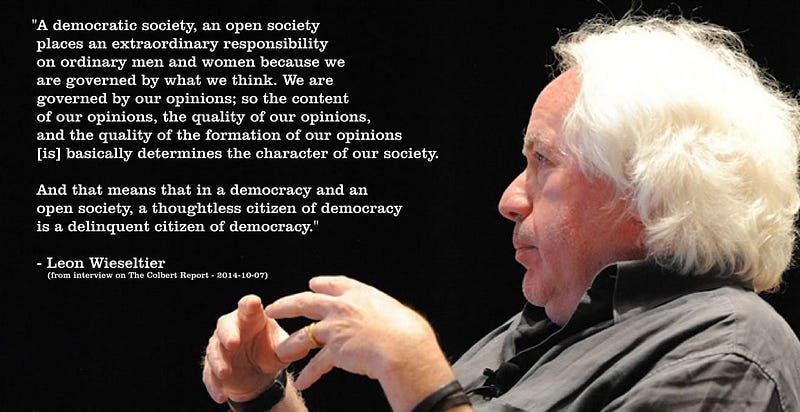
Leon Wieseltier — Democracy

Why fascism always appears in economically struggling countries.

Freikorps members flying the flag of the German Empire during the Kapp Putsch, Munich, 1920.

When people suffer from economic struggles, particularly over a prolonged period, they become desperate for someone to step up to the plate and offer solutions they cannot devise for themselves. People become conditioned through desperation for a strong leader to take charge and “lead the way to prosperity.”

Desperation causes people to lose perspective, while critical thinking skills suffer from a need to quell the pain. Anyone who can convincingly present themselves as a saviour will be welcomed with open arms.

Even though the solutions to economic problems may be obvious, they’re also too far out of reach of hope to implement them.

In today’s world, we are dominated by a handful of wealthy people who control all our systems with deaf ears to the cries of the suffering. Most of their focus is on their well-being, fortunes, and plans for their futures and legacies. The rest of us matter only insofar as we can be useful to them.

As our economies have become global and our economic infrastructures have become multinational entities, we have lost our communities.

Only a few decades ago, our communities thrived by our connectedness to each other.

We have lost that, while those who have been the greatest beneficiaries of a global economy have lost their sense of community attachment because the entire globe is their playground.

The plutocrats among us who are most responsible for the economic hardships suffered by millions are entirely due to their wins at the expense of the millions suffering today. Their goal has never been to raise humanity out of poverty, even though that has been the promise of capitalism.

They have their armies of servants at their disposal to secure themselves against resistance and to continue reshaping the world into their image. They are perceived as being too far beyond the reach of laws to allow the little people any sense of hope for justice.

Anyone who can present themselves as a leader capable of alleviating their suffering is welcomed with a total investment of all their hopes and dreams, while a widespread perception of one capable of rising to that need is one from among the untouchable class. That’s why someone like Donald Trump can succeed in assuming control of an entire party through a cult level of worship.

The trouble is that leaders who claim to be their solution also demand their unquestioning loyalty and obedience. That’s the key which opens the door to fascism because the only way for a single leader to wield enough power is to align themselves with the existing status quo of power.

Donald Trump — “Nobody know the system better than me, which is why I alone can fix it.”