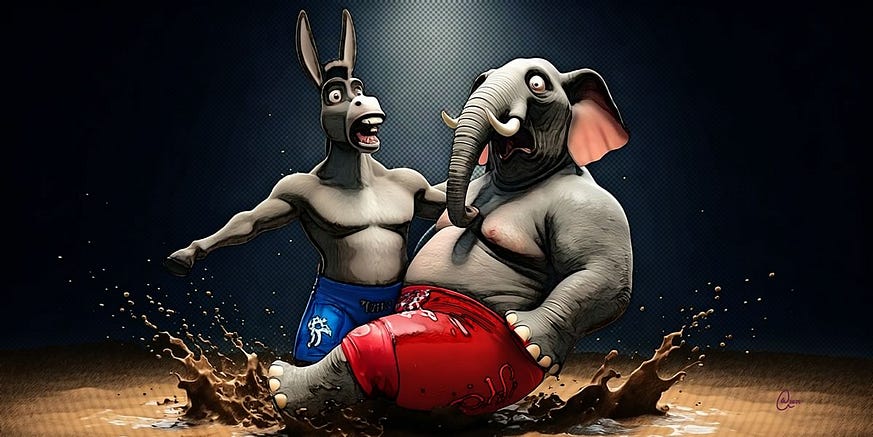
Why do a lot of Americans think politics is a dichotomy?

This post is a response to a question posed in its complete format: “Why do a lot of Americans think politics is a dichotomy that consists exclusively of democrats and republicans who are fully aligned with the platforms of either party?”

It might have something to do with almost every elected representative being a member of or closely affiliated with one or the other party.

It might have something to do with the notion that votes cast for alternatives are generally wasted protest votes that accomplish little more than a token form of expression that, at best, is viewed as a spoiler between the two major parties.

It might have something to do with the harsh reality that electoral reform will be necessary to change the current power dynamic. It might also have something to do with how much the oligarchic powers like it the way it is because it works in their favour to reduce their costs of buying government representatives and their risk of losing their investments.

It might also have something to do with a population that can easily be characterized as so much the walking wounded that they’ve developed Stockholm Syndrome because the alternative in changing the dynamic will demand a severe degree of chaos. At the same time, everyone hopes some magical solution will present itself to help them avoid risking everything while getting their hands dirty.

Finally, it might have something to do with the American people not being quite at their breaking point and have shown incredible resilience as they’ve learned to live in a dystopic environment under a perpetual threat of losing everything, including their children to gun-toting lunatics using their schools to vent their childhood rage. Since they’re okay with giving up their lives to enrich billionaires, it seems they’ve given up on being the home of the brave and the land of the free.
Which type of party system is best for a country?

This post is a response to a question posed in its complete format: “Which type of party system is best for a country, one party system, two party system or multiple party system?”

The more parties, the more broad the representation of the people.

The more parties, the less polarized the people are by ideology.

The more parties, the less gridlock on issues preventing progress on their resolution.

The more parties, the less able the plutocrats are to manipulate groups of public representatives to corrupt the entire system.

The fewer the parties, the more prone a system becomes to internal conflicts and widespread instability.

The fewer the parties, the more prone a system is to authoritarian control of the people.

The fewer the parties, the more prone the system is to civil unrest and the factors leading to a systemic collapse.

The fewer the parties, the more prone the entire system becomes to corruption at all levels, from the leadership down to the core units of society.

The fewer the parties, the more prone the people become to developing a sociopathic fragility and a callous disregard for the social contract.

The more parties, the more prone people are to cooperative negotiations in a culture of mutual respect for the social contract.

The more parties, the more democratic the system and the more egalitarian the people become.

The fewer the parties, the more prone the system becomes to toxic competitiveness that corrodes the natural goodwill of the people toward each other.

Why is democracy considered an ideal form of government?

This post is a response to a question initially posed on Quora, and can also be accessed via “https://www.quora.com/Why-is-democracy-considered-an-ideal-form-of-government/answer/Antonio-Amaral-1

There is no such thing as an “ideal form of government” because humans are from “ideal.”

What makes democracy a superior form of government to all others is self-determination.

What makes democracy a far more chaotic form of government than all others is self-determination.

No other form of governance is as capable as a democracy of facilitating the full achievement of human potential because no other form of governance empowers individuality.

No other form of governance is as prone to overt assaults against it, while no other form of governance can survive those assaults.

Human nature demands self-determination, while the assaults against democracy today are born of that demand for self-determination — albeit in horrifically corrupted and myopically self-serving terms.

Think about the perspectives of those displaying an aggrieved assault against democracy. They are commonly born from an autocratic mindset which expects the world to conform to their perspectives. They interpret the evolution of society as a rejection of their insular views and a violation of their rights to those views. It is Frankenstein’s monster of cancerous individuality disguising a toxic desire for sublimation to authoritarian rule by people who imagine freedom as their right to dictate the lives of others.

They are not entirely oblivious to the inherent hypocrisies they champion, or they would otherwise not conduct their protests while disguising their identities or hiding behind masks or fake profiles, managing multiple sock-puppet accounts on social media.

They are the disruptive elements in a democratic society screaming a need for a much more coherent strategy for social development. The challenge at hand, however, is not an authoritarian solution dictated to the masses, as history’s failures have made clear. Today’s dynamic in an information-rich society demands a supportive strategy of education and social welfare programs providing opportunities for healing and growth for a species emerging out of a dark and brutal history while still suffering the effects of generational PTSD.

For democracy to survive its current challenges and begin to approach whatever may be deemed as an “ideal form of governance,” our systems must evolve to prioritize the people over the plutocracy seeking to regress human civilization to a medieval state of rulers and serfs.

We will otherwise find ourselves repeating the bloody histories of our ancestors who sacrificed everything to win the freedoms far too many take for granted today.

In today’s world, the closest examples we have to an “ideal democracy” are embodied within the Nordic models of social democracy.

We would save countless lives if we could take stock of how fundamentally destructive the world’s current adoption of right-wing ideologies is for human society and global stability.

Which political system could replace democracy with fewer flaws?

The original format of the question this post answers was written as follows: “Which possible political system could replace modern democracy and have less flaws than democracy and still benefit the many?

This question makes it seem as if how we manage our affairs and have a dialogue over how best to peacefully coexist in productive societies that encourage us all to achieve our best potential as individuals and as a society is just a matter of a change of clothing.

That’s now how this works.

Societies do not succeed or fail based on the system we use to govern ourselves.

Societies fail because we fail to govern ourselves as individuals.

Societies fail because human corruption leads us to failure.

Societies don’t fail because we pick the wrong system.

Systems fail because we fail to raise humanity from the muck of our primitive urges as individuals.

Haitians in Springfield are not living in fear today because democracy has failed them but because corrupt human beings have chosen hatred over understanding.

The only system that will ever work is the system that cures us of horrifying statistics such as one in five of us is a mentally unstable individual or 70%-80% of families are dysfunctional, or the primary cause of people leaving their jobs is because of abusive leadership in their place of work.

The only system that will work is the system of people who refuse to tolerate monsters corrupting human society, and that extends far beyond simple politics and well into every other aspect of human life and what we colloquially refer to as “civilization.”

The only system that can ever have a hope of working is the system that focuses on developing human potential, which means education, healthcare, and the ability to succeed on one’s merits in a system that encourages and develops our ability to achieve success through self-determination.

We don’t need to be ruled. We should know better how horribly wrong every other system has turned out to be. It doesn’t matter how messy democracy is because that’s not a problem with the system of democracy. That’s a problem with human beings.

We need to fix ourselves as humans and as a species sharing this mudball with billions of other species if we want any system to be stable over time.

Democracy as a concept is not “flawed.” It’s the best idea we have ever had. The problem is us. We must focus on being better individuals before we can better organize ourselves within any system.

We need to stop pointing the finger of blame at anything and everything that is not us and start taking some responsibility for who we are and what we are. If we can’t manage to do that, then we deserve to send ourselves over the brink and into oblivion.