Subordination is the foundation for authoritarian regimes.
Authoritarian regimes are rigidly hierarchical.
Rigid hierarchies are inflexible and abusive toward all people downward in the power hierarchy.
Authoritarian regimes eventually break because humans have limits on the abuses they can tolerate.
Democracies survive because they are fundamentally adaptable to change.
Democracies are fundamentally adaptable to change because they accommodate individuality.
Individuality empowers self-determination to maximize flexibility and adaptability.
Flexibility and adaptability are contingent upon responsiveness to succeed.
Responsiveness demands input and engagement from diverse perspectives to be effective.
Dissent filters out ineffective processes that inhibit adaptability.
Navigating change requires dissent to ensure that adaptation initiatives succeed.
Without dissent, changes are made blindly to make adaptability impossible and guarantee failure.
Hence, dissent is the foundation of a democracy.
Furthermore, embracing dissent improves all of us, particularly in the essential skills area of critical thinking.
The greater our embrace of dissent, the better our thinking skills become.
The better our thinking skills become, the more robust our democracy.
Democracies are being threatened worldwide because we have been failing to equip citizens with the skills they need to build a better world together.
We have been failing to equip our citizens because arrogant assholes with too much of a desire for power wish to reduce citizen efficacy in self-governance systems because they deem themselves superior humans entitled to their power and to lord over the little people.
It’s past time they begin to relearn their lessons in humility.
This post is a response to a question posed in its complete format: “Imagine that millions lose their jobs due to AI. Is there a way for those who have lost their jobs to effectively declare war on AI?”
Well, that’s pointless.
People will not lose their jobs because of AI but because corporations save money on labour costs.
AI is a tool, and the argument that ammosexuals love to barf up applies here: “Guns don’t kill people. People kill people.”
AI doesn’t kill jobs. Capitalists kill jobs because they can and are incentivized by it within a system that worships personal wealth above all.
We, as citizens, kill jobs through our apathy and through our empowerment of those who prioritize their material benefits at the expense of the many they can exploit.
We bring this upon ourselves by not having a coherent social development roadmap. We allow our societies to grow by chaos rather than responsible systems management strategies.
We empower our leaders through a reactionary process of social development rather than a strategically reasoned and proactive process.
Sadly, authoritarian regimes are far more successful along this vector than democracies because their decision-making is limited to small, centralized powers.
This is part of the reason that the public has been increasingly questioning the value of democracy while looking toward authoritarian models to solve our problems for us.
Sadly, the solution for democracies to be far more effective in mobilizing social development in a coherent and unified direction is entirely contingent upon the quality of the education the public receives.
For instance, the transition to a fully automated society is an inevitability. There is no point in resisting it. We would all be much better off by leaning into it and demanding we adapt our systems to manage the transition better so that we can mitigate collateral damage.
Instead, we are experiencing a chaotic transition led by random powers following personal visions motivated by personal benefit rather than social good.
If our education systems provided a more comprehensive insight into social development, much of the public would be engaged in the political process in strategic rather than reactionary ways.
We would be more unified as a people in identifying trends and developing coherent strategies for successfully managing the challenges we face.
Instead, we are burdened by a dearth of education that reduces a population into cheerleading camps driven by emotionality that can be characterized as juvenile reactions against authorities. Considering how democracy means each person is a governing authority member, this is beyond an asinine apprehension of how one’s government works or how it can be made effective.
Democracy demands engagement, yet our apprehension of engagement is limited to how many likes one gets on one’s post. That’s not even remotely resembling engagement.
That’s like claiming every celebrity walking a red carpet and waving at the throngs is socializing with friends.
Sadly, part of the problem has been deliberately cultivated by the capitalists who want us distracted enough from the sausage-making process to allow them to remake human society into their image.
They have been succeeding remarkably within the U.S. as it has become a dystopian corporatocracy that prioritizes gun sales over the lives of children and billionaire profits over the healthcare needs of citizens.
The public has been so conditioned to prioritize profit at all costs that they will fight to preserve a billionaire’s right to kill people for profit.
We can’t govern ourselves in a democracy if all of our time is focused on survival and profit-churning. Most of us don’t care to be involved in the decision-making process, which would be okay if we could trust our information systems to prioritize informing people over chasing profits.
Instead, we have media that has become a singular, massive entity of public influence predicated upon churning conflict to maintain attention justified by revenue increases.
Instead of informing the public on issues of criticality to the future of the people, we have this kind of incendiary rhetoric from an attention whore indulging in shock stupidity to justify their salary increases by ginning up the rubes to create conflict.
Less than one hundred years ago, this kind of crap would be shut down immediately because it would be considered a precursor to war.
Instead, the attention-seeking mentality justified by the profit (and power-seeking) motive does not care about the casualties created by irresponsible language.
The value of human life has been downgraded, if it ever mattered to society, to a level that’s no greater than the Roman arenas when people were killed for entertainment.
If we don’t start asserting some standards on coherent behaviour that cultivates the best of us as a species, we will continue careening headlong into chaos.
Humans can take only so much abuse before they break. Everyone can break, and people like Watters are playing with fire. There’s no way he will be safe again crossing the border into Canada because of his disgusting language. Some might argue that any aggressive response against him is unjustifiable, and that may be valid, but it doesn’t change how humans behave when aggrieved. I’m confident few Canadians will give him a warm reception for his remarks if he ever crosses the border. At best, at least from my perspective, he’s earned a bloody nose for his garbage.
This kind of bullying rhetoric is toxic to society and is a betrayal of the social contract.
The acceptability of this nonsense and its prevalence is why we have no coherent strategy for managing our transition into a fully automated society. The acceptability of this kind of incendiary distraction from critical information the public needs to make proper decisions to minimize casualties in our transition will create unnecessary casualties. This kind of thinking is what permits bigotry to determine outcomes that dramatically affect lives.
This kind of nonsense is why this question exists in so many forms everywhere and why I’ve already answered this question in several forms by now.
The issues are not complex, but they are made so because we’re not talking about them where we need to be talking about them. We’re allowing jackasses to troll for reactions in “respectable mainstream media” that we would mute and block online if they were individuals and not expensively dressed and cosmetically pampered media personalities.
We are being betrayed by the Fourth Estate each and every day — and to the degree that a majority of the world now believes the U.S. is a tragic case of end times for a nation that has become so corrupt, it can never be trusted for leadership in the world again. However, anyone may parse the 2024 election, and one cannot ignore the role of the media in installing a monster in the top job for the nation.
If you genuinely want to declare war against the loss of jobs, then you need to take it to those who benefit from displacing jobs. You need to start pressuring the billionaires and the corporations they benefit from while ripping off the public through tax avoidance schemes.
Instead of war, you should demand responsible management for an unavoidably dramatic and traumatic societal transition by insisting on the only sane solution to this period in human history, UBI, as a starting point toward sanity in our social development.
The worst thing about where the world is at in this transition is that the next four years are being defined by a parasitic presence seeking to empower further those who are disempowering the working class while replacing workers with automated solutions to toss millions out onto the streets to fend for themselves.
We must stop blaming AI for job losses because it’s just a gun in the hands of mercenaries.
This post is a response to a question posed in its complete format: “How do leftists stay hopeful/resilient in times like these where fascism is on the rise and history is repeating itself?”
History has shown us that fascism always gets beaten back when the public realizes how much less they like fascism than the chaos of democracy. Every time and after enduring a period of suffering under the rule of despots, voter turnout makes a strong comeback as fascism encourages the apathetic non-voters to rethink their strategy of staying home.
Think of fascism as a lesson in consequences where people need to suffer enough to realize just how precious the delicate balance of freedom is in society and how vital the sausage-making process is, no matter how boring and dry it may otherwise seem.
People eventually learn they prefer to get off the couch and go to the polling stations to cast their votes for people they want to trust to represent their best interests. They also eventually learn that no matter how much the fascists want to paint their opposition as being identical to them, they’re not. The fascists inevitably piss off the people enough to go to war against them, and that’s precisely what Trump and Musk are inviting from the world.
They’re poking a tiger, and they’re going to get burned while they set the world aflame.
The only real question left on the table is, Just how much more pain will the people endure before the riots break out?
This isn’t even about being hopeful because we already know, just like everyone who’s been pushed past their limits, that once the anger takes over, there’s no stopping it. That neighbour who’s been pissing you off with their loud music invariably gets an earful that may embarrass you afterward. Still, it’s an emotional explosion that can’t be controlled during its moment of emotional release.
My guess is that if Luigi Mangione gets the death penalty, that might be the final trigger before all hell breaks loose. It’s hard to tell because Americans seem able to tolerate incredible horrors without doing anything substantial about them.
I know that if I was living in Flint, Michigan, for example, and I had a kid who died from the poisoned water, I would have pulled a Luigi myself. If a kid of mine were gunned down in a school while my local representative did nothing to institute sensible measures to prevent this from happening again, I’d lose my shit.
As it stands right now, from what I’ve been put through on a personal level, I’m already doing everything I can to keep from doing something stupid while attempting to resolve an issue in the most civilized manner possible. As it stands, the bullies responsible for destroying my life are behaving as if they’re going to walk away without suffering any consequences for their actions as they tell me to shut up and die quietly.
I know I’m not the only person at the end of their rope, and all it will take is the right match to set this nightmarish dystopia ablaze.
People like Musk will have to come around or beef up their security because it’s only a matter of time before their arrogance blows back like a nuclear bomb in their faces.
“Those who make peaceful evolution impossible make violent revolution necessary.”
The trouble with this dynamic is that millions of people have to be pushed to their breaking point before they realize how much less pain there is in risking death in a revolution than to continue enduring a walking death in slow motion toward oblivion.
This is all just history repeating itself.
It’s not new by any stretch of the imagination.
Those who refuse to learn from history force us all to replay it, and we all get uglier about it each time we must endure the stupidity of people who refuse to read the writing on the wall.
The only salient aspect of hope in this mess is that we can avoid the worst chaos before returning to sanity.
Within a capitalist system, one sells either one’s body or mind, which is called employment.
The only alternative to that is to pay people to use their minds and their bodies to create products that other people buy to generate revenue for them.
That’s right… either you’re a plutocrat with wealth galore and never have to sell yourself to anyone, or you’re a servant for someone else.
Women selling their bodies in today’s society is a very smart economic move because a great deal of money can be made in a very short time that can propel one from being a seller of their body to being a capitalist paying others to make money for them.
Women selling their bodies in today’s society are very pragmatic and have a clear advantage over men in generating revenue.
If you can earn upwards of six figures for a couple of hours per day of on-camera nudity, the problem isn’t women selling their bodies but your disconnect with the capitalist system you’re living within.
IOW, you may want to shame women for making that choice, but it is a choice because men have made it one. It’s not a bad choice because of women. Women choose to benefit financially in ways no longer available to most working-class people.
Perhaps if we paid school teachers more than hedge fund managers, we’d find people aligning their economic decisions more closely with moral values. In a society that steadily strips away economic choice, you can’t complain about the people who choose options you find uncomfortable. After all, they’re chosen as options because living wages no longer are.
What’s truly sad about all of this is how little people comprehend implications that stretch far past the ones that immediately impact them… and that’s not a phenomenon limited to the little people; the captains of industry we rely on for leadership in society are just as bad at failing to see past their navel… possibly even worse than the majority, although, from my biased perspective, they have a greater responsibility to rise to their status.
“To whom much is given, much is asked of in return.”
Stop crapping on the women getting rich from their birth lottery winning because benefitting from birth lotteries is the world we have created.
If you need to crap on something, crap on that.
The women getting rich by making horny incels happy are not the problem in society.
This post is a response to a question posed in its complete format: “What does the left mean by freedom? When ever I see lefties passing around rankings of the “freeist” countries, inevitably the countries at the top are the type with heavy regulation, heavy taxation, low economic freedom.”
One of the hallmarks of a lack of freedom is ideological thinking that colours one’s perceptions in ways that interfere with one’s apprehension of reality to impede one’s critical thinking skills.
For example, the flawed presumption in this question presumes higher taxation equals less economic freedom when the obvious comparison between the U.S.’s health exploitation system is far more destructive to one’s financial freedom than the taxed version of universal health care offered by every other nation that has succeeded in providing higher quality care at a lower price.
There is no economic freedom when medical bankruptcies destroy lives.
There is no economic freedom for people who pay over one thousand dollars per month for insulin when the rest of the world pays only tens of dollars.
There is no freedom when one is murdered for profit.
There is no cognitive freedom for anyone who divides the world into ideological camps, just as there is no freedom from the mind-destroying forms of bigotry polluting this world.
Within the context of this question, the definition of freedom that addresses it is clarity of thinking, in which the querent proves their mind is so trapped within a toxic paradigm they can’t understand freedom when it’s presented to them in the most unambiguous of terms.
I fully expect this answer to whoosh past the querent’s mind and trigger them into an ideological quandary where they will dismiss these words as an ideological irrelevancy in much the same way that the people who think Donald Trump is an intelligent man are utter idiots.
This post is a response to a question posed in its complete format: “Could taxing Elon Musk and other people with massive fortunes 80% be the solution to paying down the national debt in the USA?”
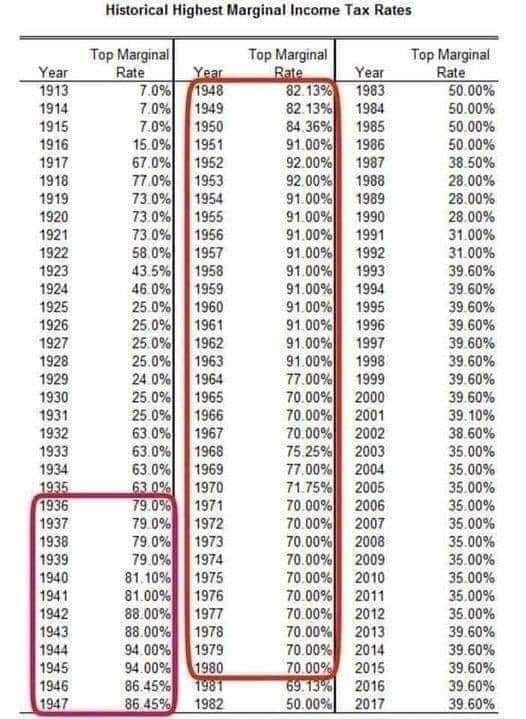
The answer is quite simple and beyond evident to anyone with eyes and a mind that’s capable of connecting simple dots from a simple table of numbers:
Here are a few points to address regarding regurgitated soporifics routinely employed by the enablers in the crowd.
Taxing the billionaires won’t be enough money. — Well… DUHHH!!!! That’s not the point. The point is multifold, but let’s cover some leading characteristics. a. Force Multiplier and b. Speed of Money
A healthily functioning economy is highly contingent upon “the speed of money flowing” through the system — like arteries in a human body. The more plaque there is that obstructs the flow, the less healthy the system is and the more prone to systemic collapse it becomes. The low tax rates that we have now and that we had leading up to the Great Depression encourage hoarding and are a leading cause of numerous social issues guaranteed to result in a dramatic economic collapse — mainly as automation speeds up.
The more money the bottom end of the economy has, the more demand for goods and services, and the more businesses grow in a feedback loop. Even more beneficial to the economy is that when more people have more resources to invest in themselves and their futures, more innovation is introduced into a system that feeds on innovation to grow.
These two concepts alone, together, make up for what the useful idiots who defend the hoarding billionaires who lack imagination for humanity’s future beyond building space penises fail to account for. It is bloody disheartening that trickle-down stars can so thoroughly blind people and make them so addicted to the taste of billionaire orifices to understand how their misanthropic stupidity is the equivalent of suicidal ideation for humanity.
The graphic above screams the economic solution in our faces.
The lower the taxes =, the more unimaginative parasites and predators horde = the more sociopathically stupid they become =, and the more of a threat to our future as a species they become.
We create laws to mitigate the impact of excessive behaviours because we understand the destructive effects of unrestrained freedom on society. We know that if laws don’t exist to prohibit murder, many more murders would occur. The laws don’t end murder, but they function as a valve on society to mitigate and minimize the impact of widespread murder on society.
We create laws to restrain an entire host of issues resulting from the toxic extremes of human behaviour. Still, for some reason, the notion of building dynasties to rule humanity isn’t viewed as the threat that it is… even when the numbers add up to our extinction.
The main reason the billionaires should be taxed isn’t even economic, at least not quite directly the most important. The main reason they need to be restrained is that if they are not, they will destroy human civilization, and they don’t care because they have enough to build bunkers to ride out the apocalypse.
The people answering this question who are defending the atrocities of unrestrained wealth are as guilty of crimes against humanity as the MAGAts who are guilty of treason against the United States.
An astute argument was raised in response to this post that I’ve included here:
One point I would make is that taxing income and taxing wealth are two completely different things. Elon Musk may be worth $300 billion but that’s his wealth, not his income. If we start taxing wealth, be prepared to start paying taxes on the increased value of your house every time it appreciates in value. Politicians that tell you they would set a minimum of $100 million before taxing are telling half truths. They may set a limit initially but over time that can change. The original income tax was 0.5% of incomes over $1 million. How’s that working out for everyone ?
That argument sounds much like the fearmongering cynicism against raising the minimum wage — inflation will go up, or robots will replace jobs.
The reality is that property ownership is not the same thing as stock wealth, and there’s a fix for that — eliminate the corporate ownership of residential real estate.
Furthermore, the number of tax brackets that exist today is an unrealistic reflection of the historic levels of wealth disparity. For example, there are only seven tax brackets today. I checked to see how many existed during more realistic tax assessments. It was strange that learning how many tax brackets existed historically took more effort to identify than my bias believes it should.
This link below shows that in 1952, there were 28 tax brackets. Eliminating tax brackets benefits only the wealthiest in the land. The more tax brackets, the more granular the taxation rates and the less discriminatory tax rates are to the lower classes, and the more progressive taxes become — as they have always been intended to be. As it stands, the radical reduction of tax brackets has just been a means of waging a class war against the little people by allowing them to skip responsibilities that are inherently theirs while redistributing tax responsibility downward.
This is a leading question. Lumping all “social expectations” into a “freedom bag” produces only “freedumb” — the inability to distinguish between regulating destructive behaviour and encouraging positive behaviour to support the social contract.
Laws against murder can conceivably be considered restrictions on freedom, but they’re also a means of protecting freedom for the victims of predators in society.
There is no universal single-size-fits-all means of parsing this question. It’s just a nonsense question designed to appeal to those who already perceive society as children complaining about having to clean their rooms.
Here’s a counter-intuitive example for people who don’t quite understand the nuances of laws and social expectations.
It can be argued that in a Mad Max dystopia, one has the greatest “amount of freedom” possible because there are no such “restrictions” (parameters) as those in a world where anything goes. The harsh reality in such a case is that what constitutes freedom for some (the powerful) constitutes enslavement for the rest of “society” to a persistent fear of having one’s life snuffed out on a whim.
Sometimes, restrictions produce greater freedoms than would otherwise be the case.
In the art world, for example, the greatest creativity can be produced simply by putting parameters on one’s work and approach to doing one’s work. In a personal case, I restricted my palette to black and white for about half of a semester after being told by an instructor that my colours looked like Disney had barfed them up and onto my canvas.
I struggled with colour and all the many nuances of colour, so I had not developed the nuance of understanding how colours work in balance, just as shapes do in a composition. Removing colour from my palette allowed me to focus on developing harmonies between shapes and finding ways to establish compositional balance without the added complexity of colour as a dimension to throw me off.
That restriction allowed me to understand my work from an entirely different and much more free perspective. I discovered freedoms I did not know existed before my self-imposed colour restrictions.
Society is much like that because it has become so complex it’s difficult to parse which aspect is beneficial and which is toxic. We can no longer live with the simplistic view of the world we once nurtured through symbologies like a difference between white hats and black hats. We live in a world of anti-heroes, and that makes demands on our ability to apprehend nuance through developing critical thinking skills. We must learn to be capable of adequately parsing subtle distinctions that can threaten to transform freedom into subjugation within the slimmest of margins.
People find the freedom to be themselves within their tribal associations but can also find their freedoms stripped by the dogmatic application of tribal expectations.
Another example I’ll take from Isaac Asimov’s Foundation series (which I applied — or interpreted as Japan in the 1980s) was the planet Terminus. Hari Seldon’s group was consigned to a planet that was slim on resources to mitigate the potentiality of becoming a threat. Instead, what happened was that scarcity of resources encouraged their creativity such that over time, they produced faster and more powerful ships that were smaller than the Empire’s massive vehicles.
This means that freedom cannot be measured by its constraints but by the results of the limitations (or parameters) placed upon a society. Those constraints can facilitate freedom when they are balanced between the needs of the many and the individual’s desires.
The mythological free society in a harmonious state of anarchy is a pipe dream founded upon a delusional presumption that all humans value the social good above one’s benefit.
The U.S. is a case study for the ages over just how toxic extreme individualism is. For a nation that pretends to value freedom, its privatized prison population screams to the world how subjugated and servile its society is. The U.S. is so “free” that they allow children to be gunned down in schools, not just once but repeatedly. The U.S. is so “free” that people are killed for profit.
A football game with rules is a dynamic tension that draws engagement from an audience, while football without rules, for example, becomes a chaotic bloodbath that disperses an audience.
This question is a testament to how badly butchered the concept of freedom has become within this modern dystopia.
Perhaps this question should be reworded as “What is freedom?”
Bonus Question and Answer: To regulate and control human behaviour, what do you understand by that?
I understand that too many people think a valid strategy for accomplishing this is imposition and subordination to power under the threat of subjugation.
The positive, proactive, and ultimately democratic means of accomplishing the goals of regulation and control are through the development of a human capacity for self-regulation by encouraging the improvement of emotional management skills bolstered by critical thinking skills while addressing fundamental threats to personhood such as living insecurities and forms of persecution through the repression of rights and freedoms.
Showing people how to achieve their potential is a far more effective means of proactive regulation than the barbarism of reactionary punitive measures. This approach also leads to far more long-term stability in society and a much more engaged citizenry actively working toward supporting the social contract by choice.
We can achieve our potential as a species only by helping all of us to be better rather than forcing conformity to myopic structures made vulnerable by their inflexibility and inability to adapt to an ever-changing universe.
Happy New Year! — Here’s hoping your 2025 is a good one. Thanks for reading.
This post is a response to a question posed in its complete format: “Why don’t they outright ban loopholes in modern law? I get how humans are, and how literal laws can be, but still it’s like it doesn’t account for human nature and the laws written for robots.”
This question is like asking why can’t every bluish-coloured pebble of sand on a massive beach be removed.
Loopholes in law are bits of legal logic in which the language can be interpreted in multiple ways. At the same time, some of those interpretations constitute an escape from consequences, also known as a “technicality.”
The only things that can be done are to write laws in such ways as to make their interpretations as unbiased, neutral, and clearly defined as possible and to ensure the spirit of those laws is adequately conveyed within their construct.
Sadly, in a distorted environment where power imbalances influence the construction, application, enforcement, and rendering of decisions based on established statutes, loopholes are a feature, not a bug.
In the corporatocracy known as the U.S., loopholes are intentionally incorporated into laws to allow those with means an ability to access technicalities and avoid accountability for their actions. The highest court in the land has been deliberately shaped to serve the interests of power over and above the interests of the people. The Citizens United ruling would have been much different if that had not happened. The same is true of the overturning of Roe v. Wade.
With an organization like the American Legislative Exchange Council, laws are written specifically to benefit the wealthy and disenfranchise everyone else.
Unbiased and neutral laws are impossible to write and enforce within such a toxic and anti-justice environment.
You may get “how humans are,” but few Americans truly understand how dire their circumstances are. With this level of corruption throughout their “justice” system, Americans have no hope of restoring justice without the people mobilizing and “pulling an Iceland manoeuvre in the extreme.” Americans are now well past the point of achieving justice in a just society without severe chaos ruling the land long enough to cull the monsters responsible for the corruption.
In short, Luigi was just the first shot back across the bow by the little people quickly reaching their breaking point. There will likely be riots nationwide before Trump’s term has run its course. Sadly, he’s not the problem, but a symptom of the problem and attacking him won’t solve the core problems. In some ways, he’ll be doing the nation a favour by making it impossible for the people to ignore just how prevalent the corruption issue is.
The MAGAts intuit this on a visceral level, and they voted for the symptom of the problem to deal with the situation. Still, their support is very much like pouring gasoline on a fire to make the apathetic among the nation wake TF up and pay attention to the freedoms they’re allowing to erode and be taken from them.
It is mind-boggling, for example, to outsiders to see a nation struggle to rein in mass murders and establish universal health care. You’ve had movies indulging in revenge fantasies against the corruption, but few of you seem willing to commit yourselves to fixing it. You seem to have settled in with having your children attend school while fearing for their lives and pretending there’s nothing horrifically surreal about that.
Americans are way, way, way past the point of fixing a few loopholes to restore sanity to your nation.
This post is a response to a question posed in its complete format: “Why does the right wing complain about the left wing far more on the internet than the left complains about the right on internet podcasts, etc.?”
I haven’t performed any surveys, nor am I aware of any statistics on the matter. I have, however, noticed a distinct difference between the nature and characteristics of the criticisms levelled.
The “left” generally identifies toxic characteristics from the right that erode or betray the social contract through blatant forms of bigotry, hypocrisy, projections, generic hatred, and unfocused rage.
The “criticisms” from the “right” are generally simplistic accusations one would expect from grade-school children. Very little thought is put into their concerns while choosing to wield broad brushes of hatred that are often confessions disguised as accusations.
I’ve used a broad brush to describe these general differences but am hard-pressed to think of criticisms from the right that are not embarrassments to the concept of critical thinking. It’s not that they don’t exist. They’re so rare that one has to focus on dredging up examples through a mountainous garbage heap of blatantly childish spite that they appear almost entirely non-existent.
Another salient difference between the two polarities is the concern for the victims of horrifically bad policy expressed by the left and a maddening sociopathic disdain and even Machiavellian pleasure taken in the notion of victims of bad policy justified through a lens of righteous indignity.
At almost every step and instance, whenever conservatives talk about the victims of bad policy, they seem to gloat their pleasure over the thought of people suffering needlessly.
Another characteristic that distinguishes political polarities is how willing and eager the right is when defending the 1% responsible for trillions in theft and the destruction of the middle-class quality of life. The right seems entirely oblivious to the causes of their anger and prefers to victimize further the victims of those responsible for their misery. One can only conclude that another characteristic common to conservatives is intellectual cowardice.
They would rather crap on the weakened and easy victims than hold the people responsible for their misery accountable. It’s like watching someone beat up on the victim of a mugging rather than go after the mugger because they’re too afraid of the mugger and would rather cozy up to them while hoping to have a few pennies thrown their way for how well they lubricate their anuses.
The reason why that would be the case is quite simple and referred to as “overcompensating behaviour.” It’s a widespread psychological phenomenon when someone subliminally recognizes the implications of their behaviour and instinctively reacts to mitigate the consequences of their actions.
We have cultivated it by allowing our societies to grow into corrupt monstrosities that people have no choice but to struggle to survive within.
We have placed a physical resource like money at the top of our values and have dehumanized people every step of the way. At the same time, we convert human beings into disposable commodities.
We are dehumanizing ourselves at every level by endorsing a system that devalues the ineffable qualities of humanity because they are not viewed as profitable by industry. Instead, we have ways of further dehumanizing people by leveraging their despair against them with global institutions that dictate dogma to follow without question.
Everything has become reduced to a competition for tentative comforts that bear no intrinsic value or meaning beyond serving the immediate gratification of shallow desires.
None of this contributes toward the growth of those qualities of humanity that we value. None of this brings us together as people in common cause for the betterment of all. Everything is catered toward the propulsion of individuals we stratify with blind worship.
When we replace human qualities we cherish with an avatar, like money as a metric for determining their value, we become divorced from our humanity.
While living in a world that views wealth as an indicator of all positive human qualities, people inevitably start to develop disparaging views toward their neighbours because everyone has been left fighting over the same scarce resources that are left behind by the plutocrats dehumanizing all of us with a system they parasitically siphon of wealth at our expense.
We can only live so long with oppressive conditions before the effects grow out of control and well into making our environments breeding grounds for chaos.
Misanthropy is just an early stage of widespread systemic collapse.













 thotbag