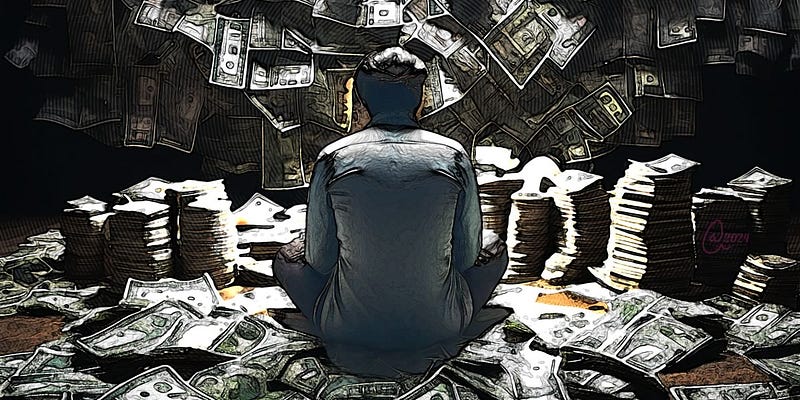
Why doesn’t the government give everyone 1 million each to save people from poverty?

This post is a response to a question initially posed on Quora, and can also be accessed via “https://www.quora.com/Why-doesn-t-the-government-just-give-everyone-1-million-each-to-save-people-from-poverty/answer/Antonio-Amaral-1

That’s an utterly ridiculous idea for many reasons. Probably the best example for showing how utterly absurd this idea is is not the devastating impact it would have on the economy.

The best example of why this idea represents a monolithic level of naivety is what happens when people win lotteries.

Massive lifelong windfalls are often mismanaged because people have no experience managing large sums and overestimate how far that will take them.

It’s much better to adopt the approach the wealthy class adopted with their children.

Providing people with enough to meet their needs until they can manage their affairs intelligently.

If they are responsible and resourceful, they will find they won’t need to rely on their entire inheritance to survive when it becomes available.

We are all part of a system into which we were born and collectively form a social contract by which our cumulative efforts guarantee the health of the whole.

Since we produce more than we consume, society is accountable to all its members to ensure everyone benefits enough to meet their basic needs.

The government should not participate in and create upward wealth redistribution schemes but spread the cumulative wealth to ensure people can survive with dignity.

We are at a point where it is not only feasible but inherently a superior form of economic management than we have in place now.

It will become ever more clear to ever more people as we march headlong in our transition to a fully automated society and entire classes of jobs vanish to be replaced by robots and AI.

Creating a sustainable lifeline gives people the space to be innovative because people are naturally creative problem solvers. Allowing people to determine their life course based on their interests is the quickest and most effective way to motivate them to invent new solutions to innumerable problems we all collectively face daily.

The solution is not a windfall because that is entirely counterproductive and a short-lived benefit with dramatically adverse effects on our economy that would radically increase poverty.

The solution to our economic and social issues is to provide for the basic survival needs determined by Maslow’s Hierarchy of Needs.

Food, shelter, clothing, security, and the ability to invest in oneself to build a future with dignity for oneself and one’s family.

Most people’s needs are modest and don’t require a radical sum of money to transform their lives without effort magically.

Most people rise to the challenge of building a better life if they can access systems instead of being barred from access because of prohibitive costs.

For example, instead of giving away money to drain into a sinkhole, provide free access to education, and people will take advantage of that to create better opportunities for themselves on their own and without any prodding.

The difference between thinking of supportive solutions and cynical solutions like this question is between a disparagingly misanthropic view of humanity and one’s neighbours and a caring and supportive view of one’s fellow citizens as human beings simply trying to live their best lives.

The sooner we can cure ourselves of this wholly destructive attitude toward each other that we have allowed to fester and grow in society, the sooner we can progress in making this a better world for everyone.

This wholly cynical view of humanity is cultivated mainly within the MAGAt crowd. It is deliberately cultivated by a small percentage of sociopathic billionaires who routinely dehumanize people and pit us all against each other so they can continue stripping us all of our dignity while ripping us off by the tens of trillions of dollars to send us into poverty and destitution while they laugh at our misery.

Are people poor because they were born to be poor?


This post is a response to a question posed in its full format as follows: “What can we say for those people that worked hard but are still poor? Is it because they were born to be poor?”

The first place to begin one’s assessment of another’s fortune is with an honest apprehension of the environment affecting all fortunes by all people who inhabit a (somewhat) closed ecosystem.

To suggest some external source of magical influence like fate to factor in any of this merely distracts from an objective apprehension of the dynamics leading to disparity.

It is precisely this kind of magical thinking that every “Confidence Artist” (“conman,” “swindler,” “scammer,” fraud) throughout human history has relied upon to enrich themselves at the expense of their victims.

Making matters worse for the victims is the belief that they’re responsible for the actions of others who impoverish them.

This thinking epitomizes victim-shaming.

It’s no different than blaming one’s attire for “causing” a rape.

It’s precisely the thinking a homicidal monster utilizes when they claim someone else’s actions forced them to commit murder. They twist the notion of self-defence into a justifiable weapon to dismiss responsibility for their actions.

This perverse thinking permits people like Derek Chauvin to suffocate George Floyd until they stop breathing. It empowers all the evil monsters in our midst to invoke sociopathic rationalizations unrelated to the incident in question to justify the commission of murder.

Inmate who stabbed Derek Chauvin 22 times is charged with attempted murder, prosecutors say

It ignores the causal nature of reality. Even the Bible’s Genesis chapter and “list of begats” acknowledge causality.

Bible, King James Version

People are not poor because of some cosmic assignment handed down to them by an authority, as if it were a justifiable assessment of their character at birth. People are poor because humanity has not learned the lessons of our primitive existence — namely, that we managed to survive our cave-dwelling origins only because we worked together as we hunted in groups. Each contributed to the welfare of the whole in ways that allowed everyone to benefit equally from the collective labours of synergy.

Margaret Mead has most succinctly identified the dawn of human civilization in her example of a knit bone discovered during her anthropological studies.


The worst aspect of all of this is that the evidence is abundant. There is no mystery as to why so many people struggle with poverty today.

In our early history, widespread poverty primarily resulted from natural scarcity due to environmental conditions such as an early frost wiping out an entire harvest or poor land management practices such as those that led to “The Dust Bowl” and the “Dirty Thirties.” Ironically, the magical thinking of “Manifest Destiny” driving an initial bump in prosperity contributed to the impoverished conditions that contributed to “The Great Depression,” which contributed to the stressors driving global aggressions leading to a Second World War only decades after the first global aggression.

Dust Bowl: Causes, Definition & Years | HISTORY

The fuel behind all of the poverty and aggression is the same fuel contributing to an increasing number and degree of violent protests occurring worldwide today — income disparity. We have surpassed the stage of income disparity that triggered our first global aggressions due to the stresses of exacerbated conditions of poverty.

This cycle of class disparity has triggered aggressions throughout human history, and many of our popular stories are based on them.

We should know better by now, but we seem incapable of learning this crucial lesson from history.

What makes matters worse is that in today’s “post-scarcity world,” we produce more than we can consume. We have no excuse for poverty today beyond human failings, as expressed through our politics.

Can we feed the world and ensure no one goes hungry?


None of this is a mystery — or should be a mystery to anyone today. Yet, here we are looking for excuses to victim-shame the vulnerable in society who struggle to feed themselves every day.

The information providing clarity exists in abundance. Few people are ignorant of the fact that eight people have as much wealth as the bottom half of the whole of humanity. No one is oblivious to the magical sound of the designation we venerate of a “centibillionaire.” It’s like a status of godhood on Earth that people seriously believe is a consequence of effort and ingenuity and not a dysfunctional system that impoverishes the vulnerable.

Few people perceive that obscenity in terms of the threat to global stability that it is. Few people perceive that amount of power within the hands of an egotist as a direct threat to their livelihoods — unless, of course, they’re one of the thousands who have been displaced on a whim by a megalomaniac who spent $44 billion to own the world’s most enormous megaphone so that they can capture global attention every day.

Few people look at graphs like these two and become horrified by their implications.

Yet… here we are, sending ourselves on a path in which the logical conclusion of the trajectory summed up by these two graphs is the end of human civilization as we know it. Instead of focusing on how to correct our course, we’re looking for reasons to victim-shame the most vulnerable among us.

It’s entirely disgusting that so many people are so willing to demonize the victims in society that it is mind-boggling how such utterly primitive thinking can exist in modern society.

Centuries from now, if we survive this insanity, this mindset will be viewed as the horrific equivalent of witch trials from our history.