Most likely because you’ve been conditioned to believe that everything is your fault, whether it has or hasn’t been. You may have been raised in a household where blameshifting and victim-shaming were standard responses to complaints, which is far more common than most people want to admit, given how prevalent that behaviour is in society.
We are generally all taught to internalize our pains and cope silently with the mistreatments we receive from others, and that’s primarily a consequence of other people’s incapacity to do anything that could help alleviate another’s suffering. Most people are just too busy trying to keep their heads above water in a dystopic world where they can’t afford to care for others because doing so comes at the expense of their survival.
This condition of “everyone for themselves” is by design and has been cultivated in society over the last several decades by a ruling class that has pitted individuals and groups within the working class against one another.
They’ve realized it’s cheaper to cultivate animosity within the lower classes than to support income equity and economic justice.
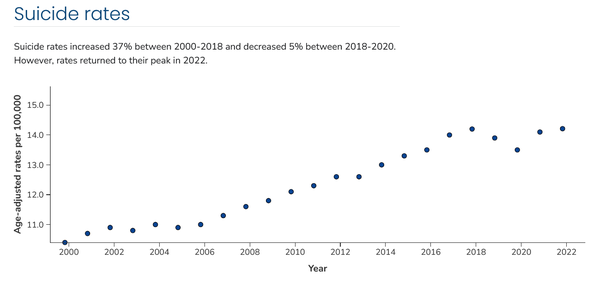
The consequence is for people to internalize their unresolved issues and begin a process of suicidal ideation. Blaming yourself for everything is a slippery slope, not limited to your personal experience but also a cultivated attitude in society. We can see an upward trend correlating suicidal ideation with the increased economic injustice we are all forced to endure by the ownership class.
In essence, the long-term consequences of the class war waged against the working class is a strategy of deflection away from their persistent threats while simply directing a flow of negative sentiment back onto the working class while denying the majority a valid outlet for their struggles, and that creates a solution for them that permits them to ignore the suffering they cause.
They have become so successful in cultivating a self-destructive form of lower-class pruning that whenever someone steps outside the paradigm and shockingly challenges their destruction, many among the lower classes will fight to protect the system of abuse by attacking those who do not capitulate and die quietly so as not to disturb their quiet reverie.
People like Luigi Mangione respond in diametric opposition to their expectations of people internalizing their abuses, and that represents a shock to a system they cannot tolerate, so take measures to ensure vigilantism like his is presented to the public in such a way that he becomes a message to the little people of what will happen to them if they resist and fight back.
In short, believing everything is your fault is precisely the attitude cultivated in society because that’s how the ruling class can rule with a minimal amount of their blood being shed.
We have cultivated it by allowing our societies to grow into corrupt monstrosities that people have no choice but to struggle to survive within.
We have placed a physical resource like money at the top of our values and have dehumanized people every step of the way. At the same time, we convert human beings into disposable commodities.
We are dehumanizing ourselves at every level by endorsing a system that devalues the ineffable qualities of humanity because they are not viewed as profitable by industry. Instead, we have ways of further dehumanizing people by leveraging their despair against them with global institutions that dictate dogma to follow without question.
Everything has become reduced to a competition for tentative comforts that bear no intrinsic value or meaning beyond serving the immediate gratification of shallow desires.
None of this contributes toward the growth of those qualities of humanity that we value. None of this brings us together as people in common cause for the betterment of all. Everything is catered toward the propulsion of individuals we stratify with blind worship.
When we replace human qualities we cherish with an avatar, like money as a metric for determining their value, we become divorced from our humanity.
While living in a world that views wealth as an indicator of all positive human qualities, people inevitably start to develop disparaging views toward their neighbours because everyone has been left fighting over the same scarce resources that are left behind by the plutocrats dehumanizing all of us with a system they parasitically siphon of wealth at our expense.
We can only live so long with oppressive conditions before the effects grow out of control and well into making our environments breeding grounds for chaos.
Misanthropy is just an early stage of widespread systemic collapse.
The entire world is undergoing a massive transformation that has steadily escalated in speed and scope year by year for decades. Although the world has constantly been changing, this degree of change is unprecedented.
I remember Alvin Toffler’s predictions on this in Future Shock from when I was a kid in school, and we had the opportunity to watch his documentary in the classroom. Among the many predictions, this rate of escalating change has always stood out for me as a consequence of being repeatedly reminded of it throughout my lifetime. I thought the beginning of the Information Age represented a peak of speed of change, but that was just the beginning of ramping up the rate of change to come.
With great changes come great uncertainty, and that fires up anxiety levels everywhere.
Making matters worse has been the class warfare reaching new peaks of disparity driven by thefts of the working class by the tens of trillions over the last few decades as world politics began shifting rightward.
Before Reagan and Thatcher, many of the democracies in developed nations around the globe still viewed the government as somewhat of an ally, even after experiencing perceived betrayals through global events like the war in Vietnam and Britain’s mishandling of the IRA in Ireland and “Sunday Bloody Sunday.” JFK’s assassination shocked the world. Labour strikes rocked the world.
People were fed up then with disruptive elements and had developed a level of comfort with their daily lives and their expectations for their future that they lost touch with the value of disruptive events like strikes. No one then realized how a disruption to their air travel plans was a positive and necessary event in a healthy democracy when negotiations broke down. The general attitude of entitlement to expectations of service became an easy wedge to force between the public and the labour organizations fighting to maintain equanimity between the classes.
Demonizing government became a path to power within government because the people in democracies began believing corruption was also as endemic to the government as unions. Political systems began being viewed through a cynical lens, while conservative politicians have since leveraged that sentiment to gain political power for themselves.
Regan’s firing of air traffic controllers was accompanied by a cheering public who saw their travelling conveniences disrupted rather than their quality of life being protected. People had begun forgetting almost a couple of centuries of sacrifice in fighting for fundamental rights and protections like weekends off, overtime pay, and healthcare benefits.
Employers had begun implementing progressive strategies for supporting staff, so the protections provided by unions began to seem redundant and perceived as an unnecessary cost for supporting a political organization that often ignored the needs of its constituents. Unions began being viewed as corrupt organizations rather than protectors of the middle class that they helped build and grow.
Conservatives took advantage of this new embrace of the ownership class and cultivated a belief that it was within reach of everyone who worked hard and lived responsibly. The American dream was possible by the beginning of disassembling the structures that gave rise to the middle class.
Reagan’s tax cuts and the heyday of spending, which characterized the 1980s, made it seem like the wealthy were just like everyone else and were equal members of a human community willing to share in the prosperity.
It was easy to support conservative ideology because it seemed the most pragmatic. Even today, people will describe themselves as “conservative” more out of an avoidance of needlessly attracting unwanted and disparaging public attention and appearing reserved than out of an embrace of a political ideology.
When people refer to themselves as “conservative,” they usually do so to appear “normal,” “predictable,” and “approachable,” while those who are not are generally viewed as “erratic” and “disruptive.” This perception is what has made conservativism most popular. It is easy to equate “fiscal conservativism” with sound financial management strategies, even though political conservatives constitute the worst among the worst economic managers. We have had decades of conservatives blowing up debts across every nation they held leadership roles in and are still publicly viewed as fiscally competent.
Conservativism represents an imaginary form of stoicism in which people hunker down and do what needs to be done because that’s the only way to survive adversity.
In times of stress and fear, withdrawing from positions of risk seems generally the safest approach toward surviving adversity. We’ve had countless generations learning to do without to make ends meet. Our forefathers lived during times of scarcity while production efforts scrambled to keep up with demand.
Most people lived independently and without the social support fought for and won by the progressives in society who demanded equitable treatment from the ownership class. They also responded to adversity by hoarding their assets as a survival strategy through adversity. Scarcity was a fact of life until only a few decades ago when our means of production exceeded our demand.
We are already living in an entirely new world, while most people born before the advent of the information age still live as if scarcity were a challenge for the human species. Most do not understand how dramatically opportunities have shrunk for people starting today like they did yesterday. Many, if not most, perceive today’s complaints and social disruptions as a consequence of overreach by attitudes of unearned entitlement.
Many live in today’s world as if it were still the 1980s without realizing how much they once took for granted has been stolen by the ownership class. What they see is increasing disruption to the predictable life and world they once knew, and they seek to blame progress itself as the culprit responsible for their anxieties. This causes people to turn inward in a protectionist strategy for survival.
The attitude of protectionism has been steadily rising while being stoked by conservative politicians as they have cultivated a cynically misanthropic attitude among their supporters toward their fellow neighbours. They take every opportunity to demonize concepts that make people feel uncomfortable and politicize them for personal gain.
Everything about the conservative ethos today has been geared toward hating anyone and anything that can potentially disrupt the sanctity of a predictable existence. Fear and hatred have been the weapons of choice wielded by conservative power mongers, and it works because people respond to threats on a visceral level before they can afford the risk of examining them for their rationale.
Conservativism is a “shoot first and ask questions later” approach to anxiety, and that used to work on some levels in a simpler world with simpler problems. Unfortunately, it only exacerbates the issues we face today.
Fortunately, within the hard swing to the right throughout these last several decades exist the seeds for reversing the course of a political pendulum that has been perpetually swinging to either extreme before being yanked back to an inevitable centre where stability lies.
It may be that we will continue swinging further rightward, but the further we go to the right, the more powerful the backlash becomes. If we find ourselves facing full-blown fascism as a clear threat to our democracies, then we may be in for some seriously chaotic times, but that’s when the voice of reason becomes influential as a guide out of madness.
We desperately need bold leadership that can press for the necessary changes we must make to our systems to ensure our transition into a fully automated society creates minimal casualties, or we will risk warfare. We can no longer afford capitulating gestures because the conservative opposition has been clear that it doesn’t negotiate in good faith. Like all situations with bullies, the only solution to their entrenchment is to meet them on their level and overpower them to such a degree that they relent.
This is the prisoner’s dilemma in game theory, where tit for tat is the only way out of this mess right now. We can face the issues head-on or watch everything collapse, hoping some miracle saves our assets. We are most definitely at a crossroads as a species, and the right appears hellbent on subjugating everyone not approved as core representatives of their tribe.



 thotbag