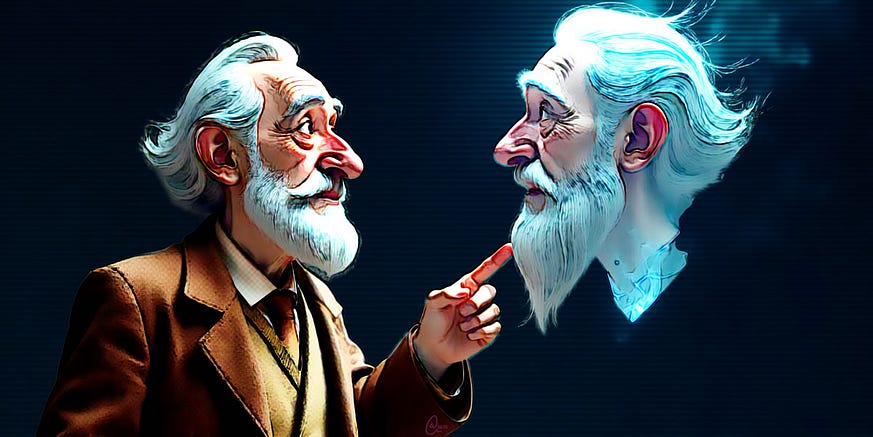
I wish I could provide tangible proof of God.

This post is a response to a question posed in its complete format: “I really wish that I could provide tangible proof of God’s existence to atheists, but I can’t. The best I can do is treat them as I know He would want me to. Does that make me a bad person?”

Why do you need to convince others of your belief?

That’s the question you should be asking yourself.

What a person believes doesn’t make them “good” or “bad.”
What they do, however, is what accomplishes that.

To be a good person in this context is to accept how others do not believe as you do, while you enjoy your life as you please, without feeling compelled to convince others to validate your beliefs by thinking the same as you.

The more you feel compelled to convince others of your belief, the more you demonstrate to the world that you doubt your beliefs.

Atheists would have absolutely no problem with believers if they just stopped trying to convert everyone else into copies of themselves.

There would be fewer wars if people could accept how others do not believe the same things they do.

The real issue here isn’t that you believe something or others believe other things. The core issue is that believers feel compelled to convert others and force them to think as they do.

Have a look at this:

This is how people can live when they’re not oppressed by the beliefs of those who impose them on others. This is how women can have the same rights as men while living as equals in a society of equals.

Now, have a look at what happens when people force others to believe as they do:
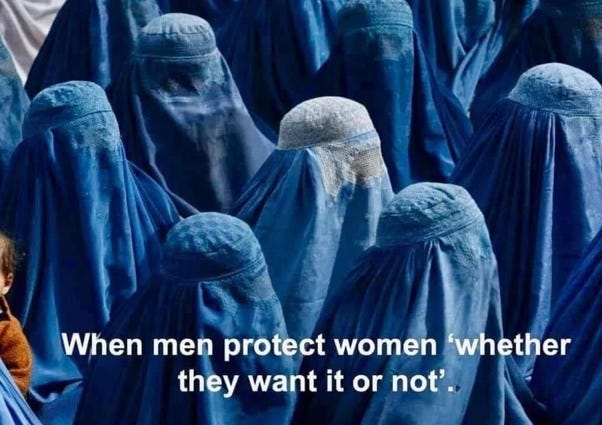
This is why the problem isn’t that you believe but that you seem compelled to convince others to adopt your beliefs.

This is where you become an enemy to humanity. This is the slippery slope to making you a bad person.

What can lead you to become a bad person is a desire to make others believe as you do.

If you are concerned about being a bad person, you must stop fretting about how others believe and deal with your toxic need to convince others of your belief. You must ask yourself why you must convince others that your God is real. You must stop caring about others believing differently than you because that is the path to becoming an evil asshole.

If you truly believed what you claim to believe, you would not feel compelled to convince others of the validity of your belief.

If you cannot find recompense within your belief, it’s not an honest belief but an indoctrination.

Do you know what else is compelled to spread and take control of other lives?
A virus. That’s what a virus does.

How do atheists approach ethical dilemmas without religious guidance?


This post is a response to a question initially posed on Quora, and can also be accessed along with comments via “https://caseforatheism.quora.com/How-do-atheists-approach-ethical-dilemmas-without-religious-guidance-17

The bonus question can also be accessed: “https://divineatheists.quora.com/Do-atheists-truly-believe-they-will-ever-silence-the-belief-in-Jesus-or-YHWH-49

This atheist interprets ethics based on harm, like the Hippocratic Oath a doctor takes, “Do no harm.

What passes for “religious guidance” isn’t resolving an ethical dilemma but following an instruction. In such a case, the issue can’t be considered an “ethical dilemma.”

There is no dilemma if you can consult a rule book to instruct you on your direction.

The only “dilemma” a religious adherent faces is whether or not to follow their instructions.

Even if a believer is confronted with that choice, their ethics are still far from the issue that has otherwise been considered an “ethical dilemma.”

Is the choice to obey a command an “ethical dilemma” or an assertion of independent will that can allow someone to then honestly resolve the ethical dilemma which forced them to question their dogma?

This question is an example of why religion is toxic, how religious beliefs cloud critical thinking, the impact of religious dogma on ethical issues, and when the struggle with cognitive dissonance presents itself within the believer’s mindset, leading to a “crisis of faith.”


Bonus Question: Do atheists truly believe they will ever silence the belief in Jesus or YHWH?

Nice projection.
The reality, however, is that believers like yourself have a centuries-long history of silencing people under the threat of death.

Atheists are not interested in your beliefs, and that’s the point.
If you could keep your personal beliefs to yourself and refrain from imposing them on the world, there would be zero conflict.

Atheists, as a whole, don’t much care what other people choose to believe.

Most care about how people behave and behaviour like yours, as you post your nonsense question to make yourself appear like a victim, is just tasteless behaviour.

If you truly believed what you claim to think, you wouldn’t put on such a performance of how much you believe what you claim to believe.

Instead, your declaration of standing fast to your belief indicates your doubts to the world.

If you don’t understand how that works, reference how those in public offices who claim to share your religious beliefs as the basis for their disparagements of every sexual proclivity. Notice how all of the most vocal, be it against gay marriage or pedophilia, end up with them being busted for the sexual crimes they preach against.

Your announcement is just a way for you and intellectual cowards like you to deflect attention away from your guilt. In this case, your guilt is the cognitive dissonance you are struggling with because you don’t want to accept how you’ve been living a lie.

Instead of trying to strip you of your belief, this atheist recommends you see a mental health professional to help you overcome your anxieties and resolve the emotional angst that has prompted you to pose this pronouncement about yourself.

Keep your beliefs all you like. What you believe makes no difference to any atheist. What you say and do, though, is another matter altogether.

Good luck with all of that.

What makes the Bible not believable for an atheist?

This post is a response to a question initially posed on Quora, and can also be accessed via “https://caseforatheism.quora.com/What-makes-the-Bible-not-believable-for-an-atheist-14

Sadly, the real question is the one you’re avoiding.

The real question is the question you have flipped around because you’re too afraid to face it.

The real question is a reversal of the deflection you have concocted to protect the lie you live by.

The real question is: What makes the bible believable for you?

The talking snake or the talking donkey?
How is love expressed through mass murder?
How can one’s female children be chattel to be sold?
Talking bushes?
Magic?

What in any of that is believable or moral to you?

Do you sincerely believe that animals from around the world travelled thousands of kilometres to sit peacefully, predators and prey alike, in a small boat for months while the entire globe was flooded and most of life was wiped out?

Do you believe an entire species born of two people who bear male children can magically fill the Earth with enough children to fill the globe?

Can an entire sea be temporarily parted to make way for peasants to cross on foot? Perhaps you’re one of those who think the moon can be chopped in half and reconstituted? (No? Different book, eh?)

Can a person be swallowed by a massive fish and live inside its belly with all the abdominal acids for three days without any ill effects?

Can people indeed be brought back from the dead?
Can water truly be converted into wine?
Can rocks be transformed into bread?
Did people live for almost one thousand years?
Was an entire river converted into blood?
Do cherubs and demons genuinely exist?
Can people be transformed into pillars of salt?

What exactly do you find believable within the bible?

Why do scientists believe the universe comes from nothing?

This post is a response to a question posed in its complete format: “Why do scientists believe that the universe and the Big Bang can come from absolutely nothing but find it so hard to believe in the Holy Spirit?”

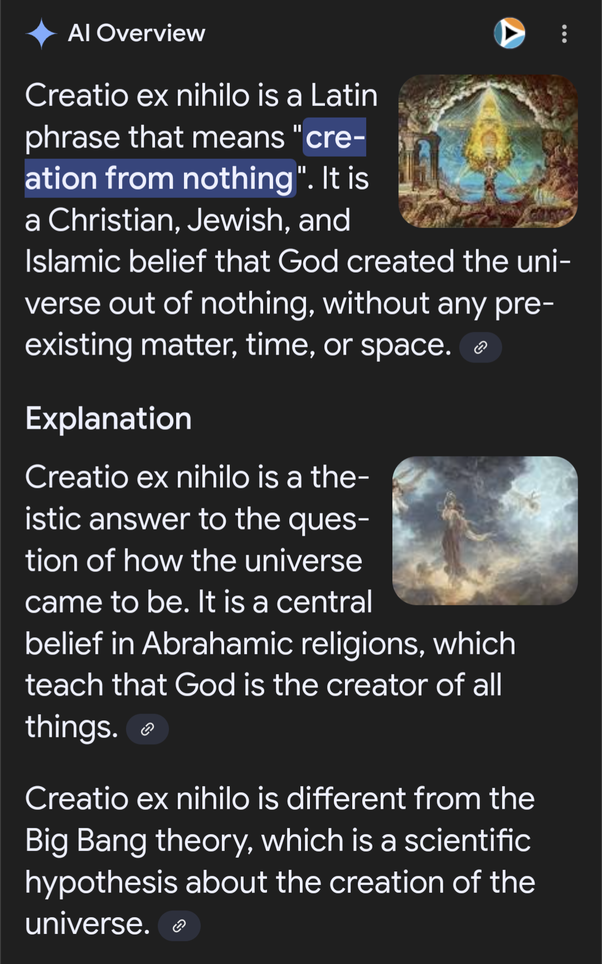
Creatio ex nihilo

This is a Latin phrase which means “creation from nothing.”

It is a phrase used in all three Abrahamic religions. The idea of something from nothing comes from the Jewish, Christian, and Islamic religions, not from science.

Scientists don’t claim something came from nothing. Your religion makes that claim.

Instead of learning about your religion, you invent nonsense derived from your religion and concoct fiction about a discipline you choose to remain ignorant of while using your fiction as justification for smearing what you have made no effort to learn anything about.

Don’t you think that’s a bit convoluted?

It’s referred to as a straw argument.

Your straw is a religious phrase you attribute to science, and then you use that false attribution as justification for fraudulent criticism. You imply hypocrisy in science while embodying hypocrisy in your question.

If this were a behaviour that rarely occurred, it would be easy to overlook. Instead, the hypocrisy you have demonstrated occurs so often that it’s almost a surprise when a question by a believer to atheists isn’t hypocritical.

Where does one find a “Holy Spirit” buried under so much hypocrisy from religious folks?

My memories of church doctrine don’t seem to include hypocrisy as an attribute of the Holy Ghost. Perhaps I missed that while my eyes rolled back up into their sockets as my head began thumping from all the mind-numbing nonsense I was being exposed to.

It could be my knees getting sore from the padded board while I wondered when I could sit back in my seat.

At any rate, I always found myself more interested in learning about scientific concepts because they made sense. I felt like my imagination was lit up when learning something tangible, while my mind felt dulled into a stupor every time I felt forced to endure the mind-numbing religious patter.

I never understood why people would prefer being lulled into a stupor to stimulating their imagination. I used to chalk that up as a subjective preference indicating benign differences between people.

I have come to realize, however, that the incuriosity of people who prefer to wallow in fiction rather than choose to stimulate their imaginations with knowledge indicates a tremendous gulf which creates problems in society.

Dialogues online with religious people rather than in person seem to provide greater freedom in exploring those differences in thinking, so perhaps you can address in more personal terms why it is that you don’t know your doctrine and believe the doctrine you don’t know but have heard it somewhere is a product of science.

Aren’t you in the least embarrassed to realize you have admitted to being ignorant of both science and the religion you seem to want to be associated with?

How does one go through life pretending they are devoted to this thing called religion but remain so ignorant of it at the same time?

I’m sure your first instinct is to dismiss these words as “fake news,” so I’ve included an AI summary to help you cope with how you have just humiliated yourself in a way not unlike peeing in your pants in public.

Good luck with all of that.