
This post is a response to a question posed in its complete format: “Considering you’ll die without a job, why is being employed not a right? Can society really just ensure someone dies by refusing to hire them anywhere?”
As the world of work becomes increasingly automated, the workplace dehumanization issue rapidly grows into a sociopathic dismissal of our essential qualities as living, breathing, thinking, and evolving beings. This pressing concern will affect more and more people in the future with increasing rapidity as workplace automation continues to adopt and incorporate an increasing rate of technological advancements into their operations.
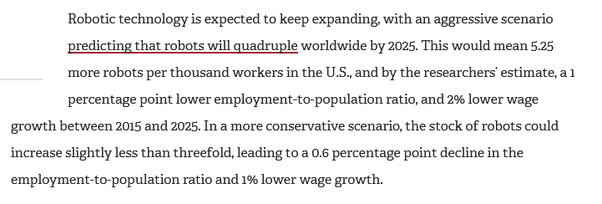
A new study measures the actual impact of robots on jobs. It’s significant. | MIT Sloan
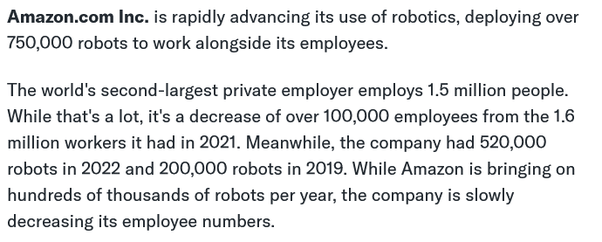
Meet the Humanoid Robot Working at a Spanx Factory (18 minutes)
To be clear, the dehumanization of the workforce isn’t a consequence of automation but of aggregation into ever larger corporate entities now spanning the globe in their operational reach. Automation is merely a step toward increased efficiency and reduced operating costs. Automation is simply the formalized acknowledgement of transforming labour into a dehumanized function that benefits capital-infused decision-makers chasing profit. What was once an entity supporting community development within the “Mom-and-Pop entrepreneurial environment” has become industrialized economics.
Entrepreneurs of today are the artists of yesteryear who sought out patrons to support their initiatives and receive benefits in return for their support in a parasitic relationship that both drains value from the creative individual and shapes their creative output in their narrowly defined image to fit an increasingly homogenized production system.
The dehumanization of the workforce began when people became deemed commodities, and “Human Resources” departments were created as legal defence linebackers to protect corporations from the consequences of exposed liabilities.
The world of employment has become less about identifying skills and more about choosing appealing aesthetics and fetishes. One is no longer in a position of being hired to function in a role with an expected standard of performance in fulfilling the requirements of that role inasmuch as they’re selected like an attractive product on a shelf that will complement the rest of the pieces on a mantle.
The disconnect between the function one is intended to fulfill, the decision-maker determining the need, the department composing the requirements list, and the agency tasked to identify appropriate candidates has become so much of a production line that they cannot help but to regard all their people as narrowly defined replaceable cogs with limited capacity and range in an expense paradigm rather than as an investment and a partner in the enterprise. The only success an individual can contribute to a dehumanized function is to meet predetermined expectations in a static environment with an expected and finite lifespan.
Corporations may be deemed people, but they’re more machine than human. Unlike humans, they can only change course and be adaptive to evolution when the small number of myopically focused humans operating them can implement global changes that often involve complete retooling and rebranding or being incorporated into another corporate system.
Once that occurs, however, whatever unique nature or personality that may have existed in the original entity is subsumed into the more enormous beast.
The issue of jobs and employment is a critical metric only for those whose role in society is to diagnose the overall health of the “super beast” referred to as “the economy.” Individuals are irrelevant to their equations. Humans are no longer humans but cattle to be herded in a dehumanizing system that renders everyone only as valuable as accords the desirability of their functionality in a narrowly defined capacity within an inhuman entity.
One’s value as a human in society is determined only by the nature of the type of cog they can function as within the parameters of an acknowledged entity that deems them suitable for its overall operation.

Society doesn’t “ensure” anything because society is a collection of humans operating within a cultural framework. The corporate culture we have endorsed for society has, in return for our loyalties, suffused society with an apathetic disinterest in the human condition and the plights of individual humans.
UBI is the only path available to regain our humanity and create an economy that serves humans rather than modern dynasties comprised of a small handful of monarch-like beings. Without it, system-wide collapse is inevitable.
 thotbag