
This post is a response to a question posed in its complete format: “How will emerging artificial womb technology affect the growth rates of off-Earth human populations?”
It won’t affect any “off-Earth” human populations because there will not be any sustainable “off-Earth human populations” any time in the foreseeable future. At best, we’ll see colonies with rotating populations because of simple biological issues such as bone density loss.
Every month in space, an astronaut loses the equivalent of what a senior on Earth loses every couple of years.
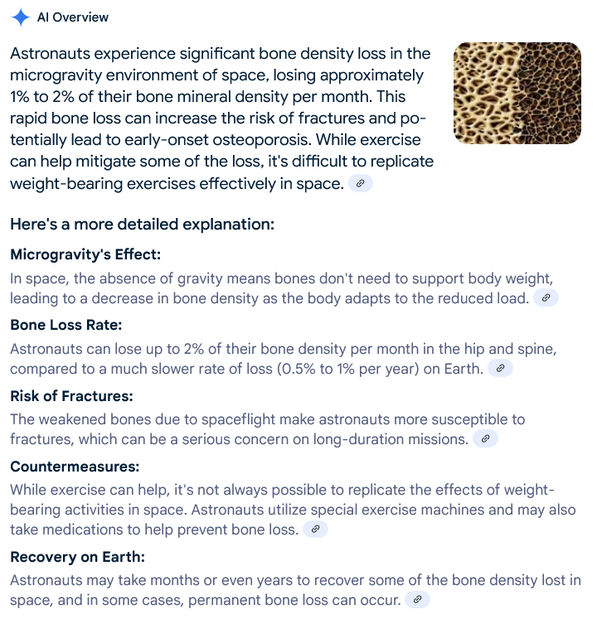
For this reason alone (and setting aside numerous other issues like prolonged exposure to radiation, isolation, etc.), any near-future space initiatives such as asteroid mining will depend heavily on robotics and automation technologies to exploit the mineral wealth floating about in our space neighbourhood.
Extraterrestrial human colonies are still very much out of reach and within the realm of fiction.
It’s impossible to predict when such initiatives will be possible because of the varying change factors we are undergoing now that are predominantly defined by our evolving technological capacities.
We could develop technologies to mitigate the biological impact of life in space, such as artificial gravity (which is probably the easiest hurdle to jump, but I’m guessing outside my wheelhouse of expertise here and understand that’s more of an engineering design issue rather than a technological limitation — rotation strategies for creating an artificial gravity are possibly doable now but an expensive and small part of the overall mix of requirements).
Transhumanism may result in a branch of human evolution that permits sustained life in space. However, that’s still quite “science-fictiony” to consider now, and where that technology goes from where we are now is radically unpredictable.
Our knowledge of biochemistry may result in chemically based solutions for protecting and prolonging life in space. In contrast, our communications technologies could result in holographic experiences that psychologically connect people more intimately than videoconferencing does now.
Too many factors influence success in establishing “off-Earth living,” and I haven’t yet mentioned the financial implications. At this point, asteroid mining is the only valid financial justification for establishing some form of presence in space.
Tourism is a complete non-starter, and quite frankly, the arrogance of Bezos and his billionaire clan’s initiative of promoting this vanity stupidity is too environmentally destructive at the moment to justify, never mind that it’s an elitist microsecond Disneyland excursion for no more than a few hundred humans. It’s not sustainable unless a far better way to reach space can be developed… like a space elevator or railgun technology… anything other than polluting our atmosphere more than a year’s worth of a dozen oil rigs does while feeding our energy hunger.


Otherwise, the social impact of artificial womb technology is explored in the movie “The Pod Generation.”
It’s a worthwhile watch for stimulating conversations on technology and how it will affect society.
https://www.imdb.com/title/tt15768848/https://youtu.be/rGMx_7oAeUM?si=xAAGxxKaRqySI7Gw
























 thotbag