
This post is a response to a question initially posed on Quora, and can also be accessed via “https://www.quora.com/Why-do-some-atheists-tell-religious-people-God-is-not-real/answer/Antonio-Amaral-1“
The implication of this question, mainly since an anonymous profile posed it, is that atheists do so out of malice.
That’s not the case at all.
Although some atheists may indulge in malicious dialectics to stir up anxiety within believers, that’s not typical of most atheists. Barry Hampe pointed out that it’s often a response to provocation from believers, while several other respondents indicated matter-factly that it’s a truth as they see it.
It goes deeper than simply asserting what appears evident to non-believers. Often, believers need to question their presumptions, and that’s precisely what the querent does by posing this question.
Telling a believer that God is not real forces them to either wallow in defensive denial (which disarms their provocation) or shakes their psyche enough to prompt them to question why someone would say something like that. This question represents the latter, which indicates, by my bias, the first inklings of doubt in one’s position. After all, we live in a world where every major religion claims to represent the “one true truth.” No rational person can accept how all are correct in their presumption — especially not after centuries of warring against each other for ideological dominion.
Often, the goal is not malice but an attempt to assist believers in expanding their perceptions beyond the box they’ve been conditioned to secure themselves within. In this regard, saying God isn’t real is a bit of a counter-provocation from a motivation opposite that of a believer who seeks homogenized thinking to validate their own.
I’ve begun asserting that if a God does exist, then it’s nothing like any human mind has ever imagined or could comprehend. Every religion has completely misunderstood and mis-imagined whatever might constitute Godhood. This is based on the reasoning that human minds are incapable of understanding something which would, by necessity, be so far beyond complex that we can’t grasp it on any level more significant than an eyelash mite can grok the body it lives on.
We may consider ourselves an intelligent species, but our metrics are self-serving. The universe is vast and complex beyond our comprehension. We may have unlocked many secrets, even enough to grasp the fundamental nature of its structure within the context of our perceptions. Still, we have no clue what may exist outside our perceptual fields — directly or in conjunction with technologies extending our perceptual capacity.
I’ve been thinking this particular approach might achieve some success with believers because the scriptures themselves already familiarize them with the notion of God being beyond human comprehension.

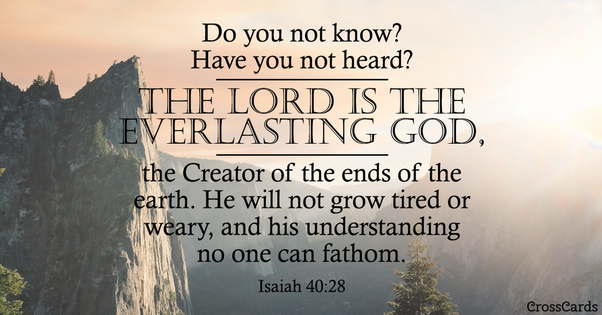
By reinforcing this particular piece of authoritative insight within the prevailing concepts of godhood, we can expand believer perceptions beyond the limits they have consistently shrunk over the centuries.
Our scientific investigations have forced them to retreat, shut down, and shut out threatening information. They’ve dug into the notion that science has been deliberately eradicating the foundations of their existence. They have reacted to this by negating everything which contradicts their biases. Everything scientific is perceived as an enemy. This phenomenon characterized much of the operative psychology within this last election.
As someone who perceives religion as a cancerous threat to our existence as a species (primarily due to the tribalist component of religious bias), I think the solution lies not in the rejection of a believer’s need to believe but in an expansion of their perceptions. By reminding believers that they don’t have definitive answers, explanations, or anything beyond their wistful imaginations to define a god that exists purely within their imaginations, they can begin looking outward instead of shutting down.
Learning to accept the necessary limitations of humanity validates a natural ignorance of godhood because it is ignorance shared by all humans. In this way, the atheist threat to their beliefs is mitigated.
Personal insecurities are also mitigated within an expansive tribe comprising all of humanity.
Our struggle with believers is born of piecemeal geographies and tribal borders hinging on being authoritatively definitive about each tribe’s perspective on the nature and shape of god. The common ground, however, lies in accepting how none of them can be accurate because humans cannot apprehend godhood — by the very definitions of “God” as established by their scriptural authorities.
By encouraging their minds to accommodate and embrace possibilities rather than allow them to be set like hardened plaster into myopically formed sculptures, the often violent competition between tribes can be mitigated. They’re all too focused on establishing a supremacy of authority within a definitive shape, boundary, and finite nature to an insular concept of godhood.
Opening their minds to accept how all are wrong instead of fighting over who is right in a “Might makes right” fashion may encourage them onto a path to the peace and love they often declare characterizes their belief systems.
In short, for believers, atheists may say, “God isn’t real,” but you can interpret that to mean, “Your vision of a god isn’t real.” You have nothing beyond your imagination and the force of your personality to support your contention that God is real. It’s a lie, and you know it.
Most atheists are open to evidence, but we’re also astute enough to understand how our primitive ancestors had no clue what lay beyond their limited geographical explorations and, much less, beyond our planet.
Even believers today no longer believe God hurls lightning bolts from the sky by hand or hides the sun from humanity when disappointed with us. We know no God sends hurricanes to our homes to punish us for mixing fabrics or eating shellfish. Most believers know this as well — and it’s usually the religious leaders who manipulate the gullible with lies for personal enrichment. Perhaps believers should choose new spiritual leaders who won’t lie to them and will open their doors to shelter them during a storm.
Perhaps it’s time to start looking outward to possibilities instead of lying to oneself and others about the products of one’s imagination and searching earnestly for a real god.
If all religions can admit to each other that they don’t know anything substantive with any certainty, then perhaps they can build bridges between each other instead of lobbing bombs. If that’s possible between belief systems, then it’s also possible for atheists and agnostics to join them in an honest endeavour toward solving life’s mysteries.
 thotbag