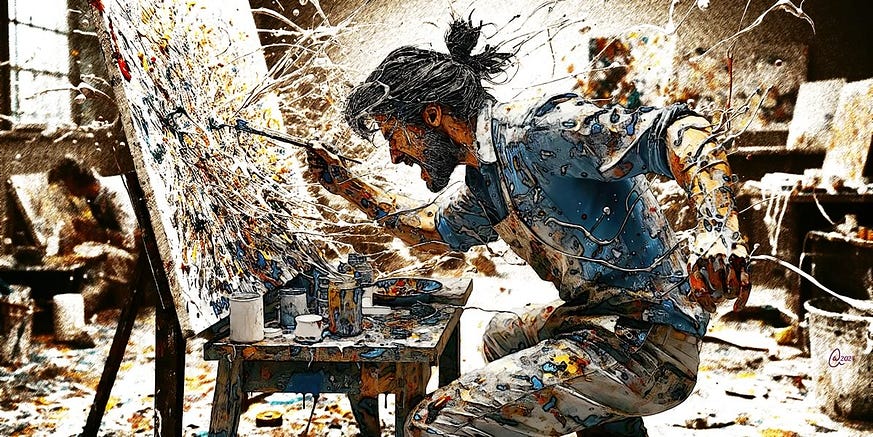
This post is a response to a question posed in its complete format: “How do I cope with feeling creatively stifled in art school? At 23, after years of studying and currently master’s, I feel blocked and discouraged. Despite my talent, constant negative feedback has left me stuck & numb. How can I regain my passion?”
Try to think of the constant negative feedback as callous-building. It won’t stop. The more success you find, the more negative feedback you will get.
Your artistic process is your means of enduring and overcoming that feedback. Let it feed your resolve to continue pursuing what matters to you in your artwork.
Allow your process and product to teach you about yourself because that’s the value of creative endeavours.
Learn what you can from the masters who came before you. Let their struggles and discoveries inspire you to explore new realms of creativity.
Let the voices of the living critics wash over you like the daily elements confronting you, whether a cold chill from a frosty wind or a downpour of hail. Your creative process can turn all that effort at weakening you into a strength that helps you push past the boundaries limiting your potential.
Learn to read between the lines of the negativity directed your way because you will discover that most of them are projections driven by fear and envy.
People not intimidated by you have no need or compulsion to be negative. People who are not driven by fear and self-loathing see no point in anything outside objective honesty when expressing their views. People who care and are considerate of your personhood will try to choose words to support you, even if they see a need to correct an error of yours.
Since you are underway in a Masters level program in the Arts, you are well underway in securing yourself a somewhat economically stable future that will permit the continued development of your artwork throughout your life.
Upon completing your graduate degree, you will be eligible for teaching positions that may or may not interest you now but will allow you to remain current within your profession.
I would have jumped at an opportunity to complete my own Masters degree for that very reason, and so this may be a bias of mine. I think there can be no greater pleasure than to share one’s love with those who come after.
They can become sources of inspiration for you that break self-limiting boundaries. I also wanted the opportunity to be the opposite of many of my toxic instructors. They would cut me down in person but always visit my studio when I wasn’t around. I was informed of that oddly conflicting behaviour by studio mates who seemed excited for me.
I didn’t understand that then, but I interpreted that dichotomy in their behaviour as a backhanded form of compliment.
You will discover that your passion is like a barometer keeping you on track and focused in the direction that your art is taking you. It is like a guide for your life to facilitate your growth and achieve your potential.
Your passion will flow in waves that lap the edges of your consciousness amid exciting discoveries and recede when formulaic repetition asserts itself.
Whenever I feel blocked, uninspired, or unmotivated to focus on creating developed pieces, I turn to processes borrowed from the technique of automatic writing. The deliberately unconscious transcription of words and mark-making function like a form of callisthenics to “loosen up the creative muscles.”
I have learned that the thrill of discovery is the key to stoking one’s passions. Nothing is more awe-inspiring than looking at a piece one has finished and wondering how it could have come from within.
If you can keep surprising yourself, you will never lose your passion. You will always be motivated to explore what lies beyond your horizon.
This is a fundamental truth of the human condition. The wonder of discovery makes life worthwhile and raises us all as a species out of the darkness of a primitive existence to touch the stars.
Temet Nosce
 thotbag