Should there be fact-checking on social media platforms?

This post is a response to a question posed in its complete format: “Do you support Meta’s (Zuckerberg’s) decision to end third-party fact-checking on Facebook? Should there be any fact-checking at all on social media platforms? Why?”

Social media appears to be entering a stage where its profit-based model is “eating itself out of existence” as the latest in end-stage capitalism’s string of “Ouroboroses” (Ourobori?).

Along with stripping costs for an expensive venture, Mark is also adding AI bot profiles to create the appearance of engagement.

This reminds me of why I lost interest in dating sites. The easiest way to know a site’s ethics is when they create bot profiles to entice people into paying membership fees to engage with non-existent people.

As much as Zuckerberg flaps the trappings of community within Facebook and social media, none of his views are legitimately about community or supporting community development.

If social media were authentically social, its focus would be community development, not profit generation.

It is precisely the model of profit generation that puts social media into a death spiral of profit chasing to the bottom of the bottom-feeding barrel.

Their metrics for engagement are derived from a superficial analysis of what engagement means. As long as someone clicks something or posts something, that counts as “engagement,” and that interpretation of engagement counts as justification for advertising rates.

Meanwhile, no one gets anything from the deal but a massive case of blue balls.

Without a mission of serving a higher purpose of community development, social media and society, by extension, cannot but devolve into the technological equivalent of a pack of stray dogs begging strangers for treats.

We will experience social anarchy in the virtual world before it greets us in the real world. Hopefully, that will create enough pressure to do something proactive to support community development before the real-world communities devolve into chaotic monstrosities of “former civilization.”

All of this is an argument in favour of social media, on some level and in some capacity, being a publicly owned and managed enterprise that exercises its self-restraint divorced from the misanthropic profit-chasing model that dehumanizes people while pretending to serve human social needs.

As much as our dialogues focus on almost everything but community development, they all serve a community needs focus.

For example, all of the discourse surrounding AI and its replacement of human labour may be considered an economic, political, or labour issue, and it’s essentially a community response to a significant change transforming human society on a fundamental level.

All social media forms the basis of community development because all social media is public discourse. However, our problems with social media stem precisely from its growth being motivated by profit over principles.

At this stage, growths in profit that can satisfy hungry boards and investors justify cutting costs to the degree that whatever spirit was initially capitalized on that prompted the development of any particular social media site has been stripped from its operation.

The justifications for stripping costs have ironically been derived from concerns about the costs of managing social engagement. Who woulda thunk it’s too expensive to properly manage human behaviour to afford the cost of developing a media enterprise focused entirely upon squeezing profits from social engagement?

People need social media. It won’t go away, but social media proves today that profiting from human interaction is the wrong way to think about social media.

We have been watching the effects everywhere as social media has been devolving into a dynamic I remember from what I used to refer to as “usenut” — that many may be more familiar with as “Google Groups,” for example. I remember this as the gutter of human interaction — where the most extreme of the extreme was its primary denizens who were free to indulge in the most hateful of behaviours and attitudes.

I still “fondly remember” one character I used to refer to as “Grog” — which wasn’t their real name, and I’m not going to publish it because he’s still active on what shreds still exist of Usenet groups. He’s still advocating for the death penalty for gay people. It turned out that his father came out of the closet late in life, and that had a devastating impact on his psychology.

At any rate, this underground dynamic of toxic attitudes has slowly been seeping into an above-ground and public state of dialogue over time. If one had not ventured into the gutters of human detritus to discover its prevalence, one would not realize it’s an undercurrent that has always existed.

We will continue witnessing a devolution to the level of bottom-feeding slugs in human interaction characterized by social media as this trend of cost-cutting and profit-squeezing continues. It’s an inevitable characteristic of the capitalist chase for profits.

At some point, we’ll experience a confluence between the demand for social media interaction and restraint on toxic behaviours that normalize the intolerable throughout society. People will grow to hate people like Zuckerberg more than they do now, as one can already see an influx of disparaging posts about him beginning to flood the social media space everywhere.

Accountability and restraint on social media will become a widespread demand because social media fulfills a human need for interaction and dialogue that has always been present in less technologically based forms, such as letters to the editor in every newspaper that once littered the landscape.

Social media won’t disappear but will require transforming from a privately profitable industry into a public service. Nations like China are already ahead in this game by using their social media enterprises as tools for managing public dynamics through social credit scores and demerits.

If we’re not careful, social media will transform from a chaotic enterprise focused on chasing profit into a tool of oppressive control over the people in a much more pernicious way than media enterprises like Fox do now with their disinformation campaigns.

Is self-sacrifice the greatest gift that an individual can give to the community?


This post is a response to a question initially posed on Quora, and can also be accessed via “https://www.quora.com/Is-self-sacrifice-the-greatest-gift-that-an-individual-can-give-to-the-community/answer/Antonio-Amaral-1

No.

Self-sacrifice isn’t a “gift,” it’s a responsibility and a call to action.

Self-sacrifice can occur as a parent sets aside their desires to make way for their children to achieve successes outside their reach. For example, a parent who works multiple jobs to help their child get an education that will give them a better life than they could attain has generally been regarded as a “typical” or “common form of self-sacrifice” and often considered noble.

Other forms of self-sacrifice, such as jumping on a live grenade (for an extreme and improbable example to make a point) to protect a crowd, are a requirement created by circumstances that would be unnecessary if extreme conditions were not present. This form of self-sacrifice is an artificially created necessity that could have been avoided if the motivations behind the person throwing the grenade were mitigated proactively.

This form of self-sacrifice is an instinctive form of preservation that extends beyond the limits of one’s life. It is an expression of commitment to the social contract historically responsible for elevating humanity beyond the baser instincts that drag us backwards into primitive states of existence. Over and above the preservation of one’s self, selfless preservation is performed from the exact sentiment of a parent sacrificing themselves for their child. It is an act of love in the extreme. It is an embodiment of the best of what humanity can be.

Like the child whose life is enriched by their parent’s self-sacrifice, the beneficiaries of such an act of selflessness have not received a gift to luxuriate in but an obligation to follow suit and make life better for those who come after.

This is how social evolution must progress in the face of apathy and against those who place themselves and their desires above the needs of others.

Without the capacity for self-sacrifice, the future of humanity is decay and self-destruction.

Self-sacrifice within this context is a warning that without the courage demonstrated by the few willing to alert an apathetic world of the need to take action, the conditions causing the suffering that demanded the sacrifice of one’s self will worsen and create more victims.

Self-sacrifice within this context is the canary in the coal mine warning the rest of humanity that death is on its way and alerting the people that they are facing a choice to serve a higher purpose than their fleeting whims or be sacrificed by parasitic forces as fodder for the conditions demanding their blood.

Self-sacrifice is a warning to the apathetic that if they do not rise against the threats facing them, their turn will come, and it will be far worse for them than the person sending their message of warning through their self-sacrifice.

Self-sacrifice can be defined with a simple quote: “Silence in the face of evil is itself evil.”


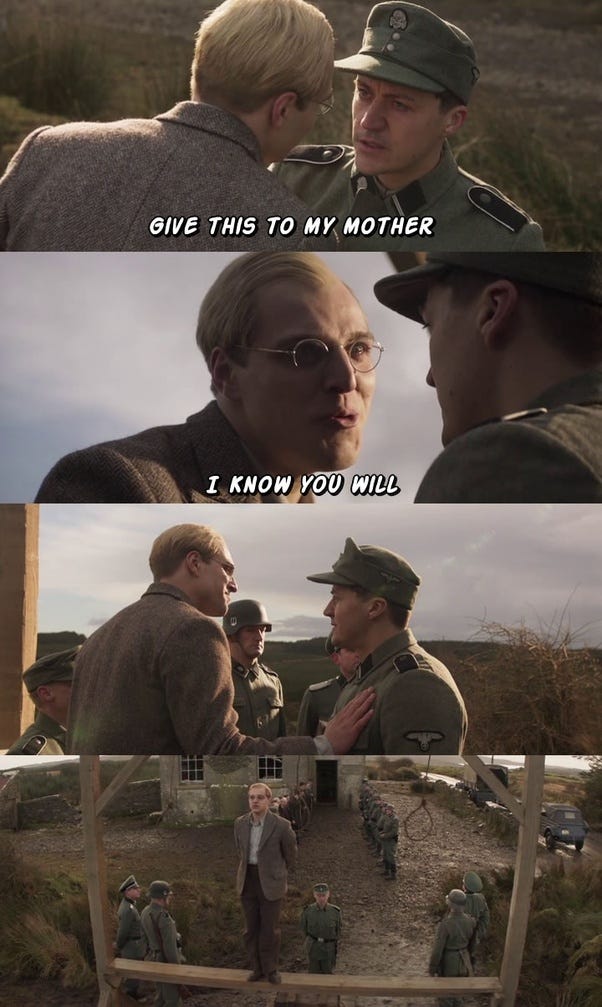
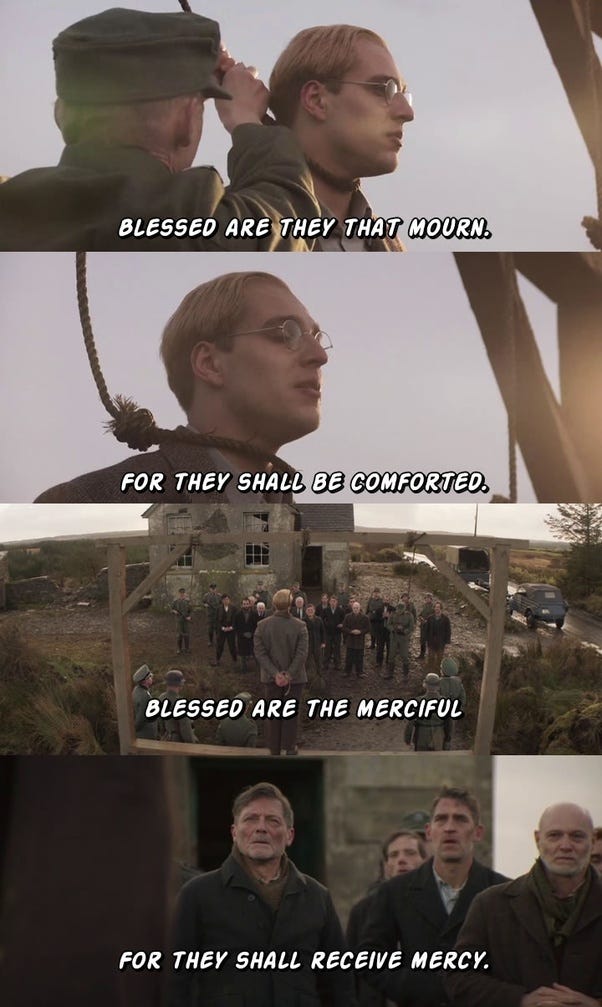
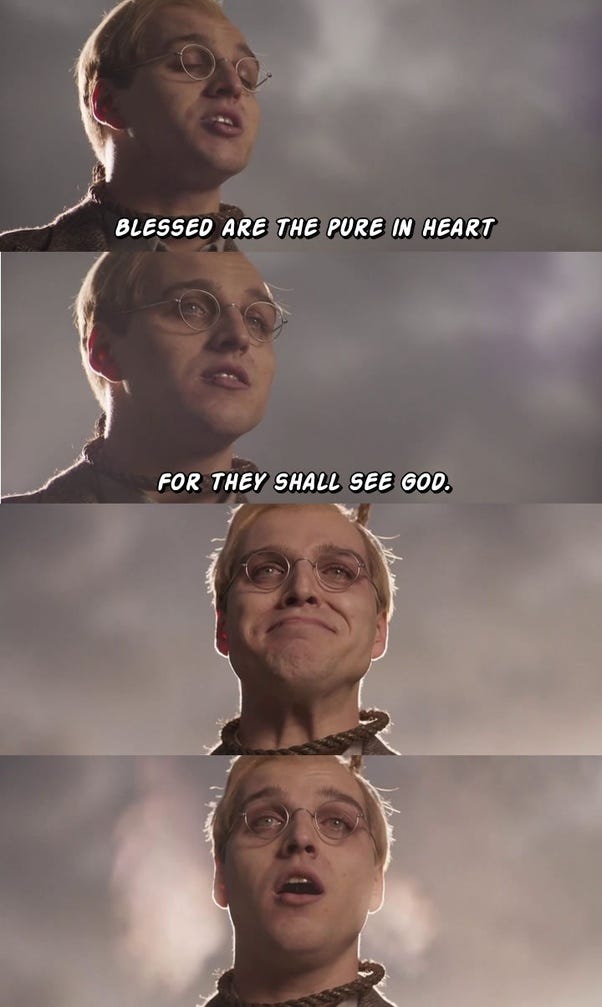
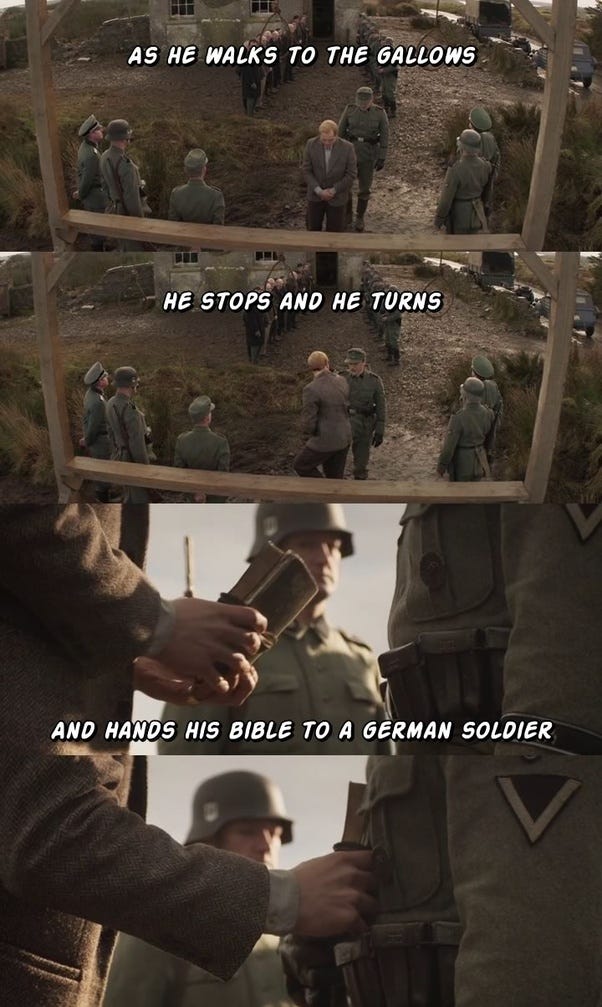
Here is an example of a story about a Pastor who sacrificed himself to try and stop Hitler while saving numerous lives. I’m posting it here because the space I otherwise posted seems unwilling to approve it in another answer because it’s appropriate to this question and because we are at a point where we are repeating history.

Dietrich Bonhoeffer — Wikipedia

Dietrich Bonhoeffer February 1906–9 April 1945), was a German Lutheran pastor, neo-orthodox theologian and anti-Nazi dissident who was a key founding member of the Confessing Church. His writings on Christianity’s role in the secular world have become widely influential; his 1937 book The Cost of Discipleship is described as a modern classic.[1] Apart from his theological writings, Bonhoeffer was known for his staunch resistance to the Nazi dictatorship, including vocal opposition to Adolf Hitler’s euthanasia program and genocidal persecution of Jews.[2] He was arrested in April 1943 by the Gestapo and imprisoned at Tegel Prison for 1½ years. Later, he was transferred to Flossenbürg concentration camp.

Bonhoeffer was accused of being associated with the 20 July plot to assassinate Hitler and was tried along with other accused plotters, including former members of the Abwehr (the German Military Intelligence Office). He was hanged on 9 April 1945 during the collapse of the Nazi regime.

Bonhoeffer: Pastor. Spy. Assassin. (2024) ⭐ 6.6 | Biography, Drama, History

Do laws, traditions, and social edicts introduce/produce more or less freedom?


This post is a response to a question initially posed on Quora, and can also be accessed via “https://www.quora.com/Do-laws-traditions-social-edicts-introduce-produce-more-or-less-freedom/answer/Antonio-Amaral-1

This is a leading question. Lumping all “social expectations” into a “freedom bag” produces only “freedumb” — the inability to distinguish between regulating destructive behaviour and encouraging positive behaviour to support the social contract.

Laws against murder can conceivably be considered restrictions on freedom, but they’re also a means of protecting freedom for the victims of predators in society.

There is no universal single-size-fits-all means of parsing this question. It’s just a nonsense question designed to appeal to those who already perceive society as children complaining about having to clean their rooms.

Here’s a counter-intuitive example for people who don’t quite understand the nuances of laws and social expectations.

It can be argued that in a Mad Max dystopia, one has the greatest “amount of freedom” possible because there are no such “restrictions” (parameters) as those in a world where anything goes. The harsh reality in such a case is that what constitutes freedom for some (the powerful) constitutes enslavement for the rest of “society” to a persistent fear of having one’s life snuffed out on a whim.

Sometimes, restrictions produce greater freedoms than would otherwise be the case.

In the art world, for example, the greatest creativity can be produced simply by putting parameters on one’s work and approach to doing one’s work. In a personal case, I restricted my palette to black and white for about half of a semester after being told by an instructor that my colours looked like Disney had barfed them up and onto my canvas.

I struggled with colour and all the many nuances of colour, so I had not developed the nuance of understanding how colours work in balance, just as shapes do in a composition. Removing colour from my palette allowed me to focus on developing harmonies between shapes and finding ways to establish compositional balance without the added complexity of colour as a dimension to throw me off.

That restriction allowed me to understand my work from an entirely different and much more free perspective. I discovered freedoms I did not know existed before my self-imposed colour restrictions.

Society is much like that because it has become so complex it’s difficult to parse which aspect is beneficial and which is toxic. We can no longer live with the simplistic view of the world we once nurtured through symbologies like a difference between white hats and black hats. We live in a world of anti-heroes, and that makes demands on our ability to apprehend nuance through developing critical thinking skills. We must learn to be capable of adequately parsing subtle distinctions that can threaten to transform freedom into subjugation within the slimmest of margins.

People find the freedom to be themselves within their tribal associations but can also find their freedoms stripped by the dogmatic application of tribal expectations.

Another example I’ll take from Isaac Asimov’s Foundation series (which I applied — or interpreted as Japan in the 1980s) was the planet Terminus. Hari Seldon’s group was consigned to a planet that was slim on resources to mitigate the potentiality of becoming a threat. Instead, what happened was that scarcity of resources encouraged their creativity such that over time, they produced faster and more powerful ships that were smaller than the Empire’s massive vehicles.

This means that freedom cannot be measured by its constraints but by the results of the limitations (or parameters) placed upon a society. Those constraints can facilitate freedom when they are balanced between the needs of the many and the individual’s desires.

The mythological free society in a harmonious state of anarchy is a pipe dream founded upon a delusional presumption that all humans value the social good above one’s benefit.

The U.S. is a case study for the ages over just how toxic extreme individualism is. For a nation that pretends to value freedom, its privatized prison population screams to the world how subjugated and servile its society is. The U.S. is so “free” that they allow children to be gunned down in schools, not just once but repeatedly. The U.S. is so “free” that people are killed for profit.

A football game with rules is a dynamic tension that draws engagement from an audience, while football without rules, for example, becomes a chaotic bloodbath that disperses an audience.

This question is a testament to how badly butchered the concept of freedom has become within this modern dystopia.

Perhaps this question should be reworded as “What is freedom?”


Bonus Question and Answer: To regulate and control human behaviour, what do you understand by that?

I understand that too many people think a valid strategy for accomplishing this is imposition and subordination to power under the threat of subjugation.

The positive, proactive, and ultimately democratic means of accomplishing the goals of regulation and control are through the development of a human capacity for self-regulation by encouraging the improvement of emotional management skills bolstered by critical thinking skills while addressing fundamental threats to personhood such as living insecurities and forms of persecution through the repression of rights and freedoms.

Showing people how to achieve their potential is a far more effective means of proactive regulation than the barbarism of reactionary punitive measures. This approach also leads to far more long-term stability in society and a much more engaged citizenry actively working toward supporting the social contract by choice.

We can achieve our potential as a species only by helping all of us to be better rather than forcing conformity to myopic structures made vulnerable by their inflexibility and inability to adapt to an ever-changing universe.


Happy New Year! — Here’s hoping your 2025 is a good one. Thanks for reading.

Why does the right wing complain more than the left?

This post is a response to a question posed in its complete format: “Why does the right wing complain about the left wing far more on the internet than the left complains about the right on internet podcasts, etc.?”

I haven’t performed any surveys, nor am I aware of any statistics on the matter. I have, however, noticed a distinct difference between the nature and characteristics of the criticisms levelled.

The “left” generally identifies toxic characteristics from the right that erode or betray the social contract through blatant forms of bigotry, hypocrisy, projections, generic hatred, and unfocused rage.

The “criticisms” from the “right” are generally simplistic accusations one would expect from grade-school children. Very little thought is put into their concerns while choosing to wield broad brushes of hatred that are often confessions disguised as accusations.

I’ve used a broad brush to describe these general differences but am hard-pressed to think of criticisms from the right that are not embarrassments to the concept of critical thinking. It’s not that they don’t exist. They’re so rare that one has to focus on dredging up examples through a mountainous garbage heap of blatantly childish spite that they appear almost entirely non-existent.

Another salient difference between the two polarities is the concern for the victims of horrifically bad policy expressed by the left and a maddening sociopathic disdain and even Machiavellian pleasure taken in the notion of victims of bad policy justified through a lens of righteous indignity.

At almost every step and instance, whenever conservatives talk about the victims of bad policy, they seem to gloat their pleasure over the thought of people suffering needlessly.

Another characteristic that distinguishes political polarities is how willing and eager the right is when defending the 1% responsible for trillions in theft and the destruction of the middle-class quality of life. The right seems entirely oblivious to the causes of their anger and prefers to victimize further the victims of those responsible for their misery. One can only conclude that another characteristic common to conservatives is intellectual cowardice.

They would rather crap on the weakened and easy victims than hold the people responsible for their misery accountable. It’s like watching someone beat up on the victim of a mugging rather than go after the mugger because they’re too afraid of the mugger and would rather cozy up to them while hoping to have a few pennies thrown their way for how well they lubricate their anuses.

The reason why that would be the case is quite simple and referred to as “overcompensating behaviour.” It’s a widespread psychological phenomenon when someone subliminally recognizes the implications of their behaviour and instinctively reacts to mitigate the consequences of their actions.

Overcompensation and the Inferiority Complex: Delving into Adler’s Theory

The Psychology of Compensation

Why doesn’t Elon Musk want to save poor people in the world?

This post is a response to a question initially posed on Quora, and can also be accessed via “https://www.quora.com/Why-doesnt-Elon-Musk-want-to-save-poor-people-in-the-world/answer/Antonio-Amaral-1

He is saving the “poor people in the world.”

The disconnect is presuming he sees other people in the world as people rather than as objects placed on this Earth to cater to his poor existence.

Haven’t you noticed how much whining Trump does about life even though he was born on third base and has destroyed hundreds of thousands of lives throughout his life? After all that destruction, he still views himself as a victim.

Ironically, they’re both victims of failing to maintain contact with their essential humanity.

They will both go to their graves, completely frustrated and confused about why most people hate them.

Sure… they have devoted followers, but those are the easy and gullible idiots to manipulate. It’s not enough because they know the people who challenge them think poorly of them.

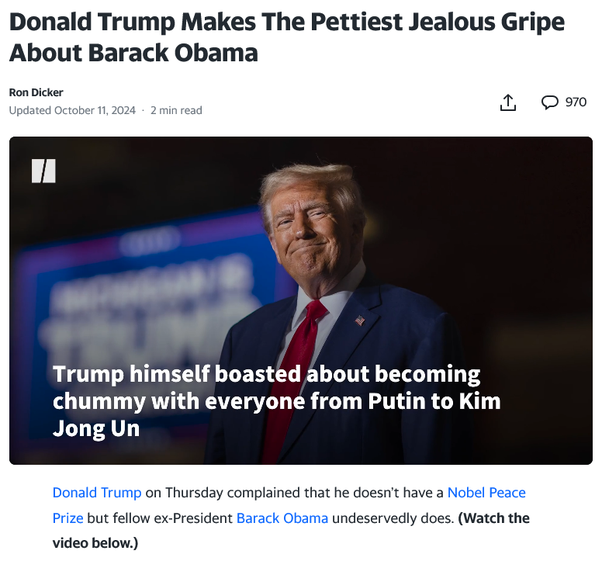
The jealousy is why Trump can still gripe about Obama a decade later.

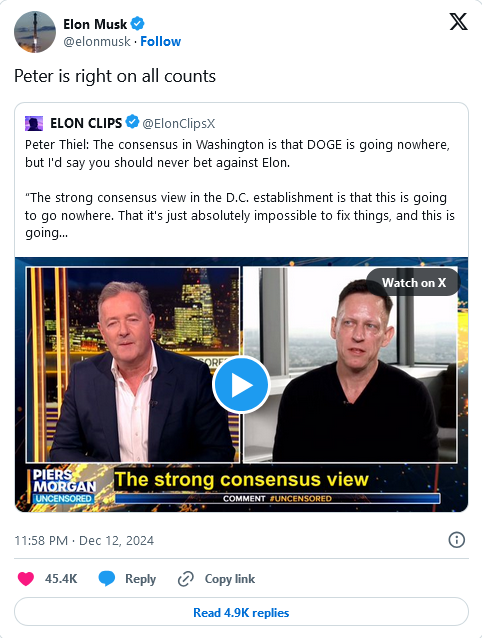
Supporting a hated monster like Trump is the closest Musk will get to camaraderie. Meanwhile, both regard each other as useful idiots to their self-serving causes. Once the wheels fall off in their relationship — and it will because there isn’t enough room on the planet for two competing megalomaniac egos — eventually, one of them will step on the other’s toes hard enough to escalate into an open conflict — we’ll see embarrassing demonstrations that remind us of all the sandbox behaviours we experienced in elementary school.

Sadly, the more Xitter fails, the harder Musk will go after austerity for the little people, and that’s how he will deal with his “poor stature.” Musk is this century’s poster boy for why restraints on personal wealth and power are crucial to the stability of human civilization.

The MAGAts won’t see that, though, because they’re conditioned to desire submission to authorities they’ve been accustomed to worship. They will identify more with Musk’s struggles than their fellow citizens who suffer from Musk’s spitefulness.

Elon Musk is essentially living a life of revenge against whatever broke him in his childhood. His and Trump’s attitudes and behaviours are typical for bullies who remain convinced of their infinite entitlement to destroy others. They are self-righteous in their acts of destruction to levels equivalent to extreme religious zealotry.

Musk will sincerely believe he is a poor victim for being denied the $56 billion he demanded as compensation from Tesla. Self-serving bullies like won’t stop until someone stops them. Until then, Musk in his “DOGE” role will strip away lifelines from the little people to save himself a few dollars on taxes with righteous fervour. He will sincerely believe he’s doing the right thing for society by getting revenge on his victimization.

The attitude of being a poor victim is a common among billionaires who brazenly justify denying people their right to life to save themselves a few dollars in taxes. Meanwhile, all of their justifications for austerity for the little people is presented as if tax increases are and should be equal across the board. The wealthy have had their taxes cut by more than half in the last several decades which constitutes billions in savings for each billionaire. The little people have conversely gained pennies in tax cuts by contrast. Meanwhile, people like Musk, Thiel, and those support Trump consider themselves poor and unjustly victimized if their taxes were increased by a few percentage points.

The next time you hear someone use the expression, “victim mentality,” pay close attention to the person who accuses others of having such a mentality because that expression is projection for a sociopath. We’ve all had enough experience now to understand how the corrupt will make accusations that are confessions in disguise — deflections away from responsibility for their actions. People like Musk and Trump embody that mentality. Every choice they make is a form of revenge for their victimization while anyone who suffers as a consequence deserves their fates.

If you are a Leftist, do you think it is wrong to build Utopias?

This post is a response to a question initially posed on Quora, and can also be accessed via “https://www.quora.com/If-you-are-a-Leftist-do-you-think-it-is-wrong-to-build-Utopias/answer/Antonio-Amaral-1

As humans, it is vital that we all work together to make a better world for all of us today and for those who come after us.

After all, we are currently enjoying many freedoms and luxuries we would otherwise not have had it not been for the contributions of those who came before us.

Failing to do our part to make this a better world makes us a parasitic element that erodes the social fabric.

Working against the betterment of humanity is a betrayal of the social contract. Today’s dynamic resembles a tribe that survived a primitive existence by everyone working together. Having one person in that tribe work against the tribe’s survival was viewed as a threat to that tribe.

They had much more efficient ways of dealing with such betrayals then.

A utopia is otherwise just a setting on a compass that keeps us on track. Utopia is a concept and a direction, not a destination.

Hiding one’s misanthropy behind a political ideology is the polluting act of an intellectual coward and a morally depraved psychopath.

As you can see from how people are united in support of Luigi Mangioni, it’s not about left versus right. It never has been. It’s always been the top attacking the bottom, while people like you who play into that divisiveness are just useful idiots keeping us all distracted from saving ourselves from disaster.

Framing this question within the context of a political ideology only adds to the chasm between political polarities, imbues it with passive-aggressive disparaging implications, and is irresponsibly divisive nonsense.

Shame on you.

Why do so many people ask why “liberals” are so intolerant?

This post is a response to a question posed in its complete format: “If being liberal means being open, and generally tolerant, why do so many people ask why “liberals” are so intolerant?”

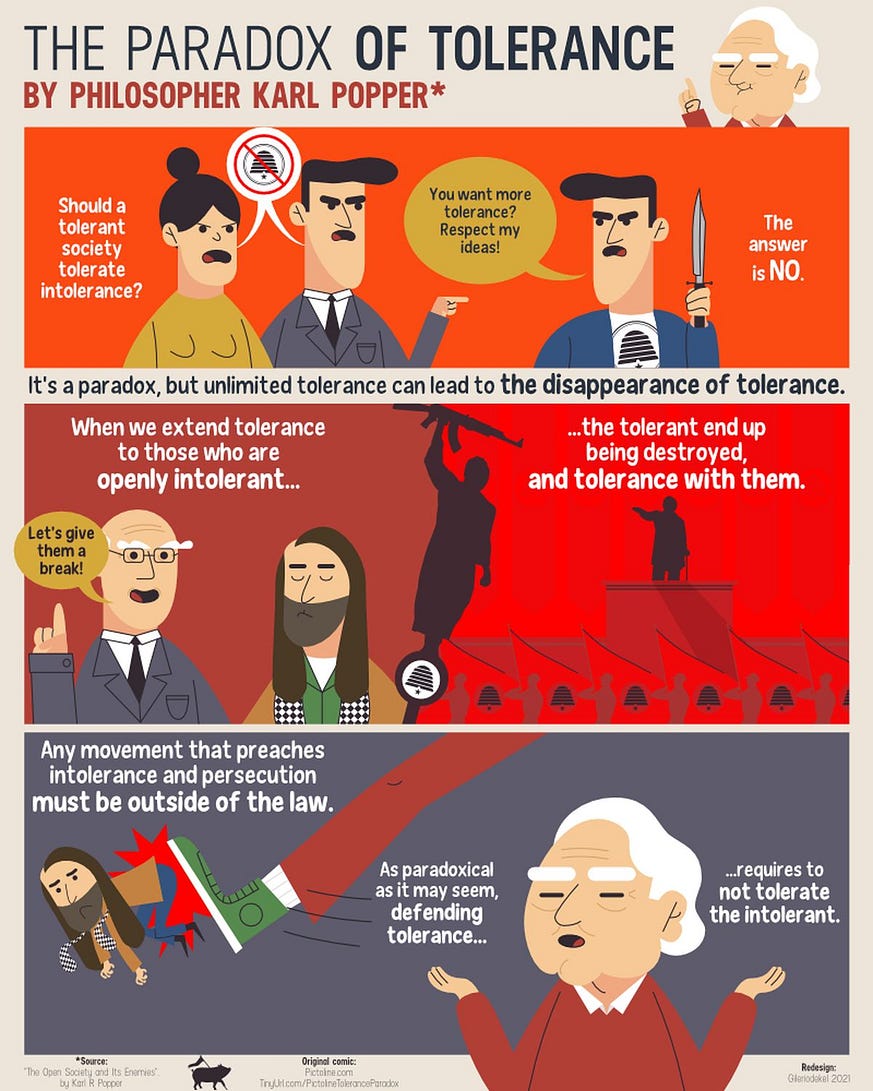
Tolerance cannot exist without limits, and the tolerance limits are the intolerant in society. Society cannot survive a tolerant existence without being intolerant of the insular and narrow-minded. Karl Popper described this limit within his “Paradox of Tolerance.”

Being tolerant means embracing the tolerant and rejecting the intolerant.

People who spread hatred cannot be tolerated if we wish to live in a tolerant society. In essence, people who spread hatred are in breach of the social contract, and the only way to address that is through the social pressure of rejection. The logic is not much different than the logic used when incarcerating criminals. Separating disruptive elements from society is a necessary strategy for preserving social cohesion.

Hate-mongers fail to understand this principle when they discover, to their chagrin, that their abusive intolerance is no longer tolerated.

They are often shocked and concoct accusations like “cancel culture” to serve as deflections for disguising their confessions. They are, after all, the same people who ban books. Most bullies in society get away with being bullies for a long time because most people just quietly turn away from them to give them the illusion they can continue being bullies. Most people prefer to avoid conflict and will often comply with a bully to get rid of them, making them think they have won.

This is a sad consequence of conflict-averse people because they only enable bullies in society while the one or two brave enough to stand up to them are destroyed.

The only way we will end the abuse we experience from bullies is when everyone stands together to show the intolerant that their intolerance will not be tolerated.

Being liberal has nothing to do with this. A decent human being willing to fight for a better world constitutes values that transcend political ideology.

Conservatives also have it within them to be better. The current prevalence of MAGAts and MAGA-style hatemongering the world over overwhelms their parties with cumulative toxicity that erodes the social fabric. At the same time, the rational conservatives among them, tacitly endorse the assault on the social contract through their tolerance of destructive MAGA attitudes and behaviours.

This is a difficult period of transformation for those who have felt themselves entitled to their biases, and we see examples of it everywhere in every contentious issue where mainly MAGA people attempt to impose their biases onto others. They can’t stomach the idea of equality when they and all of the working people are struggling during a period of extreme income inequity. Instead of being angry at those responsible for their strife, they’ve chosen the easy route of punching down instead of up because all bullies are cowards. It’s much easier for them to pick on those who appear vulnerable in society, such as immigrants, transitioning people, and women.

When liberals try to refocus their anger on those responsible for their strife, they often react with anger toward liberals, and that’s why questions like this exist. Those “so many people” who ask why liberals are intolerant are those who are too afraid to hold the people responsible for their anger accountable. Everyone else has had their tolerance eroded from the futility of attempting to reason with people who hold fast to positions they did not adopt out of reason. There is no point bridging a divide while the other side insists on digging a chasm.

What are the key reasons people voted for Trump in the 2024 election?

This post is a response to a question initially posed on Quora, and can also be accessed via “https://donewiththebullshit.quora.com/What-are-the-key-reasons-people-voted-for-Trump-in-the-2024-election-2

Unfocused rage is likely the most encompassing sound-bite answer to this question.

MAGAts hate struggling in their lives — like everyone does. These days, during our historic levels of income inequality and minimal tax burdens on the wealthy, as they plunder our world into extinction, everyone but the top is struggling.

MAGAts have had their emotions leveraged against them, though, by a steady diet of hatred toward anyone and everyone not responsible for their hardship.

They’ve been taught to hate liberals because the left is a threat to the oligarchs.

They’ve been taught to hate immigrants because they’re an easy target to blame for their misfortunes. It’s a form of manipulated displacement.

They’ve been taught to hate minorities because they have been conditioned to believe minorities, like trans people, are assaulting their way of life simply by existing.

They’ve been taught to hate women because women are easier to victimize when they can be called “baby killers.”

They’re afraid of how quickly the world is changing and feel left behind, and they hate that.

They’re afraid of being unable to keep up and are insecure about their future. Meanwhile, the groups they’ve been taught to hate appear to weather the storm better than they do, and they hate that, too.

They hate a status quo that seems deaf to their pleas, and Trump is a disruptive element in society that echoes their hate. His perceived political outsider status and natural personality of overt indulgence in hatred convince them that he represents their interests.

He validates their hate fantasies and permits them to indulge openly in their hatred while manifesting it in physical reality. They don’t realize how much other people struggle with similar emotions or that they acknowledge how a significant reason why fantasies should remain fantasies is not all fantasies should be acted out because they are too destructive to be made manifest. They are fantasies that should remain fantasies because they function as forms of therapy. Making them real necessitates entirely new levels of treatment.

MAGAts have lived a lie through their belief systems that blur the distinction between fantasy and reality, and that has convinced them to blur distinctions even more, to justify coping with all the pent-up hatred.

They can’t grasp long-term strategies or how distant a consequence can be from an action.

For example, a complaint they expressed was the cost of living, and because their narrow view of the highest authority in the land means that person dictates how everything works, it was easy for them to blame Biden. They didn’t learn to understand how the corporations that feed the media empires with profits would not risk losing those profits by demonizing the price-gouging corporations who butter their bread through advertising revenue.

The Republicans have been leveraging the naivety of their undereducated constituents for decades. States like Kentucky can sink into poverty while their leader overtly grows their wealth and blatantly betrays the entire nation, and they still can’t connect the dots.

All of this is a recipe for wallowing in the kind of hatred that can only escalate dramatically further as the fiscal incompetence of Republicans catches up to them. Their economic mismanagement has now run out of room to blame the Democrats. Trump’s strategy for tariffs and utilizing Elon Musk to be the voice of cutbacks in the trillions while gearing up to make the public accept enduring another round of austerity will begin to crack their support.

His appointments to senior administration roles are already horrifying as an overt pedophile has been appointed Attorney General, his Health and Human Services Secretary is an overt mental health case, and his Secretary of Defense is a television talking head. These three are already a toxic enough recipe for disaster, while the list of notables merely adds orders of magnitude to the levels of concern these already register.

https://www.theguardian.com/us-news/2024/nov/14/trump-cabinet-administration-maga-extremism

https://www.theguardian.com/us-news/2024/nov/14/trump-cabinet-administration-maga-extremism

Anything innocuous and unpredictable can become the match that sets the entire edifice of plutocrat manipulation over the last half-century into flames. This administration seems poised to ignite public backlash as Trump pushes an economy-killing tariff agenda and insiders like Elon Musk warn of impending cuts at impossibly surreal levels and public adjusting to another round of austerity.

The MAGAt argument, on its surface level of concern for the cost of living, appears rational. However, its sincerity will be tested in ways that challenge national stability at previously unseen familial levels. The cracks in the social contract will dramatically grow at the level of fundamental building blocks for society. 

Once we’ve breached the final veneer of tolerance and the MAGAts realize they’ve been played for fools while hating the wrong people, they will harness all their unfocused rage into a tight focus to enact destruction on orders of magnitude well beyond what they have achieved thus far in society.

Once they reach rock bottom and have their come to Jesus moment, the plutocrats responsible for dividing the people and ripping us all off will have hell to pay.

Is capitalism simply the human nature of “survival of the fittest”?

This post is a response to a question posed in its full format as follows: “Is capitalism simply “survival of the fittest” in humans, and just an explanation of human nature instead of an ideology?”

No. Capitalism is a system of exchange of value.

The toxic competitiveness that becomes defined as “survival of the fittest” is a human mental illness that perverts a life-saving, poverty-destroying system into a weapon of mass destruction serving their selfish whims.

Capitalism is not the problem, and the sooner we stop blaming abstractions, the sooner we can solve the issues that are being made worse with a tool like capitalism.

Capitalism is only one tool in a kit of corruption wielded by corrupt humans who destroy lives while seeking dominion over all others.

Another tool is our political system, and it’s being just as corrupted as capitalism.

Yet another tool being corrupted by vile creatures resembling humans is our justice system.

Our systems are corrupted by corrupt human beings seeking only one end: dominion.

The problems that have persisted throughout human history have always been the same: an evil obsession with power.

We are facing the threat we have always faced — power.

Power corrupts, and absolute power corrupts absolutely.

The only way out of the mess we are creating is to attack power, to disempower consolidations of power.

The only solution to the threat of concentrated power is to spread power throughout the globe and all of society — to share in power as equally as possible.

This is why democracy exists today, in whatever hobbled form it does.

This is why democracy is necessary for our survival as a species.

We must always find concentrations of power as threats to our existence and properly distribute power throughout the masses.

Everywhere power is concentrated, it is an enemy of the people and of the progress toward achieving our potential as a species. Institutions, industries (particularly multinational), and organizations of all stripes must be converted into democratic institutions.

We cannot continue to allow autocratic institutions to increase their power because their endgame is always dominion.

Spreading power to create democracy everywhere and in all things necessitates equipping the unskilled, the undereducated, and the under-developed with the knowledge and capacity to handle their increased personal power properly.

For this reason, we must learn to value education on such a level that we view it as the lifeblood of our existence as a species. Without it, we die.

Human nature craves education, even among those who hold educational institutions in disdain, because no one is oblivious to the value of learning something that makes their life even better.

Anyone in a position of teaching others knows that education is the link in the chain of our human existence as we pass on what we have learned from others to a future that stands upon generations of shoulders before them.

The light of awareness glowing within the mind of someone who has just learned something valuable is the most priceless treasure one can experience while passing on the most priceless gift one can give another.

Capitalism is a tool that can and has lifted us out of poverty, and we, the people, must take back control of capitalism to shape our future for the betterment of all and not solely for the few.

We must wrench the wheel of capitalism from the hands of those corrupted by its power and return it to its rightful owners — we, the people.

Are human rights natural rights endowed simply by the virtue of being human?


This post is a response to a question initially posed on Quora.

Human rights are essentially an agreement between humans to protect a characteristic or behaviour of all humans within their community.

Human rights exist only by virtue of the agreement itself and the degree of commitment by other humans to protect those rights.

This is a global issue, with human rights being violated all the time and everywhere on the planet. It’s a problem that demands our immediate attention and action. This is why human rights are violated all the time and everywhere on the earth.

We have far too many humans who view rights as scalable according to their essentially misanthropic perceptions of humanity — because we are suffering from a mental health pandemic affecting at least one in five among us. We are only now beginning to realize that we are a species that has been suffering for centuries from generational trauma from our barbaric origins.

The fight for universal human rights is a fundamental building block in a healing process that will require centuries to emerge from.

We are far better off today than we were one century ago simply because of our increased awareness of the issues we are dealing with and an emerging appropriate context from which we interpret our experiences.

Human rights are crucial to preserving the social contract and ensuring systemic stability.

Without human rights as a concept enshrined into law, we descend into barbarism.


After writing this answer and posting it, I realize I’m doing a disservice to the concept by providing such little context.

Human rights have a long and bloody history of development in which their inklings as concepts we should value as a species were responses to centuries of brutal violence characterizing human life.

The earliest examples of human rights enshrined in local laws date back to circa 2350 BC in Asia as the reforms of “Urukagina of Lagash,” which evolved into more well-known examples of legal documentation such as “The Code of Hammurabi” from circa 1780 BC.

Ancient Egypt also supported fundamental human rights through documents such as “The Edicts of Ashoka” (c. 268–232 BC). Other principles of human behaviour emerged during this period, while one such principle has been incorporated throughout most living religions today and is popularly known as “The Golden Rule.”

Fast forward to 622, and “The Constitution of Medina” functioned as a formal agreement between Muhammad and the tribes and families of Yathribe, which included Muslims, Jews, and pagans. This agreement was an early means of uniting all peoples of the land under a common identity referred to as “Ummah” and incorporated several changes to how slavery was defined and limited.

Early Islamic laws from this period incorporated principles of military conduct and the treatment of prisoners of war that became precursors to international humanitarian law.

Moving forward into the Middle Ages, the most influential document establishing the modern basis for human rights was the creation of the “Magna Carta,” itself heavily influenced by early Christian thinkers such as St Hilary of Poitiers, St Ambrose, and St Augustine.

The Magna Carta of 1215 influenced the development of “common law” and several constitutional documents following, all related to human rights, including the (1689) “English Bill of Rights” and the (1789) United States Constitution.

Some may remember from the Iraq War and the establishment of Guantanamo that the Bush administration suspended the writ of “Habeas Corpus” — the right to know what one has been accused of — was a right established in the Magna Carta. This was a fundamental violation of a basic right that set the nation back in time to an era of barbarism — and they hypocritically leveraged that violation to commit war crimes for waterboarding that the U.S. itself forced Japan to face an international tribunal for war crimes over the same behaviour decades earlier.

This is a stain on the American people that will not wash off their conscience while they do nothing to own responsibility for their grotesque violation. This dark moral failing of the nation has become a slippery slope of moral failures permitting the monstrosity of immoral behaviour. We — as in the world- are now on the verge of potentially falling entirely into a pit of immorality because of their “leadership” in this area.

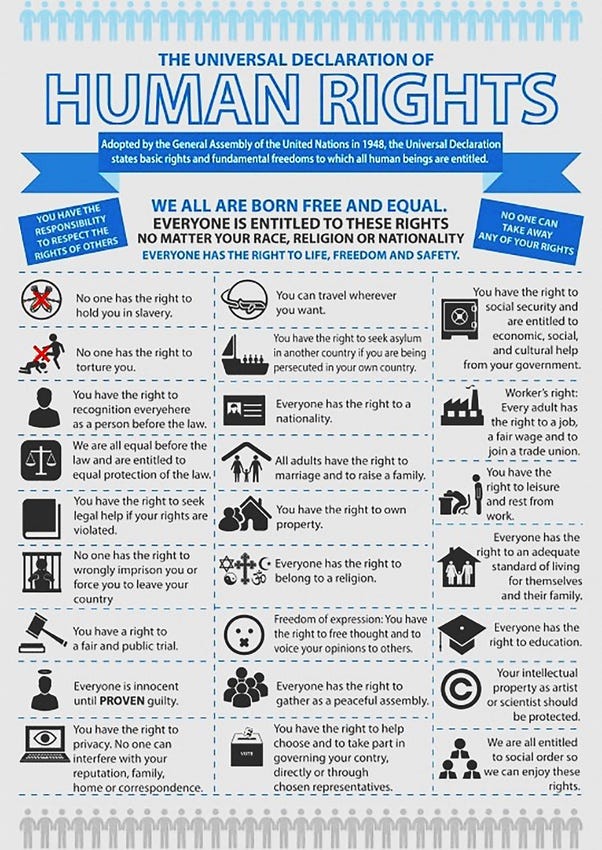
At any rate, I’ll avoid proselytizing further and get to the goods of reading material and a “pretty picture” at the end with a chart of the Universal Declaration of Human Rights:

Human rights — Wikipedia

History of human rights — Wikipedia

A Short History of Human Rights

A brief history of human rights — Amnesty International

Universal Declaration of Human Rights | United Nations