Are people poor because they were born to be poor?


This post is a response to a question posed in its full format as follows: “What can we say for those people that worked hard but are still poor? Is it because they were born to be poor?”

The first place to begin one’s assessment of another’s fortune is with an honest apprehension of the environment affecting all fortunes by all people who inhabit a (somewhat) closed ecosystem.

To suggest some external source of magical influence like fate to factor in any of this merely distracts from an objective apprehension of the dynamics leading to disparity.

It is precisely this kind of magical thinking that every “Confidence Artist” (“conman,” “swindler,” “scammer,” fraud) throughout human history has relied upon to enrich themselves at the expense of their victims.

Making matters worse for the victims is the belief that they’re responsible for the actions of others who impoverish them.

This thinking epitomizes victim-shaming.

It’s no different than blaming one’s attire for “causing” a rape.

It’s precisely the thinking a homicidal monster utilizes when they claim someone else’s actions forced them to commit murder. They twist the notion of self-defence into a justifiable weapon to dismiss responsibility for their actions.

This perverse thinking permits people like Derek Chauvin to suffocate George Floyd until they stop breathing. It empowers all the evil monsters in our midst to invoke sociopathic rationalizations unrelated to the incident in question to justify the commission of murder.

Inmate who stabbed Derek Chauvin 22 times is charged with attempted murder, prosecutors say

It ignores the causal nature of reality. Even the Bible’s Genesis chapter and “list of begats” acknowledge causality.

Bible, King James Version

People are not poor because of some cosmic assignment handed down to them by an authority, as if it were a justifiable assessment of their character at birth. People are poor because humanity has not learned the lessons of our primitive existence — namely, that we managed to survive our cave-dwelling origins only because we worked together as we hunted in groups. Each contributed to the welfare of the whole in ways that allowed everyone to benefit equally from the collective labours of synergy.

Margaret Mead has most succinctly identified the dawn of human civilization in her example of a knit bone discovered during her anthropological studies.


The worst aspect of all of this is that the evidence is abundant. There is no mystery as to why so many people struggle with poverty today.

In our early history, widespread poverty primarily resulted from natural scarcity due to environmental conditions such as an early frost wiping out an entire harvest or poor land management practices such as those that led to “The Dust Bowl” and the “Dirty Thirties.” Ironically, the magical thinking of “Manifest Destiny” driving an initial bump in prosperity contributed to the impoverished conditions that contributed to “The Great Depression,” which contributed to the stressors driving global aggressions leading to a Second World War only decades after the first global aggression.

Dust Bowl: Causes, Definition & Years | HISTORY

The fuel behind all of the poverty and aggression is the same fuel contributing to an increasing number and degree of violent protests occurring worldwide today — income disparity. We have surpassed the stage of income disparity that triggered our first global aggressions due to the stresses of exacerbated conditions of poverty.

This cycle of class disparity has triggered aggressions throughout human history, and many of our popular stories are based on them.

We should know better by now, but we seem incapable of learning this crucial lesson from history.

What makes matters worse is that in today’s “post-scarcity world,” we produce more than we can consume. We have no excuse for poverty today beyond human failings, as expressed through our politics.

Can we feed the world and ensure no one goes hungry?


None of this is a mystery — or should be a mystery to anyone today. Yet, here we are looking for excuses to victim-shame the vulnerable in society who struggle to feed themselves every day.

The information providing clarity exists in abundance. Few people are ignorant of the fact that eight people have as much wealth as the bottom half of the whole of humanity. No one is oblivious to the magical sound of the designation we venerate of a “centibillionaire.” It’s like a status of godhood on Earth that people seriously believe is a consequence of effort and ingenuity and not a dysfunctional system that impoverishes the vulnerable.

Few people perceive that obscenity in terms of the threat to global stability that it is. Few people perceive that amount of power within the hands of an egotist as a direct threat to their livelihoods — unless, of course, they’re one of the thousands who have been displaced on a whim by a megalomaniac who spent $44 billion to own the world’s most enormous megaphone so that they can capture global attention every day.

Few people look at graphs like these two and become horrified by their implications.

Yet… here we are, sending ourselves on a path in which the logical conclusion of the trajectory summed up by these two graphs is the end of human civilization as we know it. Instead of focusing on how to correct our course, we’re looking for reasons to victim-shame the most vulnerable among us.

It’s entirely disgusting that so many people are so willing to demonize the victims in society that it is mind-boggling how such utterly primitive thinking can exist in modern society.

Centuries from now, if we survive this insanity, this mindset will be viewed as the horrific equivalent of witch trials from our history.
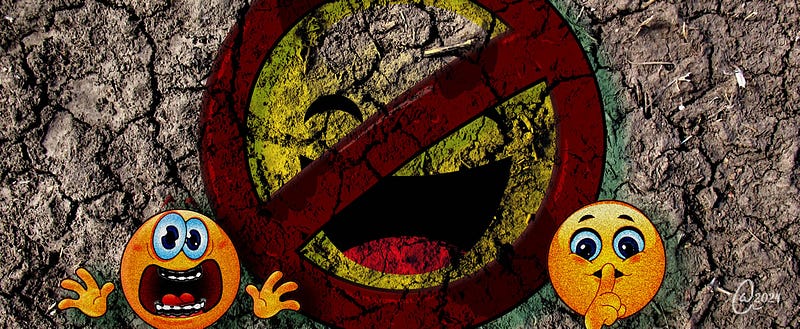
Is it worth responding to the laughing emoji reactions to a tragic post on Facebook?

This post is a response to a question that was asked in its complete format: “What do people think of others who react with a laughing emoji to a serious or tragic post on Facebook? Is it worth going through the list and giving them all a nasty pm, or would this be a rather pointless and sad exercise?”

That list you imagine going through to castigate people individually is often over one hundred people and can sometimes be several hundred to over one thousand.

Going through one list of even just one hundred people would easily chew up your entire day.

You would also have to deal with pushback and people reporting you for intrusive messages on their DM.

You would likely find yourself consigned to Facebook jail for your efforts.

Even the process of blocking on Facebook is onerous enough where if that’s all you did was block one hundred people, that would easily chew up a few hours of your day…

On just one post.

Odds are excellent, and you could find at least half a dozen such posts that motivate you to block hundreds to thousands daily.

It could be a full-time job just blocking people, and you would still find a never-ending supply of names to block within a user base of two billion.

Blocking one thousand people daily would take three years to block one million people.

If you were to go by statistics that bear out at one in five people having severe mental health issues, you would need to block 400 million people.

That would be a lifelong job working every day from morning until you fell asleep without any break from that task.

If that’s how you wish to spend your life, it’s your choice, but you may find other approaches to making your point more beneficial to your sanity.

You can post a public comment on a post where you can chastize all inappropriate laugh reactions at once. I’ve done that, and it can feel rewarding when you get a lot of feedback from people who appreciate someone publicly criticizing lousy behaviour. You will also find that you’ll get laugh reactions on your complaint that you can address.

If you think you will have a discernible impact on behaviours, then you’re not being realistic because succeeding on that level will require years of effort.

You may want to consider lobbying Facebook for improvements to their blocking process because it sucks. It’s onerous and constantly redirects you to pages you probably don’t want to see repeatedly.

Change.org has a petition that has already gathered 296 signatures, and as of this writing, it requests that the Laughing Emoji be removed from Facebook altogether.

Sign the Petition
I recently wrote feedback to Facebook about something that’s been bothering me about their emoji feature. Here is what…www.change.org

If it gains enough traction, we might see at least some changes to their emojis if the laughing emoji isn’t removed altogether.

Here is another article calling for its removal:

No laughing matter: Why it’s time to cancel Facebook’s haha reaction
That squinting, grinning idiot is poisoning Facebook.thespinoff.co.nz

Whatever you decide to do at this point, it’s probably wisest to consider it more personal venting than instigating social change. Otherwise, you will tire yourself into a frustrated frenzy while spinning your wheels and going nowhere.

A helpful quote you should keep in mind for whatever you choose to do is from Winston Churchill.

Good luck with whatever you choose to do.

Why does morality exist independently of human opinion?

Why does morality exist independently of human opinion?

This post is a response to the question posted on Quora as written above.

Morality IS “human opinion.”

Many differences exist between opinions on morality and on practically everything else people have opinions on — which makes opinions on morality somewhat unique in how they are perceived.

People generally do not equate a moral opinion on murder, for example, with an opinion on a fashion accessory.

Part of the problem is that it is the cultivated opinions of religious folk to believe morality is an objectively established standard of conduct determined by an invisible authority. If the claim of objective jurisdiction to develop and institute a moral framework existed, morality would essentially be identical and unchanging over time. That’s not the case for anyone who has made even a tiny effort to understand people or human history.

The most significant problem with establishing a universal acceptance of a moral opinion is that no one ever receives direct confirmation from an unassailable authority governing judgment over any specific behaviour. Complicating matters further are the subjectively supported morals of believers who do not share a consistent moral framework — even though religious institutions do their best to homogenize morality among their flocks.

Institutions that once endorsed slavery and have moved on to repudiating it cannot, without justified criticisms, claim to receive their moral framework from an omniscient entity.

This and all the many other changes made to institutional policies regarding morality throughout the centuries have eroded religious claims of authority in moral matters. Making things worse for them has been allowing their credibility to be assaulted by many heinous scandals, such as the institutional endorsements for victimizing countless children through sexual predation and murder and the subsequent protections of institutional leaders guilty of immoral actions.

We, as a species and as a collection of diverse societies, all governed to some degree by the notion of morality, have undergone a tremendous number of and severity of degree in the assaults on our definitions for what constitutes morality that we are struggling to unify a fractured vision of the concept.

We can no longer trust our authorities, be they religious, political, industrial, or familial, which puts us in a quandary for resolving our moral differences as a species.

The upside is that we are turning inward to identify our internal sources of moral development.

Morality is most simply defined as an extension of empathy, but the issues it encompasses make that an oversimplification. At best, empathy is merely a compass guiding actions that many hope serve to achieve moral outcomes. Some will define morality within a self-serving context, while others consider self-sacrifice an embodiment of morality. Neither is necessary to achieve some form of widely acceptable definition of morality.

We can grasp a history of morality from academia, giving us context and perspective on what we have learned about morality. That approach leads us down deep and convoluted rabbit holes of (arguable) “subclassifications” like ethics, conscience, integrity, standards, and principles. At the same time, simple definitions escape a universal simplicity promised by our examples of failing leadership because morality is itself nuanced, multifaceted, and contextual.

We may never transcend subjectivity within the context of our interpretation of morality, but that’s a feature, not a bug.

Morality as an opinion forces us to share the diversity in our views, and that’s a superior form of morality to any authoritatively imposed dogma because we must each learn to develop our apprehensions of morality to learn how to better succeed in living together under a shared social contract to achieve a peaceful and prosperous co-existence.

We’ve seen enough artificially imposed forms of morality claiming objectivity as an unassailable standard for uniting people to know it’s a fraudulent approach to morality that invariably fails us as much as we fail to adhere to universally defined, generic, and external imperatives.

To accept morality as human opinion puts us in a position to define human character along a spectrum of universally acceptable, unacceptable, and inspiring behaviours that can adapt to an ever-changing landscape.

Morality may be more messy to manage as an opinion. Still, like the principle of a democracy, it’s the only form that can maintain coherence within the context of longevity.