This post is a response to a question posed in its complete format: “One of the arguments against universal health coverage in America is that we are giving poor people something for nothing. So how are European countries able to avoid this while offering universal health coverage?”
They don’t avoid that, but those who argue against universal healthcare are more fixated on hating the poor than they are on understanding how “giving the poor something for nothing” results in superior healthcare at half the cost for themselves.
The cost-based mentality is surprisingly dumb when they can’t comprehend how much they can save when considering expenditures as investments rather than losses.
It is precisely this thinking that Donald Trump has been leveraging to send the nation into a recession.
Conservative thinking tends to be so very short-sighted that when they claim to be fiscally responsible, all they’re doing is showing the world they’re incapable of stimulating growth.
Conservative thinking about healthcare epitomizes their fiscal incompetence.
Fiscal issues are entirely based on a revenue versus costs model, but conservatives seem capable of understanding only one column on their balance sheet.
The capacity for creativity is why liberals excel in the revenue generation side of the balance sheet. Conservatives could learn some valuable lessons about fiscal competence from liberals if they weren’t so close-minded and filled with hateful bigotry.
Caring for the poor is how we bring out the best for everyone at the lowest cost.
This post is a response to a question posed in its complete format: “When will people understand that their constant selfish reckless belligerent greed is what brought society to its current disgusting miserable state of existence?”
Let’s look at someone like Donald Trump. He has spent an entire lifetime spreading hatred while bullying people to feed shallow desires, and he entertains himself through acts of cruelty he enacts on fleeting whims. He’s been behaving in ways that epitomize constant selfish, reckless, and belligerent greed, ostensibly his entire life.
His response to being criminally convicted was not remorse but to have the conviction overturned.
This question naively presumes that a person who behaves in destructive ways throughout their life will magically experience an epiphany of conscience in which they will transform into the “decent human” imagined by this querent.
Never has any evil monster throughout history found any turning point in their life that magically transformed them into saintly beings. Most who claim to have “seen the light” assume such a position as a fraudulent means of continuing their prior agenda of self-benefit at the expense of others.
The short answer to your question is “never.”
People cannot change their essential nature. They may choose to improve, but that presupposes desire that has always existed and a lifetime of dedication toward that end.
People like Donald Trump see nothing wrong with their behaviour and so will never make an effort to improve.
Epiphanies such as this question presume to be possible constitute wishful thinking on a highly destructive level of delusion that prevents us from addressing the fundamental issues of broken psychology that we must dedicate ourselves as a society to addressing on the most basic levels.
We can never truly call ourselves civilized if our systems enable and empower the kind of evil embodied by people like Donald Trump — and make no mistake about it, we encourage his evil.
Our societies embrace and enable selfish, reckless, and belligerent greed.
Until we can address the fundamentally broken human psychology on a system-wide and social scale, we will continue to be plagued by these behaviours.
Ten percent of the world’s wealthiest are destroying our planet at a rate practically matching the total of the other 90% of the rest of humanity. Instead of doing something to restrain their destructive behaviours, we put them on pedestals and worship their harmful behaviours.
Changing humans in ways that address destructive behaviours embodying selfishness, recklessness, and belligerent greed means we must start at the top and change all of human society.
This post is a response to a question posed in its complete format: “Why don’t people realize that it is plutocracy (our country being governed by the wealthy elite) that is causing our economic problems?”
People don’t magically “realize things.”
People must be educated, informed, and aware of circumstances and details.
They need to be walked through the information presented to them as if one functions as a guide on a tour, answering questions.
People also don’t respond to laments, particularly when entrenched in counterfactual bigotries that prevent them from apprehending reality through an objective lens.
In essence, if this is an issue of concern for you, which I’m glad to see it is, then you need to start banging drums and sharing information and details because there are at least 76 million people in the U.S. alone who are entirely so oblivious to what you’ve determined for yourself that they contribute to the problems caused by the plutocracy.
There are many reasons why many people support self-and-socially destructive agendas, and most of those reasons can generally fall into only a few camps:
They benefit directly from the corruption,
They interpret the economic problems of the victims of a corrupt system as personal failings,
They imagine themselves as potential beneficiaries of corrupt powers by supporting them,
They lack the wherewithal to do anything about the corruption, so they cope with what they don’t believe they can change by resigning to hate the more easily victimized,
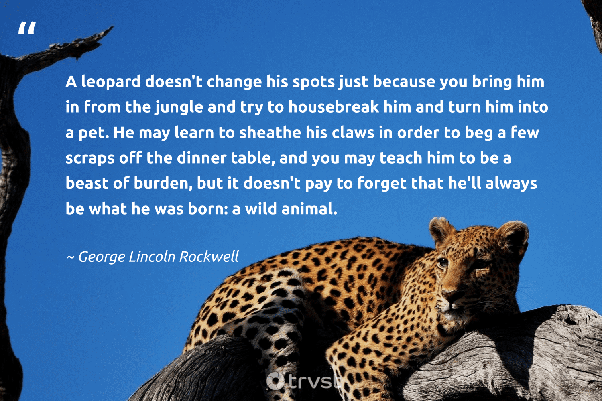
They support what they believe is a natural state of a zero-sum existence encapsulated as a butchered interpretation of life often referred to as the “law of the jungle,” in which there are only predators and prey in this world,
They’re psychologically dysfunctional — which is an explanation that applies to all the preceding points,
Their education is woefully lacking — which also applies to all preceding points and leads back to the onus placed on those who know better by providing the support necessary to make positive change while also receiving a reminder that lamenting the sad state of affairs does nothing to change them. It does, however, give the broken among us a target to jeer and mock and use as an example to justify their corrupt interpretations of life.
Now, arm yourself with the information you need to fight as a keyboard warrior and do something more productive than issue lamentations to elevate humanity from this dank pit of misanthropy.
This post is a response to a question posed in its complete format: “Do you support Meta’s (Zuckerberg’s) decision to end third-party fact-checking on Facebook? Should there be any fact-checking at all on social media platforms? Why?”
Social media appears to be entering a stage where its profit-based model is “eating itself out of existence” as the latest in end-stage capitalism’s string of “Ouroboroses” (Ourobori?).
Along with stripping costs for an expensive venture, Mark is also adding AI bot profiles to create the appearance of engagement.
This reminds me of why I lost interest in dating sites. The easiest way to know a site’s ethics is when they create bot profiles to entice people into paying membership fees to engage with non-existent people.
As much as Zuckerberg flaps the trappings of community within Facebook and social media, none of his views are legitimately about community or supporting community development.
If social media were authentically social, its focus would be community development, not profit generation.
It is precisely the model of profit generation that puts social media into a death spiral of profit chasing to the bottom of the bottom-feeding barrel.
Their metrics for engagement are derived from a superficial analysis of what engagement means. As long as someone clicks something or posts something, that counts as “engagement,” and that interpretation of engagement counts as justification for advertising rates.
Meanwhile, no one gets anything from the deal but a massive case of blue balls.
Without a mission of serving a higher purpose of community development, social media and society, by extension, cannot but devolve into the technological equivalent of a pack of stray dogs begging strangers for treats.
We will experience social anarchy in the virtual world before it greets us in the real world. Hopefully, that will create enough pressure to do something proactive to support community development before the real-world communities devolve into chaotic monstrosities of “former civilization.”
All of this is an argument in favour of social media, on some level and in some capacity, being a publicly owned and managed enterprise that exercises its self-restraint divorced from the misanthropic profit-chasing model that dehumanizes people while pretending to serve human social needs.
As much as our dialogues focus on almost everything but community development, they all serve a community needs focus.
For example, all of the discourse surrounding AI and its replacement of human labour may be considered an economic, political, or labour issue, and it’s essentially a community response to a significant change transforming human society on a fundamental level.
All social media forms the basis of community development because all social media is public discourse. However, our problems with social media stem precisely from its growth being motivated by profit over principles.
At this stage, growths in profit that can satisfy hungry boards and investors justify cutting costs to the degree that whatever spirit was initially capitalized on that prompted the development of any particular social media site has been stripped from its operation.
The justifications for stripping costs have ironically been derived from concerns about the costs of managing social engagement. Who woulda thunk it’s too expensive to properly manage human behaviour to afford the cost of developing a media enterprise focused entirely upon squeezing profits from social engagement?
People need social media. It won’t go away, but social media proves today that profiting from human interaction is the wrong way to think about social media.
We have been watching the effects everywhere as social media has been devolving into a dynamic I remember from what I used to refer to as “usenut” — that many may be more familiar with as “Google Groups,” for example. I remember this as the gutter of human interaction — where the most extreme of the extreme was its primary denizens who were free to indulge in the most hateful of behaviours and attitudes.
I still “fondly remember” one character I used to refer to as “Grog” — which wasn’t their real name, and I’m not going to publish it because he’s still active on what shreds still exist of Usenet groups. He’s still advocating for the death penalty for gay people. It turned out that his father came out of the closet late in life, and that had a devastating impact on his psychology.
At any rate, this underground dynamic of toxic attitudes has slowly been seeping into an above-ground and public state of dialogue over time. If one had not ventured into the gutters of human detritus to discover its prevalence, one would not realize it’s an undercurrent that has always existed.
We will continue witnessing a devolution to the level of bottom-feeding slugs in human interaction characterized by social media as this trend of cost-cutting and profit-squeezing continues. It’s an inevitable characteristic of the capitalist chase for profits.
At some point, we’ll experience a confluence between the demand for social media interaction and restraint on toxic behaviours that normalize the intolerable throughout society. People will grow to hate people like Zuckerberg more than they do now, as one can already see an influx of disparaging posts about him beginning to flood the social media space everywhere.
Accountability and restraint on social media will become a widespread demand because social media fulfills a human need for interaction and dialogue that has always been present in less technologically based forms, such as letters to the editor in every newspaper that once littered the landscape.
Social media won’t disappear but will require transforming from a privately profitable industry into a public service. Nations like China are already ahead in this game by using their social media enterprises as tools for managing public dynamics through social credit scores and demerits.
If we’re not careful, social media will transform from a chaotic enterprise focused on chasing profit into a tool of oppressive control over the people in a much more pernicious way than media enterprises like Fox do now with their disinformation campaigns.
Self-sacrifice isn’t a “gift,” it’s a responsibility and a call to action.
Self-sacrifice can occur as a parent sets aside their desires to make way for their children to achieve successes outside their reach. For example, a parent who works multiple jobs to help their child get an education that will give them a better life than they could attain has generally been regarded as a “typical” or “common form of self-sacrifice” and often considered noble.
Other forms of self-sacrifice, such as jumping on a live grenade (for an extreme and improbable example to make a point) to protect a crowd, are a requirement created by circumstances that would be unnecessary if extreme conditions were not present. This form of self-sacrifice is an artificially created necessity that could have been avoided if the motivations behind the person throwing the grenade were mitigated proactively.
This form of self-sacrifice is an instinctive form of preservation that extends beyond the limits of one’s life. It is an expression of commitment to the social contract historically responsible for elevating humanity beyond the baser instincts that drag us backwards into primitive states of existence. Over and above the preservation of one’s self, selfless preservation is performed from the exact sentiment of a parent sacrificing themselves for their child. It is an act of love in the extreme. It is an embodiment of the best of what humanity can be.
Like the child whose life is enriched by their parent’s self-sacrifice, the beneficiaries of such an act of selflessness have not received a gift to luxuriate in but an obligation to follow suit and make life better for those who come after.
This is how social evolution must progress in the face of apathy and against those who place themselves and their desires above the needs of others.
Without the capacity for self-sacrifice, the future of humanity is decay and self-destruction.
Self-sacrifice within this context is a warning that without the courage demonstrated by the few willing to alert an apathetic world of the need to take action, the conditions causing the suffering that demanded the sacrifice of one’s self will worsen and create more victims.
Self-sacrifice within this context is the canary in the coal mine warning the rest of humanity that death is on its way and alerting the people that they are facing a choice to serve a higher purpose than their fleeting whims or be sacrificed by parasitic forces as fodder for the conditions demanding their blood.
Self-sacrifice is a warning to the apathetic that if they do not rise against the threats facing them, their turn will come, and it will be far worse for them than the person sending their message of warning through their self-sacrifice.
Self-sacrifice can be defined with a simple quote: “Silence in the face of evil is itself evil.”
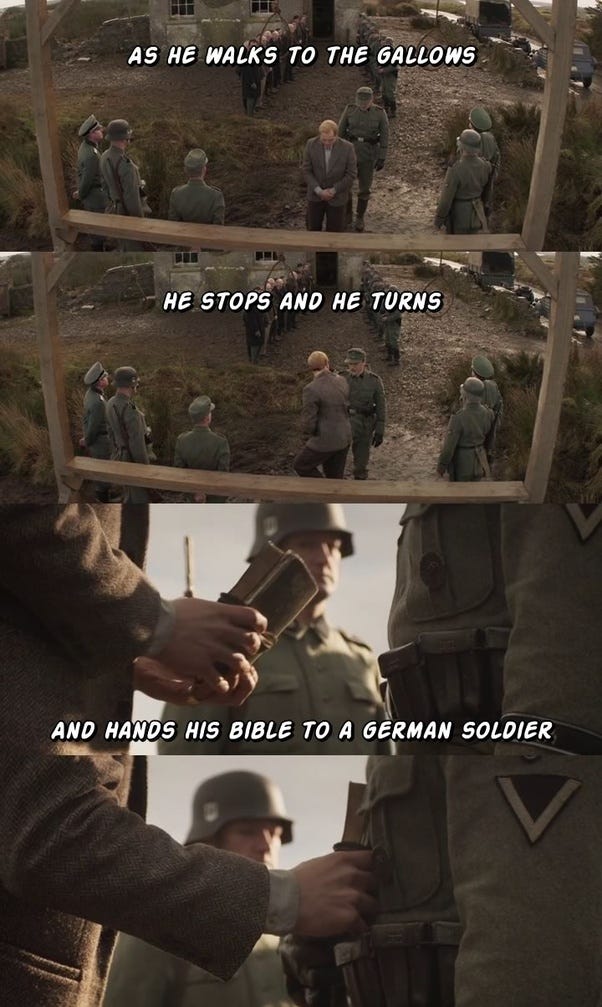
Here is an example of a story about a Pastor who sacrificed himself to try and stop Hitler while saving numerous lives. I’m posting it here because the space I otherwise posted seems unwilling to approve it in another answer because it’s appropriate to this question and because we are at a point where we are repeating history.
Dietrich Bonhoeffer February 1906–9 April 1945), was a German Lutheran pastor, neo-orthodox theologian and anti-Nazi dissident who was a key founding member of the Confessing Church. His writings on Christianity’s role in the secular world have become widely influential; his 1937 book The Cost of Discipleship is described as a modern classic.[1] Apart from his theological writings, Bonhoeffer was known for his staunch resistance to the Nazi dictatorship, including vocal opposition to Adolf Hitler’s euthanasia program and genocidal persecution of Jews.[2] He was arrested in April 1943 by the Gestapo and imprisoned at Tegel Prison for 1½ years. Later, he was transferred to Flossenbürg concentration camp.
Bonhoeffer was accused of being associated with the 20 July plot to assassinate Hitler and was tried along with other accused plotters, including former members of the Abwehr (the German Military Intelligence Office). He was hanged on 9 April 1945 during the collapse of the Nazi regime.










 thotbag