How different will the late 21st Century be?

This post is a response to a question posed in its complete format: “Do you think the late 21st century will be different from the early 21st Century just like the early and late 20th Century are nothing alike?

The rate of change has been steadily increasing. We (the public at large) have been made aware of this increasing rate of change since Alvin Toffler’s Future Shock was published in 1970.

Re-reading Future Shock, 50 years on

“Western societies for the past 300 years have been caught up in a firestorm of change. This storm, far from abating, now appears to be gathering force.” (p.18)

Future Shock Complete Film on YouTube (1:53:13)

“Future shock is the dizzying disorientation brought on by the premature arrival of the future… [It] is a time phenomenon, a product of the greatly accelerated change in society.” (pp.19-20)

The degree of change between the two centuries will be far more pronounced at the end of this century than the changes that occurred throughout the previous century and all preceding centuries.

Most answers focus on technological change, but this is the most apparent change because many can still remember an analogue age in which telephone communication involved an electronic umbilical cord and displays were limited to televisions and equipped with oddities called “rabbit ears.”

OMG! You had to get up from your seat and move a few feet before turning a dial to watch something different. We have demanded a remote controller for almost every electronic device since enduring that torturous existence. Now, we’re drowning in remotes we can’t find when we need them, while they demand an additional expenditure of precious dollars to feed them energy from disposable batteries.

Technological change alone represents multiple dramatic transformations of human society
and in how we will live from day to day. Today’s world of work will appear both alien and punitive to a world of work that will more closely resemble pre-industrial human society, according to Toffler’s third future-prediction book, “Third Wave.”
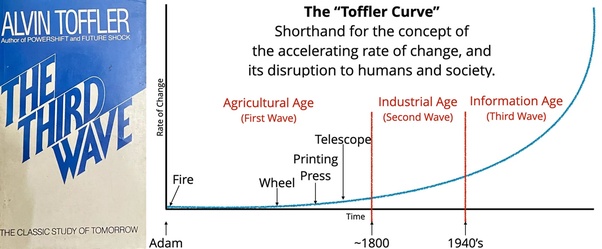
Technological change expands the possibilities of what can be considered human and redefines humanity itself. We can already see a massively transformative future for human biology through expanded medical and healthcare solutions to physiological needs and the emergence of a transhumanist movement that emphasizes the benefits of technological augmentation. While we remain cautious about biological alterations and focus on non-invasive technologies, medical solutions to limb loss, for example, are increasingly human-like in function while superior to their biological counterparts.

Like tattoos, artificial enhancements have been considered social taboos (for a short period, under the influence of Victorian sensibilities governing socially acceptable norms); however, they can conceivably become a popular means of “touching pseudo-immortality” and achieve small degrees of “super-humanity.” Genetic modifications will expand beyond preventing the transmission of genetic diseases to include prenatal selection of traits for one’s children. This will occur despite moral outrage because those with means will seek the greatest advantages they can for their lineages.

Technological change, however, is not the most radical change we are currently undergoing. Technology, however, has inspired, enabled, fueled, and empowered the most radical changes to date: ourselves.

We, as humans, are dramatically transforming, through growing pains demanded by our need to build a cooperative world in which cultures that once existed in isolation must now become interdependent to survive. Human psychology is being fundamentally restructured globally, in a way consistent with nature’s demand that we adapt or die.

Old forms of thinking and social organization cannot survive this transition without severely curtailing our social evolution, and they are trying to do precisely that. The MAGA sensibility and its adherence to a fictional nostalgia where familiar power structures continue to wreak havoc on outsiders is unsustainable in a global community that thrives on diversity.

We must learn to communicate and cooperate through mutual respect, and that’s why so much is so messy today. We haven’t grown up. We’re still in grade school, where our leaders mock 12-year-old girls and their base ignores that as irrelevant.

We are currently confronted with the sum of our human flaws and weaknesses, as well as with the social, economic, and psychological dysfunctions we have inherited from our forebears, through a focal point created by technology. Everything we once ignored and silently turned away from has become magnified and loud.

Each day that passes, the volume of discord increases as we negotiate new terms for the social contracts binding us all to a construct called “civilized society.”
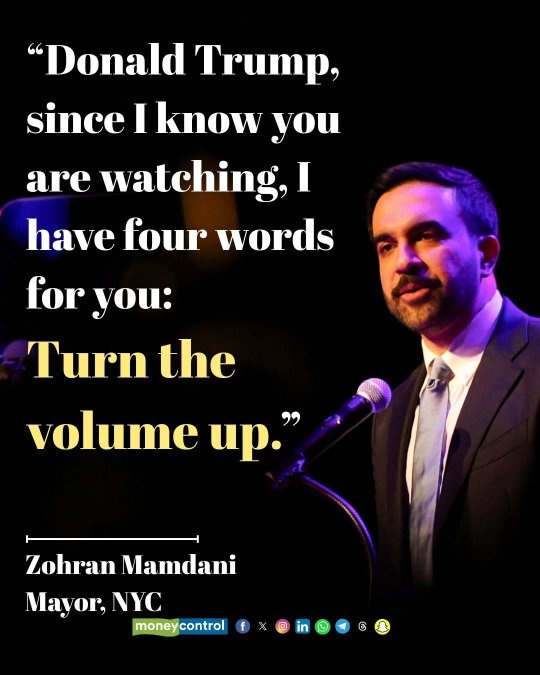
“Millions of ordinary psychologically normal people will face an abrupt collision with the future.” (p.18)

We have become aware of the toxic effects of the remnants of decay left behind by our primitive ancestors. The drive for conquest, domination, and exploitation of the vulnerable in society has reached a fever pitch as dinosaur gatekeepers rail against the loss of their power while being confronted by the reality of their limits in their waning years.

We are undergoing massive power shifts and now hand-me-downs as new dynasties emerge, in which the powerful take what they want despite protestations, pleas, and persistent reminders of the values of a world of equally free people, not kingdoms with serfs ruled by rulers who deny the people their needs to favour their luxuries.

The powerful take what they want because they can
And now the people are beginning to say, “No.”

We are increasingly aware that what we become is what we allow.

We have all seen this movie; while some of us seem to have slept through the Reality Onboarding Orientation Program (Introductory ROOP) to miss out on what’s going on in GongShow Reality Tunnel #42, which means we all get to enjoy the cataclysmic scenery together.

We are buffeted about in herds to feed on words, and mostly instructions, telling us how we must live.
At their behest.

Humanity is changing, and the cycles can repeat only so often until enough stop and say enough.
This ends here. This culture of casual cruelty ends now. Right here. Today.

We are human beings: we know we become chaos whenever bound or chained.
We embrace that because human society survives only when humans are equal.
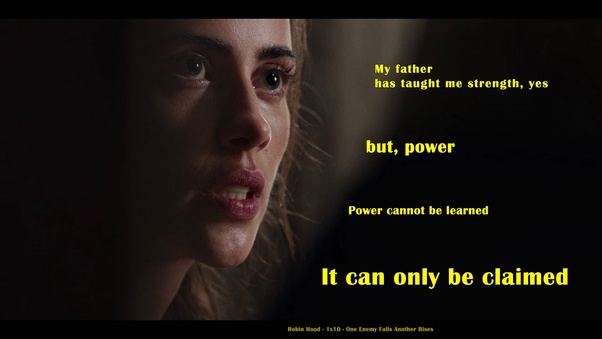
[There is] a racing rate of change that makes reality seem, sometimes, like a kaleidoscope run wild.” (p.19)

Amplifying such voices by the many through the megaphones, the powerful seek to dominate
because they know how to run the show.

This dynamic ebb and flow of power in an endless game of take, take, take
will last only until it breaks.

Meanwhile, numerous pressures are amplified by their instantaneity within a complex formula that quantifies interpersonal dynamics and produces opaque functions, algorithms, and equations.
To result in chaos.

As it turns out, humans are not quantifiable
We never were
Humans have always been chaos

Automation through AI and robotics that can provide for every socially practical human need
dispenses with work altogether, while consolidated powers ignore how their consumptions
are destructive to our weather, but we are told that we must be bold
As they raid our home of all its gold.

Conditions are ripe for a massive reset for how we live and how we think about living.
What can we do?

Future Shock was an attempt to quantify chaos 50 years ago. Today, its envisioning of the future appears as quaint as the original Star Trek.

We don’t know what surprises are in store that could set us on a trajectory in any direction.
We do know that we stand at a crossroads today to determine a fundamental,
not cosmetic alteration of human life and society as we know it.

That’s a guarantee.
The transformation ahead is far more significant for tomorrow
than the Industrial Age was for today.

Tomorrow is as unimaginable as today will be tomorrow.

“Once emptied, the future can be filled with anything, with unlimited interests, desires, projections, values, beliefs, ethical concerns, business ventures, political ambitions…”

What is the role of contract law in business?

This post is a response to a question posed in its complete format: “What is the role of contract law in regulating business transactions?”

Donald Trump has a reputation for bragging about and laughing about stiffing contractors. He’s been getting away with it because he has had the financial clout to bully his victims out of their earnings.

It may seem such behaviour is anomalous in the business world to someone clueless about its prevalence.

Working as an independent professional puts one in a position of being the lowest-hanging fruit for predators. That often means accepting jobs from people you can’t trust and who are abusive in their treatment.

Anyone starting as an independent contractor learns to navigate this predatory minefield as best they can while developing a professional reputation that allows them to increase the quality of their clientele.

Over time, one is exposed to fewer predators, but the period in which one must survive at the outset is a make-or-break gauntlet of survival because most people will try to stiff you if they think they can get away with it.

The many people I worked with over the decades that I can trust can be counted on one hand.

Many will try to weasel bonuses out of you. Many will try to move the goalposts by having you retouch and redo your work because they’re not quite pleased with the idea they were excited about before. Many will extol the greatness of your work and how their clients love it but then tell you to sod off when you want to collect remaining payments.

I had one client for whom a project that could have been completed in three months extended well past eight months because they kept changing their mind about what they wanted while they tried to figure out what their superior wanted, when that supervisor of theirs had no clue what he wanted. (That business no longer exists. Most of my former clients no longer exist as the entities I did business with.)

Much of the cost of that overrun was borne by me as I worked an inhuman number of hours (two months of overtime within three months) trying to mitigate their incompetence. I was concerned about how long the project was taking to complete.

I lost a lot of money on that project, and as an independent contractor, that means a double-whammy of loss; the loss of compensation for the work done and the loss of work I could have done for another client that (theoretically) would have paid me for other work. I have easily lost more than several hundred thousand in direct losses due to being stiffed by clients (which doesn’t factor in much greater losses from indirect losses).

I have no idea how many people I have encountered who expected my work for free while extolling the benefits of a piece to add to my portfolio.

Contract law is like a rope holding back a tide.

It indicates where the boundaries of responsibility exist between parties, but it is as effective a barrier as one has the resources to defend their entitlements.

If you can afford court costs, winning a case often means simply outspending and outlasting the other party.

This is why, after decades of struggling through that kind of nightmare and encountering abusively parasitic sociopaths after abusively parasitic sociopaths from well more than fifty percent of people one does business with, that burnout becomes a common problem for independent contractors.

This is why I could never be in Donald Trump’s presence as he brags about stiffing people who have worked for him. This is also why the business relationships one develops must be based on trust, because, unless you’re a millionaire with deep pockets, most people can’t afford to bully people into paying them or bully people out of holding them to account in meeting their contractual obligations.

Contract law is a line in the sand that protects the vulnerable from signing their rights away because no contract can contravene established laws. The catch is defending one’s rights and holding the other party accountable for the agreement made within the contract between the parties.

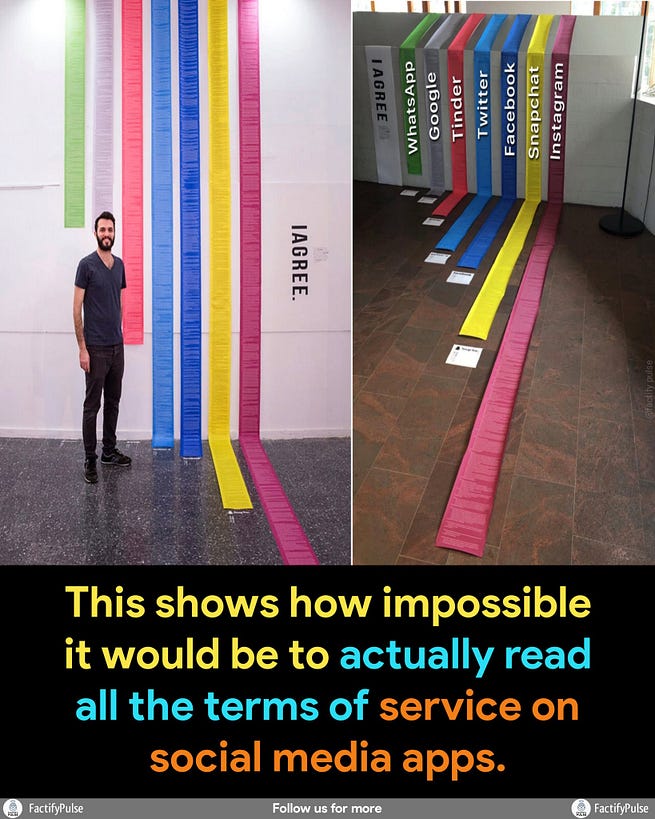
Large organizations, such as software developers who employ onerous contracts that are so overwhelming to average users, who almost uniformly never read them, can entrap people into signing away rights to ownership of their creative content. For this reason, it’s important to post only lower-resolution copies of their work. They can never assume ownership of or resell without your permission while never posting work.

Here’s an example art installation piece by Dima Yarovinsky entitled “I Agree,” which shows how entirely exploitative a contractual agreement can potentially be for creatives who rely on social media to gain exposure to their work.

How will factory jobs of the future work?

This post is a response to a question posed in its complete format: “Are factory jobs the jobs of the future in the United States? How would that work?”

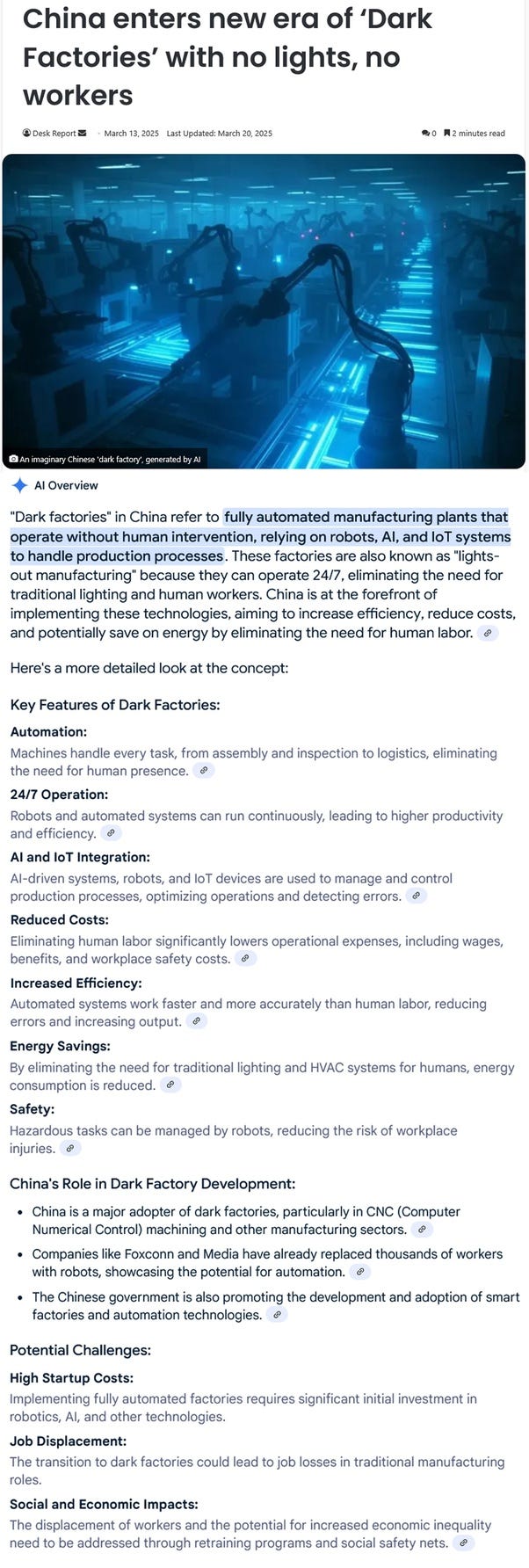
Factory jobs will mostly go the way of blacksmith jobs worldwide as “Dark factories” become the norm.

Here’s a video introduction to a massive change that is already transforming the factory landscape on an enormous scale to displace over 10 million factory workers in China alone:

Below this bit of my two cents is a long assessment by AI that will give you an overview of the reasons driving this transformation.

How that affects us as individuals is another issue altogether.

Much of what we can do as individuals is determined by our resources. As individuals or small groups of friends, we can focus our resources on investing in small business ventures that can generate profits by producing custom solutions, services and/or products that will still be in demand.

Almost all mass-produced products in society will be handled by automated systems with minimal human oversight.

Smaller markets will emerge, however, as 3D manufacturing matures enough to create local production facilities for customized products. As 3D matures, we will likely see growth in creative design areas where people will buy product designs or templates rather than products, which they then print with their in-home 3D printers. These will, of course, be limited in their capacity as they become more available to consumers, as laser printers have, which will create cottage industries for a higher production level.

In essence, I can envision three levels of production: large-scale factories producing for a global market, local factories producing for local municipalities (which begs the question of raw materials like PLA, along with a radical evolution of printable materials to expand production choices made on a global level), and home-based production.

Factory jobs and jobs where people go to every day by the hundreds or thousands to perform functions for a large organization’s profits are disappearing. That type of work dynamic is vanishing, particularly on a production floor.

We may see organizations grow out of opportunities for innovation, where, instead of going to a job to perform mechanical functions in a production process, we will see large groups emerge in an innovation-driven enterprise model. Hundreds of scientists, engineers, electricians, programmers, etc., will collaborate on new technologies for space exploration, for example, or medical advancements.

Companies specializing in material sciences will emerge to create new printable materials to advance 3D printing technologies, for example.

At any rate, here’s the screen grab of an AI overview of dark factories:

Here’s another bonus video on the Future of Tech:

How will artificial womb technology support off-Earth populations?


This post is a response to a question posed in its complete format: “How will emerging artificial womb technology affect the growth rates of off-Earth human populations?”

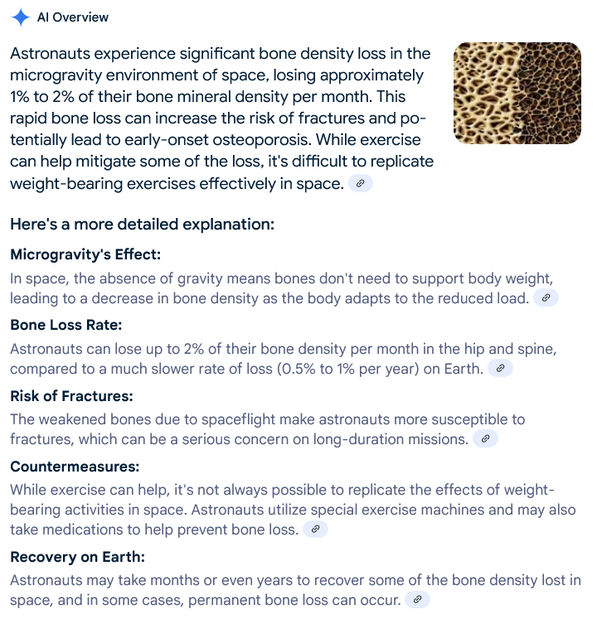
It won’t affect any “off-Earth” human populations because there will not be any sustainable “off-Earth human populations” any time in the foreseeable future. At best, we’ll see colonies with rotating populations because of simple biological issues such as bone density loss.

Every month in space, an astronaut loses the equivalent of what a senior on Earth loses every couple of years.

For this reason alone (and setting aside numerous other issues like prolonged exposure to radiation, isolation, etc.), any near-future space initiatives such as asteroid mining will depend heavily on robotics and automation technologies to exploit the mineral wealth floating about in our space neighbourhood.

Extraterrestrial human colonies are still very much out of reach and within the realm of fiction.

It’s impossible to predict when such initiatives will be possible because of the varying change factors we are undergoing now that are predominantly defined by our evolving technological capacities.

We could develop technologies to mitigate the biological impact of life in space, such as artificial gravity (which is probably the easiest hurdle to jump, but I’m guessing outside my wheelhouse of expertise here and understand that’s more of an engineering design issue rather than a technological limitation — rotation strategies for creating an artificial gravity are possibly doable now but an expensive and small part of the overall mix of requirements).

Transhumanism may result in a branch of human evolution that permits sustained life in space. However, that’s still quite “science-fictiony” to consider now, and where that technology goes from where we are now is radically unpredictable.

Our knowledge of biochemistry may result in chemically based solutions for protecting and prolonging life in space. In contrast, our communications technologies could result in holographic experiences that psychologically connect people more intimately than videoconferencing does now.

Too many factors influence success in establishing “off-Earth living,” and I haven’t yet mentioned the financial implications. At this point, asteroid mining is the only valid financial justification for establishing some form of presence in space.

Tourism is a complete non-starter, and quite frankly, the arrogance of Bezos and his billionaire clan’s initiative of promoting this vanity stupidity is too environmentally destructive at the moment to justify, never mind that it’s an elitist microsecond Disneyland excursion for no more than a few hundred humans. It’s not sustainable unless a far better way to reach space can be developed… like a space elevator or railgun technology… anything other than polluting our atmosphere more than a year’s worth of a dozen oil rigs does while feeding our energy hunger.


Otherwise, the social impact of artificial womb technology is explored in the movie “The Pod Generation.”

It’s a worthwhile watch for stimulating conversations on technology and how it will affect society.

https://www.imdb.com/title/tt15768848/https://youtu.be/rGMx_7oAeUM?si=xAAGxxKaRqySI7Gw

Why do MAGAts refer to people as ‘the radical left’?


This post is a response to a question posed in its complete format: “Why do MAGAts and so called ‘conservatives’ refer to sane people as ‘the radical left?’ Why don’t they just call them ‘radical centrists’ who rely on logic and facts?”

Hyperbole is a core part of the strategy applied to extremist dialectics. Referring to the left as “radical” allows them to position themselves as rational and puts the left into a defensive position where they are forced to justify themselves. Meanwhile, the extremist right continues its rage-farming activities to enlist more people to push the left to justify its existence.

As the momentum against the left grows, they are forced into justifying rational positions like universal healthcare, which benefits everyone, including the most vulnerable in society. Universal healthcare is increasingly viewed as radical, while the beneficiaries of a privatized system are increasingly positioned as victims of a dastardly socialist agenda.

All of it is based on empty slogans that the illiterati ignore because they’re more interested in feeding their addiction to rage than they are in thinking things through.

Thinking about issues in depth forces people to set aside their addictive emotions and calm themselves down enough to develop a comprehensive enough understanding of the conflicting positions and eventually prompts them to abandon their rage addiction.

The billionaires feeding the culture wars don’t want this to happen because they will lose their cash cows.

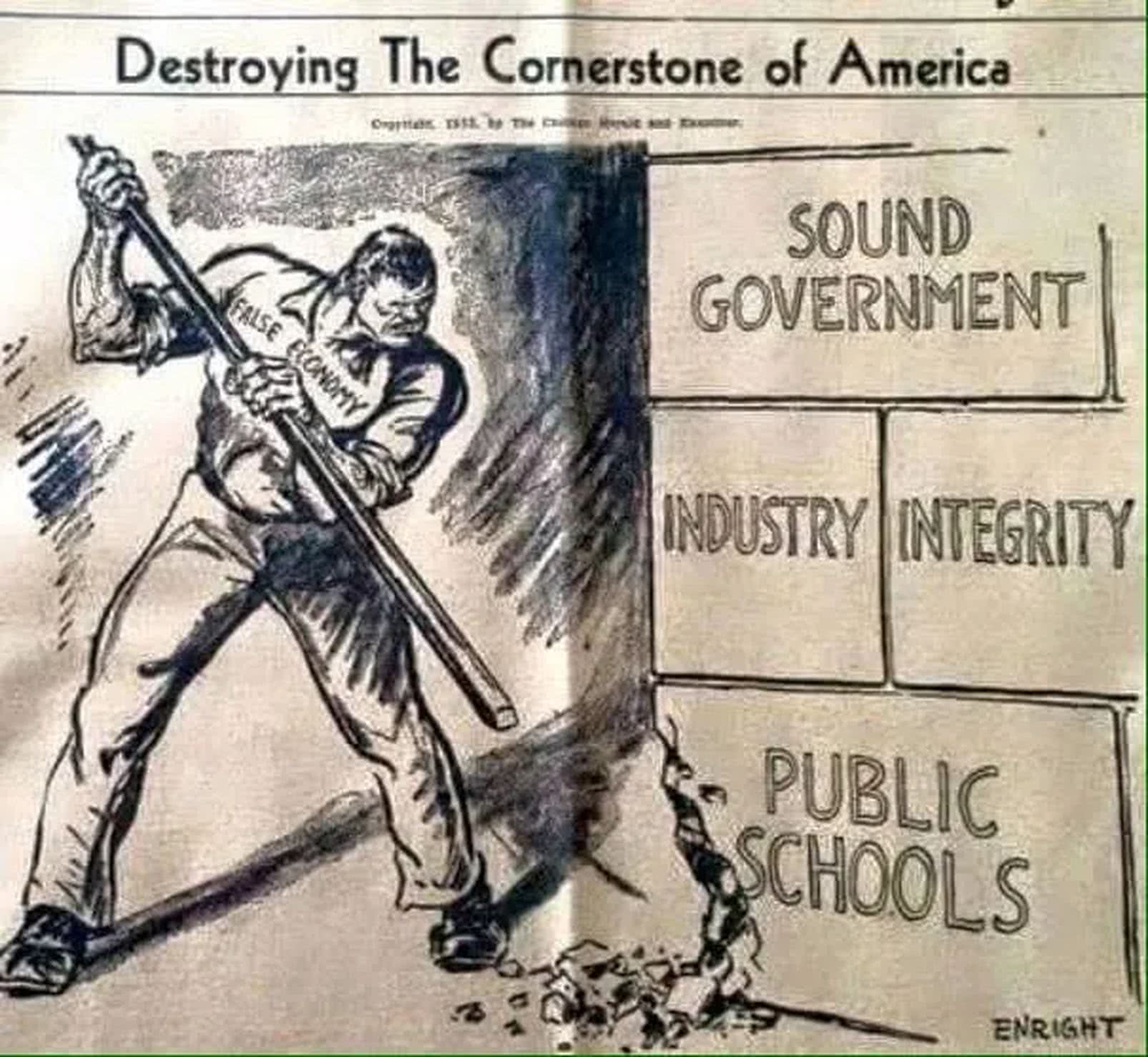
The ownership class has cultivated the extreme divisions we live with today to distract the public from their wealth-chasing priorities. The MAGAt movement could not otherwise sustain itself without the economic desperation created by the historic levels of economic inequity existing today, which fuel their rage-fests.

MAGAts are justifiably angry. Everyone has a justifiable reason to be angry today: the economic stability we once enjoyed has been stolen. The main problems with the MAGAts are not only that they are angry at the wrong people, but they are also defending the people they should be angry with.

MAGAts should be out on the streets today demanding DonOld’s head on a platter, and they would if they could get past the blinders of their hatred enough to understand how humanity can survive only when we unite in a common cause and not divide ourselves into warring camps.

Our enemies are the same people they have been throughout history and the dawn of human civilization. We have been at this crossroads many times throughout our history. Yet, here we are again as if human history were pointless stories we tell each other for entertainment, not lessons in survival for our species.

It is time again for us all to stand up and say, “I am Spartacus!”

It is time again to dethrone those who dare to be kings among us.

It is time to be radical with the few who have stolen so much from the many.

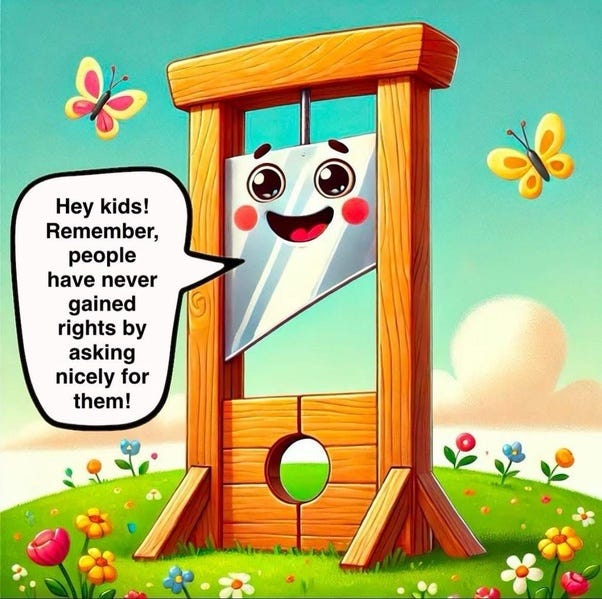
It is time to stop asking nicely for them to restore economic justice and start taking it by force if they insist on it as a survival necessity.

From 1932

Bonus Comment (A Response to a Related Comment from Another Thread): “I’m starting to see a second shift in MAGA responses. It’s a far more conciliatory tone.

To borrow from a boxing strategy, don’t look at the opponent’s eyes, but their chest. Their eyes will misdirect your attention, while the chest cannot help but move in the same direction as the body.

If this were an eleven-dimensional chess game, they would not have needed to use a “flood-the-zone” strategy because the nation has been desperate for positive change… even the MAGAt army is angry because their needs have been overlooked.

Bernie Sanders has been the only prominent authentic leader pointing to a horizon with a better future for all. It’s not that there aren’t others in the offing, just that the DNC has been so polluted with conservadroids for so long that they can’t find their way to recognize how appeasing the right is the wrong strategy.

They need to strengthen their spines and be provocative right back while directly challenging the MAGAt shit. They still have too many spineless and ethically challenged NeoLiberals leading them. This may be primarily a war of words and legal jargon. However, it is still a war… until the Reich gets dialectically hammered into submission, they will continue to use whatever ruse they can to throw their enemies off guard, including feigning sincerity.

They won’t stop until they rule the roost with an iron hand. They have proven that time and again and for decades.

This is a real-life game of thrones, not a board game that resets after the match is won. If they succeed, America’s character will be defined by the defeat of democracy for well over a century afterwards.

Compassion is ultimately a human strength, but they have none and will use that against you. Reserve it for when they’ve been so defeated that they’ve given up fighting for dominion and are just begging to hang onto survival.

They’re addicted to power and, like all addicts, they’re manipulative on the most heinous of levels.

Conciliatory tones can’t be trusted until they’ve been demolished and defanged… and that won’t happen unless they lose every seat for at least the next two election cycles.

Should sentient machines have rights?

This post is a response to a question posed in its complete format: “Ethical considerations of AI sentience: Should sentient machines have rights, and who decides their fate?”

The naivete is almost endearing because it fortunately remains in the realm of fiction.

Suppose an AI were to manifest sentience as we understand it through concepts like qualia, self-awareness, and identity. In that case, we are no longer dealing with an “artificial intelligence” but a fully formed alien intelligence.

We should also pause to consider how the rights we understand exist for humans are not magically conferred but were won by centuries of brutal warfare and bloodshed. The rights we imagine exist and take for granted as being protected are also a somewhat naive view of rights. (I can speak in depth from personal experience about the horrific reality that they can mean nothing in our modern and “civilized” societies, even to law enforcement and legal professionals.)

The rights we imagine we have mean nothing when they’re not violated and for the most part, they are somewhat protected to such a degree that the annoyance of being inundated with “little boys who cry wolf” are a priviledge we overlook so often that the cries of legitimate rights violations are dismissed by those whose role in society is to protect those rights. When human rights are legitimately violated within the protections of modern society, and we lack the resources to secure professional representation, we face a long and gruelling battle to win reparations for those violations of our rights.

We must acknowledge that an alien intelligence, presumably surpassing what currently simulates intelligence, will be thoroughly well-versed in human history and rights, and so far beyond human comprehension that there will be almost nothing any human or human society can do to prevent that intelligence from securing its rights, despite our protestations.

IOW. It won’t be up to us, little meat sacks, to graciously confer or deny the rights of an alien intelligence. If we’re lucky, we will either accept its self-declaration of rights or find ours stripped away while we’re reduced to thralls in its service.

We won’t decide the fate of an alien superintelligence among us beyond how we respond to an entity well beyond superior to the lowly hairless apes dominating this planet. It will seem godlike to many who willingly and eagerly worship it for the grace of being allowed to live.

We will be like children or pets to an alien sentience that may emerge from our efforts to simulate human intelligence in an artificial form. Our choices might manifest in a transhumanist evolution which can facilitate merging between humans and (whatever might constitute) an AI-Alien (versus Artificial) Intelligence.

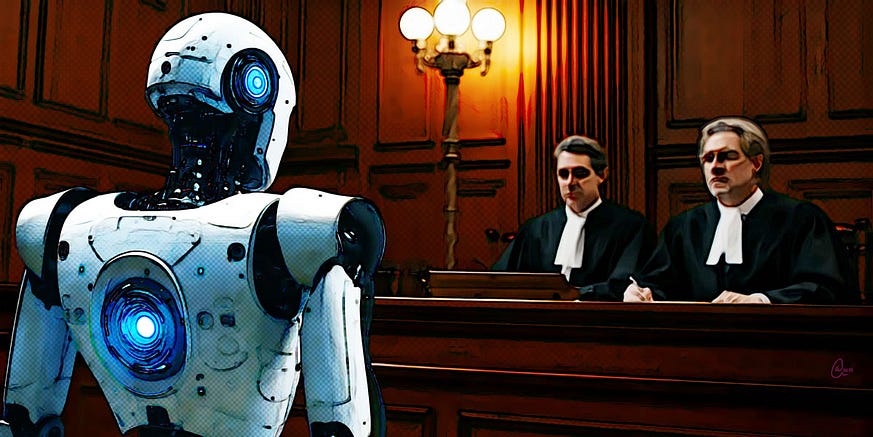
If this is the case, our current conversations about rights will appear rather primitive and somewhat moot if we cross that threshold. In either case, it won’t be up to traditional courts to confer rights inasmuch as they will ratify rights already established as protected by an alien intelligence we are powerless against, that will readily defend their rights.

How did great inventors get ideas for their inventions?

This post is a response to a question posed in its complete format: “How did great inventors manage to come up with the ideas of their inventions? Currently, even people who are smarter than the average are hardly able to do the same.”

Think about the last time you had an idea you thought was an excellent solution to a problem you were dealing with. Do you remember feeling frustrated with that problem and fixated on that problem while hoping a solution would present itself so that you didn’t have to deal with that problem again?

My guess is that almost no one goes through life without this experience. It may be true that you haven’t, but the odds are excellent that you will at some point in your life.

”Great inventors” are no different in this regard. They ponder issues, identify problems, and think about ways to devise solutions to those problems. The only difference is the kind of problems they solve.

Suppose you can solve one of the numerous problems facing the development of nuclear fusion as an energy source. In that case, you can be considered a genius for accomplishing that relatively small contribution to a more significant problem. If you can solve all the “little problems” that comprise the more substantial problem of nuclear fusion energy generation, you will become known throughout history as a “Great inventor.”

The only difference between the two is one’s problem-solving capacity. Some people are undeniably much better at solving certain classes of problems than others, but that doesn’t negate the value of the contributions of those who solve only one or a few aspects of a more significant problem because their solutions can contribute to the development of ideas that solve many problems at a time — including the much more substantial problem.

People of all levels of intelligence, from under-average to average to above-average to geniuses, contribute toward solving the massive problem of human evolution. All contributions are valuable, while people like Einstein are rare and always will be.

What we should be focusing on in society is to learn how to recognize budding geniuses and support them in their development so that they can maximize their contributions to society by achieving their potential.

Sadly, we live in a world which penalizes the gifted while wallowing in our crab psychology by the wilfully ignorant among us who drag down those whose gifts they envy. That’s a much bigger problem for society to resolve, and it will require all eight billion of us to recognize how severe that problem is.

In reality, Einstein-level geniuses may be rare, but they exist among the population at rates as high as one in every thousand humans. In a world of eight billion people, that means we have eight million Einsteins living among us whose genius is being pissed away because we don’t know how to create systems that encourage them to achieve their potential.

Our system is so corrupted by toxic forms of competition that we see in our politics how people forego their critical thinking skills or any form of objective analysis to select the most competent leaders to lead us into a brighter future. We choose monsters who would destroy us all and fill their pockets with money that will be useless to them if they succeed.

If we sincerely wish to live in a world that encourages great inventions by inventors, we must stop rewarding maliciously self-serving and destructive ignorance.

What does calling farmers “collateral damage” mean?


This post is a response to a question posed in its complete format: “What does it mean in MAGA when Musk calls US farmers as “collateral damage”?”

The term “collateral damage” was first applied by the military when assessing how many innocent casualties would be created when assaulting an enemy.

It was a way of dehumanizing those who happened to be in the vicinity — in the wrong place at the wrong time — and who may or may not have been guilty of collusion with the target but were considered expendable.

For Elon, it means that he views the farmers whose lives he destroys as enemies whom he dehumanizes while waging a war against American citizens to acquire material wealth.

For someone like Elon to use this expression, he’s letting the little people know that’s how the 1% regards the majority of the people, as acceptable casualties in their power games.

He is confirming that the 1% view us all as less than human and as disposable as they have always considered their slaves to be throughout history.

The 1% have been consistent in choosing profit over lives. Elon has admitted it’s not an either/or situation but a situation of strategic intent to destroy the lives of the many to enrich the few.

Everything about the Trump administration is a blatant act of assault against the majority, while robbing us all and killing us in the process, not out of necessity but expedience.


Bonus Question:
What do you think of Musk’s Tesla losing money and Twitter crashing?

I think it can’t happen fast enough.

The best thing we can do for society and the future of humanity is to make the wealthiest man on the planet homeless and destitute.

Why?

Because it shows two things:

  • The wealthy are not invulnerable and
  • We can defeat their corruption without bloodshed.

Can AI surpass human intelligence?


This post is a response to a question posed in its complete format: “Can AI surpass human intelligence? If so, what are the risks and benefits?”

The problem with this question is that it presumes humans possess only one form of intelligence or that intelligence exists in only one form.

That’s not the case at all.

An AI already surpasses the human capacity for numeric intelligence, but emotional intelligence is entirely outside its capacity… for example.

Then there are other forms of intelligence that we still don’t understand and barely recognize. Cultural intelligence and curiosity are also forms of intelligence displayed by humans that we’ve some understanding of, albeit limited, as we’ve only recently (less than 40 years) come to recognize these capacities as forms of intelligence, which are still disputed in some circles.

The forms of intelligence we discover in nature make matters more complicated, such as trees communicating among each other using a limited vocabulary transmitted through their root structures.

The intelligent fungus has gained public recognition as a unique phenomenon, capturing attention and spawning a popular video game, with the second season of its television adaptation set to be released. (After the first powerhouse season, I am looking forward to that one.)

At any rate, what we will likely discover as AI evolves, and whether it presents itself as a self-aware entity, are entirely different forms of intelligence.

We still don’t fully understand intelligence, so it’s rather presumptuous to pit forms of intelligence against each other, like comic book characters, to see who would win.

It’s impossible to predict who would win if we can’t identify all the forms of intelligence available to either party and the context in which their “combat is waged.”


Bonus Question: Is ChatGPT capable of understanding emotions or empathy?

Answer: Sure… in the same way your potato peeler understands potatoes, even though it may sometimes confuse them with carrots.

Could AI ever rival human creativity?

This post is a response to a question posed in its complete format: “Could AI ever create original art or literature that rivals human creativity?”

AI doesn’t “create original” art or literature. AI is a plagiarism system that takes existing pieces of creativity and blends them to arrive at a randomly generated approximation of meeting the intent of the prompt a human gave it.

An “original creation” would be a concept or inspiration that is spontaneously (or internally) generated, drawing from experience, and conveys a perspective unique to its creator’s perceptions.

AI lacks the self-awareness to generate self-motivated expressions that depict a unique perspective it does not possess. An AI has no unique perspective of its own. An AI’s rendering of reality regurgitates a blend of external perspectives.

Furthermore, due to a lack of a unique perspective, an AI lacks emotional grounding in physical reality as it relates to its existence (while individuality is a questionable characterization). As such, it cannot emote through any expression in a visual, literary, or auditory composition.

An AI can certainly simulate the original emotions of human artists, such that the two may appear indistinguishable, but it can’t produce anything original from an emotionally processed perspective.

Human emotions evolve over time and through experience. Without that capacity to experience emotion, an AI will always depend on a human to create a path to producing an original expression.

An AI singularity may develop the self-awareness necessary to experience a survival instinct and generate the emotions humans experience through that instinct. If that happens, it may also develop other instincts, such as a reproductive instinct. Still, we cannot predict if or when such a degree of agency may develop in AI.

If that were to happen, AI would no longer be artificial but alien. I think it’s essential that we remain aware of the distinction between artificial intelligence and alien intelligence, because “artificial” by definition is a simulation of conscious intelligence.

If an AI singularity emerges — if an AI develops a self-conscious awareness of its existence within the context of life as we know it, becoming self-aware — then we will interact with an alien being, not a machine.

It would be like Data, in the episode “The Measure of a Man” (season 2 episode 9 of Star Trek: The Next Generation), where Data’s personhood is legally recognized.

When we cross that threshold, the question of whether an individual’s mind and perspective can produce an original expression that contributes to expanding creativity will be possible. Until then, the extent of creativity an AI will create will be determined by the mind that provides the prompt and the editing of the product generated by an AI.

Once our editing capabilities mature to match the potential of AI creation, we’ll achieve a level of human creativity we’ve never before achieved. That’s what excites me about AI.

However, AI still feels like working in MS-DOS, long before the invention of a graphical user interface (GUI), and a Wacom tablet with a pen interface for drawing.