How different will the late 21st Century be?

This post is a response to a question posed in its complete format: “Do you think the late 21st century will be different from the early 21st Century just like the early and late 20th Century are nothing alike?

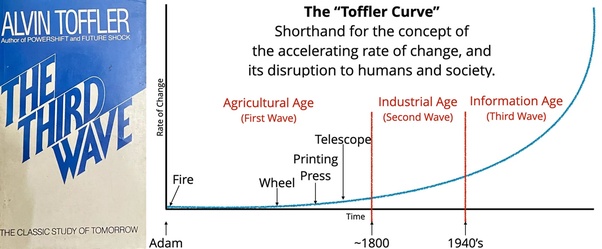
The rate of change has been steadily increasing. We (the public at large) have been made aware of this increasing rate of change since Alvin Toffler’s Future Shock was published in 1970.

Re-reading Future Shock, 50 years on

“Western societies for the past 300 years have been caught up in a firestorm of change. This storm, far from abating, now appears to be gathering force.” (p.18)

Future Shock Complete Film on YouTube (1:53:13)

“Future shock is the dizzying disorientation brought on by the premature arrival of the future… [It] is a time phenomenon, a product of the greatly accelerated change in society.” (pp.19-20)

The degree of change between the two centuries will be far more pronounced at the end of this century than the changes that occurred throughout the previous century and all preceding centuries.

Most answers focus on technological change, but this is the most apparent change because many can still remember an analogue age in which telephone communication involved an electronic umbilical cord and displays were limited to televisions and equipped with oddities called “rabbit ears.”

OMG! You had to get up from your seat and move a few feet before turning a dial to watch something different. We have demanded a remote controller for almost every electronic device since enduring that torturous existence. Now, we’re drowning in remotes we can’t find when we need them, while they demand an additional expenditure of precious dollars to feed them energy from disposable batteries.

Technological change alone represents multiple dramatic transformations of human society
and in how we will live from day to day. Today’s world of work will appear both alien and punitive to a world of work that will more closely resemble pre-industrial human society, according to Toffler’s third future-prediction book, “Third Wave.”
Technological change expands the possibilities of what can be considered human and redefines humanity itself. We can already see a massively transformative future for human biology through expanded medical and healthcare solutions to physiological needs and the emergence of a transhumanist movement that emphasizes the benefits of technological augmentation. While we remain cautious about biological alterations and focus on non-invasive technologies, medical solutions to limb loss, for example, are increasingly human-like in function while superior to their biological counterparts.

Like tattoos, artificial enhancements have been considered social taboos (for a short period, under the influence of Victorian sensibilities governing socially acceptable norms); however, they can conceivably become a popular means of “touching pseudo-immortality” and achieve small degrees of “super-humanity.” Genetic modifications will expand beyond preventing the transmission of genetic diseases to include prenatal selection of traits for one’s children. This will occur despite moral outrage because those with means will seek the greatest advantages they can for their lineages.

Technological change, however, is not the most radical change we are currently undergoing. Technology, however, has inspired, enabled, fueled, and empowered the most radical changes to date: ourselves.

We, as humans, are dramatically transforming, through growing pains demanded by our need to build a cooperative world in which cultures that once existed in isolation must now become interdependent to survive. Human psychology is being fundamentally restructured globally, in a way consistent with nature’s demand that we adapt or die.

Old forms of thinking and social organization cannot survive this transition without severely curtailing our social evolution, and they are trying to do precisely that. The MAGA sensibility and its adherence to a fictional nostalgia where familiar power structures continue to wreak havoc on outsiders is unsustainable in a global community that thrives on diversity.

We must learn to communicate and cooperate through mutual respect, and that’s why so much is so messy today. We haven’t grown up. We’re still in grade school, where our leaders mock 12-year-old girls and their base ignores that as irrelevant.

We are currently confronted with the sum of our human flaws and weaknesses, as well as with the social, economic, and psychological dysfunctions we have inherited from our forebears, through a focal point created by technology. Everything we once ignored and silently turned away from has become magnified and loud.

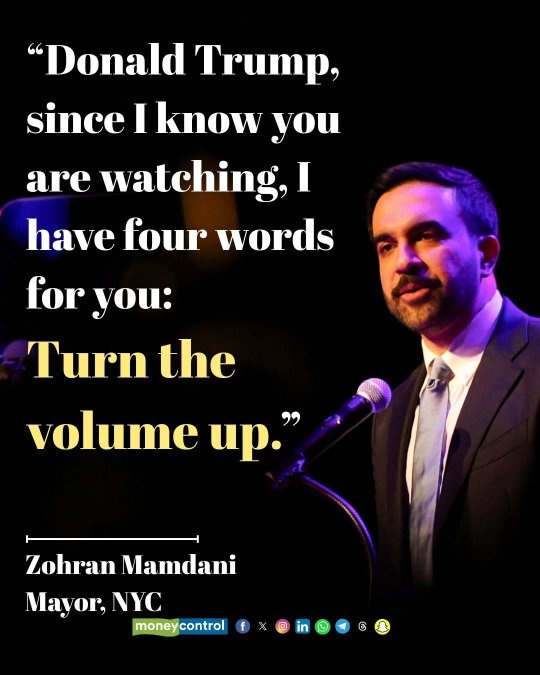
Each day that passes, the volume of discord increases as we negotiate new terms for the social contracts binding us all to a construct called “civilized society.”
“Millions of ordinary psychologically normal people will face an abrupt collision with the future.” (p.18)

We have become aware of the toxic effects of the remnants of decay left behind by our primitive ancestors. The drive for conquest, domination, and exploitation of the vulnerable in society has reached a fever pitch as dinosaur gatekeepers rail against the loss of their power while being confronted by the reality of their limits in their waning years.

We are undergoing massive power shifts and now hand-me-downs as new dynasties emerge, in which the powerful take what they want despite protestations, pleas, and persistent reminders of the values of a world of equally free people, not kingdoms with serfs ruled by rulers who deny the people their needs to favour their luxuries.

The powerful take what they want because they can
And now the people are beginning to say, “No.”

We are increasingly aware that what we become is what we allow.

We have all seen this movie; while some of us seem to have slept through the Reality Onboarding Orientation Program (Introductory ROOP) to miss out on what’s going on in GongShow Reality Tunnel #42, which means we all get to enjoy the cataclysmic scenery together.

We are buffeted about in herds to feed on words, and mostly instructions, telling us how we must live.
At their behest.

Humanity is changing, and the cycles can repeat only so often until enough stop and say enough.
This ends here. This culture of casual cruelty ends now. Right here. Today.

We are human beings: we know we become chaos whenever bound or chained.
We embrace that because human society survives only when humans are equal.
[There is] a racing rate of change that makes reality seem, sometimes, like a kaleidoscope run wild.” (p.19)

Amplifying such voices by the many through the megaphones, the powerful seek to dominate
because they know how to run the show.

This dynamic ebb and flow of power in an endless game of take, take, take
will last only until it breaks.

Meanwhile, numerous pressures are amplified by their instantaneity within a complex formula that quantifies interpersonal dynamics and produces opaque functions, algorithms, and equations.
To result in chaos.

As it turns out, humans are not quantifiable
We never were
Humans have always been chaos

Automation through AI and robotics that can provide for every socially practical human need
dispenses with work altogether, while consolidated powers ignore how their consumptions
are destructive to our weather, but we are told that we must be bold
As they raid our home of all its gold.

Conditions are ripe for a massive reset for how we live and how we think about living.
What can we do?

Future Shock was an attempt to quantify chaos 50 years ago. Today, its envisioning of the future appears as quaint as the original Star Trek.

We don’t know what surprises are in store that could set us on a trajectory in any direction.
We do know that we stand at a crossroads today to determine a fundamental,
not cosmetic alteration of human life and society as we know it.

That’s a guarantee.
The transformation ahead is far more significant for tomorrow
than the Industrial Age was for today.

Tomorrow is as unimaginable as today will be tomorrow.

“Once emptied, the future can be filled with anything, with unlimited interests, desires, projections, values, beliefs, ethical concerns, business ventures, political ambitions…”

Is the entire world moving further to the right?

This post is a response to a question initially posed on Quora, and can also be accessed via “https://www.quora.com/Is-the-entire-world-moving-further-to-the-right/answer/Antonio-Amaral-1

The entire world is undergoing a massive transformation that has steadily escalated in speed and scope year by year for decades. Although the world has constantly been changing, this degree of change is unprecedented.

I remember Alvin Toffler’s predictions on this in Future Shock from when I was a kid in school, and we had the opportunity to watch his documentary in the classroom. Among the many predictions, this rate of escalating change has always stood out for me as a consequence of being repeatedly reminded of it throughout my lifetime. I thought the beginning of the Information Age represented a peak of speed of change, but that was just the beginning of ramping up the rate of change to come.

With great changes come great uncertainty, and that fires up anxiety levels everywhere.

Making matters worse has been the class warfare reaching new peaks of disparity driven by thefts of the working class by the tens of trillions over the last few decades as world politics began shifting rightward.

Before Reagan and Thatcher, many of the democracies in developed nations around the globe still viewed the government as somewhat of an ally, even after experiencing perceived betrayals through global events like the war in Vietnam and Britain’s mishandling of the IRA in Ireland and “Sunday Bloody Sunday.” JFK’s assassination shocked the world. Labour strikes rocked the world.

People were fed up then with disruptive elements and had developed a level of comfort with their daily lives and their expectations for their future that they lost touch with the value of disruptive events like strikes. No one then realized how a disruption to their air travel plans was a positive and necessary event in a healthy democracy when negotiations broke down. The general attitude of entitlement to expectations of service became an easy wedge to force between the public and the labour organizations fighting to maintain equanimity between the classes.

Demonizing government became a path to power within government because the people in democracies began believing corruption was also as endemic to the government as unions. Political systems began being viewed through a cynical lens, while conservative politicians have since leveraged that sentiment to gain political power for themselves.

Regan’s firing of air traffic controllers was accompanied by a cheering public who saw their travelling conveniences disrupted rather than their quality of life being protected. People had begun forgetting almost a couple of centuries of sacrifice in fighting for fundamental rights and protections like weekends off, overtime pay, and healthcare benefits.

Employers had begun implementing progressive strategies for supporting staff, so the protections provided by unions began to seem redundant and perceived as an unnecessary cost for supporting a political organization that often ignored the needs of its constituents. Unions began being viewed as corrupt organizations rather than protectors of the middle class that they helped build and grow.

Conservatives took advantage of this new embrace of the ownership class and cultivated a belief that it was within reach of everyone who worked hard and lived responsibly. The American dream was possible by the beginning of disassembling the structures that gave rise to the middle class.

Reagan’s tax cuts and the heyday of spending, which characterized the 1980s, made it seem like the wealthy were just like everyone else and were equal members of a human community willing to share in the prosperity.

It was easy to support conservative ideology because it seemed the most pragmatic. Even today, people will describe themselves as “conservative” more out of an avoidance of needlessly attracting unwanted and disparaging public attention and appearing reserved than out of an embrace of a political ideology.

When people refer to themselves as “conservative,” they usually do so to appear “normal,” “predictable,” and “approachable,” while those who are not are generally viewed as “erratic” and “disruptive.” This perception is what has made conservativism most popular. It is easy to equate “fiscal conservativism” with sound financial management strategies, even though political conservatives constitute the worst among the worst economic managers. We have had decades of conservatives blowing up debts across every nation they held leadership roles in and are still publicly viewed as fiscally competent.

Conservativism represents an imaginary form of stoicism in which people hunker down and do what needs to be done because that’s the only way to survive adversity.

In times of stress and fear, withdrawing from positions of risk seems generally the safest approach toward surviving adversity. We’ve had countless generations learning to do without to make ends meet. Our forefathers lived during times of scarcity while production efforts scrambled to keep up with demand.

Most people lived independently and without the social support fought for and won by the progressives in society who demanded equitable treatment from the ownership class. They also responded to adversity by hoarding their assets as a survival strategy through adversity. Scarcity was a fact of life until only a few decades ago when our means of production exceeded our demand.

We are already living in an entirely new world, while most people born before the advent of the information age still live as if scarcity were a challenge for the human species. Most do not understand how dramatically opportunities have shrunk for people starting today like they did yesterday. Many, if not most, perceive today’s complaints and social disruptions as a consequence of overreach by attitudes of unearned entitlement.

Many live in today’s world as if it were still the 1980s without realizing how much they once took for granted has been stolen by the ownership class. What they see is increasing disruption to the predictable life and world they once knew, and they seek to blame progress itself as the culprit responsible for their anxieties. This causes people to turn inward in a protectionist strategy for survival.

The attitude of protectionism has been steadily rising while being stoked by conservative politicians as they have cultivated a cynically misanthropic attitude among their supporters toward their fellow neighbours. They take every opportunity to demonize concepts that make people feel uncomfortable and politicize them for personal gain.

Everything about the conservative ethos today has been geared toward hating anyone and anything that can potentially disrupt the sanctity of a predictable existence. Fear and hatred have been the weapons of choice wielded by conservative power mongers, and it works because people respond to threats on a visceral level before they can afford the risk of examining them for their rationale.

Conservativism is a “shoot first and ask questions later” approach to anxiety, and that used to work on some levels in a simpler world with simpler problems. Unfortunately, it only exacerbates the issues we face today.

Fortunately, within the hard swing to the right throughout these last several decades exist the seeds for reversing the course of a political pendulum that has been perpetually swinging to either extreme before being yanked back to an inevitable centre where stability lies.

It may be that we will continue swinging further rightward, but the further we go to the right, the more powerful the backlash becomes. If we find ourselves facing full-blown fascism as a clear threat to our democracies, then we may be in for some seriously chaotic times, but that’s when the voice of reason becomes influential as a guide out of madness.

We desperately need bold leadership that can press for the necessary changes we must make to our systems to ensure our transition into a fully automated society creates minimal casualties, or we will risk warfare. We can no longer afford capitulating gestures because the conservative opposition has been clear that it doesn’t negotiate in good faith. Like all situations with bullies, the only solution to their entrenchment is to meet them on their level and overpower them to such a degree that they relent.

This is the prisoner’s dilemma in game theory, where tit for tat is the only way out of this mess right now. We can face the issues head-on or watch everything collapse, hoping some miracle saves our assets. We are most definitely at a crossroads as a species, and the right appears hellbent on subjugating everyone not approved as core representatives of their tribe.

How do atheists view the concept of being born again?

This post is a response to a question initially posed on Quora, and can also be accessed via “https://divineatheists.quora.com/How-do-atheists-view-the-concept-of-being-born-again-60

I remember someone I once trusted approaching me for relationship advice.

I don’t remember the specific complaints registered against him by his then-recent ex, but I remember how he tried to convince her that he had changed overnight.

The next day after she ended her relationship, he returned to her and claimed he had changed.

After relating that to me, I tried to explain to him that’s not how change works. One doesn’t change oneself like they change their clothes, most certainly not overnight.

That wasn’t my best approach to helping him overcome his anxiety. He outright rejected what I tried to get him to understand. I believe that was the last conversation he and I ever had.

However, His attitude toward change stuck with me as I struggled to understand that thinking. I thought of it as chillingly superficial and worse as it appears to be an attitude which fits within the mindset that justifies telling people what they want to hear.

Everything about how a certain mindset perceives the world around them is based entirely on optics, and their behaviours are mere performances designed to elicit desired responses from their audience.

It left me feeling cold, and I’ve learned to understand how severe a red flag that is. I wish I hadn’t been such a slow learner in this regard because I could have saved myself a world of hurt if I had fully considered the implications of that behaviour then.

At any rate, the notion of undergoing a transformative experience had always intrigued me as I deliberately sought paths and methodologies for transcending limiting ways of being. From a very young age, I was aware that I was conditioned into being what I conceptually rejected but required something tangible to transform my desire for change into actual change.

Symbolically, the notion of being “reborn” is a ritualized performance in which people present themselves as if they had changed from committing to a belief system and being “remade” by that commitment itself.

People who have undergone such a ritual sincerely think they have transformed into a better version of themselves. Their exclamations, however, have more often been expressions of hopeful anticipation rather than observable reality.

Their subsequent behaviours and fundamental attitudes remain the same. From an outsider’s perspective, the only change visible was the compass setting they prioritized.

Although some stick with their new compass setting over the long haul, many returned to being who they always were while dismissing a temporary compass setting as one they outgrew and was no longer relevant to them.

Some remained within their faith but regarded it with their “old eyes” and treated their entire relationship with their beliefs and community as a game of optics. Others moved on as they acknowledged their experience as helpful but not enough to commit to it for a lifetime. I found this latter group more authentic in their journey of discovery. The clarity of direction or need they expressed as they described their choices through fogs of confusion they struggled to dispel always made them feel more human to me. In contrast, I found those who appeared to skim through emotional turmoil somewhat confusing. I didn’t know how to interpret their responses to emotional struggles. I must have envied them as I could never respond to my own in similar ways and often wished I could have. It seemed to make life easier for them.

These “performers at life” always made me feel cold, though, and it’s taken me a long time to understand why.

Understanding how a proportion of our population lives through a shallow lens may be conceptually easy to grasp superficially, but that’s not a satisfying apprehension of the phenomenon. One inevitably finds oneself mystified by its manifestations while wondering why they feel put off in ways they don’t quite understand. It can be a harrowing journey to fully grasp the implications of such a life on a visceral level for those whose feelings run deep.

Another example was an individual who had been married for about six years and who I had gotten to know as a close couple who seemingly shared everything. Conversations with either always involved extolling the virtues of the other and never was an unkind or critical word shared. I thought they were a remarkable example of a successful couple until the husband informed me they were getting divorced.

Their separation appeared as if life sped forward at super-speed for them because it all took place within a couple of weeks — from agreement to the formalized documentation of divorce. There was no emotional turmoil I could detect in the husband, as the ex-wife had already left, and I had no means of gauging her condition. In his case, however, I was more shocked at his ability to move on than I was at their separation.

For him, it was as if nothing of note had happened in his life. I couldn’t fathom that, particularly after having endured my periods of extended angst over far shorter and more superficial commitments. I remember envying his ability to rebound from what would have been at least a year or two of turmoil for me.

I didn’t realize until later that his personality was characterized by subtle paranoia and mistrust toward others on mostly innocuous levels. I first noticed that aspect of his character after he described a business venture I found myself intrigued by and expressed how much I liked it. His response became immediately cold and protective of it. He clarified that I had no place in his venture even though I had not expressed such desire or intent.

I remember switching the conversation at that point and inquiring about his ex-wife, and I was curious to know if she was doing well. His response was mainly dismissive, but he let the cat out of the bag by indicating that the reason for their divorce was his unfaithfulness.

The ability to move on quickly from a profoundly emotional experience had often been a source of admiration for me. That was before I understood the costs of such a state of being — to both themselves and those they inevitably victimize.

I don’t think he was ever capable of connecting deeply with anyone, and I didn’t understand, even then, how profound that was. I knew it was essential for me, and I accepted how that might not be for others. I didn’t think of it as a toxic dysfunctionality — even though I should have known better after having experienced it with many others so often throughout my life.

From a ritualistic perspective, there can be some benefit to undergoing a formalized process that symbolically represents change and, more importantly, a desire for change. However, it’s all done for optics more than acknowledging the necessity of change and its role in one’s personal growth.

I always have felt this way, but I never understood how that attitude itself, on my behalf, was present even as a child when I underwent my first confession. It wasn’t conducted in a booth but in an empty classroom on a chair across from the minister. We were in full view of each other without obstruction, and he asked me to speak.

I struggled to find words while suppressing a broad smile as I found the experience entirely superficial. After all, how could I possibly be exonerated of guilt over actions I may have taken that were considered sinful by simply uttering them to this stranger? At the age of eleven, the most egregious sin I could think of was masturbation, and I suppose that might have been why I struggled to suppress a broad smile.

Within a belief system that purports to provide adherents with pathways for growth, I can understand and support the prescriptive manner of formalizing rituals to celebrate that growth. The shortfall in converting subjective experience into an objectively procedural system is that it fails to account for individual differences. It is a process that cannot account for or mitigate abusive misuse.

Much like the reporting systems across all social media, the symbolic ritual of change is a tool that can be weaponized for personal gain. The emphasis on optics is a form of corrupt thinking which overlooks the critically ineffable in favour of supporting shallow expedience.

The concept of “being born again” is just a formalized process of stripping profundity from life in favour of optics because we do not, as a whole, value depth in a world that has industrialized human existence and reduced the human condition to the level of a disposable commodity.

We have evolved into an increasingly dehumanized existence while being led by institutions that claim to represent higher states of being. Our only hope for reclaiming our existence as human beings capable of achieving our potential is completing our transformation into a fully automated society. It will only be once we cross this threshold that human beings will be free of the superficial trappings of optics made necessary by the industrialized herding of our species. The function of symbolic optics is an inherent limit to our potential as individual beings within what we refer to as “civilized society.”

I believe the concept of “being born again” should be viewed with great suspicion and mistrust because it reflects nothing of an individual’s inner world or the foundation of their character.

It can, however, be a practical means of applying a metric for identifying differences between that standard and one’s words and deeds to triangulate a more accurate picture of one’s internal world.