This post is a response to a question posed in its complete format: “What’s the point of working if you can live through getting “benefits”?”
You’re asking the wrong question.
Instead, you should ask, “What is the point of living like a lazy slug who accomplishes nothing and does nothing to make themselves feel good about themselves or their lives?”
That’s what you’re implying with your question.
You imply a false dichotomy between living one’s life based on laziness rather than doing what motivates them or submitting themselves to an abusively dehumanizing existence as a disposable cog to make someone else rich while struggling with one’s self-respect.
Life isn’t a choice between working and not working. It’s a choice between employment as a wage slave or generating an income for oneself based on doing what matters to them and which motivates them to be excited about their lives.
Employment used to be a motivator when the income generated enough to go well beyond meeting basic needs and into enough disposable income to invest in one’s future.
That’s no longer the case.
Employment today is the equivalent of a lifetime of dog-paddling in an ocean until one gets too tired and drowns.
That’s not a life. That’s a lifetime prison sentence.
What’s the point of struggling in poverty until you die to make someone else wealthy when you can be much happier and less stressed while doing what you love?
Bonus Question: Should there be a universal basic income to address economic inequality?
UBI doesn’t address the issue of economic inequity, and it isn’t intended to.
UBI provides economic stability and gives people room to make the best choices for themselves without having a desperate need to survive leveraged against them.
UBI frees people from the pressures of meeting basic survival needs enough to escape oppressive working conditions. The consequences of businesses losing the leverage of economic desperation to create downward pressure on wages can more easily permit upward pressure on wages.
This change in a negotiating dynamic contributes to a reduction in economic disparity, but it doesn’t address it head-on.
This post is a response to a question posed in its complete format: “Would people continue to work if everyone received a universal basic income ($2,000 per month) for the rest of their lives?”
The numerous tests that have been performed bear out that they would, but that’s overlooking the problem with this question and its mindset.
The people who ask this question never bother to consider the percentage of the population that never has to work for someone else to sustain a living income.
The average net worth of the top 0.1% worldwide is around $62 million.
No one in this wealth category must work for an income at any point throughout their lives. Having their money in a low-interest-bearing account would be enough to live on the interest alone and without touching their capital.
0.1% of the population is 8 million people.
Eighty million people worldwide comprise the top 1% of the population, with an average net worth equivalent to the lifetime earnings of most reasonably upper-middle-class workers. No one in this entire group of 80 million people must be employed to survive comfortably.
Every time the question of how people will live once they are no longer forced into an (often abusive) employment relationship (in which abusive employment conditions comprise the primary reason people leave their jobs), the implication is that they will turn into lazy do-nothing slugs.
Meanwhile, 80 million people somehow find ways to keep themselves occupied daily without anyone wondering if they’re lazy layabouts. Even if they are, no one seems to care.
All of the tests performed to determine the viability of UBI involve people who would otherwise be compelled to work in soul-crushing roles while being subjected to people on power trips who should never have any power over other people.
No one who asks this question seems to consider how those 80 million people manage to make it through their lives doing absolutely nothing. No one assumes they do nothing because we see the results everywhere. In fact, without that group of 1% elites, we’d never know the upward mobility that has led to the creation of a centibillionaire class.
The reality that the misanthropes presuming people need to be herded like animals throughout their lives is that without having to piss away most of their lives on basic survival, people would invest their time in themselves and become involved in activities that bring meaning to their lives.
Whether that constitutes “work” or not is a matter of semantics. Many people who would not be required to commute to a daily dehumanizing ritual of functioning like a disposable cog would perform functions in society that many others would find valuable.
Some would devote their lives to becoming successful caretakers for their families, friends, and neighbours in need while adding positive value to their community with basic tasks such as performing chores others could not. They may choose not to devote their time to salaried activities because they would find more significant meaning in helping their community address some fundamental needs capitalists don’t care about addressing. After all, there’s no profit in providing mental health services to those in need.
(Meanwhile, we are suffering from a mental health pandemic affecting one in five people. A whopping majority — 70%-80% — of families are dysfunctional. We are a species in desperate need of focusing on our mental health issues.)
People in general would also be much more free to focus on community needs and political dynamics such that when they go to the polls to cast their ballot, they would do so from a perspective of much greater insight into the candidates and the issues than they can currently afford to focus on now while working two jobs to survive at a minimally conscious level.
(How are people supposed to find time to understand the intricacies of nuanced issues if a majority are unclear on how something as simple as how tariffs affect their lives?)
The people who ask this question also seem oblivious to how long and how much effort is required to develop a successful career. Without external resources and funding, creating a successful enterprise takes much more time than it does to create one that’s been heavily capitalized.
Let’s say, for example, you’ve created a special recipe for a unique jam that everyone in your neighbourhood loves. You can get busy and produce perhaps 1000 jars of jam per month, which earns you enough to continue making 1000 jars of product while supporting yourself, and while eventually being able to afford increasing your production slowly over time by being able to expand your operation by reinvesting into it. You can slowly add to equipment and materials and hire assistance on both a production level to increase output volume and a professional level to expand market presence.
Let’s say that your success allows you to create a one-million-dollar per year business after 10 years of effort. If you had the capitalization required to purchase all your equipment, staffing, and professional assistance up front, you could easily achieve that one-million-dollar per year revenue level within half the time.
This is how massive franchises grow from small mom-and-pop operations into national chains within a few years. Capitalization is everything in building a successful enterprise. If one has no capitalization, then time is everything to them. Time is money.
Without the wealth to propel a business into respectable success as defined by a capitalist marketplace, one still has to work hard on one’s dream to achieve it. People are not discouraged from working while collecting enough to live on in a UBI program. The opposite is true. They are free to pursue their dreams and benefit from the sweat of their brow without having to sacrifice their lives feeding a parasite that views them as disposable commodities.
People have a far greater incentive to work for themselves than they ever could working for an abusive employer.
That’s the lesson the one percent teach us about humanity.
Only misanthropic cynics believe human beings become slugs when they’re given enough money to choose not to submit themselves to making other people rich at the cost of their life satisfaction.
People don’t need to be whipped to work. Anyone with experience working with volunteers understands what it means to dedicate time and energy toward causes which matter, and the fact is that not all things which matter involve acquiring vast stores of material wealth.
Life satisfaction is worth far more than money.
The best and only way to achieve life satisfaction is to focus one’s time and energy on doing what they love and applying themselves to produce outcomes they can be proud of. Rarely does that satisfaction get defined by money… and certainly not by those in society whom we recognize as psychologically healthy individuals whom we respect and admire as human beings.
We have learned and continue to realize that those among us who worship wealth acquisition above basic human decency are the most broken and villainous threats to our social stability and progress.
People often blame money as the root of all evil, but that’s not the case; the love of money is above all else.
UBI is the freedom to pursue our higher human aspirations, not an excuse to become lazy.
If having money made people lazy, we would not now have centibillionaires walking among us in a psychotic competition to become the world’s first trillionaire.
This post is a response to a question posed in its complete format: “Why do people opt for get rich schemes when they could just turn a hobby into a business by doing something they actually like doing?”
Hobbies take time to develop into viable businesses.
People often overlook how much time, effort, and resources are required to make a new business break into a new market before it begins turning a profit.
Massive enterprises like the social media giants were roundly criticized in their early years for operating without turning a profit for years before they became viable and self-sustaining entities.
People often fail to comprehend how much of an investment is required, from manpower to infrastructure to market development, to go from concept to generating revenue on a break-even basis.
When people are struggling to make ends meet every month, their choices become limited and long-term endeavours are sacrificed to fill their hungry bellies today.
This is the worst consequence of the historic levels of income inequity we are experiencing today. This is, by far, the worst consequence of the $60 trillion stolen from the working class in the U.S. in the last several decades alone.
We have had our opportunities stripped from us while being thrown into the middle of an ocean and told to dog paddle for our survival while getting thrown plastic-laden chum to feed on until we drown and being mocked for our inability to survive the challenges created for us by the exploitative class.
A person who has time, energy, and resources to capitalize on a hobby they love can succeed based on privileges denied to a majority who struggle with inescapable poverty for life.
This is why we need UBI.
When people are free to pursue what they love, they stop chasing wild geese and become less prone to falling for grifters and making bad decisions out of desperation.
Eliminating the threat of homelessness and destitution frees people up to achieve their potential, but even more so, it’s an insurance against being victimized by one’s desperation that otherwise translates into numerous costs to society, ranging from crime to toxic coping mechanisms and domestic disruptions.
UBI both saves on social costs and grants a massive boost to economic growth through individual motivations, contributing innovative solutions that carry the potential of becoming massive engines of economic growth.
Anyone wishing to engage in a dialogue on UBI is invited to participate in an open space on Quora dedicated to the issue. You may need to register for a Quora account — It’s free, and I don’t get any kickbacks from it. This space is intended purely for stimulating discussion on the topic — there are no hidden surprises beyond possibly needing to join Quora if you want to post comments. Visitors to the site can read the content without registration hassles.
…because they can, and because they’re being rewarded for their success in accruing large sums of money with more money by the puppets they pay to play the role of a government representative of the people.
Why should they care about helping those in need if that fundamentally changes nothing about the existence of those in need?
Why should they cut back on their trips across the globe for their favourite ice cream to ease someone’s suffering for only a few moments while they continue to suffer throughout their lives?
Isn’t it just easier to let the suffering die so that they can be done with their misery once and for all?
The real problem here is the concept of altruism. In an economically just world, altruism would be moot.
We already know that the executive boardroom is populated with the same density of psychopaths as a prison. Yet, we somehow expect they will be charitable enough with their money to sacrifice their luxuries to temporarily ease the pain of those suffering from unmet basic needs.
As individuals, they can only accomplish a little of anything.
As a group, however, we can ensure our system holds them accountable for their fair share of contributions to the world in which they disproportionately benefit from its bounties.
If they were held accountable for how they were at our height of middle-class growth, they would be more successful at helping all in need in proportion to their contributions as a whole because no one would benefit more or less from an act of altruism.
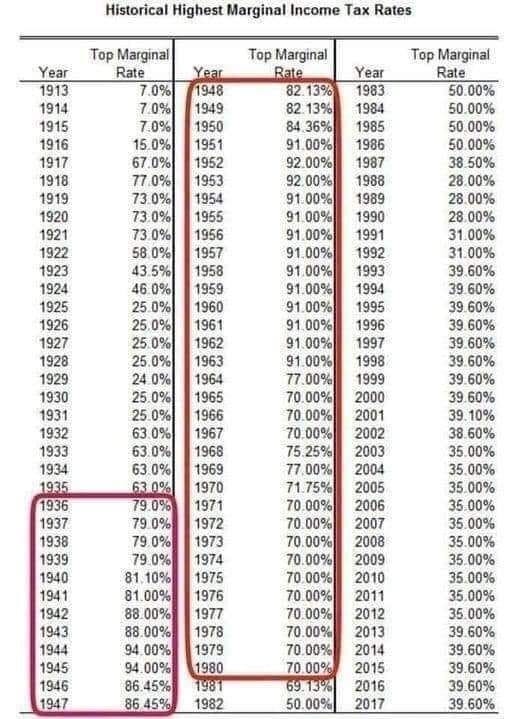
By returning tax rates on the wealthy to an Eisenhower level of progressive taxation, replete with the rules restricting corporations from benefitting from loopholes that permit them to escape a tax burden, we would resolve the needs of those in need on a systemic level.
We would not need to rely on a delusional expectation of the mega-wealthy to voluntarily practice austerity as has often been imposed upon the little people.
Have a close look at what happened to tax rates in the 1920s. That era was called the “Roaring 20s” because it had a booming economy due to the wealthy having much more disposable income. The same thing happened in the 1980s when Reagan dropped tax rates. The economy boomed briefly, and everyone loved Reagan because of it.
In both cases, those boom periods were finite and led, in the first case, to a worldwide war, while in the second case of Reagan’s tax cuts, it led to the “Great Recession.”
That’s what happens when large sums of money are released “out to the wild” for the peasants to get their trickle-down benefits. In the first case, that form of “voodoo economics” was called “Horse and Sparrow” economics because the Sparrow would benefit from all the food the horse hogged and shat out the other end.
That’s what trickle-down has always been. The little people get what the wealthy shit out as waste for them, and we’re supposed to find ways to live in dignity with that disgusting degree of indignity mounted onto our lives while we labour to make the rich wealthy.
It is precisely this dynamic that has been responsible for every social meltdown in history.
Meanwhile, if you look at that tax table, you’ll see the higher taxes resulted in the most tremendous growth ever for the middle class while the most significant number of people were lifted out of poverty.
None of it occurred because we relied on the generosity of greedy people but because we had our system tuned to maximize the benefits of a capitalist system.
“Trickle-down economies” are also called “boom and bust economies” because they go through cycles of recession and growth. The wealthy class loves this dynamic as the little people must suffer through periods of belt-tightening austerity. For the little people, austerity means having to go without essential needs being met, while for the wealthy class, austerity means excellent deals on going out of business sales. This is where they make their most significant cash grabs.
When small businesses thrive in a booming economy, they grow in value and expand while taking on more debt. That debt eventually crushes them when the cycle of a bear economy rears its ugly head. Many are forced to sell or go personally bankrupt and become devastated entirely for life. Many accept giving up the business that they grew out of love for what they were doing and allowed “an Elon Musk” to step in and claim credit for all their years of hard work while benefitting from that work to win humungous profits when the economy turned back into a bull.
It’s a class warfare game they have been playing with us as they corrupt the capitalist economy like it were a casino, and they’re the house that always wins, no matter how lucky any of the little people are.
This is why the guillotines come out whenever the little people figure out how badly rigged the game is against them.
The rich spend lavishly because they can and because they have rigged the game in their favour to specifically allow them to spend our money while programming the gullible among us to run interference for them as they victim-shame their fellow little people and accuse them of all the disgusting behaviours exhibited by the wealthy class, such as accusing the working class of wanting to steal the “hard-earned money of the rich” instead of demanding the money they stole returned to their victims.
Some care about those in need, but about 20% don’t, and they make it impossible to change the system because they invest billions in making it unfair while the rest reap the benefits of their corrupt activities. As a whole, they intentionally aim to strip the little people of our value precisely so they can spend gobs of money feeding their egos.
Due to their unrestrained behaviour, our species is on a trajectory toward extinction. Should we not push back on their greed and restore economic sanity, we won’t be able to continue at this pace, and we’ll be so severely humbled as a species that we may never recover, even if we survive the naive stupidity of our time.
Anyone wishing to engage in a dialogue on UBI is invited to participate in an open space on Quora dedicated to the issue. You may need to register for a Quora account — It’s free, and I don’t get any kickbacks from it. This space is intended purely for stimulating discussion on the topic — there are no hidden surprises beyond possibly needing to join Quora if you want to post comments. Visitors to the site can read the content without registration hassles.
This post is a response to a question posed in its complete format: “Why shouldn’t the factory of money just make money and deposit a fixed amount into everyone’s account around the world to stop poverty and see what’s going to happen on this Earth?”
There is no “factory of money.”
There is a means of adding value to a raw state measured by money.
Even though we have money printing systems, money doesn’t magically appear from nowhere.
Money isn’t a magical piece of paper without any connection to the reality in which it operates.
Money is a token representing effort.
At its most basic level, money is a metric that determines labour volume, quality, and output.
Each person’s labour adds value to society and is supposed to be reflected in the amount of money each person has.
Money as a concept works exceptionally well as a store of value and a medium of value exchange.
What is screwed up in our economies is that we determine the value of each person’s contributions on largely subjective bases.
For example, there is no way that any executive on the planet works one thousand times harder than their front-line staff. It can be argued that the value of an executive’s labour is higher than that of the janitor, but it is also not one thousand times more valuable per hour.
That’s where the disconnect occurs in society and why poverty is not being solved as a problem even though we produce more than we can consume.
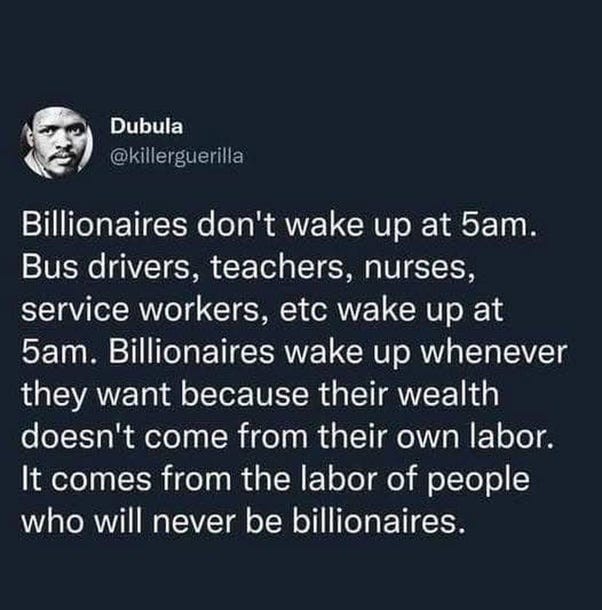
The problem we have been suffering from is due to a deliberate strategy for upward wealth redistribution. We have been lied to when told that the billionaires among us are the job creators. We have been lied to when our economies are structured around a “trickle-down” (and parasitic) economy that shuts down economic growth in favour of growing hoards by the few.
The problem, if the economy were a human circulatory system, is that we have allowed massive deposits of plaque to gum up the works, and it’s now threatening the entire body with systemic shutdown.
We need to clear up the plaque buildup and restore our circulatory system to full functionality — and that’s referred to as “speed of money” in economic terms.
The best way to accomplish that is to provide for the basic needs of all members of a society so that each is empowered to negotiate fair treatment in an environment characterized by abusive mistreatment by employers.
We can’t end poverty by printing magic money. If we try that, we ensure a global collapse due to the stable value of money becoming entirely destabilized. Doing that would send the world’s economies into a tailspin.
We need to reverse the effects of the upward wealth redistribution schemes we’ve allowed ourselves to be conned into adopting, as we have proved we learned nothing from history.
We’ve been here before, and our naivety cost us a world war to learn why making the rich richer at the expense of the poor was terrible.
The best way to make the rich richer is to concentrate on helping the poor become rich through their efforts to better themselves and their lives as they are so motivated. The rich will always benefit, but their benefits are long-term and stable if they invest in the people who make them rich instead of scheming to rip off the little people and pit us all against each other.
This is not rocket science. None of this is a mystery. We have had over a century of direct experience creating the economic problems we are dealing with today and solving these problems.
We could take the long-term route of making unions mandatory. We could restore economic equity in a few decades and start seeing the middle class grow again.
Or, we can institute UBI and dramatically change the dynamics of abuse between those with power and those without almost literally overnight. The additional bonus is that we save a lot of money when dealing with social issues by providing a comprehensive social safety net. We become far more successful in enriching the rich because hundreds of millions of people worldwide can pursue their initiatives and supercharge the capitalist economy with unprecedented levels of innovation, adding an immeasurable amount of value to the economy that would wipe out poverty across the globe much faster than re-empowering unions alone could accomplish.
Anyone wishing to engage in a dialogue on UBI is invited to participate in an open space on Quora dedicated to the issue. You may need to register for a Quora account — It’s free, and I don’t get any kickbacks from it. This space is intended purely for stimulating discussion on the topic — there are no hidden surprises beyond possibly needing to join Quora if you want to post comments. Visitors to the site can read the content without registration hassles.
This post is a response to a question posed in its complete format: “I don’t want my jobs to be automated. What can I do? Will there be a chance to get it?”
Hi again Furquan. 🙂
You have asked me several questions on automation in the last few months, and I appreciate that you find value in my words. Thank you.
I have to say that it is essential to understand the automation revolution is inevitable and unstoppable.
The decisions for automation are being made not by us lowly citizens but by those who have the power to implement what they view as solutions to their needs — such as cutting back on labour costs.
The career one chooses for oneself does not matter to the ownership class because their perspective is based on what they are willing to pay to produce the revenue they seek for themselves.
This is the fundamental flaw of capitalism.
Capitalism, as it stands, has been permitted to flourish in ways that disregard the needs of the many in favour of the whims of the few. I say “permitted” because we have always had the power, as a people, to restrain corruption, but we have been mollified by messaging and the “luxurious” benefits of modern technologies.
We used to be much better at restraining greed, and our societies flourished. The ownership class, however, has invested hundreds of billions over the last half-century in lobbying the government, installing government puppets, and creating propaganda machines often referred to as “Think Tanks,” like the Heritage Foundation. Their goals are clear: to re-establish dynastic rule over the people. They made that abundantly clear when they released Project 2025 and issued a threat against anyone who resisted.
They have become so comfortable in their misanthropic regard for citizens that they no longer hide their agenda.
As individuals trying to navigate and survive the nightmare of this transformation into fully automated societies, we have two personal mandates to adopt.
The first mandate we have to ourselves is to equip ourselves with as much knowledge of the transformations as we are able. You have shown yourself eager and well underway on your first step by simply asking questions. The only way to anticipate the changes coming and avoid any potential disruptions to your life is by asking questions.
The second mandate we have for ourselves is to accept the fundamental premise of capitalism, which is that every human being is a business entity. We have no choice now because the era of life-long jobs and straight-up career ladders has vanished. That means even a stable job one is employed within today will be temporary, not necessarily by malice, but because the world is changing rapidly. The capitalist owners of that business also have to adapt to the changes or go bankrupt.
We are, in essence, in a surreal state of every person for themselves, and it’s taking a toll on us as individuals and creating cracks in the social contract.
This leads us to a second set of mandates we have to ourselves by serving our fellow citizens.
The first of these “community mandates” is to stand against lies and disinformation. Call out the lies and counter them with facts. Refuse to support individuals and institutions that disseminate lies. Take action, like boycotting Fox, and make your decision public. Let other people know there is a line to be drawn between decency and depravity in society that we must all be in solidarity with if we want to re-establish ourselves as humans worthy of the distinctions we revere when referring to our collective selves as “humanity.”
Greed is not good. Greed hurts us all, and we must support each other, or we will not survive the challenges ahead without great calamity and horrific losses of life that will scar whatever remains of humanity for whatever future may manifest for us as a species.
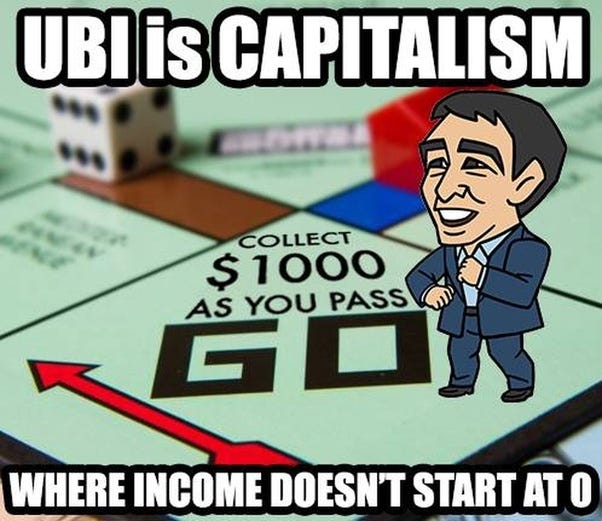
The second of these “community mandates” is to do what you can to support actions intended to restore decency. For example, I can do little with my resources beyond shooting my mouth off at every opportunity and creating memes to challenge the bullshit. I also actively sign petitions and help out in ways that are available to me.
Register with this organization — Change dot org — get on their list and peruse the many ways in which people are taking action worldwide:
Choose from whatever causes matter to you and support them by signing a petition. If you can afford to donate even small amounts, that helps. Please don’t underestimate the power of a single voice when it comes together in harmony with millions.
Anyone can start up a petition on this site. If you have something that you specifically want people to support, such as protecting jobs in a particular industry or role — something tangible in which people can take action by speaking up, then you can contribute toward the issue of ongoing automation.
The third social mandate may be construed as primarily a personal bias. It is an inevitable necessity precisely because of automation and because capitalism forces us all to be capitalists on some level.
Each of us needs some support to survive the challenges of meeting our basic needs.
Society, as a whole, produces more than our basic needs.
The success of capitalism is predicated upon innovation and productivity.
These three fundamental presumptions are what have led me to understand this fourth premise:
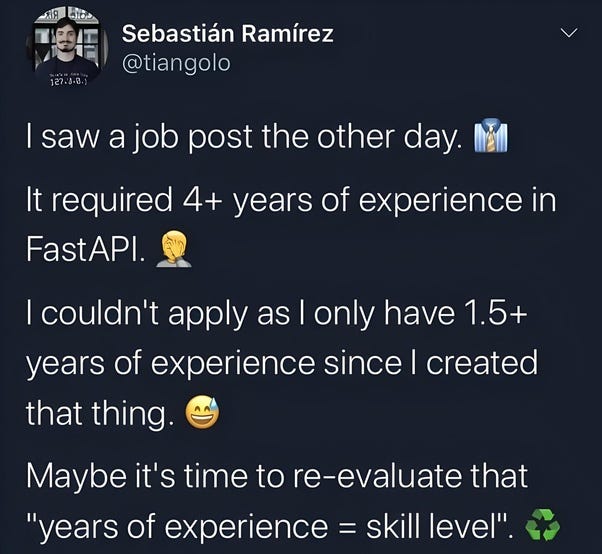
As I look back on my life and consider the thousands of hours spent on resume development and submitting tens of thousands of applications to employers that either mostly ignore and mistreat their applicants or allow the ignorance that defines many of the decision-makers among them to result in abominations like this:
I think that this entire system is broken.
Had I not wasted so much time and energy trying to fit into a system that has largely rejected me, I would have had plenty of time to develop my skills and voice to carve out my unique place of success in this world and the capitalist system we operate within.
For all the benefits that capitalism proffers to society, what it robs from us as we are herded through dehumanizing machinery to be regarded as commodities is a horrendous evil and a blight on humanity.
For this reason, I welcome our transition to a fully automated society because at the end of this painful transition is the freedom to live our lives as we choose.
The only thing that’s missing right now from our global support to a universal basic income is the awareness and acknowledgement we need from the wealthy class that this is THE best solution for almost all of our social ills — and it is much more than simply a solution, it’s an opportunity for them to capitalize on the repressed ingenuity of billions of people worldwide.
Once they realize the amount of untapped potential within the human race, in which they are shortchanging themselves with a master/slave relationship as employers/employees, they will broadly endorse UBI. Sadly, many are too short-term focused to want anything more than the quick buck that Donald Trump and sociopathic exploiters among the ownership class embody.
None of them are capable of innovation. They are capable of parasitic forms of self-enrichment. Elon Musk has clearly shown us that material wealth is not derived from personal innovation but by bleeding the benefits of the innovations of others.
My suggestion for you, Furquan, is to not buy into the myth that you will need a job to ensure long-term security for yourself because that’s a lie. Your long-term security is guaranteed only by your skills, capacity to provide value (mainly through any innovations you can devise), and the community supporting your efforts.
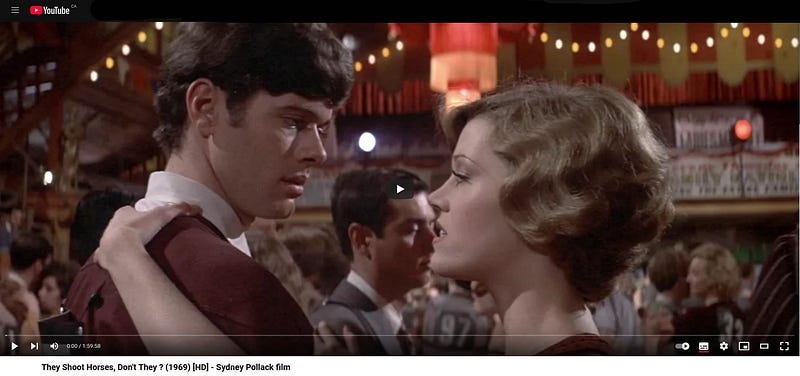
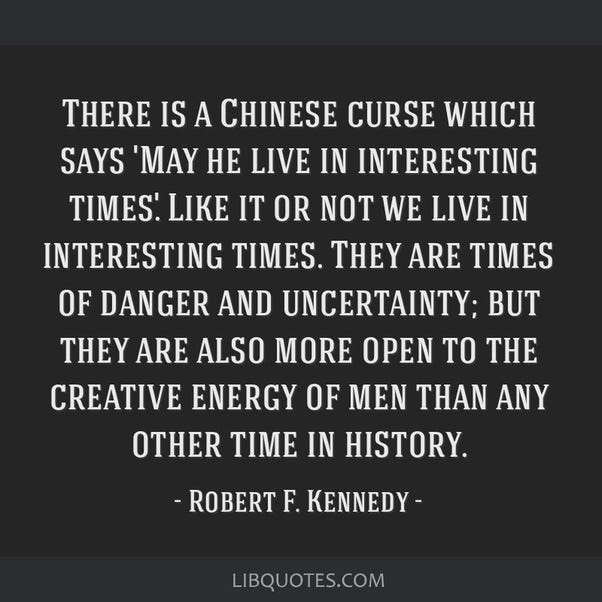
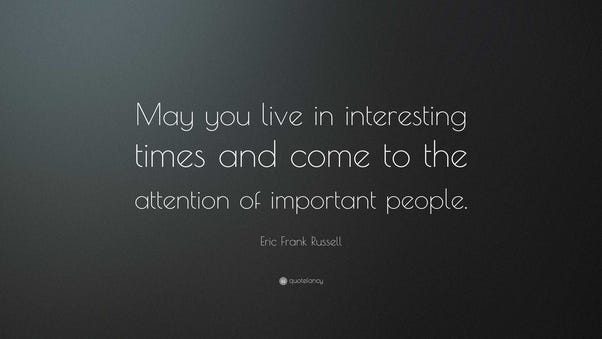
There are many different ways to perceive one’s challenges, and in this case, it appears to me the best way to represent this and the challenges we face today are embodied with an ancient curse:
I wish you all the best of luck in your future during this exceptionally unique period in human history that we have had the “great fortune” of being born into.
Anyone wishing to engage in a dialogue on UBI is invited to participate in an open space on Quora dedicated to the issue. You may need to register for a Quora account — It’s free, and I don’t get any kickbacks from it. This space is intended purely for stimulating discussion on the topic — there are no hidden surprises beyond possibly needing to join Quora if you want to post comments. Visitors to the site can read the content without registration hassles.














 thotbag