This post is a response to a question posed in its complete format: “Are people taking Chat GPT answers and posting them on Quora? It seems there are many answers all with the same format every time, and sometimes people post the same answer twice. It is very annoying. How can this be stopped?”
There appears to be less of that behaviour today than about a year ago when ChatGPT became a public sensation.
AI-generated content has generally been easy to spot, and I’ve blocked several accounts where people have tried passing off AI content as their own. It may be for that reason I see less of it.
People may also have become more discerning with their inclusions of AI-generated text — by removing obvious clues and editing the content before posting it. ChatGPT has also evolved and become more sophisticated and less easy to spot.
I use Grammarly to speed up my writing and clean up errors, but I still struggle with its structure as it “suggests” changes that are not natural expressions to me.
My experience with it has affected my writing by improving it and relenting on choices I would not have made. I’m unsure how I feel about that beyond feeling a bit dirty in accepting a suggestion out of expedience rather than rewriting an entire paragraph to make it acceptable.
I will fight more vigorously against Grammarly on my desktop than on my phone because typing — especially editing- can be a pain.
Grammarly can generate content from existing text by rewriting it in a more grammatically acceptable (not always correct) format. This makes it somewhat different than the content generated by ChatGPT and other AI LLMs used for content generation.
There also exists AI systems that are designed to spot AI-generated content, of which I am sure many are included within academic budgets. I noticed recently, however, that new AI systems are emerging that claim to be capable of passing muster on being scrutinized by AI detection systems.
Whether those are effective or not, I don’t know. Still, I suspect this will continue to be an evolving issue where it will become impossible to differentiate between human-generated and AI-generated content.
For my part, it seems like I’m being encouraged to cuss more frequently to ensure people understand that they are reading words produced by a human mind over that of a “robot,” but that may be an excuse with a limited shelf life.
This post is a response to a question posed in its complete format: “What is Quora used for? Can I use it to post my social life? What can I use Quora for?”
You can use Quora to ask questions or answer questions.
What you do with those questions or answers is entirely up to you.
For example, my use of Quora has evolved into a sketchbook of ideas where I repurpose some of the answers I write here into articles for publication on other sites.
This was a natural evolution for me that occurred from when I first joined over ten years ago. I was drawn to an academic vibe at the time, with primarily intelligent questions and answers from people who were very knowledgeable and extremely generous in sharing their knowledge.
It felt like a welcoming environment of aspiration for contributing value to our world.
Sadly, most of that is gone or buried under volumes of nonsense as the profit motive prioritized decisions that cared little about preserving knowledge sharing. Quora has succumbed to the same community-deteriorating profit-chasing phenomenon that all other social media sites have.
My personal life was also supremely upended shortly after joining, and I stuck with Quora, not out of my original intent of adding to a marketing funnel for my consulting efforts as an instructional designer but out of a therapeutic need to feel I was still able to make positive contributions to other people’s lives.
As Quora quality devolved, so did my participation to such a degree that it became a vessel for venting. As much as that has helped me to cope with what I’ve endured, it’s often toxic and destructive to a fragile state of mind. Fortunately, writing leaves a trail for facilitating introspection, which has become a path out of personal darkness for me.
I hope my latest stage of using Quora as a springboard of ideas and back into a life of some modest dignity will be a stage where I can leave most of my negativity behind and be grateful to Quora for functioning as my only source of productive therapy over the last decade.
A condition of where my life is at right now involves meeting with an actual therapist. I have concluded, however, that he’s a hired assassin for an entity that seeks to escape responsibility for the consequences of its actions through a strategy of encouraging suicidal ideation.
That may seem like hyperbole, but there is no other explanation for the overtly antagonistic and abusive behaviours exhibited by this “professional.”
For me, the only valid forms of therapy I have ever experienced have been through my creative expressions, which have mostly been through writing and creating pictures.
For me, Quora will, hopefully, be a means of moving on from a stage of inertia into a productive future where I can encapsulate ideas I’ve explored here into formats that can serve as some form of legacy to my life I can feel proud of.
What you want Quora to be for yourself is whatever value it brings to your life. Generally speaking, however, as social beings, how we manage our social interactions, whether in person or online, defines our lives for each of us.
Quora users are no different than anyone else on other social media sites.
The virtual environment, coupled with the insulation of an identity divorced from who people are in real life, allows them to indulge in their basest behaviours without repercussions to themselves.
Some are deliberately more abusive online than they would be in person because of a lack of consequences to them in life. Some use social media as a vehicle for venting their frustrations, and that often involves victimizing others.
It’s a dynamic that exists everywhere but is exaggerated online due to the shield a fraudulent identity provides.
All social media is much like Quora, but I would argue that Quora is more civilized than Facebook. A lot of aggression on Facebook is expressed passively through the emoticon reaction system. Facebook UI also sucks big time for permitting extended dialogues, while Quora’s system of ownership of content and content threads by the answer writer helps to minimize aggressions here.
Quora’s system is less antagonistic than Facebook’s because of its structure and is more efficient than other sites at handling long discussion threads.
Insofar as degrees of meanness on social media, my decades of experience on Usenet remain unsurpassed in meanness. Still, social media has generally degenerated in decorum to more closely resemble interpersonal dynamics on Usenet.
It’s a shame that social media has become so toxic. This devolution of courtesy is an argument for a publicly owned and supported social media venue that eliminates the profit motive by operating as a non-profit entity to serve as a community development tool, performing various community development functions and providing various public services.
A sign-on system, for example, could replace the various sign-on systems that people use for logging into sites where sensitive data is stored while ensuring one’s data is accessed through a single entity that provides access to one’s government-related needs such as their taxes or identification needs, and etcetera.
Social media has always been about community development. I have found amusement in statements about upholding community standards from privately owned entities like Facebook that routinely violate the bounds of decency within a community-oriented context. I often complained to Quora about inconsistently applied BNBR standards, and the result of attempting to manage nuance was resolved for them as a business decision deemed too expensive to operate effectively. There was no profit-oriented point to them to pretend that being nice and respectful was an important feature to protect.
Part of the problem with moderating systems is that petty people find ways to weaponize moderation against people they decide to behave spitefully toward.
I’ve been considering a series of articles on social media while arguing in favour of a community-based, owned-and-operated system that can address a number of the shortcomings while functioning as a means of “encouraging” improved interpersonal dynamics through a self-moderating model, but that’s a significant endeavour while I’m currently in the process of addressing more profound to me issues through a struggle I’ve been undergoing for the last decade. I hope I finally get a resolution to it soon and in time to focus on other areas in which I hope to make more constructive contributions to society rather than the wholly destructive path I’m currently on.
In short, and as a summary, however, people can be pretty mean everywhere, and sometimes, there’s nothing one can do about it but try to avoid or dismiss their meanness. It might help to be aware that not everyone is always mean. I’ve noticed within myself while using Quora as a public therapy tool for coping with my circumstances that my bouts with meanness correlate directly with my mood, and my mood is often affected by my current experiences. The best I can do is to learn to understand myself so that I can better understand the meanness of others, and that seems to be helping because their meanness over time has a decreasing impact on my psychology while I’ve become more effective in addressing their meanness in ways that I hope help them to improve.
That’s essentially all we can do for each other is to ensure we protect our boundaries in ways where the meanness doesn’t destroy our self-image. If it impacts it, then it serves as a teaching moment where we improve ourselves and become less mean over time rather than more mean — which is precisely the distinction in attitude I see creating the division between the toxic MAGA phenomenon and a world struggling to cope with increasingly aggravated divisions that have been cultivated within us by the people who have been setting us against each other while they rob us of our dignities.
This post is a response to a question initially posed on Quora, and can also be accessed via “What could be the main reasons some people experience stagnation, even if they aren’t lazy?”
Trauma and burnout are immensely impacting causes of inertia in one’s life. Burnout often precedes depression, and severe trauma can result in Executive Dysfunction. Depression can be debilitating, and Executive Dysfunction is scary AF.
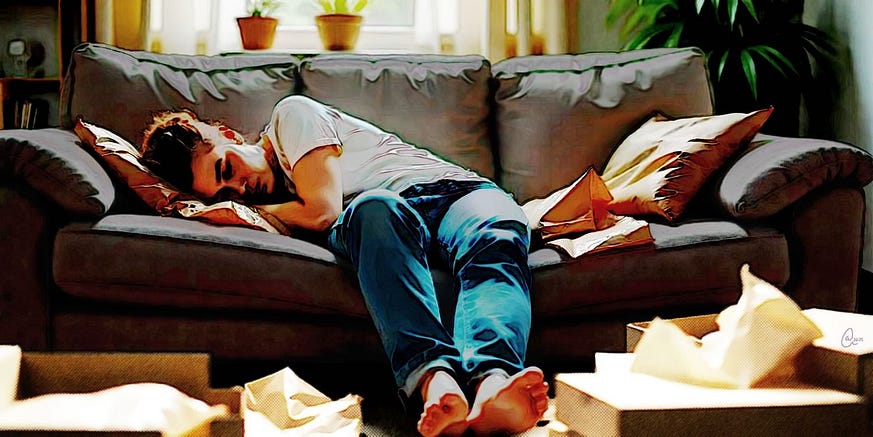
Imagine waking up daily with a laundry list of activities you sincerely want to do, but your “round-to-it” never makes it off the couch for some indiscernible reason. “Yeah, yeah, yeah — I’ll get around to it.”
Weeks later… that five-minute job of daily housecleaning is a prohibitive three-day adventure you decide is no longer worth the effort. It’s better to return to doing nothing while thinking, “Tomorrow’s another miserable day when it can be done.”
Loss of hope for one’s future is a terrible thing to experience that can lead to all sorts of ugly and tragic outcomes. Restoring hope is the fastest way to cure one’s depression and worse.
Our economic dystopia is the main culprit of many of our social ills today, and it’s leading us down a dark road just like it did last century when it gave rise to fascism and the Nazi scourge to ignite a global war.
It’s mind-boggling to me that both the victims and perpetrators of this centuries-long class war so easily overlook such a prominent issue that it never seems to stop being waged against the little people.
It’s harrowing to realize how conceptually straightforward it is to avoid chaos and how impossible it is in practice to prevent it.
There is something so intoxicating about having power that people think of themselves as insulated from all the harm they do to countless others with impunity.
The worst thing about Trump, for example, isn’t the damage he’s doing with his decisions and actions. That he can continue wreaking havoc while he should, by all forms of reason that claim to value the concept of justice, be rotting behind bars right now — that causes us all the most harm. His freedom is the grossest of violations of the social contract imaginable.
His freedom confirms that there is no value in decency, integrity, honesty, trust, or responsibility. His freedom is an encouragement of every rotten behaviour and attitude imaginable by humans. It’s a veritable permission to be our worst selves. His freedom is a purge of our humanity.
Why TF should anyone think they have a future if that future means having to become a grotesque monster who is willing to destroy lives to get some money for themselves?
When push comes to shove, I doubt few people would trade having a loving family and being surrounded by a community of people who care for you as a person for a gold toilet.
Since that’s the world we live in today, that’s deeply depressing. What kind of person can believe a hopeful future awaits at the top of a garbage heap? It certainly isn’t the best of humanity.
It’s the kind of world most decent human beings don’t want to live in. With that in mind, it shouldn’t surprise anyone that birth rates are plummeting because what decent human being wants to tell their kid to learn how to manage their plastic intake enough to minimize the health risks it poses while admitting they did as little as they could to prevent this shit from getting worse.
“Yes, kids… I decided not to vote because I didn’t care enough to know the difference between parties and just decided to believe they’re all the same, so I said fuckem, let them turn this world into a shithole for my kids.”
In short, the main reason people are experiencing stagnation is the same reason they experienced it during the fall of communism as a system of governance. We are failing ourselves because we are failing to demand better from our leadership instead of holding their feet to the fire. After all, that requires risking one’s perks and benefits in life; w may as well let them do whatever they want so that we can complain about how shitty things are and be able to say, “I told you so.” when it all turns to shit.
This post is a response to a question posed in its complete format: “Why are GOP voters suddenly alarmed about Ramaswamy’s and Musk’s stances about H1-B workers compared to locally sourced ones? Weren’t they supporting them and voting knowing that these men would be involved in policy-making directly or indirectly?”
None of their supporters were interested in the sausages their leaders intended to make. All of them have been more wrapped up in being enamoured by the superficial trappings of personality politics.
They voted for Trump because they admire him as a human being, even though he is beyond apparent in his overtly abusive and criminal behaviour.
They believed the only people that Trump, Musk, and their entourage of parasitic human slugs were going to victimize were the people in their imagination that they hated.
They shut their eyes, ears, and minds off to the realities of their words and promises.
I doubt even one of them made the slightest effort to peruse Project 2025 as they dismissed complaints about it as fake news and propaganda.
It’s the same intellectual laziness at play that we see when they make vague references to The Constitution that show they’ve never read it themselves.
They operate purely on instinct, and their instincts tell them to hate the world because they are in pain. Meanwhile, the exploitative parasites in our midst that they trust point out to them who they should hate, and they mindlessly go forth hating the people who are fighting on their behalf to make this a better world for everyone, including them.
They are so lost in the throes of their hatred cult that many will not stop hating their fellow citizens even after significant damage has been done to the nation. They will insist on some nefarious entities, conspiracies, and machinations by their political “enemies within” who are responsible for their policy failures.
If kids get hauled off in cages again, they’re going to rationalize that as a public good in the name of national security. If those kids get sold off to wealthy couples for a profit, they will rationalize that as being a better solution for those kids than being raised by their “filthy illegal parents.”
They will destroy families and lives all over again because they operate on instincts tweaked by paranoia over manufactured fear because the things they should fear are just too overwhelming for them to grasp. It’s much easier to fear and hate defenceless people than to hate the powerful, particularly when they’re all focused on developing sycophantic relationships and worshipping the ground they walk on in the hopes that they, too, will be blessed with unfathomable wealth.
This post is a response to a question posed in its complete format: “How do I cope with feeling creatively stifled in art school? At 23, after years of studying and currently master’s, I feel blocked and discouraged. Despite my talent, constant negative feedback has left me stuck & numb. How can I regain my passion?”
Try to think of the constant negative feedback as callous-building. It won’t stop. The more success you find, the more negative feedback you will get.
Your artistic process is your means of enduring and overcoming that feedback. Let it feed your resolve to continue pursuing what matters to you in your artwork.
Allow your process and product to teach you about yourself because that’s the value of creative endeavours.
Learn what you can from the masters who came before you. Let their struggles and discoveries inspire you to explore new realms of creativity.
Let the voices of the living critics wash over you like the daily elements confronting you, whether a cold chill from a frosty wind or a downpour of hail. Your creative process can turn all that effort at weakening you into a strength that helps you push past the boundaries limiting your potential.
Learn to read between the lines of the negativity directed your way because you will discover that most of them are projections driven by fear and envy.
People not intimidated by you have no need or compulsion to be negative. People who are not driven by fear and self-loathing see no point in anything outside objective honesty when expressing their views. People who care and are considerate of your personhood will try to choose words to support you, even if they see a need to correct an error of yours.
Since you are underway in a Masters level program in the Arts, you are well underway in securing yourself a somewhat economically stable future that will permit the continued development of your artwork throughout your life.
Upon completing your graduate degree, you will be eligible for teaching positions that may or may not interest you now but will allow you to remain current within your profession.
I would have jumped at an opportunity to complete my own Masters degree for that very reason, and so this may be a bias of mine. I think there can be no greater pleasure than to share one’s love with those who come after.
They can become sources of inspiration for you that break self-limiting boundaries. I also wanted the opportunity to be the opposite of many of my toxic instructors. They would cut me down in person but always visit my studio when I wasn’t around. I was informed of that oddly conflicting behaviour by studio mates who seemed excited for me.
I didn’t understand that then, but I interpreted that dichotomy in their behaviour as a backhanded form of compliment.
You will discover that your passion is like a barometer keeping you on track and focused in the direction that your art is taking you. It is like a guide for your life to facilitate your growth and achieve your potential.
Your passion will flow in waves that lap the edges of your consciousness amid exciting discoveries and recede when formulaic repetition asserts itself.
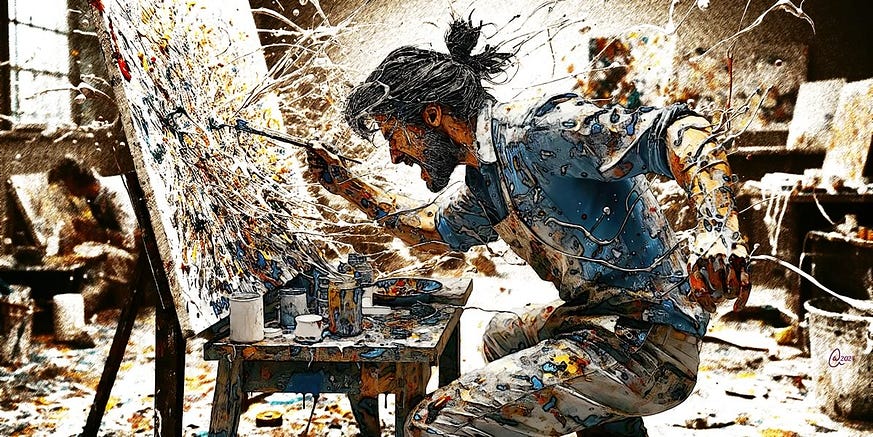
Whenever I feel blocked, uninspired, or unmotivated to focus on creating developed pieces, I turn to processes borrowed from the technique of automatic writing. The deliberately unconscious transcription of words and mark-making function like a form of callisthenics to “loosen up the creative muscles.”
I have learned that the thrill of discovery is the key to stoking one’s passions. Nothing is more awe-inspiring than looking at a piece one has finished and wondering how it could have come from within.
If you can keep surprising yourself, you will never lose your passion. You will always be motivated to explore what lies beyond your horizon.
This is a fundamental truth of the human condition. The wonder of discovery makes life worthwhile and raises us all as a species out of the darkness of a primitive existence to touch the stars.
No, but I always trust my instincts when I encounter dripping cynicism applied to “high falutin’” concepts like “so-called theories.”
I don’t “have to trust” art theories since they are primarily subjective analyses of movements, stylistics, and socio-political contexts applied toward individuals, groups, or random associations between artists sharing aesthetic or subject matter concerns.
Theory in art differs from a science-based theory backed up by testable methods to determine an objective and consistently predictable outcome.
They’re not meant “to be trusted” but used as a lens or a filter to focus one’s surveying of a landscape.
In the art world, one learns to trust the analysis and the analyst based on the quality of their insight, depth of knowledge, and the strength of their observations.
Art theories are less critical to artists than academics like Art Historians, whose role in society is to contextualize the whole of art production into descriptions reflecting our social evolution through artistic expression.
Most artists could not care less where they fit into the grand scheme of artistic expression within the context of social evolution. They tend to be more concerned with matters that are important to them on a personal scale.
How one feels about issues they encounter is much more artistically motivating than an academic assessment of artistic context within the creative product.
My initial response to this question was, “What are you talking about?” and that turned out to be a good prompt for me to find a theory as a basis for answering this question.
I know art theories exist from my experience in art school, but I struggled to bring one to mind in any clear focus. Sure, various movements, styles, attitudes, and manifestos vaguely touched the surface of my conscious awareness, but I immediately rejected them as “theories” that relate to the context of this question.
I found this article to be an interesting and concise representation of “art theories” that distinguishes them from scientific theories to assist with making a point in my answer. After getting this far, I find it serves less as a function for contributing to my answer than as a helpful guide for a layperson to consider when assessing a piece.
The fact that I find this a novel summation for contextualizing one’s art-viewing experience reinforces how little concern I place on art theories when considering the pieces I produce.
For the most part, art production is a process of burying oneself in the fundamentals of artmaking more so than it is about where in the vast spectrum of historical context a piece should occupy. That is my bias, of course.
Art theories are a non-existent concern when working on a piece, whereas composition, shape, balance, colour, line, and tension are foremost in my mind.
All this leads me to ask, “What are you talking about?”
Your profile doesn’t provide much context, but it has several hallmarks for being a troll profile — such as being less than one month old and sparse in detail. Unlike my similar experiences with answering questions on Quora, I won’t mute and block you, but I’m sure I will remember the red flag this question left me with.
Perhaps you have been somewhat affected by a confluence of insecurity and psychological abuse by a pretentious asshole in the arts. Sadly, there are many, as this seems to be a field of endeavour that functions like a magnet for egotistical types.
I suggest focusing more on what moves you to create and less on what others might have to say because their input is often more about them than you or your work.
This post is a response to a question posed in its complete format: “Why is there so much misogyny or misandry online? Is it because of the internet being filled with socially outcasted people?”
What you see online doesn’t exist because of the Internet. It has always existed as “normal” and without being challenged throughout society.
Imagine what the Internet would be like if it existed before the Civil Rights movement. There would be “Whites Only” and “ Coloureds Only” websites. Facebook would be racially segregated, and so would genders. Any woman visiting an auto servicing site would be banned. They would be allowed only at sites that promoted the expectation of their role of being barefoot and pregnant in the kitchen. People would be penalized for visiting sites that violated segregation laws, and all those “wonderful sensibilities” from yore would permeate the virtual world in far greater degrees of hatred and bigotry than we see now… because they would be considered acceptable by the majority.
The virtual world has only allowed those “old sentiments” that we have deluded ourselves into believing we have grown past to remind us they still exist. They’re just not considered acceptable by the mainstream.
That’s why those attitudes stand out.
The upside, however, is that we can and do push back on that toxicity while social media enables us to talk about it directly.
We can confront racists and bigots directly now when, in real life, we would bite our tongues and walk away to let them believe there’s nothing wrong with them or their attitudes.
Complaining about the prevalence of such ugliness results from a naive view of the world and a Disneyesque vision of humanity through rose-coloured glasses.
In real life, you can associate with people you agree with and avoid those you find toxic, but it’s not easy to do online.
That’s a good thing because pretending this horror doesn’t exist is how it continues.
Over 5 billion people are online, so you can’t single out portions of the population you don’t like and pretend the Internet is a magnet for a small subsection of humanity. These attitudes are prevalent everywhere.
The online world is the only safe space to resolve them. We would otherwise find ourselves either trying to ignore them to let them metastasize and grow worse or joining along because of being pressured into it, like being pushed into a cult for fear of one’s life.
Use your voice online and speak out against the ugliness. Challenge the bigots you encounter. Make them accountable for their hatreds.
That’s the only way to deal with the horror. That’s the only way to make our species heal.
You have an obligation to yourself, your sanity, and the future of our species now that you have been empowered with a platform to fight back against what’s broken with humanity. If we don’t, we won’t have a human civilization by the end of this century. We’ll have a shattered smattering of primitive tribes struggling to survive a planet that has become hostile to human life.
I remember someone I once trusted approaching me for relationship advice.
I don’t remember the specific complaints registered against him by his then-recent ex, but I remember how he tried to convince her that he had changed overnight.
The next day after she ended her relationship, he returned to her and claimed he had changed.
After relating that to me, I tried to explain to him that’s not how change works. One doesn’t change oneself like they change their clothes, most certainly not overnight.
That wasn’t my best approach to helping him overcome his anxiety. He outright rejected what I tried to get him to understand. I believe that was the last conversation he and I ever had.
However, His attitude toward change stuck with me as I struggled to understand that thinking. I thought of it as chillingly superficial and worse as it appears to be an attitude which fits within the mindset that justifies telling people what they want to hear.
Everything about how a certain mindset perceives the world around them is based entirely on optics, and their behaviours are mere performances designed to elicit desired responses from their audience.
It left me feeling cold, and I’ve learned to understand how severe a red flag that is. I wish I hadn’t been such a slow learner in this regard because I could have saved myself a world of hurt if I had fully considered the implications of that behaviour then.
At any rate, the notion of undergoing a transformative experience had always intrigued me as I deliberately sought paths and methodologies for transcending limiting ways of being. From a very young age, I was aware that I was conditioned into being what I conceptually rejected but required something tangible to transform my desire for change into actual change.
Symbolically, the notion of being “reborn” is a ritualized performance in which people present themselves as if they had changed from committing to a belief system and being “remade” by that commitment itself.
People who have undergone such a ritual sincerely think they have transformed into a better version of themselves. Their exclamations, however, have more often been expressions of hopeful anticipation rather than observable reality.
Their subsequent behaviours and fundamental attitudes remain the same. From an outsider’s perspective, the only change visible was the compass setting they prioritized.
Although some stick with their new compass setting over the long haul, many returned to being who they always were while dismissing a temporary compass setting as one they outgrew and was no longer relevant to them.
Some remained within their faith but regarded it with their “old eyes” and treated their entire relationship with their beliefs and community as a game of optics. Others moved on as they acknowledged their experience as helpful but not enough to commit to it for a lifetime. I found this latter group more authentic in their journey of discovery. The clarity of direction or need they expressed as they described their choices through fogs of confusion they struggled to dispel always made them feel more human to me. In contrast, I found those who appeared to skim through emotional turmoil somewhat confusing. I didn’t know how to interpret their responses to emotional struggles. I must have envied them as I could never respond to my own in similar ways and often wished I could have. It seemed to make life easier for them.
These “performers at life” always made me feel cold, though, and it’s taken me a long time to understand why.
Understanding how a proportion of our population lives through a shallow lens may be conceptually easy to grasp superficially, but that’s not a satisfying apprehension of the phenomenon. One inevitably finds oneself mystified by its manifestations while wondering why they feel put off in ways they don’t quite understand. It can be a harrowing journey to fully grasp the implications of such a life on a visceral level for those whose feelings run deep.
Another example was an individual who had been married for about six years and who I had gotten to know as a close couple who seemingly shared everything. Conversations with either always involved extolling the virtues of the other and never was an unkind or critical word shared. I thought they were a remarkable example of a successful couple until the husband informed me they were getting divorced.
Their separation appeared as if life sped forward at super-speed for them because it all took place within a couple of weeks — from agreement to the formalized documentation of divorce. There was no emotional turmoil I could detect in the husband, as the ex-wife had already left, and I had no means of gauging her condition. In his case, however, I was more shocked at his ability to move on than I was at their separation.
For him, it was as if nothing of note had happened in his life. I couldn’t fathom that, particularly after having endured my periods of extended angst over far shorter and more superficial commitments. I remember envying his ability to rebound from what would have been at least a year or two of turmoil for me.
I didn’t realize until later that his personality was characterized by subtle paranoia and mistrust toward others on mostly innocuous levels. I first noticed that aspect of his character after he described a business venture I found myself intrigued by and expressed how much I liked it. His response became immediately cold and protective of it. He clarified that I had no place in his venture even though I had not expressed such desire or intent.
I remember switching the conversation at that point and inquiring about his ex-wife, and I was curious to know if she was doing well. His response was mainly dismissive, but he let the cat out of the bag by indicating that the reason for their divorce was his unfaithfulness.
The ability to move on quickly from a profoundly emotional experience had often been a source of admiration for me. That was before I understood the costs of such a state of being — to both themselves and those they inevitably victimize.
I don’t think he was ever capable of connecting deeply with anyone, and I didn’t understand, even then, how profound that was. I knew it was essential for me, and I accepted how that might not be for others. I didn’t think of it as a toxic dysfunctionality — even though I should have known better after having experienced it with many others so often throughout my life.
From a ritualistic perspective, there can be some benefit to undergoing a formalized process that symbolically represents change and, more importantly, a desire for change. However, it’s all done for optics more than acknowledging the necessity of change and its role in one’s personal growth.
I always have felt this way, but I never understood how that attitude itself, on my behalf, was present even as a child when I underwent my first confession. It wasn’t conducted in a booth but in an empty classroom on a chair across from the minister. We were in full view of each other without obstruction, and he asked me to speak.
I struggled to find words while suppressing a broad smile as I found the experience entirely superficial. After all, how could I possibly be exonerated of guilt over actions I may have taken that were considered sinful by simply uttering them to this stranger? At the age of eleven, the most egregious sin I could think of was masturbation, and I suppose that might have been why I struggled to suppress a broad smile.
Within a belief system that purports to provide adherents with pathways for growth, I can understand and support the prescriptive manner of formalizing rituals to celebrate that growth. The shortfall in converting subjective experience into an objectively procedural system is that it fails to account for individual differences. It is a process that cannot account for or mitigate abusive misuse.
Much like the reporting systems across all social media, the symbolic ritual of change is a tool that can be weaponized for personal gain. The emphasis on optics is a form of corrupt thinking which overlooks the critically ineffable in favour of supporting shallow expedience.
The concept of “being born again” is just a formalized process of stripping profundity from life in favour of optics because we do not, as a whole, value depth in a world that has industrialized human existence and reduced the human condition to the level of a disposable commodity.
We have evolved into an increasingly dehumanized existence while being led by institutions that claim to represent higher states of being. Our only hope for reclaiming our existence as human beings capable of achieving our potential is completing our transformation into a fully automated society. It will only be once we cross this threshold that human beings will be free of the superficial trappings of optics made necessary by the industrialized herding of our species. The function of symbolic optics is an inherent limit to our potential as individual beings within what we refer to as “civilized society.”
I believe the concept of “being born again” should be viewed with great suspicion and mistrust because it reflects nothing of an individual’s inner world or the foundation of their character.
It can, however, be a practical means of applying a metric for identifying differences between that standard and one’s words and deeds to triangulate a more accurate picture of one’s internal world.
The first place to start is to give up the notion that being “right” or “wrong” matters more than being accurate, informed, and knowledgeable.
“Right” and “wrong” are egotistical expressions that either stroke one’s sense of self or dismantle one’s self-confidence. Neither is helpful to oneself, others, or the issues at play.
As I often find myself checking out profiles to gain context into the querent’s mind, I did so with yours and am pleased to discover that you’re already on the right track.
Fundamentally, we’re all fumbling about in the dark and clueless, even about things we think we know. The worst thing we can do is believe we are “right” because that perspective contributes nothing to one’s growth and kills one’s ability to explore beyond that point.
No matter how “right” we might feel about something or how complete we think our knowledge of something, there is always something to learn about it that will be new to us. There is always a different perspective on that thing that we have not yet encountered.
If we could all adopt the perspective of being clueless, our world would experience far fewer conflicts because people would be more open to the perspectives of others.
Unfortunately, we live in a world built upon the foundation of exploiting insecurity at all levels throughout society — whether selling hair products or climbing corporate ladders. Insecurity has been weaponized as a tool of manipulation for personal gain over and above benefiting society as a whole.
We have never been more fortunate than we are today when confronted by the limits of our knowledge and understanding. Solving the problem of being unsure about one’s position means simply whipping out one’s means of accessing a comprehensive knowledge base to conduct basic research to verify if one’s position contradicts facts.
There is no real point in engaging with others to determine if one’s compass setting on knowledge is on true north by triangulating it with the settings of others because one is just engaging in an egotistical fencing match at that point. Online “debates” are often more about egotistical masturbation than they are about deriving an objective apprehension of issues to determine pragmatic resolutions.
Sharing information obtained through research efforts is far more rewarding and less prone to conflict over subjectively defined notions of being “right” or “wrong.”
One can still certainly derive flawed conclusions on matters, but that’s also a function of incomplete information that may be deemed “wrong.” Adding to one’s information base is less about determining “right” or “wrong” and more about ensuring the completeness of knowledge in a subject domain.
Knowing the difference in a dynamic with someone else on this level is essentially determined by whether or not the critic of one’s knowledge adds to one’s information base or disparages one’s person as a reaction to the information conveyed.
To directly answer your question, after all the verbiage I packed into this long-winded answer, is that you will know by the content of your critics’ arguments.
You can always deem yourself “not wrong” if the other party adds nothing to your position. If they can add valuable information to expand your knowledge base, you can still consider yourself “not wrong” while learning to be “more right” by their contribution.
This is how you can preserve your superior perspective of evolved humility by remaining confident in being clueless.
Congratulations on achieving a higher level of awareness than most of us monkeys ever attain throughout our very challenging lives.






 thotbag