Why do people think I should feel guilty about shoplifting?

This post is a response to a question posed in its complete format: “Why do people think I should feel guilty shoplifting, when literally so many people in the world want to use other people for what they have?”

You seem to want to justify shoplifting as a form of protest.

Meanwhile, protesting is a means by which systemic injustices are challenged by publicizing grievances. The point of doing that is to garner widespread support and enough momentum to make a systemic change that addresses a grievance over a condition which victimizes many people.

Sometimes, protests must be escalated to such a degree that some form of tradeoff between victimizing an aggressor and sacrificing someone in an act which alerts an otherwise unaware public of the severity of a grievance.

The incident between Luigi Mangioni and Brian Thompson from United Health qualifies as a situation in which escalation was deemed necessary (by Luigi) to sacrifice one’s life to alert the public to the severity of a systemic injustice.

Most often, protestors sacrifice only time and effort to address injustices. The goal of protesting, however, is to help people other than themselves who may or may not participate in the protest itself.

The purpose of a protest that can successfully gain support and make meaningful change is never to benefit an individual at the expense of victimizing someone else because that’s just another form of victimization.

It may be true that the degree of victimization is practically invisible to the victim such that they suffer a loss on an unnoticeable level, but they remain victims nonetheless.

It may very well be that the stores absorb their losses from your thefts with little impact on their operations, but that’s mostly because they amortize their losses across their operations. That means that a proportion of the cost of their products contains a piece of math they’ve determined recoups their shoplifting losses through every product sold.

Your thefts as an individual may be unnoticeable. Cumulatively, however, with others who think the same way you do, your thefts contribute to the increased cost of products that everyone bears while the store factors in a profit margin for managing those losses. Your thefts contribute to their net revenue while further victimizing those who pay full price for their products.

You may view your theft as a personal protest, but it’s an act that solely benefits you and injures all other consumers more than it injures the store you steal from. For this reason, your behaviour is considered selfish, over and above being a crime that contributes no benefit as a protest to the issue you criticize.

Your reasoning shares more in common with the stores you steal from when they add surcharges to an expected percentage of loss that’s padded enough to profit from.

Your reasoning and theirs are based on misanthropic, spiteful, and opportunistic thinking to justify an essentially parasitic behaviour.

You may not feel guilty about your choices, but they are neither justifiable nor actions to be proud of. However, the risks you take will one day result in criminal charges against you, while no one will be interested in empathizing with your reasoning.

You will carry a stigma of shame for the rest of your life once that happens, and no one will be sympathetic to whatever suffering you might experience as a consequence of your criminal choices.

Furthermore, your shame will be compounded by the reality that you will have become exactly the type of person that you justified harming through your thefts.

In short, your reasoning makes you a hypocrite, and you may not feel guilty about stealing from a greedy operation. You might still want to consider alternative forms of protesting to make your point — assuming, of course, that you believe your reasoning instead of just making excuses for being precisely the same as the people you criticize.

The circular and self-serving nature of your reasoning is precisely the same reasoning every criminal uses to justify their behaviour.

After all, in their minds, they also believe “everyone else does or would do the same in the same situation they’re in.”

Try to imagine the chaos that would ensue if everyone made the decisions you have made for yourself using the same reasoning you employ.

Society would shut down, and that’s why you will get no mercy when you inevitably get caught. After all, it’s never an issue of “if” with repeat offences but “when.”

Your luck will eventually run out, and you will be caught. If guilt isn’t enough to motivate you, then understanding how impossible it is to shoplift indefinitely might help you to reconsider your choices.

Security systems are improving every day. It’s already impossible enough for security experts to keep up with all emerging technologies, let alone someone like yourself. Cameras are cheap nowadays and tiny. You won’t know where you might be recorded, and it’s only a matter of time before you won’t know about the GPS tracker hidden in the liner of the coat you steal.

Good luck, though. Maybe you’ll convince a billionaire to give their people a decent raise just to convince shoplifters to stop shoplifting… which will happen after cows learn to fly. 😜


How can I motivate myself and feel less miserable?

This post is a response to a question posed in its complete format: “Sometimes I cry inside myself that I’m not like other intelligent people in my school and it hurts me every single day. I want to do my best but it just feels hard and my motivation dies off quickly. How can I motivate myself and feel less miserable?”

You joined Quora about three years ago and appear to have only two questions, including this one. The other question is about the lack of support and apparent abuse you endure from your parents.

It seems you are dealing with some intense emotional struggles that you do not deserve. However you perform in your academics and to improve yourself and achieve your goals, your parents have a moral obligation to be supportive.

Since they are not, you get saddled with the doubly hard challenge of finding your way through life’s confusing mess.

It’s not fair to you, but it may help you to understand how utterly broken most of the world is. We live in a world where a whopping majority (70%-80%) of families are dysfunctional.

You are not alone.

You can overcome your challenges.

A few things to consider while struggling to make something worthwhile of your life include;

  1. Focus on doing what you love doing. By investing your energies into something that brings you joy, you can create successes that will help you develop the confidence and motivation to succeed in other areas of your life.
  2. Find people who can empathize with your struggles — mainly because they endure similar struggles. Develop friendships with them to experience the emotional support your parents cannot give you.
  3. Read and read a lot to experience life through different eyes and learn to understand the complexities of life and its struggles through perspectives different from your own. Learn from what other minds have to teach you, and you will find strength within that you cannot feel now.
  4. Get a pet, if you can — a dog or a cat that can fill your heart with unconditional love and give you a reason to carry on through your toughest challenges.
  5. Spend as much time as you can with nature to feel that you belong here and to something much greater than the box of sorrow you have been given to bear.
  6. Know that nothing matters more than your ability to grow and change and adapt to an increasingly chaotic world undergoing a dramatic change that is pushing all of us to our limits. If we can survive this period of change, we will find a much friendlier world awaiting us on the other side of these challenges.
  7. Believe in yourself even when you make mistakes. Indeed, feel good about recognizing your mistakes because they are lessons you have succeeded in learning. It is much worse to make mistakes without identifying them as mistakes. It means you will repeat them like banging your head against a wall and hurting yourself even more.
  8. Allow yourself to see your parents as human beings like all other human beings. All of us have been damaged in some form or another by life, and it is a consequence of having undergone generations of struggle to emerge from a darkness of barbarism.
  9. Whatever you do, if you approach it with honesty, you are doing your best. You don’t have to try to do your best. You will always do your best if you are honest with yourself about what you do. Expect nothing more from yourself than complete honesty because knowing yourself matters most in your life. Knowing yourself is where you will find the strength to endure all the many challenges your life has in store.

I wish you all the best in your journey through this madness called “life.”

Temet Nosce

What should you never say to an atheist?

This post is a response to a question initially posed on Quora. For answers to additional questions, my profile can be accessed via “https://www.quora.com/profile/Antonio-Amaral-1/

“Atheism is a belief.”

“Atheism requires faith.”

“Atheism is a religion or cult or institution.”

“Atheists are a group which share characteristics or interests or views in common beyond disbelief in a God creature.”

“Atheists have no morals.”

“Atheists reject or hate God or worship Satan or any fictitious creature imagined by theists.”

“Atheists believe in science.” (No one, atheist or otherwise, who understands or has a basic understanding of science “believes in” science. Science is not a matter of faith, so please stop superimposing your insular paradigm onto others.)

“Creationism is an alternative to evolution.” (Also, don’t ever call people, atheists or otherwise, “evolutionists” because that’s just plain ignorance at an incredibly ignorant level of insular stupidity.)

Other statements like “God bless you” are contingent upon an individual atheist’s perspective on the matter. (I’m okay with people expressing positive sentiments in terms they are comfortable with and interpreting them as such.)

Atheists do not, as a whole, hate theists; they want them to stay in their lane and stop pretending like their beliefs trump facts because they don’t. Freedom of religion is the freedom to believe as you wish, not the right to impose your beliefs onto others. I don’t care if you think your interpretation of your scriptures causes you to believe homosexuality is wrong; you’re not God, and you have no right to pass judgment on people for how they were born… oh, and stay out of politics or start paying taxes like everyone else does.

By the way, Jesus wasn’t white, and his views were liberal. He did not support wealth but service to his fellow humans. He was not a narcissist who cared more for himself than the poor. His life was dedicated to peace, not war, nor to becoming wealthy or superior to others. He washed the feet of lepers to show you what that means, so betraying your saviour with your idiotic divisiveness and hatred will only send you to the hell you fear (if your beliefs pan out to be confirmed).

Even worse than simply betraying your beliefs, you make life hell for others — yes, I know, not all religious types are hypocrites. Still, all religious types must call out hate-mongering hypocrites like Steven Anderson, Kenneth Copeland, Jim Bakker, and the Westboro Baptist Church, who all prey upon your fellow believers by feeding on their insecurities. Make an effort to show the world you do believe what you claim to believe by raising a humungous stink over the very many atrocities committed by supposed religious leaders. There is no bloody way any religion can have any claim on morality when the predation of minors is institutionally protected. You must clean out the corruption in your own house first before you can hypocritically claim to care about so-called “unborn babies.” All this hypocritical crap makes people justifiably hate you and everything you claim to believe in — even the innocent ones among you; and worse for you, it makes people run away from your toxicity while eviscerating your credibility in everything you claim to believe.

That should cover most of the broad strokes I can identify from the top of my head (yes, it’s true, my references were Christian because that’s what I am most familiar with, but that doesn’t mean every other form of theist fantasy gets a pass because these sentiments apply to you, too.) We are living in a world characterized by disinformation and hatemongers to disenfranchise innocent people who cannot defend themselves. At the same time, hate crimes escalate as a monstrous hypocrite profits from selling autographed bibles.

(I wrote this five years ago and have been discussing these issues throughout my entire life, and instead of seeing any improvements with your lack of integrity issues, we’re seeing an increase in the kind of hypocrisy that would send chills down the spines of your venerated saviours. It’s horrifying just how little effort religious followers put into holding their leaders accountable for the hate they spread, and you dare to pretend you have a moral high ground. It is this kind of hypocrisy that’s driving people away from you.

If you want to be legitimately viewed as a moral people, then concentrate on feeding children in your schools instead of putting up fraudulent props like your Ten Dogmatic and repetitive Commandments. Kids need nutrition to focus on school and succeed at getting an education, not orders barked at them with threats of eternal punishment. This isn’t supposed to be the dark ages any longer. Those were over 500 years ago.)

All I can say as a summary is, Thank God I live in Canada because Americans are in for one helluva wake-up call over these next four years. What truly sucks, though, is how much of a negative impact you’re going to have on the entire rest of the world as you grapple with your lack of basic human decency.

Why do poor people move all the time?

This post is a response to a question initially posed on Quora, and can also be accessed via “https://www.quora.com/Why-do-poor-people-move-all-the-time/answer/Antonio-Amaral-1

Their options are always limited to housing, which most often includes conditions that would be unbearable for those who take their ability to afford decent housing for granted. Consequently, any time spent with anyone living a marginal life will reveal horror stories most people could not believe were real.

As an example, someone I know had no choice due to prior “accommodation difficulties” (of which this person was a victim of the behaviours of others in this prior matter), chose an opportunity of availability and expedience because neither time nor resources allowed the luxury of shopping and waiting. As a result, a choice was made for a temporary resolution to bide time and save money for something better. The living conditions were rather horrendous as it was a suite within a house (which tends to be what’s most available at the lowest costs) owned by a hoarder who often snooped and eavesdropped while generally inebriated every waking moment — fortunately, not the violent type.

At any rate, this temporary accommodation was six months filled with fun and adventure, ending in an almost surreal form of coincidence. Upon having found another, more appropriate suite in a moderately priced complex and beginning preparations for moving, the owner was found unconscious. He was rushed to the hospital and treated for a heart condition, but since his mental faculties had failed so severely, he was moved into a care facility. Of course, this turn of events meant relocating sooner rather than later.

This person’s new and seemingly stable accommodation required some austerity to maintain a stable and relatively comfortable lifestyle. After the one-year lease expired, the rent increased by its legal maximum. Shortly thereafter, they were informed that the building complex had been sold and that the new owners were considering redevelopment, which may require them to move again.

This is one of the overlooked details of poverty. The lack of stability itself is an incredible drain on resources, which means this approach to living by addressing crisis after crisis over time is psychologically, physically, and financially draining. The consequence is this is just another forgotten example of how poverty is an existence of perpetual punishment for simply being poor while having little to no access to escape.

A harrowing statistic I’ve just recently posted in another answer to another question since answering this question 6 years ago is the number of people who work full time and are homeless.

I was also prompted by what’s been happening in California with predatory real estate corporations owned explicitly by Blackstone and headed up by Stephen A. Schwarzman from an email I received from Brave New Films. It prompted me to create a provocative meme to post on Xitter that may be a bit too provocative for some but can’t be ignored as a practice that can only be endorsed by psychopaths who are responsible for the current state of dire straits experienced by victims of theirs.

This is an argument against corporate ownership of residential real estate.

Why don’t people realize our plutocracy causes our problems?

This post is a response to a question posed in its complete format: “Why don’t people realize that it is plutocracy (our country being governed by the wealthy elite) that is causing our economic problems?”

People don’t magically “realize things.”

People must be educated, informed, and aware of circumstances and details.

They need to be walked through the information presented to them as if one functions as a guide on a tour, answering questions.

People also don’t respond to laments, particularly when entrenched in counterfactual bigotries that prevent them from apprehending reality through an objective lens.

In essence, if this is an issue of concern for you, which I’m glad to see it is, then you need to start banging drums and sharing information and details because there are at least 76 million people in the U.S. alone who are entirely so oblivious to what you’ve determined for yourself that they contribute to the problems caused by the plutocracy.

There are many reasons why many people support self-and-socially destructive agendas, and most of those reasons can generally fall into only a few camps:

  1. They benefit directly from the corruption,
  2. They interpret the economic problems of the victims of a corrupt system as personal failings,
  3. They imagine themselves as potential beneficiaries of corrupt powers by supporting them,
  4. They lack the wherewithal to do anything about the corruption, so they cope with what they don’t believe they can change by resigning to hate the more easily victimized,
  5. They support what they believe is a natural state of a zero-sum existence encapsulated as a butchered interpretation of life often referred to as the “law of the jungle,” in which there are only predators and prey in this world,
  6. They’re psychologically dysfunctional — which is an explanation that applies to all the preceding points,
  7. Their education is woefully lacking — which also applies to all preceding points and leads back to the onus placed on those who know better by providing the support necessary to make positive change while also receiving a reminder that lamenting the sad state of affairs does nothing to change them. It does, however, give the broken among us a target to jeer and mock and use as an example to justify their corrupt interpretations of life.

Now, arm yourself with the information you need to fight as a keyboard warrior and do something more productive than issue lamentations to elevate humanity from this dank pit of misanthropy.

Good luck in this war for basic human decency.

Are far-left and far-right ideologies inherently about hating people with different lifestyles?

This post is a response to a question initially posed on Quora, and can also be accessed via “https://www.quora.com/Are-far-left-and-far-right-ideologies-inherently-about-hating-people-with-different-opinions-of-lifestyles/answer/Antonio-Amaral-1

The presumption in this question is an oversimplification. It’s like saying the flu is about the sniffles, the chills, the sneezing, and the perpetual flow of mucus when it’s inherently about a virus infestation.

The hatred is the symptom of an underlying cause, or set of causes, as it were. The first cause is always the same and has always been the same throughout history, driving every public conflagration: living insecurity. In today’s world, that translates into economic insecurity.

We’ve had an odd confluence of events occurring throughout this modern phase of the class war we’ve been undergoing for centuries now and since the dawn of human civilization, as the small group of the most powerful among us seek (and have always sought) to sublimate the majority in service to their will.

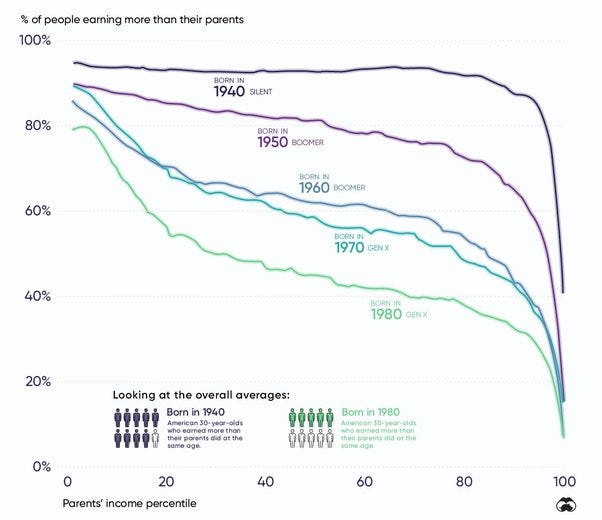
Quality of life for the middle class has been steadily tanking while the ownership class has been leveraging the benefits of technological progress to ameliorate and offset the increasing hardship they’ve been imposing upon the rest of us.

For example, poverty only one-half-century ago was evident in that the appearance of failing to meet essentials like clothing for appearance was a hallmark indicating poverty. That’s no longer the case, as many of the most impoverished among the working class avail themselves of systems that allow them to maintain an appearance of modest living while enduring severe degrees of economic insecurity.

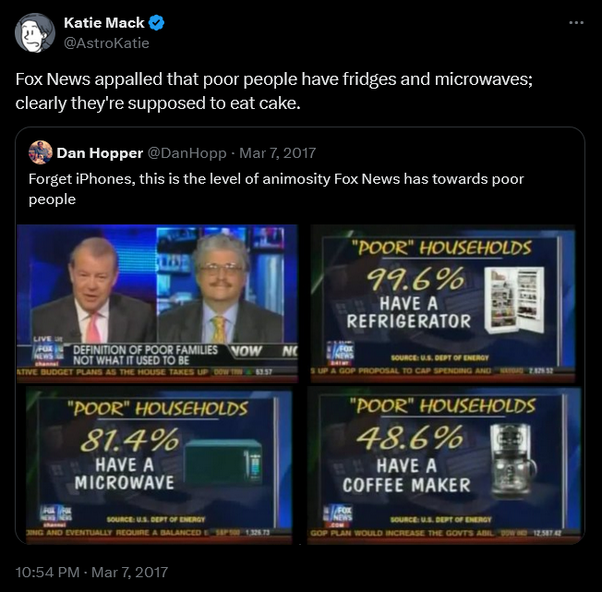
The Fox network made a big deal about people not living in poverty because they had refrigerators and microwaves. It is that kind of difference between poverty today and the poverty of last century that allows the ownership to more easily shame the victims of their efforts at impoverishing the majority in service to their hoards.

The harsh reality, however, is that most essential components of psychological health and emotional stability have been steadily stripped from the middle class in a stream of primarily invisible and ignored cuts over time.

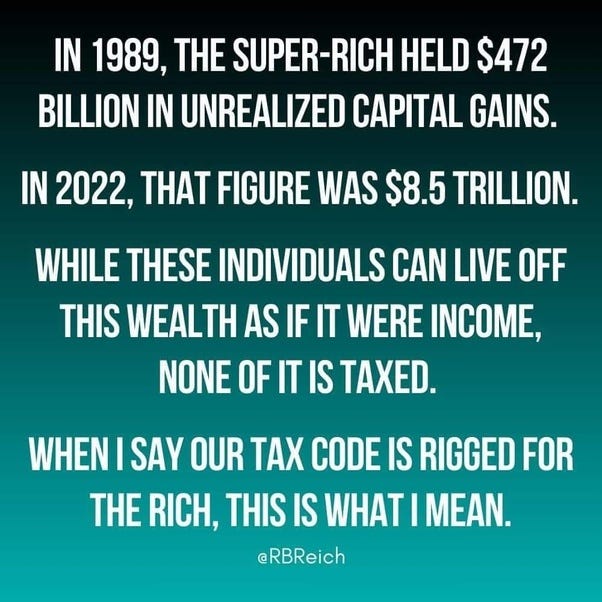
Compensation increases virtually halted for the middle class (and have even experienced shrinkages due to inflation), while income has skyrocketed for the ownership class.

The promise of capitalism raising people out of poverty from good ol’ fashioned elbow grease and modest living has vanished. The age of the Wealthy Barber lasted only a couple of decades before it was stripped from the people.

What we are left with now is a perpetual struggle for survival that has been steadily increasing year by year in the number of victims and the scope of theft perpetrated. The most privileged among us have had enough of an economic buffer to weather the storms that have destroyed the lives of millions victimized by the economic war waged by the ownership class against the working class. For many of those who would have qualified as being “upper middle class” fifty years ago and whose wealth would be more than double what it is today had the economy continued growing as it did during the heyday of Eisenhower tax rates, the economic war has remained largely invisible to them because they have not had to face the threat of food and housing insecurity that millions of working poor do today.

They may still face medical bankruptcies because those are huge bills that could and should be non-existent in a nation as wealthy as the U.S. However, the percentage of victims of that particular form of theft is relatively rare compared to the general population. We would otherwise have already had many Luigis acting out on their frustrations by now.

Instead, we have extremist right-wing groups on terrorist watch lists because they align themselves within their tribes and stoke their hatred toward those they blame for their woes. Occasionally, their outbursts gain public attention, but mostly, they’re made manifest in the ongoing and almost daily mass murders of innocent citizens and schoolchildren.

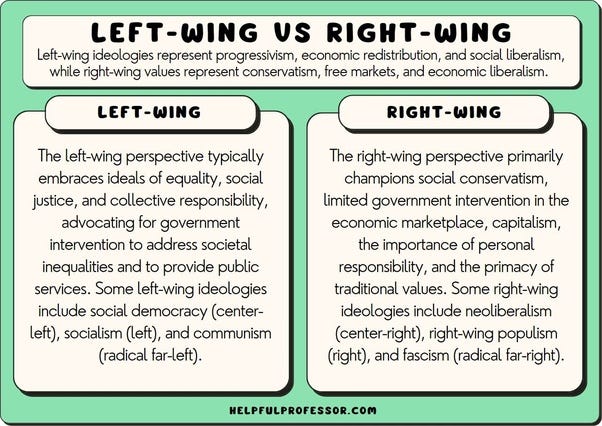
While the extreme right acts out their anger in unfocused ways, the left is targeted specifically on the causes of their anger. While the right victimizes anyone who doesn’t capitulate to their dogmatic adherence to the power wielded by those most responsible for victimizing them, like Stockholm Syndrome candidates, the mostly non-existent “extreme left” campaigns for economic justice through programs that restore equity.

Conflating the two as being identical is worse than oversimplifying a complex issue; it’s empowering the conditions that give rise to the hatred one seeks to demonize. It serves the narrative of a culture war perpetuated by the ownership class to divide the people further and distract them from the thefts perpetrated against them.

The irrational conflation made within this question merely functions as a self-fulfilling prophecy in which one declares a bullet wound fatal while stabbing the patient in the heart with a hunting knife to dig out the bullet.

This question is like accusing people of being jealous of Elon Musk’s money when the reality is that they hate white supremacists who install puppet rulers to destroy nations to attain their goal of empowering themselves at the expense of impoverishing the world. It’s a rather short-sighted attack on reality and the countless victims suffering needlessly in service to gluttonous powers.

How can the concept of authority be explained?

This post is a response to a question initially posed on Quora, and can also be accessed via “https://www.quora.com/How-can-the-concept-of-authority-be-explained/answer/Antonio-Amaral-1

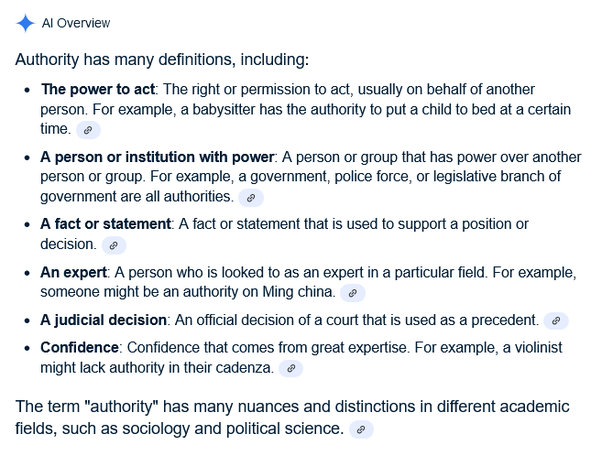
There appear to be two distinct perceptions that dominate public responses to authority.

On the one hand, an authority is an entity with the power to issue demands, impose edicts, and enforce compliance. On the other hand, an authority is a trusted entity that serves as a resource for empowering people and enabling their ambitions.

Our good friend and authoritative source of plagiarized information, AI Bot (Ayebot? iBot? EyeBot? — It needs a name so that it can be further anthropomorphized. “Gemini” seems a bit too much like impersonal woo.), provides a bit more detail:

Wikipedia has this definition, which appears to favour an interpretation based on an exercise of power:

Authority is commonly understood as the legitimate power of a person or group over other people.[1][dead link][2] In a civil state, an authority may be practiced by legislative, executive, and judicial branches of government,[3][need quotation to verify] each of which has authority and is an authority.[4] The term “authority” has many nuances and distinctions within various academic fields, from sociology to political science. ”

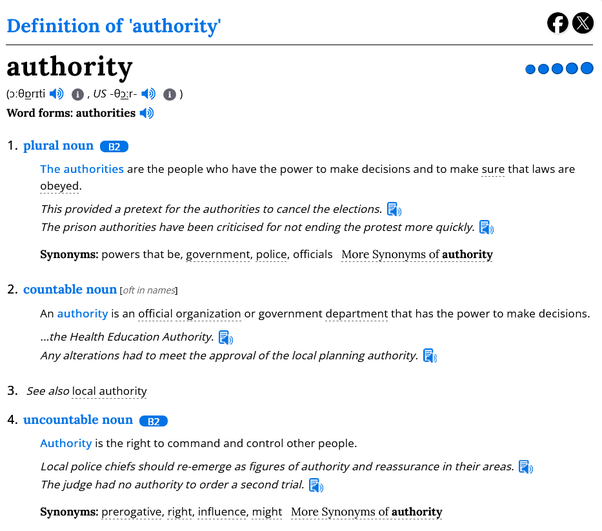
Let’s comb the world of language authorities to see how they interpret authority:

Collins has this to say about authority:

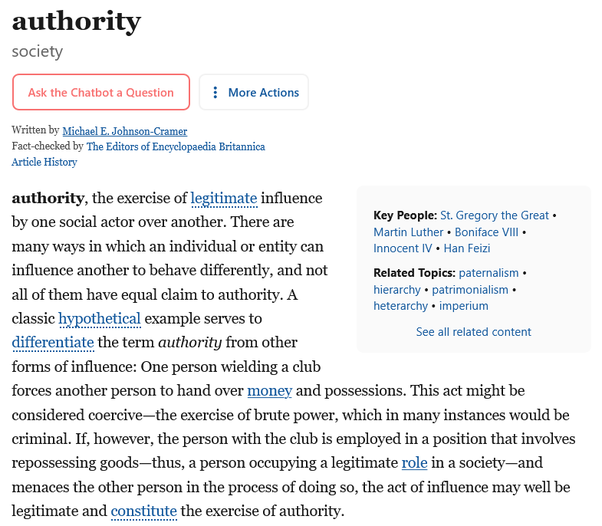
Britannica attempts a more concise definition favouring “influence” over “imposition” like Collins.

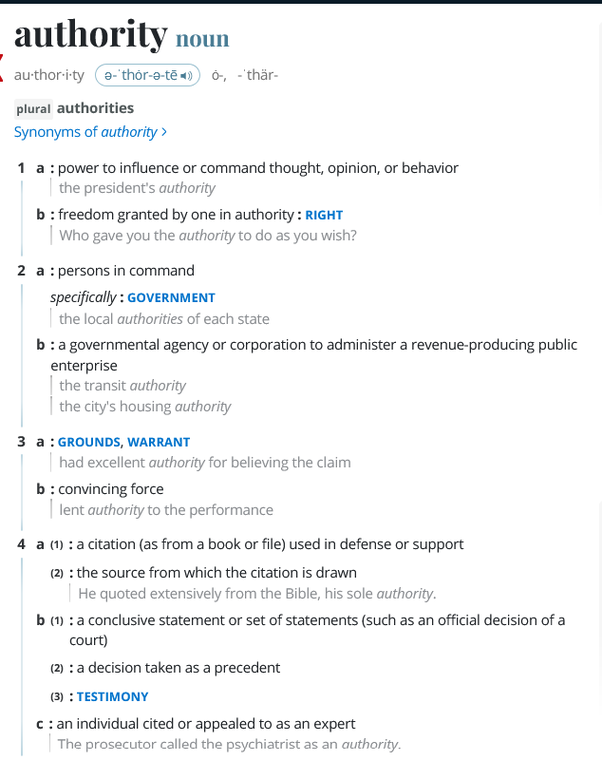
Merriam-Webster provides a more comprehensive overview of how “authority” is apprehended and implemented in society — although imposition precedes influence in its hierarchy of interpretations.

Interestingly, two of the world’s premiere language authorities place a profit premium on sharing basic definitions for words… which begs the question of the value of definitions versus profit and whether these institutions actually are authorities in realms beyond basic definitions.

Oxford at least asks for personal information to be granted access to elementary information, while Cambridge’s efforts are laughable.

These last two efforts suggest to me that their authority is entirely contingent upon reputation — part of the “old boy’s club” of authoritative prestige in the world, which essentially shuts out the plebians among us who must wrestle with “inferior language authorities.”

Meanwhile, freebie entity Dictionary dot com presents itself as a superior authority in marketing and business development to the two staid elements of anachronistic society above and provides an even more comprehensive set of definitions than Merriam-Webster.

This tells us that authority is actively cultivated by those who desire it and then, once achieved, is actively protected and zealously guarded beyond levels resembling reason. At the same time, newcomers overturn established authorities who fade into oblivion as the barbarians at the gates no longer storm them out of existence but supplant them through more effective forms of adapting to an ever-changing world.

In short, “authority” can be explained entirely by the dynamics of ego, power, and how much one is addicted to asserting their prominence in a chaotic world.

Interestingly, the most respected authorities throughout history have rejected the impositional form of authority flowing from within in favour of empowering the people at large by serving as a resource for enabling their assertions of personal authority within their relative spheres of influence.

For example, people still recognize the names of rare individuals who embodied humility, such as Gautama Buddha — or even a more modern instance like Nelson Mandela. Still, few outside dedicated historians can remember the many “authorities” throughout history who imposed their will upon the public. Those remembered are often anomalies serving as massive engines of destruction whose names are whispered rather than revered. Few among those whose authority was impositional in nature are remembered for their introspective wisdom, like Marcus Aurelius and Sun Tzu, but are revered for their insights in contrast to those of the conquerors like Alexander the Great or Genghis Khan, who are studied for their strategies (and often critiqued for their human failings).

For example, I predict that if humanity survives in some form resembling the humanity we know today, Jimmy Carter will be remembered with deep reverence and respect one thousand years from now. In contrast, Donald Trump will be remembered as the cautionary tale of a bull in a china shop whose lesson for humanity is the necessity of restraint and accountability.

Should there be fact-checking on social media platforms?

This post is a response to a question posed in its complete format: “Do you support Meta’s (Zuckerberg’s) decision to end third-party fact-checking on Facebook? Should there be any fact-checking at all on social media platforms? Why?”

Social media appears to be entering a stage where its profit-based model is “eating itself out of existence” as the latest in end-stage capitalism’s string of “Ouroboroses” (Ourobori?).

Along with stripping costs for an expensive venture, Mark is also adding AI bot profiles to create the appearance of engagement.

This reminds me of why I lost interest in dating sites. The easiest way to know a site’s ethics is when they create bot profiles to entice people into paying membership fees to engage with non-existent people.

As much as Zuckerberg flaps the trappings of community within Facebook and social media, none of his views are legitimately about community or supporting community development.

If social media were authentically social, its focus would be community development, not profit generation.

It is precisely the model of profit generation that puts social media into a death spiral of profit chasing to the bottom of the bottom-feeding barrel.

Their metrics for engagement are derived from a superficial analysis of what engagement means. As long as someone clicks something or posts something, that counts as “engagement,” and that interpretation of engagement counts as justification for advertising rates.

Meanwhile, no one gets anything from the deal but a massive case of blue balls.

Without a mission of serving a higher purpose of community development, social media and society, by extension, cannot but devolve into the technological equivalent of a pack of stray dogs begging strangers for treats.

We will experience social anarchy in the virtual world before it greets us in the real world. Hopefully, that will create enough pressure to do something proactive to support community development before the real-world communities devolve into chaotic monstrosities of “former civilization.”

All of this is an argument in favour of social media, on some level and in some capacity, being a publicly owned and managed enterprise that exercises its self-restraint divorced from the misanthropic profit-chasing model that dehumanizes people while pretending to serve human social needs.

As much as our dialogues focus on almost everything but community development, they all serve a community needs focus.

For example, all of the discourse surrounding AI and its replacement of human labour may be considered an economic, political, or labour issue, and it’s essentially a community response to a significant change transforming human society on a fundamental level.

All social media forms the basis of community development because all social media is public discourse. However, our problems with social media stem precisely from its growth being motivated by profit over principles.

At this stage, growths in profit that can satisfy hungry boards and investors justify cutting costs to the degree that whatever spirit was initially capitalized on that prompted the development of any particular social media site has been stripped from its operation.

The justifications for stripping costs have ironically been derived from concerns about the costs of managing social engagement. Who woulda thunk it’s too expensive to properly manage human behaviour to afford the cost of developing a media enterprise focused entirely upon squeezing profits from social engagement?

People need social media. It won’t go away, but social media proves today that profiting from human interaction is the wrong way to think about social media.

We have been watching the effects everywhere as social media has been devolving into a dynamic I remember from what I used to refer to as “usenut” — that many may be more familiar with as “Google Groups,” for example. I remember this as the gutter of human interaction — where the most extreme of the extreme was its primary denizens who were free to indulge in the most hateful of behaviours and attitudes.

I still “fondly remember” one character I used to refer to as “Grog” — which wasn’t their real name, and I’m not going to publish it because he’s still active on what shreds still exist of Usenet groups. He’s still advocating for the death penalty for gay people. It turned out that his father came out of the closet late in life, and that had a devastating impact on his psychology.

At any rate, this underground dynamic of toxic attitudes has slowly been seeping into an above-ground and public state of dialogue over time. If one had not ventured into the gutters of human detritus to discover its prevalence, one would not realize it’s an undercurrent that has always existed.

We will continue witnessing a devolution to the level of bottom-feeding slugs in human interaction characterized by social media as this trend of cost-cutting and profit-squeezing continues. It’s an inevitable characteristic of the capitalist chase for profits.

At some point, we’ll experience a confluence between the demand for social media interaction and restraint on toxic behaviours that normalize the intolerable throughout society. People will grow to hate people like Zuckerberg more than they do now, as one can already see an influx of disparaging posts about him beginning to flood the social media space everywhere.

Accountability and restraint on social media will become a widespread demand because social media fulfills a human need for interaction and dialogue that has always been present in less technologically based forms, such as letters to the editor in every newspaper that once littered the landscape.

Social media won’t disappear but will require transforming from a privately profitable industry into a public service. Nations like China are already ahead in this game by using their social media enterprises as tools for managing public dynamics through social credit scores and demerits.

If we’re not careful, social media will transform from a chaotic enterprise focused on chasing profit into a tool of oppressive control over the people in a much more pernicious way than media enterprises like Fox do now with their disinformation campaigns.

What do you do if you’re a lost cause?

This post is a response to a question posed in its complete format: “What do you do if you’re just a lost cause and there’s nothing anyone or you could say or do to change that?”

Stop believing that’s true about you, or resign yourself to a long and slow death while proving you are a lost cause.

Everyone can change, and it always boils down to desire and the effort one makes toward change.

Without a desire to change, neither you nor anyone else can do anything to change that.

First and foremost, you have to want it because that allows you to find the motivation to develop the discipline you need to change to prove to yourself that you’re not a lost cause.

You otherwise are and will always be what you believe yourself to be.

Robert Anton Wilson described the dynamic in simple and entertaining terms that might help, “Within each of us is the thinker and the prover. Whatever the thinker thinks, the prover proves.”

One can only be a lost cause by giving up one’s responsibility to oneself to live one’s best life. No matter how lousy the cards you’re dealt are, you still can make the best of them. Wallowing in defeat is a living a death. Use other people’s disparaging views of you as fuel to change.

Allow those unjust views to anger you justifiably. Convert them into a giant act of rejection and prove them wrong.

Good luck.

Is self-sacrifice the greatest gift that an individual can give to the community?


This post is a response to a question initially posed on Quora, and can also be accessed via “https://www.quora.com/Is-self-sacrifice-the-greatest-gift-that-an-individual-can-give-to-the-community/answer/Antonio-Amaral-1

No.

Self-sacrifice isn’t a “gift,” it’s a responsibility and a call to action.

Self-sacrifice can occur as a parent sets aside their desires to make way for their children to achieve successes outside their reach. For example, a parent who works multiple jobs to help their child get an education that will give them a better life than they could attain has generally been regarded as a “typical” or “common form of self-sacrifice” and often considered noble.

Other forms of self-sacrifice, such as jumping on a live grenade (for an extreme and improbable example to make a point) to protect a crowd, are a requirement created by circumstances that would be unnecessary if extreme conditions were not present. This form of self-sacrifice is an artificially created necessity that could have been avoided if the motivations behind the person throwing the grenade were mitigated proactively.

This form of self-sacrifice is an instinctive form of preservation that extends beyond the limits of one’s life. It is an expression of commitment to the social contract historically responsible for elevating humanity beyond the baser instincts that drag us backwards into primitive states of existence. Over and above the preservation of one’s self, selfless preservation is performed from the exact sentiment of a parent sacrificing themselves for their child. It is an act of love in the extreme. It is an embodiment of the best of what humanity can be.

Like the child whose life is enriched by their parent’s self-sacrifice, the beneficiaries of such an act of selflessness have not received a gift to luxuriate in but an obligation to follow suit and make life better for those who come after.

This is how social evolution must progress in the face of apathy and against those who place themselves and their desires above the needs of others.

Without the capacity for self-sacrifice, the future of humanity is decay and self-destruction.

Self-sacrifice within this context is a warning that without the courage demonstrated by the few willing to alert an apathetic world of the need to take action, the conditions causing the suffering that demanded the sacrifice of one’s self will worsen and create more victims.

Self-sacrifice within this context is the canary in the coal mine warning the rest of humanity that death is on its way and alerting the people that they are facing a choice to serve a higher purpose than their fleeting whims or be sacrificed by parasitic forces as fodder for the conditions demanding their blood.

Self-sacrifice is a warning to the apathetic that if they do not rise against the threats facing them, their turn will come, and it will be far worse for them than the person sending their message of warning through their self-sacrifice.

Self-sacrifice can be defined with a simple quote: “Silence in the face of evil is itself evil.”


Here is an example of a story about a Pastor who sacrificed himself to try and stop Hitler while saving numerous lives. I’m posting it here because the space I otherwise posted seems unwilling to approve it in another answer because it’s appropriate to this question and because we are at a point where we are repeating history.

Dietrich Bonhoeffer — Wikipedia

Dietrich Bonhoeffer February 1906–9 April 1945), was a German Lutheran pastor, neo-orthodox theologian and anti-Nazi dissident who was a key founding member of the Confessing Church. His writings on Christianity’s role in the secular world have become widely influential; his 1937 book The Cost of Discipleship is described as a modern classic.[1] Apart from his theological writings, Bonhoeffer was known for his staunch resistance to the Nazi dictatorship, including vocal opposition to Adolf Hitler’s euthanasia program and genocidal persecution of Jews.[2] He was arrested in April 1943 by the Gestapo and imprisoned at Tegel Prison for 1½ years. Later, he was transferred to Flossenbürg concentration camp.

Bonhoeffer was accused of being associated with the 20 July plot to assassinate Hitler and was tried along with other accused plotters, including former members of the Abwehr (the German Military Intelligence Office). He was hanged on 9 April 1945 during the collapse of the Nazi regime.

Bonhoeffer: Pastor. Spy. Assassin. (2024) ⭐ 6.6 | Biography, Drama, History